Ask Ayurvedic doctor a question and get a consultation online on the problem of your concern in a free or paid mode. More than 2,000 experienced doctors work and wait for your questions on our site and help users to solve their health problems every day.
FREE! Ask Ayurvedic Doctors 24/7

 Fast responses
 1000+ verified doctors
Body DetoxEar, Nose, and Throat DisordersGeriatrics & RejuvenationImmunodeficiencyInfertility TreatmentNutritionOrthopedic DisordersPediatricsRespiratory DisordersSexually Transmitted Diseases (STDs)Surgery RecoveryUrological DisordersVascular DisordersDental DisordersEndocrinological DisordersGastrointestinal DisordersYoga TherapyGeneral MedicineAllergic DisordersCardio DisordersGynecology and ObstetricsCosmetologySkin and Hair DisordersEye DisordersInfectious DiseasesMental DisordersNeurological DisordersOncologyPanchakarmaSexual Health & DisordersSports Medicine
Published on 02/14/25
(Updated on 07/05/26)
3,029
Dosha Dushya Sammurchana – Understanding Tissue and Dosha Interactions in Ayurveda

- Dosha Dushya Sammurchana is the critical stage in Ayurvedic pathogenesis where vitiated (imbalanced) doshas merge with weakened or vulnerable body tissues (dhatus) and waste products (malas), initiating the actual disease process.
- Without this pathological union, no disease can manifest — regardless of how aggravated a dosha becomes.
- Think of it this way: an aggravated dosha is like a seed, and the compromised tissue is the fertile soil. Sammurchana is the moment the seed takes root.
- Understanding this concept is not just academic — it is the very foundation upon which Ayurvedic diagnosis, prognosis, and treatment planning rest.
In this comprehensive guide, we'll break down every dimension of Dosha Dushya Sammurchana: its classical definition, its place within the six stages of disease (Shat Kriya Kala), the factors that determine which tissue becomes the target, practical examples linking specific dosha-dhatu combinations to real diseases, and actionable strategies to prevent this pathological union from ever occuring.
What Is Dosha Dushya Sammurchana? Definition and Etymology
Meaning of Dosha, Dushya, and Sammurchana
To understand the compound term, let's dissect each word:
- Dosha — The three fundamental bio-energies: Vata (air + ether), Pitta (fire + water), and Kapha (water + earth). In their balanced state, they sustain life. When vitiated, they become the primary agents of disease.
- - Dushya — Literally "that which gets vitiated." This includes the seven dhatus (Rasa, Rakta, Mamsa, Meda, Asthi, Majja, Shukra) and the three malas (Purisha/feces, Mutra/urine, Sveda/sweat).
- Dushyas are the passive recipients — they don't initiate disease, but they become the substrate where disease lodges.
- Sammurchana — Derived from the root "murch" meaning to faint, congeal, or solidify. In this context, it refers to the pathological amalgamation, fusion, or intermingling of doshas with dushyas. It is not a casual contact; it is a deep, functional entanglement.
So, Dosha Dushya Sammurchana = the pathological intermingling of aggravated doshas with susceptible tissues and waste products, resulting in the initiation of disease.
Classical References from Charaka Samhita, Sushruta Samhita, and Ashtanga Hridaya
The concept finds its roots across all major Ayurvedic treatises:
- Charaka Samhita (Nidana Sthana, Chapter 1) describes that disease manifests only when vitiated doshas find a suitable location (sthaana) in weakened dhatus. The verse "Dosha dushya sammurchana visheshena cha vyadhi janayanti" directly states that diseases are born specifically from this union.
- Sushruta Samhita (Sutra Sthana 21) emphasizes the role of Srotas (body channels) in facilitating the movement of vitiated doshas toward vulnerable tissues. Sushruta's surgical perspective adds that sammurchana in Rakta dhatu is particularly significant in inflammatory and hemorrhagic conditions.
- Ashtanga Hridaya (Nidana Sthana 1) explains sammurchana as part of the broader Samprapti framework, stating that the nature, location, and prognosis of disease depend entirely on which dosha merges with which dushya.
- Madhava Nidana further refines the diagnostic application, using sammurchana patterns to differentiate between diseases with similar symptoms.
Dosha Dushya Sammurchana vs Dosha Dushti — Key Difference
This is a point of confusion even among Ayurveda students. Dosha Dushti is simply the vitiation or imbalance of a dosha — it can happen due to diet, lifestyle, seasonal changes, or emotional stress. But Dosha Dushti alone does NOT produce disease.
Dosha Dushya Sammurchana requires a second condition: the presence of a weakened, defective, or vulnerable tissue. Only when the vitiated dosha reaches and merges with such a tissue does the pathological process truly begin. A person can have significant Vata aggravation (Dosha Dushti) but if all their dhatus are strong and channels are clear, the dosha may simply be managed through normal homeostatic mechanisms — no disease results.
This distinction has massive clinical implications. It explains why two people eating the same unhealthy diet may develop entirely different diseases, or why one develops disease and the other doesn't at all.
Role of Dushyas — Dhatus and Malas as Targets of Disease
The Seven Dhatus: Rasa, Rakta, Mamsa, Meda, Asthi, Majja, Shukra
Each dhatu represents a progressively deeper layer of tissue. Disease severity and treatability often correlate with which dhatu is involved:
| Dhatu | English Equivalent | Function | Example of Sammurchana Disease |
|---|---|---|---|
| Rasa | Plasma / Lymph | Nourishment, hydration | Jwara (fever), Aruchi (anorexia) |
| Rakta | Blood | Oxygenation, vitality | Raktapitta (hemorrhagic disorders), Vatarakta (gout) |
| Mamsa | Muscle | Strength, structure | Arbuda (tumors), Galaganda (goiter) |
| Meda | Adipose / Fat | Lubrication, energy storage | Prameha (diabetes), Sthaulya (obesity) |
| Asthi | Bone | Support framework | Sandhivata (osteoarthritis), Asthikshaya (osteoporosis) |
| Majja | Marrow / Nerve | Fills bones, nourishes nerve tissue | Tama (fainting), Bhrama (vertigo) |
| Shukra | Reproductive | Reproduction, vitality | Klaibya (impotence), Vandhyatva (infertility) |
The deeper the dhatu involved, the harder the disease is to treat. This is why a Rasa-dhatu level disease like simple fever resolves quickly, while an Asthi-dhatu disease like osteoarthritis requires prolonged, intensive therapy.
The Three Malas: Purisha, Mutra, and Sveda
- Most discussions of Dosha Dushya Sammurchana focus exclusively on dhatus, but this is an incomplete picture.
- The classical texts are clear: malas are also dushyas. Vitiated Vata interacting with Purisha (feces) contributes to conditions like Atisara (diarrhea) and Pravahika (dysentery). Pitta-Mutra sammurchana can lead to Mutrakricchra (painful urination). Kapha-Sveda sammurchana may manifest as excessive sweating disorders or skin conditions.
Ignoring malas in the sammurchana framework means missing an entire category of diseases.
Khavaigunya — Why Specific Tissues Become Vulnerable
This is arguably the most important concept for understanding why a particular tissue becomes the target. Khavaigunya (literally "defect in space") refers to a pre-existing weakness or defect in a specific tissue or channel.
This weakness can arise from:
- Genetic predisposition (Sahaja) — inherited tissue weakness
- Previous injury or surgery (Abhighata) — scar tissue, trauma sites
- Poor diet over time — chronic nutritional deficiency weakening specific dhatus
- Suppression of natural urges (Vegadharana) — e.g., habitual suppression of urination weakening the Mutravaha srotas
- Previous disease — a tissue that was affected before remains more susceptable to future attacks
- When vitiated doshas circulate through the body during the Prasara (spread) stage, they don't randomly settle anywhere.
- They are attracted to sites of Khavaigunya — like water flowing into a ditch.
- This explains the clinical reality we see daily: a person with a family history of joint problems who eats Vata-aggravating foods develops Sandhivata (osteoarthritis), not a skin disease. The Asthi dhatu had pre-existing Khavaigunya.
How Dosha Dushya Sammurchana Forms — Step-by-Step Pathogenesis
Nidana Sevana: Exposure to Causative Factors
Every disease begins with Nidana Sevana — habitual exposure to causative factors.
These include:
- Aharaja (dietary) — incompatible food combinations (Viruddha Ahara), excessive intake of one taste, eating at wrong times
- Viharaja (lifestyle) — irregular sleep, excessive exercise or complete sedentariness, suppression of urges
- Manasika (psychological) — chronic stress, anger, grief, fear
- Kalaja (seasonal) — failure to adapt diet and lifestyle to seasonal changes
Nidana Sevana doesn't immediately produce disease. It gradually vitiates doshas, setting the stage for the cascading events that follow.
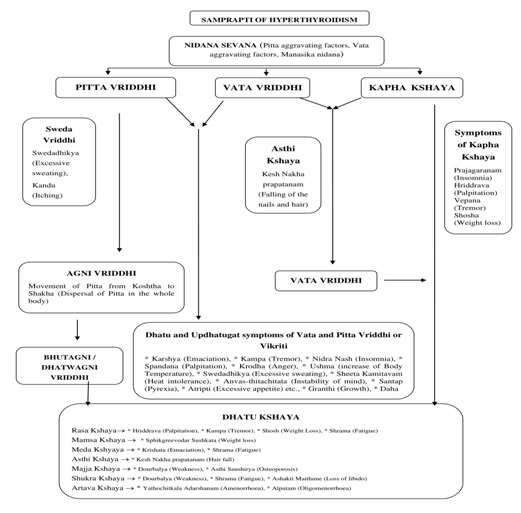
Shat Kriya Kala — The Six Stages of Disease Progression
Acharya Sushruta described six sequential stages through which disease develops. Dosha Dushya Sammurchana occurs specifically at the 4th stage, but understanding all six is essential:
Stage 1: Sanchaya (Accumulation)
- The vitiated dosha begins to accumulate in its own site (Svakshetra). Vata accumulates in the colon, Pitta in the small intestine, Kapha in the stomach.
- Symptoms are mild and often ignored — a slight feeling of fullness, mild discomfort.
- This is the easiest stage to treat: simple dietary correction is usually sufficient.
Stage 2: Prakopa (Aggravation)
- The accumulated dosha becomes aggravated and excited. It hasn't moved yet, but it's now actively disturbed.
- Symptoms become more noticeable — bloating and gas for Vata, acidity and heartburn for Pitta, nausea and heaviness for Kapha.
Stage 3: Prasara (Spread / Overflow)
The aggravated dosha overflows from its home site and begins to circulate through the Srotas (body channels). This is a critical turning point. The dosha is now mobile and searching for a place to lodge. At this stage, it interacts with the circulatory dynamics of the body. If all tissues are strong and channels are clear, the dosha may actually be neutralized or expelled. But if Khavaigunya exists somewhere...
Stage 4: Sthana Samshraya (Localization — Where Sammurchana Happens)
This is the stage of Dosha Dushya Sammurchana. The circulating vitiated dosha finds a tissue with Khavaigunya and lodges there. The dosha and dushya intermingle at a functional level. The tissue's normal metabolic processes begin to be disrupted.
Clinically, this stage manifests as Purvarupa — prodromal symptoms. These are vague, non-specific warning signs that disease is developing but hasn't fully manifested. For example, before frank diabetes (Prameha) manifests, there may be increased thirst, mild fatigue, and a sweetish taste in the mouth. Recognizing Purvarupa is a powerful diagnostic skill because treatment at this stage can still prevent full disease manifestation.
Stage 5: Vyakti (Full Manifestation)
The disease becomes clinically evident with all its characteristic signs and symptoms (Rupa). Sammurchana is now well-established. The tissue is functionally compromised. Treatment at this stage requires more aggressive intervention — Panchakarma, specific herbal formulations, and sustained dietary-lifestyle changes.
Stage 6: Bheda (Complications / Chronicity)
If left untreated or improperly treated, the disease produces complications (Upadravas) and may become chronic or incurable. The sammurchana has become so deep that the original tissue structure may be permanently altered. For example, chronic Vatarakta (gout) in the Bheda stage can lead to joint deformity.
The Role of Agni and Ama in Strengthening Sammurchana
No discussion of disease pathogenesis is complete without addressing Agni (digestive and metabolic fire) and Ama (metabolic toxins). This is a dimension that most resources on sammurchana completely overlook.
When Agni is weakened (Mandagni), incomplete digestion produces Ama — a sticky, toxic, heavy substance that circulates through the body. Ama has a special affinity for Kapha-dominant sites and acts as a "glue" that strengthens the bond between vitiated doshas and tissues.
A 2019 review published in the Journal of Ayurveda and Integrative Medical Sciences (JAIMS) noted that Ama amplifies the pathological union by reducing tissue immunity (Vyadhikshamatva), making the sammurchana more resistant to treatment. This is why Ama Pachana (digestion of toxins) is almost always the first step in Ayurvedic disease management — you must weaken the glue before you can separate the dosha from the tissue.
Types of Dosha Dushya Sammurchana — A Classification Framework
This is a critically under-explored area in available literature. Sammurchana is not a single, monolithic event. It varies based on the number and types of doshas involved.
Eka-Dosha Sammurchana (Single Dosha Involvement)
- One vitiated dosha interacts with one or more dushyas.
- Example: Vata + Asthi dhatu = Sandhivata. These are generally simpler to treat because the therapeutic target is clear.
Dwi-Dosha Sammurchana (Two Dosha Involvement)
- Two doshas jointly vitiate a tissue.
- Example: Vata-Kapha + Rasa dhatu and Meda dhatu = Sthaulya (obesity) with joint pain. Treatment must address both doshas, which requires careful balancing since Vata and Kapha have opposing qualities.
Sannipata / Tri-Dosha Sammurchana (Three Dosha Involvement)
All three doshas are vitiated and interact with multiple dushyas simultaneously. This produces the most severe and complex diseases. Sannipatika Jwara (fever involving all three doshas) is a classic example. Prognosis is guarded, and treatment requires highly skilled management.
The following table illustrates common sammurchana patterns and their clinical outcomes:
| Dosha(s) Involved | Dushya (Target Tissue) | Resulting Disease | Severity |
|---|---|---|---|
| Vata | Asthi dhatu | Sandhivata (Osteoarthritis) | Moderate |
| Pitta | Rakta dhatu | Raktapitta (Hemorrhagic disorder) | Moderate-Severe |
| Kapha | Rasa + Meda dhatu | Sthaulya (Obesity) | Moderate |
| Vata + Pitta | Rakta dhatu | Vatarakta (Gout) | Severe |
| Pitta + Kapha | Meda + Mamsa dhatu | Vidradhi (Abscess) | Moderate |
| Kapha + Vata | Rasa + Mamsa dhatu | Kasa (Chronic cough) | Moderate |
| Vata + Pitta + Kapha | Multiple dhatus | Sannipatika Jwara (Complex fever) | Very Severe |
The Fate of Dosha Dushya Sammurchana — What Determines the Outcome?
Not every instance of dosha-dushya interaction leads to full-blown disease.
The outcome depends on a balance of forces:
When Tissues Are Strong Enough to Resist
If the dhatu has adequate Bala (strength), sufficient Ojas (vital essence), and the person's overall Vyadhikshamatva (immunity/disease resistance) is high, the tissue may resist the invading dosha.
In such cases:
- The dosha is expelled back into circulation
- The body's natural homeostatic mechanisms (particularly Agni) neutralize the dosha
- No disease manifests despite temporary dosha aggravation
This is precisely why two individuals exposed to identical causative factors may have vastly different outcomes. One person eats the same junk food and develops metabolic syndrome; another seems unaffected. The difference lies in the strength of their dhatus and the presence or absence of Khavaigunya.
Modern Parallels with Western Pathology
The concept of Dosha Dushya Sammurchana has remarkable parallels in modern biomedical science, though these correlations are not often discussed:
- Autoimmune reactions — The immune system (analogous to vitiated dosha) attacks the body's own tissues (dushya), creating inflammation and tissue damage at specific sites
- Inflammatory cascade — Pro-inflammatory cytokines circulate and lodge at sites of previous injury or genetic vulnerability (Khavaigunya), initiating localized inflammation
- Tumor microenvironment — Circulating cancer cells preferentially metastasize to tissues that provide a supportive "soil" (the seed-and-soil hypothesis proposed by Paget in 1889 mirrors the Ayurvedic concept remarkably)
- Gut-tissue axis — Modern research on intestinal permeability ("leaky gut") shows that toxins (comparable to Ama) entering circulation can trigger inflammation in distant tissues — conceptually identical to Ama-facilitated sammurchana
A 2021 paper in the International Journal of Research in Ayurveda and Pharmacy highlighted these parallels, suggesting that Dosha Dushya Sammurchana provides a systems-level framework for understanding multifactorial disease pathogenesis that complements reductionist Western models.
Don't wait or self medicate. Start chat with Doctor NOW
Treatment Through Dosha Dushya Sammurchana Vighatana (Breaking the Pathological Union)
Samprapti Vighatana — The Core Principle of Ayurvedic Treatment
Charaka states unequivocally: the treatment of disease IS the disruption of its pathogenesis (Samprapti Vighatana). Since Dosha Dushya Sammurchana is the heart of pathogenesis, all treatment essentially aims to break this union.
This is achieved through:
- 1.Nidana Parivarjana — Removing the causative factors (diet, lifestyle, psychological triggers) that initiated dosha vitiation
- 2.Ama Pachana — Digesting and clearing metabolic toxins that strengthen the dosha-tissue bond
- 3.Shodhana (Panchakarma) — Bio-purificatory therapies (Vamana, Virechana, Basti, Nasya, Raktamokshana) that physically expel vitiated doshas from tissues
- 4.Shamana (Palliative therapy) — Herbs and formulations that pacify doshas and nourish damaged tissues
- 5.Rasayana (Rejuvenation) — Post-treatment tissue-rebuilding therapies that strengthen dhatus and eliminate Khavaigunya, preventing recurrence
Practical Strategies for Preventing Sammurchana
Prevention is always superior to cure. These evidence-based Ayurvedic practices work by maintaining dhatu strength and preventing dosha vitiation:
- Ritucharya (Seasonal Regimen) — Adapting diet, exercise, and daily routine according to the six seasons. For example, consuming cooling foods and Pitta-pacifying herbs during Greeshma ritu (summer) prevents Pitta prakopa that could lead to Pitta-Rakta sammurchana in autumn.
- Dinacharya (Daily Routine) — Regular wake-sleep cycles, Abhyanga (oil massage), tongue scraping, and timely meals maintain Agni and prevent Ama accumulation.
- Sadvritta (Ethical Conduct) — Management of psychological factors (stress, anger, grief) that vitiate doshas — particularly Vata and Pitta.
- Rasayana Sevana — Regular intake of rejuvenative substances like Chyawanprash, Ashwagandha, and Amalaki strengthens tissue immunity and eliminates tissue-level weaknesses.
- Vegadharana Avoidance — Never suppressing natural urges (urination, defecation, sneezing, yawning, etc.), as this directly creates Khavaigunya in the corresponding srotas.
Dushya in Ayurveda — A Deeper Understanding
What Is Dushya in Ayurveda?
Dushya literally means "that which is susceptible to vitiation." While doshas are the active pathological agents, dushyas are the passive substrates that suffer the consequences. All seven dhatus and three malas qualify as dushyas. But it's important to understand that a dhatu in its healthy state is NOT a dushya — it becomes a dushya only when it is weakened, malnourished, or structurally compromised.
- This distinction matters clinically.
- A practitioner doesn't just identify which dosha is vitiated — they must also assess which dhatus are currently functioning as dushyas (i.e., are weak and vulnerable). This dual assessment forms the basis of Samprapti analysis and determines the entire treatment strategy.
Dushya Dushti — How Tissues Become Corrupted
- When sammurchana progresses, the dushya undergoes Dushti (corruption) — its normal structure and function are altered.
- Each dhatu shows specific signs of dushti:
- Rasa dushti — loss of appetite, nausea, heaviness, cardiac discomfort
- Rakta dushti — skin diseases, bleeding disorders, inflammation
- Mamsa dushti — muscular growths, tonsillar hypertrophy, fibroids
- Meda dushti — obesity, lipomas, excessive sweating
- Asthi dushti — joint pain, cracking joints, dental problems, hair fall
- Majja dushti — fainting, heaviness of eyes, deep bone pain
- Shukra dushti — infertility, low libido, congenital defects in offspring
Recognizing these patterns helps practitioners identify exactly where sammurchana has occurred and target treatment precisely.
Frequently Asked Questions (FAQ)
What is the meaning of Dosha Dushya Sammurchana in simple terms?
Dosha Dushya Sammurchana is the process where imbalanced doshas (biological energies) merge with weakened body tissues (dhatus) or waste products (malas), creating the foundation for disease. Without this pathological merging, mere dosha imbalance cannot produce disease. It is essentially the "meeting point" between the cause and the site of disease.
What is the Dosha Dushya Sammurchana shloka?
The most commonly referenced shloka is from Charaka Samhita, Vimana Sthana 5/3, which explains the Samprapti concept: "Sampraptirvikalpo dhatuvaigunya doshadushya sammurchana..." — meaning that the specific variation (Vikalpa) of disease depends on the nature of the dosha-dushya union and the specific tissues involved.
How is Dosha Dushya Sammurchana different from Samprapti?
- Sammurchana is a specific event within the broader Samprapti (complete pathogenesis). Samprapti encompasses the entire disease trajectory from Nidana to Bheda, while sammurchana refers specifically to the moment of dosha-dushya fusion at the Sthana Samshraya stage.
- Sammurchana is the most critical node within Samprapti — breaking it (Samprapti Vighatana) is the goal of treatment.
Can Dosha Dushya Sammurchana be reversed?
Yes, especially if detected in the Sthana Samshraya or early Vyakti stages. Through Nidana Parivarjana, Panchakarma, and appropriate Shamana therapy, the dosha-dushya bond can be broken. However, at the Bheda stage (complications), reversal becomes extremely difficult, and management shifts toward damage control and palliation.
How do I remove excess Vata from my body?
Excess Vata is managed through warm, unctuous (oily), heavy foods; regular oil massage (Abhyanga) with sesame oil; Basti (medicated enema — the primary Panchakarma for Vata); maintaining regular routines; and herbs like Ashwagandha, Bala, and Dashamula. Avoiding cold, dry, and raw foods is essential.
What is the best drink to reduce Pitta dosha?
Cooling beverages like gulkand-infused milk, coriander seed water (boil 1 tsp seeds in 2 cups water, cool, and strain), tender coconut water, Amla juice, and mint-cumin buttermilk are highly effective Pitta-pacifying drinks. Avoid citrus juices, coffee, and alcohol.
What is the rarest dosha type?
A true single-dosha Prakriti (constitution) is actually quite rare. While many people identify as "Vata type" or "Pitta type," most individuals have a dual-dosha or even tri-dosha constitution. Among single-dosha constitutions, Vata Prakriti is considered the least common in its pure form, though regional and genetic factors influence prevalence.
Conclusion — Why Dosha Dushya Sammurchana Matters for Every Ayurveda Practitioner and Student
Dosha Dushya Sammurchana isn't just an abstract theoretical concept — it is the operational core of Ayurvedic medicine. Every diagnosis is an attempt to identify which dosha has merged with which dushya, at which stage. Every treatment is an attempt to break this union. And every preventive strategy aims to ensure this union never forms in the first place.
For students preparing for exams, understanding sammurchana is non-negotiable — it connects Nidana, Samprapti, Lakshana, and Chikitsa into a unified logical framework. For practitioners, it provides a systematic lens through which to analyze even the most complex multi-system diseases.
Whether you're reading classical texts like Charaka Samhita and Sushruta Samhita, or exploring modern integrative research, this concept remains timelessly relevant. If you found this guide useful, consider bookmarking it for reference, and feel free to share it with fellow Ayurveda students and practitioners who want a comprehensive, clinically grounded understanding of Dosha Dushya Sammurchana.
Scientific Sources
- Herbal medicines to prevent dental caries — Pradeep P et al., 2024, The Cochrane database of systematic reviews
- Alteration of Community Metabolism by Prebiotics and Medicinal Herbs — Peterson CT et al., 2023, Microorganisms
- Merger of ayurveda and tissue culture-based functional genomics: inspirations from systems biology — Deocaris CC et al., 2008, Journal of translational medicine
- Chyawanprash: A Traditional Indian Bioactive Health Supplement — Sharma R et al., 2019, Biomolecules
- Indian Traditional Treatments for Psoriasis: A Critical Appraisal of Available Evidence Supporting Efficacy — Dayanand ND et al., 2023, Chinese journal of integrative medicine
- Dementia in Ayurveda — Manyam BV, 1999, Journal of alternative and complementary medicine (New York, N.Y.)
- Mechanism of action of certain medicinal plants for the treatment of asthma — Usmani K et al., 2023, Journal of ethnopharmacology
- Essential concepts and vocabulary in herbal medicine — Tillotson AK, 2008, Journal of dietary supplements
- Phytochemicals in the treatment of patients with depression: a systemic review — Picheta N et al., 2024, Frontiers in psychiatry
- Ayurveda for Animals — Dohmen L, 2025, The Veterinary clinics of North America. Small animal practice
- Exploration of phytoconstituents of Medhya Rasayana herbs to identify potential inhibitors for cerebroside sulfotransferase through high-throughput screening — Singh N et al., 2024, Frontiers in molecular biosciences
- Ayurveda and in silico Approach: A Challenging Proficient Confluence for Better Development of Effective Traditional Medicine Spotlighting Network Pharmacology — Sahu R et al., 2023, Chinese journal of integrative medicine
- Personalized Response of Parkinson's Disease Gut Microbiota to Nootropic Medicinal Herbs In Vitro: A Proof of Concept — Peterson CT et al., 2023, Microorganisms
- Traditional Nutritional and Health Practices Targeting Lifestyle Behavioral Changes in Humans — Singh A et al., 2020, Journal of lifestyle medicine
- Efficacy and Safety of an Ayurveda Herbal Formulation in Uncomplicated Type 2 Diabetes mellitus — Perera B et al., 2025, Journal of evidence-based integrative medicine
- Ayurvedic Stress Management: Balancing Mind Body in Men Women — Swaroop A, 2025, Advances in mind-body medicine
- Herbal hepatotoxicity: a tabular compilation of reported cases — Teschke R et al., 2012, Liver international : official journal of the International Association for the Study of the Liver
- Mechanistic role and potential of Ayurvedic herbs as anti-aging therapies — Raina K et al., 2023, Drug metabolism and personalized therapy
- Review of Pharmacotherapeutic Targets in Alzheimer's Disease and Its Management Using Traditional Medicinal Plants — Tripathi PN et al., 2024, Degenerative neurological and neuromuscular disease
- Molecular insights into anti-inflammatory activities of selected Indian herbs — Upadhyay S et al., 2025, Journal of Ayurveda and integrative medicine
Questions from users
What is Dosha Dushya and how does it affect overall health in Ayurveda?
Walter
8 days ago
Dosha dushya is a core idea in Ayurveda, where doshas (Vata, Pitta, Kapha) become imbalanced and start affecting dushya - (tissues, organs). When doshas are disturbed due to diet or stress, they influence tissues, leading to health issues like bloating for Vata, acidity for Pitta, etc. Balanced doshas means better overall health! 🌿
What therapies can help break the dosha-dushya bond in Ayurvedic medicine?
Sierra
17 days ago
To break the dosha-dushya bond, therapies like Panchakarma are really powerful. It detoxifies and resets the system, while Nidana Parivarjana involves avoiding causative factors. Shamana therapy helps balance doshas with diet, herbs, and lifestyle changes. Each therapy should be tailored to the person's unique needs and dosha imbalances.
What is the process of tissue rejuvenation in Ayurvedic therapies?
Walker
27 days ago
Tissue rejuvenation in Ayurveda usually involves nourishing and restoring the tissues (dhatus) using special herbs, diet changes, and treatments like Panchakarma. Bhasmas or rasayanas (rejuvenatives) are often used to enhance ojas and agni. Detox helps, too! It can be quite unique depending on one's dosha imbalance or specific ailment.
What is the role of diet in balancing doshas according to Ayurvedic principles?
Savannah
36 days ago
Diet plays a huge role in balancing doshas in Ayurveda. Foods can either pacify or aggravate different doshas. For example, if you have too much pitta, cooling and calming foods like cucumber and melon can help balance it out. It's about eating according to your dosha constitution and current imbalances. If you're unsure about your dosha, it's best to consult an Ayurvedic practitioner!
What is the role of stress management in maintaining dosha balance according to Ayurveda?
Sutton
45 days ago
Stress management is really important in Ayurveda for keeping doshas in check. When you're constantly stressed, it can aggravate your doshas, especially Vata, leading to imbalances in your body and mind. Practicing relaxation techniques like meditation, yoga or even simple pranayama (breathing exercises) helps calm the mind and keep your doshas balanced.
Can I consult an Ayurvedic practitioner online for dosha balance?
Theodore
55 days ago
Yup, you can definitely consult an Ayurvedic practitioner online! Many certified practitioners offer virtual consultations now and it can be a great way to get personalized advice on balancing your doshas, especially if you're looking for authentic guidance. Just make sure they're reputable and certified for the best results.
Can I use herbal formulations alone to balance my doshas without other therapies?
Oakley
65 days ago
You can start with herbal formulations, but it's usually more effective if combined with diet, lifestyle changes, and other therapies. Ayurveda is all about balance, so think of it like a holistic team effort for the best results. But hey, start where you feel comfortable and adjust as needed!
Is it safe to undergo panchakarma if I have a chronic health condition?
Paige
74 days ago
Whether panchakarma is safe for someone with a chronic condition really depends on the specific condition and individual constitution. It's super important to consult with a qualified Ayurvedic practitioner first as they can tailor the approach to your needs. Panchakarma can be intense process, and certain steps might not be suitable for everyone. Always best to get some personalized advice! 😉
What lifestyle changes can help improve tissue health alongside Ayurvedic treatments?
Landon
84 days ago
Sure, there are some cool lifestyle tweaks you can make! First, eat with the seasons and include fresh, whole foods in your diet, like fruits and veggies, making sure it suits your dosha type. Regular exercise, like yoga or brisk walks, is great too! And don't forget about stress-busting activities like meditation or deep breathing – they’re brilliant for keeping doshas balanced and tissues nourished. Sleep well, it’s super important for overall health. Be gentle with yourself; these changes take time, and it's about progress, not perfection!
What is Ayurvedic detoxification and how does it support dosha balance?
Joshua
93 days ago
Ayurvedic detoxification, or "Panchakarma," cleanses the body of toxins (ama) and helps restore balance to the doshas (Vata, Pitta, Kapha). It includes practices like oil massage, steam therapies and herbal remedies. By clearing out impurities, it supports the body's natural balance and strengthens digestion (agni), leading to better overall health. Always best to consult with a practitioner to tailor detox to your individual needs!
Related articles

General Medicine
Vasaguluchyadi Kashayam Tablets – Ayurvedic Remedies for Respiratory & Joint Health
Explore Vasaguluchyadi Kashayam Tablets, a traditional Ayurvedic formulation for managing respiratory ailments and inflammatory joint conditions using natural herbal remedies.
2,519

General Medicine
Nimbadi Choornam Uses: Benefits & Applications in Ayurveda
Discover the uses and benefits of Nimbadi Choornam in Ayurveda. Learn how this traditional herbal formulation supports health, boosts immunity, and promotes well-being.
3,086

General Medicine
Dadimavaleha Benefits, Dose, Side Effects, How To Use, Ingredients
Exploration of Dadimavaleha Benefits, Dose, Side Effects, How To Use, Ingredients
2,799
General Medicine
Virechana: An Ayurvedic Detox That’s Not for the Faint-Hearted (But Totally Worth It)
Virechana is one of the five core therapies under Panchakarma, Ayurveda’s deep detox and healing methodology. It specifically targets the Pitta dosha, which governs metabolism, digestion, and transformation in the body. Think of it like flushing out all t
3,101

General Medicine
Sitopaladi Churna Shloka – Ancient Ayurvedic Verse for Respiratory Health
Explore an ancient Sanskrit shloka detailing Sitopaladi Churna, a revered Ayurvedic formulation for managing cough, cold, and respiratory ailments through natural ingredients and holistic healing.
5,346

General Medicine
Jawahar Mohra Pishti Benefits, Dosage, Ingredients, Side Effects
Exploration of Jawahar Mohra Pishti Benefits, Dosage, Ingredients, Side Effects
2,001

General Medicine
Kalyanakam Kashayam: Ancient Healing for Modern Wellness
Explore Kalyanakam Kashayam: a traditional Ayurvedic decoction that boosts immunity, detoxifies, and supports respiratory health for modern wellness.
5,728

General Medicine
Cardocalm – Ayurvedic Formula for Heart Health & Calm
Discover CardoCalm, a natural supplement for heart health. Learn about its benefits, usage, dosage, potential side effects, and scientific insights for cardiovascular support.
3,847

General Medicine
Brihat Varunadi Kadha: Uses and Benefits in Kidney and Urinary Health
Discover the uses, benefits, proper dosage, and scientific research behind Brihat Varunadi Kadha, a potent Ayurvedic herbal decoction for enhancing health and vitality.
5,955
General Medicine
Exploring Types of Medicine in Ayurveda
Ayurveda is a holistic system of medicine that emphasizes balance and natural healing through the use of healing herbs.
2,648
Related consultations on the topic
Legal
Additional Documents
© 2024 Ask Ayurveda. All rights reserved.