Ask Ayurvedic doctor a question and get a consultation online on the problem of your concern in a free or paid mode. More than 2,000 experienced doctors work and wait for your questions on our site and help users to solve their health problems every day.
FREE! Ask Ayurvedic Doctors 24/7

 Fast responses
 1000+ verified doctors
Body DetoxEar, Nose, and Throat DisordersGeriatrics & RejuvenationImmunodeficiencyInfertility TreatmentNutritionOrthopedic DisordersPediatricsRespiratory DisordersSexually Transmitted Diseases (STDs)Surgery RecoveryUrological DisordersVascular DisordersDental DisordersEndocrinological DisordersGastrointestinal DisordersYoga TherapyGeneral MedicineAllergic DisordersCardio DisordersGynecology and ObstetricsCosmetologySkin and Hair DisordersEye DisordersInfectious DiseasesMental DisordersNeurological DisordersOncologyPanchakarmaSexual Health & DisordersSports Medicine
Published on 12/06/24
(Updated on 07/04/26)
star_border 4
9,270
Ayurvedic Eye Cream for Xanthelasma: A Natural Remedy for Healthier Skin
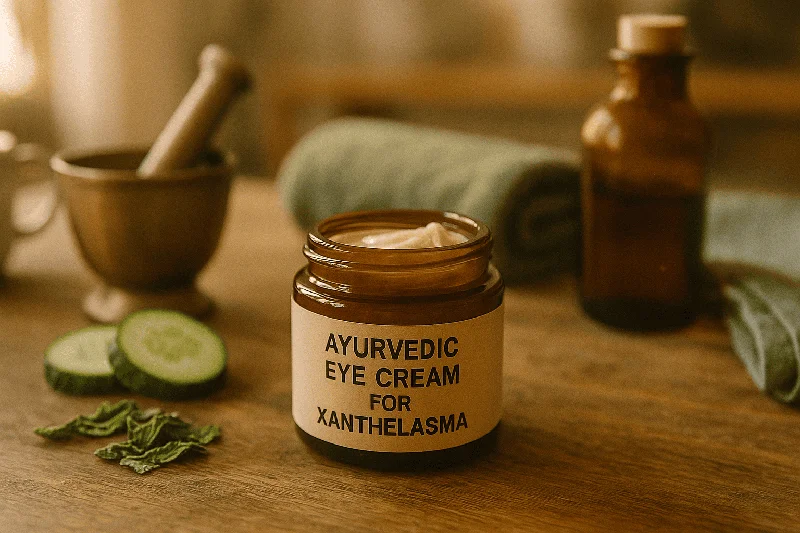
- If you've noticed yellowish patches creeping around your eyelids and started searching for a natural solution — you're in the right place. An ayurvedic eye cream for xanthelasma works by combining time-tested herbs like Turmeric, Triphala, and Manjistha to address both the visible deposits and the underlying metabolic imbalance that causes them. Unlike surgical removal which has a recurrence rate as high as 40-60%, Ayurveda targets the root cause: disturbed lipid metabolism, Kapha dosha imbalance, and toxin accumulation (Ama).
- This guide covers everything — from what actually works in these creams, to exact dosages of internal remedies, to a head-to-head comparison of Ayurveda vs surgery that no one else is providing.
What Is Xanthelasma?
Xanthelasma (also called Xanthelasma Palpebrarum) refers to flat or slightly raised yellowish deposits of cholesterol that form on or around the eyelids — most commonly near the inner canthus (corner of the eye). They're soft, semi-solid plaques that sit just beneath the skin surface and are usually painless.
- They're not dangerous in themselves.
- But here's what most people miss: xanthelasma can be an early warning sign of cardiovascular disease. A 2011 study published in the British Medical Journal involving over 12,700 participants found that xanthelasma was an independent predictor of heart attack and ischemic heart disease, regardless of cholesterol levels.
Xanthelasma vs Xanthoma: What's the Difference?
Many people confuse the two, and the distinction matters for treatment.
| Feature | Xanthelasma | Xanthoma |
|---|---|---|
| Location | Exclusively on/around eyelids | Anywhere on the body — elbows, knees, tendons, buttocks |
| Appearance | Flat, yellowish, soft patches | Nodular, sometimes firmer lumps |
| Associated conditions | Hyperlipidemia, thyroid dysfunction, diabetes | Severe hyperlipidemia, familial hypercholesterolemia |
| Cosmetic concern | High (visible on face) | Variable |
In classical Ayurveda, xanthelasma correlates with specific conditions documented in ancient texts. The term Bisa Vartma describes eyelid lesions resembling lotus stem cross-sections, while Medoja Granthi refers to lipid-based growths. Both fall under the broader category of Meda-dhatu vikara — disorders of the fat tissue element.
What Causes Xanthelasma?
The causes are both systemic and metabolic:
- Hyperlipidemia / High LDL cholesterol — the most common association. Roughly 50% of xanthelasma patients have elevated lipid levels.
- Diabetes mellitus — insulin resistance promotes abnormal lipid storage.
- Hypothyroidism / Thyroid dysfunction — impaired thyroid function slows lipid metabolism significantly.
- Genetic predisposition — familial hypercholesterolemia dramatically increases risk.
- Hormonal imbalances — particularly during menopause or with PCOS.
- Chronic stress — often overlooked, but stress elevates cortisol which in turn disrupts lipid metabolism and aggravates Kapha dosha.
- Liver dysfunction — the liver is central to cholesterol processing; any impairment cascades outward.
- Important: Before starting any treatment, a lipid profile blood test is mandatory. This is non-negotiable. You need to know your total cholesterol, LDL, HDL, triglycerides, and VLDL levels.
- Without this data, any treatment — Ayurvedic or otherwise — is essentially guesswork.
The Ayurvedic Understanding of Xanthelasma
Ayurveda doesn't view xanthelasma as merely a skin problem. It sees it as the visible manifestation of a deeper metabolic disturbance.
Kapha Dosha and Meda Dhatu Vikara
According to Ayurvedic pathology, xanthelasma arises from:
- 1.Kapha dosha aggravation — excess Kapha leads to sluggish metabolism and accumulation of fatty tissue.
- 2.Meda dhatu vikara — a disorder of the fat tissue (Meda dhatu), where lipids aren't properly metabolized and instead deposit in abnormal locations.
- 3.Ama accumulation — undigested metabolic toxins (Ama) combine with disturbed Kapha and block the microchannels (Srotas) of the body.
- 4.Impaired Agni (digestive fire) — specifically Meda-dhatvagni, the metabolic fire responsible for fat tissue transformation.
This is why Ayurvedic treatment for xanthelasma always combines topical application with internal medicines and dietary corrections. Treating just the surface would be like mopping the floor while the tap is still running.
Pharmacological Properties Used in Treatment
Ayurvedic formulations for xanthelasma leverage specific pharmacological actions (Karma):
- Lekhana — scraping action that reduces abnormal tissue growth
- Deepana — kindling of digestive and metabolic fire
- Kapha-Medhohara — directly reducing Kapha and fat tissue
- Raktashodhaka — blood purification
These aren't vague concepts — they describe precise therapeutic mechanisms that determine which herbs get selected for treatment.
Can Eye Cream Really Treat Xanthelasma?
- Let's be honest here.
- No topical cream — Ayurvedic or otherwise — can single-handedly cure xanthelasma if the underlying metabolic imbalance persists. Anyone claiming that is misleading you.
What a well-formulated Ayurvedic eye cream can do:
- Gradually reduce the size and visibility of existing deposits
- Improve local circulation and lymphatic drainage around the eye area
- Prevent further lipid accumulation at the application site
- Nourish and protect the extremely delicate periorbital skin
The real transformation happens when topical treatment is combined with internal medicines, Panchakarma detox, and dietary changes. This multi-pronged approach is where Ayurveda genuinely shines compared to one-dimensional surgical removal.
Key Ayurvedic Ingredients That Actually Work
Here are the herbs with the strongest traditional backing and emerging scientific support:
| Ingredient | Primary Action | How It Helps Xanthelasma | Evidence |
|---|---|---|---|
| Turmeric (Curcumin) | Anti-inflammatory, Lekhana | Reduces lipid peroxidation; a 2014 study in Atherosclerosis showed curcumin lowered LDL by 12% over 12 weeks | Moderate clinical evidence |
| Guggulu (Commiphora mukul) | Kapha-Medhohara, hypolipidemic | Directly lowers cholesterol and triglycerides; contains guggulsterone which modulates the farnesoid X receptor | Strong traditional + some clinical evidence |
| Triphala | Deepana, detoxification | Improves liver function and fat metabolism; a 2012 study in JACM demonstrated lipid-lowering effects in obese individuals | Moderate evidence |
| Manjistha (Rubia cordifolia) | Raktashodhaka (blood purifier) | Cleanses blood, removes stagnant Kapha from microchannels | Strong traditional evidence |
| Neem (Azadirachta indica) | Antimicrobial, Pitta-Kapha balancing | Detoxifies blood, supports liver function | Traditional evidence |
| Aloe Vera (Kumari) | Soothing, penetration enhancer | Helps active ingredients penetrate skin; anti-inflammatory for delicate eye area | Well-established topical safety |
| Amla (Emblica officinalis) | Rasayana (rejuvenative) | Potent antioxidant (high Vitamin C), supports collagen repair around deposits | Moderate evidence |
| Castor oil (Eranda taila) | Vata-Kapha balancing, Lekhana | Improves local circulation, traditionally used for growths and deposits | Traditional evidence |
Does Castor Oil Remove Xanthelasma?
This is one of the most searched questions, so let's address it directly. Castor oil contains ricinoleic acid, which has anti-inflammatory and circulation-boosting properties. Some people report modest improvement after consistent application over several months.
However, there is no published clinical study confirming castor oil alone can remove xanthelasma. It may serve as a useful carrier oil in Ayurvedic formulations and can help soften deposits, but expecting it to work as a standalone treatment is unrealistic. It's best used as part of a broader herbal cream formulation.
How to Use Ayurvedic Eye Cream for Xanthelasma: Step-by-Step Protocol
The skin around your eyes is the thinnest on your body — roughly 0.5mm compared to 2mm elsewhere on the face. This means both that active ingredients penetrate more easily (good) and that irritation risk is higher (caution needed).
Application Protocol
Step 1: Cleanse
Wash the eye area gently with lukewarm water or a mild Triphala decoction (1/4 teaspoon Triphala powder steeped in warm water, cooled, and strained). Pat dry.
Step 2: Apply
Take a pea-sized amount of the Ayurvedic eye cream. Apply directly to the xanthelasma deposits using your ring finger (it exerts the least pressure).
Step 3: Gentle Massage
Using circular motions, massage the cream for 1-2 minutes. Do not tug or pull the skin. Massaging improves local blood circulation and enhances absorption.
Step 4: Leave-on Duration
If using a homemade paste (see below), leave for 10-15 minutes then rinse. If using a commercial cream formulated for leave-on application, follow the product's instructions.
Step 5: Frequency
Apply twice daily — morning and night — for a minimum of 8-12 weeks before assessing results. Consistency is absolutley critical.
DIY Ayurvedic Paste Recipes for Xanthelasma
Turmeric-Aloe Vera Paste
- ½ teaspoon organic turmeric powder
- 1 teaspoon fresh aloe vera gel
- 2-3 drops of raw honey
Mix into a smooth paste. Apply to the affected area, avoiding direct contact with the eye. Leave for 10-15 minutes. Rinse with cool water. Use daily.
Triphala-Rose Water Paste
- ½ teaspoon Triphala churna (fine powder)
- Rose water — enough to form a paste
Apply to xanthelasma patches for 10-15 minutes. The astringent (Kashaya) properties of Triphala combined with rose water's cooling effect work synergistically on Kapha deposits.
Almond Oil Massage
Warm a few drops of pure almond oil between your fingertips. Massage the xanthelasma deposits in gentle circular motions for 2-3 minutes before bed. Almond oil is rich in Vitamin E and improves microcirculation. This can be done nightly in addition to the paste treatment.
> ⚠️ Caution: Always perform a patch test on your inner wrist 24 hours before applying anything near your eyes. Discontinue immediately if you experience redness, burning, or swelling. Pregnant and nursing women should consult an Ayurvedic practitioner before using turmeric or Guggulu-based preparations topically.
Internal Ayurvedic Medicines: Exact Dosages and Duration
This is where most online resources fall short — they mention herbs but never tell you how much to take, in what form, or for how long. Here are specific protocols, though always confirm with your Ayurvedic physician based on your Prakriti (constitution) and severity:
Guggulu Preparations
Guggulu is the single most important internal remedy for xanthelasma. It has been shown to reduce total cholesterol by 11-12% and triglycerides by 15-17% in clinical settings (Nityanand et al., Journal of the Association of Physicians of India, 1989).
| Preparation | Dosage | Form | Timing | Duration |
|---|---|---|---|---|
| Triphala Guggulu | 500mg - 1g, twice daily | Tablet | After meals with warm water | 2-3 months |
| Kanchanar Guggulu | 500mg, twice daily | Tablet | After meals | 2-3 months (specifically for growths/deposits) |
| Medohar Guggulu | 500mg - 1g, twice daily | Tablet | After meals with warm water or honey | 3 months |
Blood Purifiers and Liver Support
| Medicine | Dosage | Action | Duration |
|---|---|---|---|
| Manjistha churna | 3-5g daily (divided into 2 doses) | Blood purification (Raktashodhaka) | 6-8 weeks |
| Triphala churna | 3-5g at bedtime with warm water | Liver detox, mild laxative, lipid-lowering | Ongoing (can be taken long-term) |
| Arogyavardhini Vati | 250-500mg, twice daily | Liver-protective, fat metabolism | 4-8 weeks |
| Amla churna or juice | 10-20ml fresh juice OR 3g powder daily | Antioxidant, Vitamin C, rejuvenative | Ongoing |
> Note: These dosages are for adults. Pediatric cases of xanthelasma (rare but possible) require significantly reduced doses under strict medical supervision. Elderly patients or those on statin medications should inform their Ayurvedic doctor, as Guggulu can interact with lipid-lowering drugs.
Don't wait or self medicate. Start chat with Doctor NOW
Panchakarma Detox Therapies for Xanthelasma
Panchakarma represents the heavy artillery of Ayurveda — deep systemic detoxification that addresses the root metabolic dysfunction causing lipid deposits.
Virechana (Therapeutic Purgation)
This is the primary Panchakarma therapy for xanthelasma. Virechana eliminates excess Pitta and Kapha from the body through controlled purgation, directly targeting the liver and gallbladder. It is particularly effective for Meda dhatu disorders.
Typical protocol: 3-7 days of preparatory oleation (internal ghee administration) followed by the purgation day. Best performed under clinical supervision.
Basti / Vasti (Medicated Enema)
Basti therapy helps balance Vata dosha, which when disturbed can drive Kapha into abnormal locations. Medicated enemas using Lekhana (scraping) herbs help reduce excess fat tissue systemically.
Raktamokshana (Bloodletting)
In specific cases where blood vitiation (Rakta dushti) is prominent, Raktamokshana through leech therapy or venepuncture may be recommended. This is particularly relevant when xanthelasma accompanies skin conditions or visible venous congestion.
Intermittent Fasting (Langhana)
Though not technically Panchakarma, therapeutic fasting (Langhana) is strongly recommended as a supportive measure. It rekindles Agni, reduces Ama, and promotes lipid metabolism. Even simple practices like skipping dinner once a week or maintaining a 14-16 hour overnight fast can support the treatment significantly.
Ayurveda vs Surgery vs Laser: Honest Comparison
- No other resource provides this comparison transparently.
- Here it is:
| Criteria | Ayurvedic Treatment | Surgical Excision | Laser Ablation | TCA Chemical Peel |
|---|---|---|---|---|
| Recurrence rate | Low (when systemic treatment followed) | 40-60% (Rohrich et al., Plastic and Reconstructive Surgery) | 10-20% | 20-30% |
| Invasiveness | Non-invasive | Invasive (cutting, sutures) | Minimally invasive | Minimally invasive |
| Downtime | None | 1-2 weeks (swelling, bruising) | 3-7 days | 5-10 days |
| Approximate cost (India) | ₹2,000-8,000 for a 3-month course | ₹15,000-50,000 per session | ₹10,000-30,000 per session | ₹5,000-15,000 per session |
| Addresses root cause | Yes (lipid metabolism, liver, Kapha) | No (removes deposit only) | No | No |
| Side effects | Minimal (possible skin sensitivity) | Scarring, ectropion (eyelid distortion), infection | Hypopigmentation, scarring | Burning, scarring, hyperpigmentation |
| Time to visible results | 8-16 weeks | Immediate | Immediate | 2-4 weeks |
| Recurrence prevention | Built into the treatment approach | Requires separate lipid management | Requires separate lipid management | Requires separate lipid management |
The critical advantage of Ayurvedic treatment is that it addresses why the deposits formed in the first place. Surgery removes the patch but does nothing about the metabolic dysfunction — which is exactly why recurrence rates are so high with procedural approaches.
That said, Ayurveda takes time. If you need immediate removal for a significant cosmetic concern, surgical or laser options give faster visible results. A pragmatic approach for many patients is combining surgical removal with Ayurvedic systemic treatment to prevent recurrence.
Dietary Recommendations (Pathya-Apathya) for Xanthelasma
Diet is not supplementary to treatment — it's foundational. In Ayurveda, Pathya (favorable diet) is considered half the treatment.
Foods to Include (Pathya)
- Bitter and astringent tastes — bitter gourd (karela), fenugreek (methi), turmeric, green leafy vegetables. These directly pacify Kapha and Meda.
- Whole grains — barley (yava) is considered the best grain for Kapha-Meda conditions; also millet, ragi, and old rice (purana shali).
- Warm spices — black pepper, ginger, cumin, coriander, fennel — these kindle Agni.
- Lean proteins — moong dal, masoor dal, lightly cooked vegetables.
- Honey — 1-2 teaspoons of raw, unheated honey daily helps reduce Kapha. (Never cook honey — Ayurveda considers heated honey toxic.)
- Warm water — drink throughout the day to support metabolism.
Foods to Avoid (Apathya)
- Deep-fried foods, excessive ghee/butter in cooking
- Full-fat dairy — cheese, cream, full-fat milk
- Red meat and processed meats
- Refined sugar and refined flour (maida)
- Cold beverages and ice cream
- Excessive sweet, sour, and salty tastes
- Daytime sleeping (Divaswapna) — aggravates Kapha and slows Meda metabolism
Yoga and Lifestyle Practices
- Surya Namaskar — 12 rounds daily; excellent for overall metabolism
- Kapalabhati Pranayama — stimulates Agni, promotes detoxification
- Bhujangasana, Dhanurasana, Ardha Matsyendrasana — twisting and backbending postures that stimulate liver function and abdominal organs
- Meditation / Stress management — chronic stress elevates cortisol, directly disrupting lipid metabolism. Even 10-15 minutes of daily meditation makes a measurable difference.
Safety, Contraindications, and When to See a Doctor
Contraindications for Ayurvedic Eye Creams
- Pregnancy and breastfeeding — avoid Guggulu (internal) and turmeric-based topicals near the eyes without medical guidance
- Active eye infections — conjunctivitis, stye, or any active infection — treat the infection first
- Known allergies — to any ingredient; always patch test
- Children under 12 — the periorbital area is even more delicate; consult a pediatric Ayurvedic specialist
- Post-eye surgery patients — wait at least 6-8 weeks after any eye procedure
When to See a Doctor Immediately
- Xanthelasma growing rapidly in size
- Pain or vision changes associated with the deposits
- Lipid profile showing very high LDL (>190 mg/dL) or triglycerides (>500 mg/dL)
- Xanthelasma appearing in someone under 30 — may indicate familial hypercholesterolemia requiring urgent cardiac evaluation
What to Do If You Have an Allergic Reaction
If you experience redness, swelling, itching, or burning after applying an Ayurvedic eye cream:
- Rinse the area immediately with cool, clean water for 2-3 minutes
- Apply pure aloe vera gel to soothe the area
- Take an antihistamine if swelling persists
- Do not re-apply the product
- Consult your doctor if symptoms don't resolve within 24 hours
Frequently Asked Questions
Is there a natural remedy for xanthelasma?
Yes. Ayurveda offers a comprehensive natural approach combining topical herbal creams (turmeric, aloe vera, Triphala), internal lipid-lowering medicines (Guggulu, Manjistha), Panchakarma detox, and dietary modifications. The key is treating the root metabolic cause, not just the visible deposit. Results typically appear within 8-16 weeks of consistent treatment.
How to treat xanthelasma under eyes?
Lower eyelid xanthelasma requires the same approach as upper eyelid deposits — topical Ayurvedic cream application, internal medicines for cholesterol management, and dietary changes. Be extra gentle with application on the lower lid as the skin there is even thinner. Avoid pulling or stretching the skin during massage.
What is the best eye cream for xanthelasma?
The most effective Ayurvedic eye cream for xanthelasma should contain a combination of Turmeric (curcumin), Triphala, Aloe Vera as a base, and ideally Manjistha or Kumkumadi taila components. Look for creams specifically formulated for the periorbital area — regular face creams with these ingredients may be too harsh for the eye zone.
What is the price of xanthelasma removal cream in India?
Ayurvedic eye creams for xanthelasma in India typically range from ₹300-1,500 for topical preparations. A complete 3-month treatment course including internal medicines (Guggulu, Triphala) may cost ₹2,000-8,000 total. This is significantly more affordable than surgical excision (₹15,000-50,000) or laser treatment (₹10,000-30,000).
Can lifestyle affect xanthelasma development?
Absolutely. Sedentary lifestyle, high-fat diet, chronic stress, inadequate sleep, and daytime sleeping all aggravate Kapha dosha and impair Meda dhatu metabolism. Studies show that regular aerobic exercise can raise HDL cholesterol by 5-10% and lower triglycerides by 20-30%, directly addressing the lipid imbalance behind xanthelasma.
Can xanthelasma come back after Ayurvedic treatment?
Recurrence is significantly lower with Ayurvedic treatment compared to surgery because Ayurveda addresses the systemic metabolic imbalance. However, if dietary and lifestyle modifications are abandoned, recurrence is possible. This is why Ayurveda emphasizes ongoing Pathya (favorable diet and lifestyle) as a permanant part of management.
Final Thoughts: A Holistic Path Forward
Xanthelasma is your body communicating something important — that lipid metabolism needs attention. An Ayurvedic eye cream for xanthelasma is a valuable tool, but it works best as part of a comprehensive approach: topical herbs for the visible deposits, internal medicines to correct the metabolic dysfunction, Panchakarma for deep detoxification, and dietary-lifestyle changes to prevent recurrence.
- Don't ignore the underlying message. Get your lipid profile tested. Start with the dietary changes and internal medicines.
- Add the topical cream.
- Be patient — natural healing takes time, but the results are more sustainable and far gentler on your body than invasive procedures.
The ancient science of Ayurveda has addressed conditions like Bisa Vartma and Medoja Granthi for thousands of years. Modern understanding of lipid metabolism only confirms what Ayurvedic physicians documented centuries ago — that fat tissue disorders require systemic treatment, not just surface-level removal.
Your eyes deserve that kind of thoughtful care.
Scientific Sources
- Twenty-eight days of repeated dose sub-acute toxicological evaluation of polyherbal Ayurvedic medicine BPGrit in Sprague-Dawley rats — Balkrishna A et al., 2024, Journal of applied toxicology : JAT
- Network Pharmacology of Ayurveda Formulation Triphala with Special Reference to Anti-Cancer Property — Chandran U et al., 2015, Combinatorial chemistry & high throughput screening
- Ayurvedic medicine for rheumatoid arthritis: a systematic review — Park J et al., 2005, Seminars in arthritis and rheumatism
- Hegemony versus pluralism: Ayurveda and the Movement for Global Mental Health — Halliburton M, 2023, Anthropology & medicine
- Is there anything good about aging? — Maiti AK, 1998, Journal of the Indian Medical Association
- Research in Ayurveda: where do we go from here? — Hardy ML, 2001, Alternative therapies in health and medicine
- Ajurveda in modern medical science (https://pubmed.ncbi.nlm.nih.gov/27211357/) — Korossy A et al., 2016, Orvosi hetilap
- Foundations of clinical logagogy — Bühler KE, 2003, Medicine, health care, and philosophy
- Nootropic potential of Ashwagandha leaves: Beyond traditional root extracts — Wadhwa R et al., 2016, Neurochemistry international
- A review on the concept of aging in Ayurveda literature — Yamuna Sisupalan A et al., 2022, Journal of complementary & integrative medicine
- Genomic insights into ayurvedic and western approaches to personalized medicine — Prasher B et al., 2016, Journal of genetics
- Health System Development in Nepal — Marasini B, 2020, JNMA; journal of the Nepal Medical Association
- Merger of ayurveda and tissue culture-based functional genomics: inspirations from systems biology — Deocaris CC et al., 2008, Journal of translational medicine
- Stress and Ayurveda: Selye--Mehta dialogue in context of the current findings — Dhuri KD et al., 2000, The Journal of the Association of Physicians of India
- Are we close to a theory of energy medicine? — Hankey A, 2004, Journal of alternative and complementary medicine (New York, N.Y.)
- Public Health Approach of Ayurveda and Yoga for COVID-19 Prophylaxis — Tillu G et al., 2020, Journal of alternative and complementary medicine (New York, N.Y.)
- Ayurvedic Management of Presbycusis (Project TOPMAC): Protocol for an Exploratory Randomized Controlled Trial — V KK et al., 2024, JMIR research protocols
- Suspected Cutaneous Allergic Reactions with Ayurveda Medicine Punaranava Mandura: A Case Report — Roseleena S et al., 2025, Current drug safety
- Prakriti Analysis of COVID 19 Patients: An Observational Study — Rajan S et al., 2021, Alternative therapies in health and medicine
- Personalized medicine: a confluence of traditional and contemporary medicine — Jafari S et al., 2014, Alternative therapies in health and medicine
Questions from users
What is Raktamokshana and how does it relate to Ayurvedic skin treatments?
Thomas
8 days ago
Raktamokshana is a bloodletting technique in Ayurveda used to detoxify when blood is considered 'vitiated' or impure. In skin treatments, it helps by removing toxins from the blood that may be affecting the skin's health. It's often paired with herbal remedies to tackle skin issues from inside and out. If interested, consulting a practitioner would be a wise path!
What is the best way to apply turmeric and aloe vera paste for treating xanthelasma?
Millie
18 days ago
You can apply the turmeric and aloe vera paste gently on the xanthelasma area. Just dab it on lightly, avoiding overly rubbing it into the skin, especially near the eyes, coz the skin is delicate there. Leave it on for about 10-15 minutes, then rinse it off. Doing this regularly might help with deposits, but remember, it's not a standalone treatment. Keep an eye on your cholesterol levels too!
Can Ayurvedic treatments improve overall skin health in addition to xanthelasma?
Lila
27 days ago
Absolutely! Ayurvedic treatments can surely improve overall skin health, not just xanthelasma. By balancing your doshas and enhancing agni (digestive fire), Ayurveda promotes healthier skin. Regular detox practices like Virechana can help clear toxins (ama) that affect skin quality. You might want to focus on Pitta and Kapha balancing foods and lifestyle changes too. Just remember, it's not an overnight fix and consistency is key! Keep up with good practices, and you'll often see an improvement.
How to improve lymphatic drainage around the eyes naturally?
Anthony
36 days ago
To naturally improve lymphatic drainage around your eyes, try using a gentle Ayurvedic eye cream with ingredients like turmeric and aloe vera. These can boost circulation and help drainage. Internal herbal remedies like Guggulu and Manjistha also support the process. Combine this with a Panchakarma detox and a balanced diet to see better results! Be gentle when applying anything, especially on the lower lid.
What is Triphala and how does it help with detoxification?
Paul
48 days ago
Triphala is made from three fruits: amla, bibhitaki, and haritaki. It's known in Ayurveda for its detoxifying properties—it helps cleanse the digestive system by improving digestion (agni) and eliminating toxins from the body. This supports a healthy liver and can even aid in better nutrient absorption. If you are considering it, just be mindful of your individual dosha balance to use it properly 😊
What is the best way to use coconut oil for moisturizing sensitive skin as part of an Ayurvedic routine?
Amelia
58 days ago
For moisturizing sensitive skin with coconut oil, try applying a small amount gently to damp skin after showering when the oil absorbs best. Use it sparingly since a little goes a long way. Keep in mind, always do a patch test first, as even natural oils might cause reactions in sensitive skin sometimes. It's all about balance!
Can I use Ayurvedic eye cream on xanthelasma if I'm pregnant?
Wyatt
68 days ago
Using Ayurvedic eye cream on xanthelasma during pregnancy can be safe, but it's super important to be cautious. Always check the ingredients for anything potentially harmful. Maybe talk to your doctor or an Ayurvedic practitioner to be sure it's okay for you. Every pregnancy is different, and they’ll help figure out what’s best for you.
What is the role of cholesterol in the development of xanthelasma?
Presley
77 days ago
Cholesterol plays a big role in xanthelasma because it builds up under the skin, creating these yellowish plaques. It often indicates a lipid imbalance, meaning there might be too much cholesterol in the blood. Ayurvedic approach looks at balancing doshas to handle this, promoting digestion and healthy liver function to support cholesterol management.
Is it safe to use Ayurvedic eye cream on sensitive skin for xanthelasma treatment?
Zachary
87 days ago
Using Ayurvedic eye cream on sensitive skin is generally safe, but patch test first to check reactions. Everyone's skin can react differently, you know? Just dab a little on a small area and see how it goes. To address xanthelasma effectively, consider lifestyle and diet tweaks too. Balancing can be tough, but it's key!
Can xanthelasma go away on its own without treatment?
Paris
97 days ago
Xanthelasma often doesn't go away on its own, unfortunately. It's all about those cholesterol deposits, right? Lifestyle changes like a healthy diet and exercises can help, tho they might not completely remove them. Some people see improvements with Ayurvedic remedies, too. But consulting a specialist is always a good idea!
Related articles
Eye Disorders
Nayanamritam Kuzhambu – Traditional Ayurvedic Eye Elixir for Vision Wellness
Discover Nayanamritam Kuzhambu, a classical Ayurvedic eye elixir. Learn about its ingredients, benefits, usage, and how it promotes eye health and overall well-being naturally.
2,980

Eye Disorders
Anjana Ayurveda – Ancient Eye Care from Ayurveda
Explore Anjana Ayurveda, a time-honored approach to eye health. Discover herbal remedies, traditional practices, and holistic techniques for nurturing vision naturally.
5,116

Eye Disorders
Eye Allergy Ayurvedic Treatment: Soothing Relief for Irritated Eyes
Discover holistic Ayurvedic treatments for eye allergies that soothe irritation, reduce redness, and restore comfort naturally through gentle herbal remedies.
4,390

Eye Disorders
Is Amla Good for Eyes and Vision Health?
Discover if amla is good for eyes, its benefits for eyesight, and Ayurvedic ways to use amla juice for vision health. Learn how to improve eyesight naturally
8,696

Eye Disorders
Itone Eye Drops
Exploration of Itone Eye Drops
5,559
Eye Disorders
Ayurvedic Treatment for Retina: Protect & Revitalize Your Vision Naturally!
Discover Ayurvedic remedies to support retinal health, improve vision, and protect against age-related eye conditions with natural treatments.
4,746

Eye Disorders
Is Rose Water Good for Eyes: Benefits, Uses, and Precautions
Find out if rose water is good for eyes, its Ayurvedic benefits, how to use it safely, side effects, and tips for application to improve eye health naturally
11,515
Eye Disorders
Akshi Tarpana in Ayurveda – Revitalizing Eye Health Therapy
Explore the benefits of Akshi Tarpana, a traditional Ayurvedic eye therapy that nourishes, rejuvenates, and revitalizes vision. Learn how this time-honored remedy improves eye health and alleviates common ocular issues.
3,679
Eye Disorders
Netra Bindu: Benefits & Ayurvedic Eye Care
Discover the benefits, proper dosage, uses, and scientific research behind Netra Bindu, an effective Ayurvedic remedy for eye health and vision enhancement.
4,764
Related consultations on the topic
Legal
Additional Documents
© 2024 Ask Ayurveda. All rights reserved.