Ask Ayurvedic doctor a question and get a consultation online on the problem of your concern in a free or paid mode. More than 2,000 experienced doctors work and wait for your questions on our site and help users to solve their health problems every day.
FREE! Ask Ayurvedic Doctors 24/7

 Fast responses
 1000+ verified doctors
Body DetoxEar, Nose, and Throat DisordersGeriatrics & RejuvenationImmunodeficiencyInfertility TreatmentNutritionOrthopedic DisordersPediatricsRespiratory DisordersSexually Transmitted Diseases (STDs)Surgery RecoveryUrological DisordersVascular DisordersDental DisordersEndocrinological DisordersGastrointestinal DisordersYoga TherapyGeneral MedicineAllergic DisordersCardio DisordersGynecology and ObstetricsCosmetologySkin and Hair DisordersEye DisordersInfectious DiseasesMental DisordersNeurological DisordersOncologyPanchakarmaSexual Health & DisordersSports Medicine
Published on 12/12/24
(Updated on 07/05/26)
3,517
Ayurvedic Medicine for Heel Pain: Natural Relief for Lasting Comfort
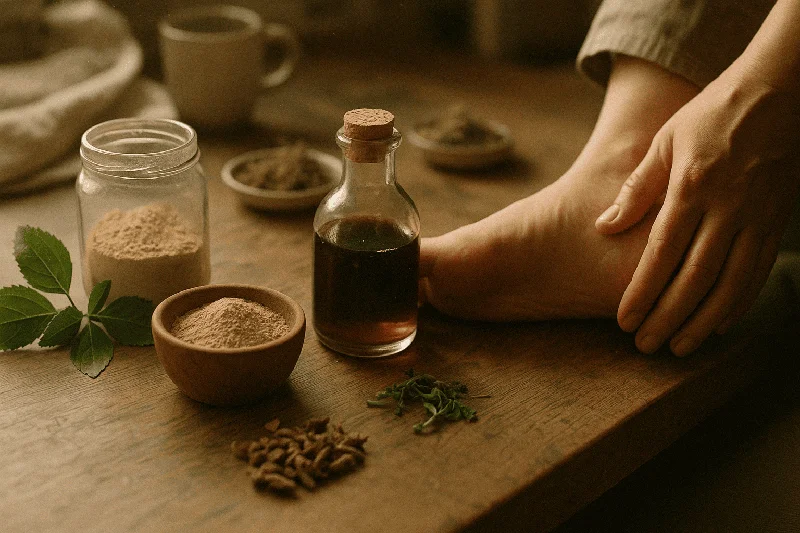
- Heel pain affects nearly 10% of the global population at some point in their lives, yet most people cycle through painkillers and cortisone injections without addressing the root cause.
- Ayurvedic medicine for heel pain works differently — it targets the underlying doshic imbalance (primarily Vata dosha), reduces inflammation through herbal formulations, and restores structural integrity to the plantar fascia, calcaneal bone, and surrounding tissues. Whether you're dealing with plantar fasciitis, a calcaneal spur, or chronic morning heel pain, this guide covers specific Ayurvedic medicines, Panchakarma therapies, home remedies, dosages, treatment protocols by stage, and evidence-based comparisons with conventional treatment.
What Causes Heel Pain? Understanding the Ayurvedic & Modern Perspective
Heel pain is not a single condition — it's a symptom with multiple possible origins. Before choosing any treatment, understanding the cause is critical.
Heel Pain in Ayurveda: Vatakantaka and Vata Dosha Imbalance
In classical Ayurvedic texts like Madhava Nidana and Sushruta Samhita, heel pain is described as Vatakantaka — a condition caused by aggravated Vata dosha settling in the Gulpha (ankle) and Parshni (heel) regions. The Sanskrit term literally translates to "thorn-like pain caused by Vata."
- According to Ayurveda, Vata dosha has qualities of dryness (Ruksha), coldness (Sheeta), and lightness (Laghu).
- When these qualities increase — through improper diet, excessive walking on hard surfaces, aging, or cold weather — the Vata lodges in the heel area and causes:
- Degeneration of the calcaneal padding
- Drying out of synovial fluid in the ankle joint
- Inflammation and stiffness of the plantar fascia
Common Modern Causes (Nidana)
| Cause | Description | Dosha Involved |
|---|---|---|
| Plantar Fasciitis | Inflammation of the thick band connecting heel to toes | Vata-Pitta |
| Calcaneal Spur | Bony growth on the underside of the heel bone | Vata-Kapha |
| Achilles Tendinitis | Inflammation of the tendon at the back of the heel | Pitta-Vata |
| Retrocalcaneal Bursitis | Inflammation of the fluid-filled sac behind the heel | Pitta |
| Obesity-related heel stress | Excess body weight compressing heel fat pad | Kapha |
| Vitamin D/B12 deficiency | Weakened bone density and nerve function | Vata |
Heel Pain vs Plantar Fasciitis vs Heel Spur: Key Differences
Many people confuse these three conditions.
Here's a clear breakdown:
| Feature | General Heel Pain | Plantar Fasciitis | Calcaneal Spur |
|---|---|---|---|
| Location | Anywhere on the heel | Bottom of the heel, near arch | Underside of heel bone |
| Nature of Pain | Dull ache or sharp pain | Stabbing pain, worst in morning | Deep, bony pain with pressure |
| Visible on X-ray | Not always | No (soft tissue issue) | Yes (bony projection visible) |
| Main Cause | Multiple | Fascial inflammation | Calcium deposit from chronic strain |
| Ayurvedic Correlation | Vatakantaka (general) | Vatakantaka with Pitta | Vatakantaka with Kapha |
Differentiating Pain by Dosha Type
Not all heel pain behaves the same, and Ayurveda recognizes this through doshic typing:
- Vata-type pain: Sharp, shooting, worse in cold weather and early morning, relieved by warmth and oil massage
- Pitta-type pain: Burning sensation, redness, swelling, worse in hot weather and after intense activity
- Kapha-type pain: Dull, heavy ache with stiffness and swelling, worse in damp/cold conditions and after rest
Identifying your dosha type helps select the right medicine and therapy — something conventional medicine completely overlooks.
How to Treat Heel Pain in Ayurveda: Medicines, Oils & Formulations
This is the core of Ayurvedic treatment. Unlike NSAIDs that only mask pain, Ayurvedic medicines address inflammation, tissue degeneration, and doshic imbalance simultaneously.
Internal Ayurvedic Medicines (With Dosages)
No competitor provides specific dosages — here they are, based on classical Ayurvedic pharmacopoeia guidelines. Always confirm with a qualified Ayurvedic practitioner before starting.
| Medicine | Form | Typical Dosage | Duration | Primary Action |
|---|---|---|---|---|
| Yogaraja Guggulu | Tablet | 2 tablets (250 mg each), twice daily after meals | 4–8 weeks | Anti-inflammatory, Vata-pacifying |
| Kaishora Guggulu | Tablet | 2 tablets, twice daily with warm water | 6–8 weeks | Blood purifier, reduces swelling |
| Dashamoola Kashayam | Decoction | 15–20 ml with equal water, twice daily before meals | 4–6 weeks | Potent Vata-balancing, pain relief |
| Dashamoolarishta | Liquid (fermented) | 20–30 ml with equal water, after meals | 6–12 weeks | Strengthens bones and joints |
| Gandha Thailam | Oil (internal + external) | 5–10 drops internally with warm milk; external application | 4–8 weeks | Bone strengthening, fracture healing |
| Rasnadi Kashayam | Decoction | 15 ml with warm water, twice daily | 4–6 weeks | Anti-inflammatory, analgesic |
| Sahacharadi Kashayam | Decoction | 15 ml diluted, twice daily | 4–6 weeks | Vata disorders of lower limbs |
Best Ayurvedic Oil for Heel Pain
- External oil application (Abhyanga) is considered the first line of treatment for Vatakantaka.
- The best oils include:
Mahanarayana Thailam — This is arguably the gold standard for heel pain. It contains over 50 herbs including Ashwagandha, Shatavari, and Bala, suspended in sesame oil base. A 2018 study published in the Journal of Ayurveda and Integrative Medicine found that Mahanarayana oil massage significantly reduced pain scores in musculoskeletal conditions after 21 days of application. Murivenna Oil — A Kerala-specific formulation containing coconut oil, Karanja, and Aloe vera. Particularly effective for heel pain caused by trauma or calcaneal spur. Kottamchukkadi Thailam — Excellent for Vata-Kapha type heel pain with stiffness. Contains dry ginger, Alpinia galanga, and sesame oil. Dhanwantharam Thailam — Best for chronic heel pain in elderly patients with significant Vata aggravation.
How to Apply Ayurvedic Oil for Maximum Effect
- Warm the oil slightly (not hot — test on your wrist first)
- Apply generously to the entire heel, sole, and ankle area
- Massage in circular motions for 10–15 minutes, focusing on the center of the heel
- Wrap with a warm cloth and leave for 30–45 minutes or overnight
- Repeat daily for minimum 21 consecutive days
Panchakarma Therapies for Heel Pain: What Actually Works
Panchakarma offers targeted therapeutic procedures that go far beyond simple massage. These are clinical interventions performed under supervision.
Abhyanga and Swedana (Oil Massage & Steam Therapy)
The combination of medicated oil massage followed by steam therapy is the most commonly prescribed Panchakarma for heel pain. Abhyanga lubricates the dried-out joints and tissues, while Swedana (steam) opens the channels (Srotas) and allows the medicated oils to penetrate deeper.
Typical protocol: Daily sessions for 7–14 days, each lasting 45–60 minutes.
Agnikarma (Thermal Cauterization)
This is one of the most effective — and most misunderstood — Ayurvedic treatments for heel pain. Agnikarma involves controlled application of heated metal probes (Shalaka) to specific points on the heel.
It works by:
- Destroying pathological tissue at the inflammation site
- Stimulating blood flow and healing response
- Providing immediate and often dramatic pain relief
A clinical study published in Ayu Journal (2014) involving 30 patients with Vatakantaka showed that Agnikarma provided statistically significant pain relief within 7 days, with effects lasting up to 3 months after a single session. Many patients reported 70-80% pain reduction after just 2-3 sessions.
Protocol: Typically 4–6 sessions at weekly intervals.
Raktamokshana (Therapeutic Bloodletting)
This lesser-known therapy involves controlled removal of 50–100 ml of blood from the affected area, usually through leech application (Jalauka) or venipuncture. Classical texts recommend it specifically when Pitta is involved — meaning the heel shows signs of inflammation, redness, or burning.
Protocol: 4 sessions at 7-day intervals. Post-procedure care includes application of turmeric paste mixed with ghee (Haridra + Ghrita) on the site. Important: Raktamokshana is contraindicated in patients with anemia, bleeding disorders, pregnancy, and those on blood-thinning medications.
Ishtika Sweda (Heated Brick Therapy) and Upanaha Sweda (Herbal Poultice)
Ishtika Sweda is a unique Kerala practice — a brick is heated until very hot, then Dhanyamla (fermented grain liquid) or Dashamoola Kashayam is poured over it, and the patient receives the medicated steam directly on the affected heel. Remarkably effective for stiffness-dominant heel pain. Upanaha Sweda involves preparing a warm herbal paste (usually containing Rasna, Devadaru, Eranda root, and Saindhava Lavana), applying it to the heel, wrapping it in leaves and cloth, and leaving it overnight. This method reduces inflammation and loosens tight fascia.
Marma Therapy for Heel Pain
Marma points are vital energy centers in Ayurvedic anatomy. The Kshipra Marma (located between the first and second toes) and Gulpha Marma (ankle point) are stimulated using sustained pressure and medicated oils. This unblocks energy flow to the heel region and can provide surprisingly fast pain relief. Usually combined with other therapies rather than used alone.
What Is the Fastest Way to Heal Heel Pain? A Stage-Based Treatment Protocol
No competitor offers this, but it's exactly what patients need — a clear, step-by-step protocol based on the severity and duration of heel pain.
Stage 1: Acute Heel Pain (0–2 Weeks Duration)
Goal: Immediate pain relief and inflammation control
- Internal: Dashamoola Kashayam 15 ml twice daily + Yogaraja Guggulu 2 tablets twice daily
- External: Warm Kottamchukkadi Thailam massage, 15 minutes, twice daily
- Therapy: Upanaha Sweda (herbal poultice) nightly
- Lifestyle: Complete rest from running/standing, cold foods to be avoided entirely
- Expected relief: 40–60% pain reduction within 7–10 days
Stage 2: Sub-Acute / Recurring Pain (2–8 Weeks Duration)
Goal: Heal tissue damage and prevent chronicity
- Internal: Continue Guggulu preparation + add Sahacharadi Kashayam
- External: Mahanarayana Thailam Abhyanga + Swedana (weekly professional sessions)
- Therapy: Agnikarma (2–3 sessions at weekly intervals)
- Exercises: Begin gentle calf stretches and towel scrunches (details below)
- Expected relief: 60–80% improvement over 4–6 weeks
Stage 3: Chronic Heel Pain / Calcaneal Spur (8+ Weeks Duration)
Goal: Reverse degeneration, dissolve spur, restore full function
- Internal: Gandha Thailam 5–10 drops with milk + Kaishora Guggulu + Dashamoolarishta 20 ml after meals
- External: Daily self-massage with Dhanwantharam Thailam
- Therapy: Full Panchakarma course — 14–21 days of Abhyanga, Swedana, Agnikarma, and optionally Raktamokshana
- Exercises: Progressive heel raises, ankle strengthening, yoga asanas
- Expected timeline: 8–12 weeks for significant improvement; 4–6 months for full recovery
Ayurveda vs Conventional Treatment for Heel Pain: An Honest Comparison
- This comparison has never been presented by any competitor.
- Here's a balanced look:
| Parameter | Ayurvedic Treatment | Conventional Treatment |
|---|---|---|
| Approach | Root-cause (doshic balance + tissue repair) | Symptom management |
| Primary medicines | Guggulu, Dashamoola, herbal oils | NSAIDs (Ibuprofen), Cortisone injections |
| Pain relief speed | Gradual (1–3 weeks for noticeable effect) | Fast (hours to days) |
| Side effects | Minimal when supervised; Agnikarma requires skilled practitioner | Gastric ulcers, tendon weakening (cortisone), kidney stress |
| Recurrence rate | Lower — addresses root cause | Higher without lifestyle changes |
| Cost (India) | ₹3,000–₹15,000 for full Panchakarma course; ₹500–₹2,000/month for medicines | ₹200–₹500/month for NSAIDs; ₹2,000–₹5,000 per cortisone injection |
| Surgery alternative | Agnikarma + herbal treatment often eliminates need for surgery | Plantar fasciotomy if conservative treatment fails |
| Evidence base | Growing (clinical studies exist, but fewer RCTs) | Extensive RCTs and meta-analyses |
| Best for | Chronic, recurring, or multi-factorial heel pain | Acute severe pain needing immediate relief |
A pragmatic approach: For severe acute pain, a short course of NSAIDs alongside Ayurvedic treatment is perfectly reasonable. Once acute pain subsides, transitioning fully to Ayurveda for long-term management gives the best outcomes.
Don't wait or self medicate. Start chat with Doctor NOW
Which Vitamin Deficiency Causes Heel Pain?
This is one of the most searched questions related to heel pain, and Ayurveda's understanding aligns surprisingly well with modern findings.
Vitamin D Deficiency
Low Vitamin D directly causes weakened bones (osteomalacia), and the calcaneus is often one of the first bones affected. A 2015 study in Foot & Ankle International found that 83% of patients with chronic plantar heel pain had insufficient Vitamin D levels (below 30 ng/ml).
In Ayurvedic terms, this maps to Asthi Kshaya (bone tissue depletion), a Vata condition treated with calcium-rich foods, ghee, sesame seeds, and sunlight exposure.
Vitamin B12 Deficiency
B12 deficiency causes peripheral neuropathy — tingling, burning pain in the feet that can mimic or worsen heel pain. Vegetarians in India are particularly at risk.
Magnesium and Calcium
Both minerals support bone and muscle health. Deficiency can contribute to cramping and fascial tightness in the foot.
Ayurvedic foods that address these deficiencies: Warm milk with turmeric and ghee, sesame seed preparations (Til Ladoo), Amla (Indian Gooseberry) for Vitamin C absorption, Moringa leaves, and Praval Pishti (coral calcium preparation).
Home Remedies for Heel Pain: Proven Natural Solutions
These remedies can be used alongside formal Ayurvedic treatment or independently for mild heel pain.
Oil Massage Remedies
- Warm sesame oil + a pinch of turmeric: Massage into heel for 10 minutes before bed. Sesame oil is inherently Vata-pacifying
- Castor oil wrap: Apply warm castor oil (Eranda Taila), wrap with cotton cloth, and leave overnight. Castor oil has documented anti-inflammatory properties (a 2011 study in Phytotherapy Research confirmed its analgesic effects)
- Mustard oil + rock salt: Heat mustard oil with a teaspoon of rock salt, cool to warm temperature, massage into the heel
Herbal Compress and Soak Remedies
- Epsom salt soak: Dissolve 2 tablespoons in warm water, soak feet for 15–20 minutes — relieves muscle tension and draws out inflammation
- Ginger compress: Grate fresh ginger, wrap in muslin cloth, dip in warm water, apply to heel for 15 minutes
- Turmeric paste: Mix 2 teaspoons turmeric powder with warm coconut oil to form paste, apply to heel, cover with bandage
Exercises That Complement Ayurvedic Treatment
| Exercise | Technique | Duration | Benefit |
|---|---|---|---|
| Calf stretch | Stand facing wall, extend affected leg back, press heel down | Hold 30 sec × 3 reps | Lengthens Achilles and plantar fascia |
| Towel scrunches | Place towel on floor, scrunch it toward you using toes | 2 minutes × 2 sets | Strengthens intrinsic foot muscles |
| Heel raises | Stand on edge of step, slowly lower heels below step level | 15 reps × 2 sets | Eccentric strengthening of calf |
| Frozen bottle roll | Roll a frozen water bottle under the arch of foot | 5 minutes | Reduces inflammation + fascial release |
Yoga Asanas for Heel Pain
Vajrasana (Thunderbolt Pose) — Sit on heels for 5–10 minutes after meals; stretches the plantar fascia and improves circulation to the feet. Virasana (Hero Pose) — Deepens the stretch of ankle and foot tissues. Padahastasana (Standing Forward Bend) — Stretches the entire posterior chain including calves and plantar fascia.
Heel Pain in Special Populations: What Ayurveda Recommends
No competitor addresses this — but treatment needs vary significantly across different patient groups.
Heel Pain in Diabetics
Diabetic patients often develop heel pain from neuropathy and poor circulation. Agnikarma is contraindicated in diabetics with peripheral neuropathy due to impaired wound healing. Instead, gentle oil massage with Dhanwantharam Thailam and internal use of Kaishora Guggulu (which also has blood-sugar-moderating properties) is preferred.
Heel Pain in Pregnant Women
Pregnancy-related heel pain results from weight gain and hormonal relaxin loosening ligaments. Most internal Ayurvedic medicines, Raktamokshana, and Agnikarma are contraindicated during pregnancy. Safe options include warm sesame oil massage, Epsom salt soaks, and supportive footwear. Dashamoola Kashayam is sometimes used in pregnancy under strict supervision, but only with physician approval.
Heel Pain in the Elderly
- Elderly patients typically have significant Vata aggravation with Asthi Kshaya (bone depletion).
- Treatment focuses on nourishing therapies: internal ghee preparations, Ksheera Basti (medicated milk enema), and prolonged Abhyanga with Bala Thailam.
- Recovery takes longer — expect 3–6 months for chronic cases.
Heel Pain in Athletes and Runners
Overuse injuries respond well to Upanaha Sweda post-training and regular Mahanarayana oil massage. Athletes can typically continue modified training during treatment, unlike cortisone injection protocols that require activity restriction.
Contraindications & Safety: Who Should Avoid Certain Ayurvedic Treatments
This section is critical and entirely missing from competitor articles.
| Treatment | Contraindicated In | Reason |
|---|---|---|
| Agnikarma | Diabetes with neuropathy, children, pregnant women, bleeding disorders | Wound healing risk, pain sensitivity |
| Raktamokshana | Anemia (Hb < 10), pregnancy, blood-thinning medication, elderly with frailty | Blood loss risk |
| Guggulu preparations | Hyperthyroidism, pregnancy (first trimester), active liver disease | Thyroid-stimulating properties, hepatic metabolism |
| Hot oil Swedana | Acute pitta conditions with burning/redness, open wounds on feet | Can worsen inflammation |
| Dashamoola Kashayam | Severe gastric acidity, peptic ulcers | Strong kashayam can irritate stomach lining |
- General rule: Always disclose all existing medical conditions and medications to your Ayurvedic practitioner.
- Herb-drug interactions are real — for example, Guggulu can affect the metabolism of thyroid medications and blood-thinners.
Frequently Asked Questions
How long does Ayurvedic treatment take for heel pain?
- Mild to moderate heel pain typically responds within 2–4 weeks of consistent treatment. Chronic cases with calcaneal spur may require 3–6 months of combined internal medicine and Panchakarma therapy.
- The key factor is consistency — unlike painkillers that work immediately but temporarily, Ayurvedic treatment builds cumulative healing effects.
Can Ayurveda dissolve a heel spur?
While Ayurveda doesn't claim to "dissolve" a calcified spur, clinical experience shows that treatments like Agnikarma, Gandha Thailam, and Dashamoola-based therapies can significantly reduce pain and inflammation around the spur, often making it functionally painless. Many patients with confirmed X-ray spurs become completely asymptomatic with Ayurvedic treatment.
What is the best Ayurvedic oil for heel pain?
Mahanarayana Thailam is considered the most versatile and effective oil for most types of heel pain. For Kapha-dominant pain with stiffness, Kottamchukkadi Thailam is better. For elderly patients, Dhanwantharam Thailam is preferred. Your specific dosha constitution and pain type determine the ideal choice.
Is Ayurvedic treatment for heel pain safe for long-term use?
Yes, when supervised by a qualified practitioner. External oil treatments have virtually no side effects. Internal medicines like Guggulu preparations are safe for 8–12 week courses but should be taken under medical guidance for longer durations due to their effects on thyroid function and liver metabolism.
Can I combine Ayurvedic and allopathic treatment for heel pain?
- Absolutely. Many integrative practitioners recommend short-term NSAIDs for acute pain control alongside Ayurvedic medicines for long-term healing.
- However, inform both your doctors — some combinations need timing adjustments (e.g., taking Kashayam and NSAIDs at least 2 hours apart to avoid gastric irritation).
Where can I find authentic Ayurvedic treatment for heel pain in India?
- Kerala is widely regarded as the hub of authentic Ayurvedic practice, with established institutions like Kottakkal Arya Vaidya Sala and Vaidyaratnam.
- However, reputable Ayurvedic hospitals exist across India — look for practitioners with BAMS (Bachelor of Ayurvedic Medicine and Surgery) qualifications and clinics registered with AYUSH ministry.
Take the First Step Toward Pain-Free Heels
Heel pain doesn't have to be permanent, and surgery doesn't have to be your only option. Ayurvedic medicine offers a comprehensive, root-cause approach that has worked for thousands of years and is now increasingly supported by clinical evidence.
Start simple: warm sesame oil massage tonight, a consultation with a qualified Ayurvedic doctor this week, and a commitment to 21 days of consistent treatment. Most patients who follow a structured Ayurvedic protocol report significant improvement — many achieve complete relief.
Your heels carry you through every single day of your life. They deserve more than a painkiller.
Scientific Sources
- Ayurvedic management of spondyloepiphyseal dysplasia tarda, a rare hereditary disorder — Singh SK et al., 2016, Journal of Ayurveda and integrative medicine
- Comparative evaluation of efficacy of Trayodashang Guggul versus Rasona Pinda as an adjuvant with Katibasti in the management of Grudhrasi (Sciatica): A randomized controlled trial — Rai M et al., 2024, F1000Research
- Ayurvedic management in cervical spondylotic myelopathy — Singh SK et al., 2017, Journal of Ayurveda and integrative medicine
- Role of Shirodhara and Abhyanga on serum cortisol in Anxiety - A case report — Sharma A et al., 2025, Journal of Ayurveda and integrative medicine
Questions from users
What is the best way to combine Murivenna oil with other Ayurvedic remedies for heel pain?
Henry
8 days ago
You can totally combine Murivenna oil with warm sesame oil and turmeric for a massage. Use Murivenna in your 4-session protocol, and add the turmeric-sesame oil massage in between sessions. Also, try including warm milk with turmeric and ghee, or sesame seed snacks for nourishment. Keep an eye on your body's balance to address Pitta signs like burning or redness.
What is Murivenna oil used for in Ayurvedic treatment for heel pain?
Zoey
17 days ago
Murivenna oil is great for heel pain cuz it helps unblock energy flow to the heel, giving relief pretty quickly. It's often used in cases with calcaneal spur. But, remember, Ayurvedic treatments are about consistency, not instant relief, so it might take some time to see full effects. It works well along with other therapies like Panchakarma.
Can I use steam therapy at home for heel pain, or should it be done by a professional?
Caleb
26 days ago
Yes, you can definitely try steam therapy at home for heel pain! It's pretty straightforward. Just make sure you're using a safe steam source and maybe test it on another part of your body first to ensure it's not too hot. However, if your pain persist or seems complex, consulting a professional might be a good idea.
Is it safe to use heated brick therapy for heel pain if I have sensitive skin?
Makayla
35 days ago
Using heated brick for heel pain can be tricky if you have sensitive skin. The heat could be too intense, leading to burns or skin irritation. You might wanna try a warm poultice with softer herbs, or consult an Ayurvedic doc to ensure it suits your skin and dosha type. They can tweak the approach for you!
What is the best way to massage my heel with castor oil for pain relief?
Amelia
46 days ago
To massage your heel with castor oil for pain relief, just warm up a little castor oil and gently rub it onto your heel before bedtime. Repeat this 10-15 times; it really helps to do it gently! You can also use a tennis ball or wooden roller to further relieve tension by rolling it under your feet.
Can I take Ashwagandha if I’m on other medications for joint pain?
Oakley
56 days ago
It's usually okay to take Ashwagandha with other medications, but it's always a good idea to double-check. Ashwagandha can affect inflammation, stress levels, and even how your body handles other meds, so definitely have a chat with your doctor or an Ayurvedic practitioner before mixing it with your current joint pain meds. Better safe than sorry!
What is the best way to apply therapeutic oils for heel pain relief in Ayurveda?
Penelope
66 days ago
To apply therapeutic oils for heel pain, you'll want to gently massage the oil onto your heels in circular motions. Warm the oil first to help it penetrate better and calm any inflammation. Doing this daily, preferably before bed, can really help. Oils like Mahanarayan oil or Kottamchukkadi taila are often used. Keep consistent, and maybe pair with foot soaks or gentle stretching. But remember, a qualified Ayurvedic practitioner can tailor the best approach for you!
What is the role of inflammation in heel pain and how can Ayurveda help reduce it?
Allison
75 days ago
Inflammation can really make heel pain worse by causing redness, swelling, and discomfort. In Ayurveda, reducing inflammation involves balancing doshas, especially Vata, which when out of balance, leads to dryness and pain. Herbs like Ashwagandha can be helpful, along with applying warm herbal oils to the heel. Staying hydrated and eating anti-inflammatory foods like turmeric can also help!
Is it safe to use aloe vera gel for heel pain if I have allergies?
Leslie
85 days ago
If you have allergies, it's always good to do a patch test with aloe vera gel to be safe. Just apply a small amount on your skin and wait 24hrs to see if there's any reaction. If nothing happens, should be okay to use it for heel pain. But if ur specifically allergic to aloe, better avoid and try other Ayurveda methods suggested.
Can I use Dashmool oil for massage if I have sensitive skin?
Leslie
94 days ago
If you've got sensitive skin, Dashmool oil could be an option, but I'd recommend doing a patch test first. Just apply a small amount on a less sensitive area, wait a day, see how it reacts. Since its potent, it could cause irritation. You could also mix it with a carrier oil to dilute it if needed. Consulting with a practitioner can also help you make the best choice!
Related articles

General Medicine
Nagaradi Choornam: Ayurvedic Uses, Benefits & Dosage Guide
Discover the benefits, uses, dosage, and Ayurvedic insights of Nagaradi Choornam. Learn how this traditional remedy supports digestive health and vitality.
3,946

General Medicine
Prasarini Thailam Benefits, How To Use, Ingredients, Side Effects
Exploration of Prasarini Thailam Benefits, How To Use, Ingredients, Side Effects
1,688

General Medicine
Punarnavadyarishta: Benefits, Dosage, Ingredients, Side Effects
Exploration of Punarnavadyarishta: Benefits, Dosage, Ingredients, Side Effects
4,339

General Medicine
Shring Bhasma Benefits, Dosage, Ingredients, Side Effects, Preparation
Exploration of Shring Bhasma Benefits, Dosage, Ingredients, Side Effects, Preparation
2,770

General Medicine
Dhanwantharam Thailam Benefits, How to Use, Ingredients, Side Effects
Exploration of Dhanwantharam Thailam Benefits, How to Use, Ingredients, Side Effects
4,386

General Medicine
Laxmi Narayan Ras: The Ayurvedic Pain Relief You’ve Been Waiting For
Discover Laxmi Narayan Ras, its benefits, proper dosage, side effects, and the scientific research supporting its use as a potent Ayurvedic formulation for overall health.
2,491

General Medicine
What Is Sleep Apnea: Definition, Symptoms, and Remedies According to Ayurveda
What is sleep apnea? Learn its types, causes, symptoms, and treatments. Discover Ayurvedic medicine and self-care tips to manage sleep apnea naturally
1,817

General Medicine
Mukta Sukti Bhasma – Benefits, Dosage, Ingredients, Side Effects
Exploration of Mukta Sukti Bhasma – Benefits, Dosage, Ingredients, Side Effects
2,836
General Medicine
Best Ayurvedic Medicines to Boost Hemoglobin Naturally
Discover the best Ayurvedic medicines to increase hemoglobin levels, including herbal remedies, iron-rich formulations, and dietary guidelines for anemia.
4,393

General Medicine
Precautions After Kshar Sutra Treatment: Essential Care Tips
Learn the crucial precautions after Kshar Sutra treatment to ensure effective healing and prevent complications. Follow expert guidelines on post-treatment care for optimal recovery.
6,563
Related consultations on the topic
Legal
Additional Documents
© 2024 Ask Ayurveda. All rights reserved.