Ask Ayurvedic doctor a question and get a consultation online on the problem of your concern in a free or paid mode. More than 2,000 experienced doctors work and wait for your questions on our site and help users to solve their health problems every day.
FREE! Ask Ayurvedic Doctors 24/7

 Fast responses
 1000+ verified doctors
Body DetoxEar, Nose, and Throat DisordersGeriatrics & RejuvenationImmunodeficiencyInfertility TreatmentNutritionOrthopedic DisordersPediatricsRespiratory DisordersSexually Transmitted Diseases (STDs)Surgery RecoveryUrological DisordersVascular DisordersDental DisordersEndocrinological DisordersGastrointestinal DisordersYoga TherapyGeneral MedicineAllergic DisordersCardio DisordersGynecology and ObstetricsCosmetologySkin and Hair DisordersEye DisordersInfectious DiseasesMental DisordersNeurological DisordersOncologyPanchakarmaSexual Health & DisordersSports Medicine
Published on 12/13/24
(Updated on 07/05/26)
3,942
Benefits of Swarna Prashana
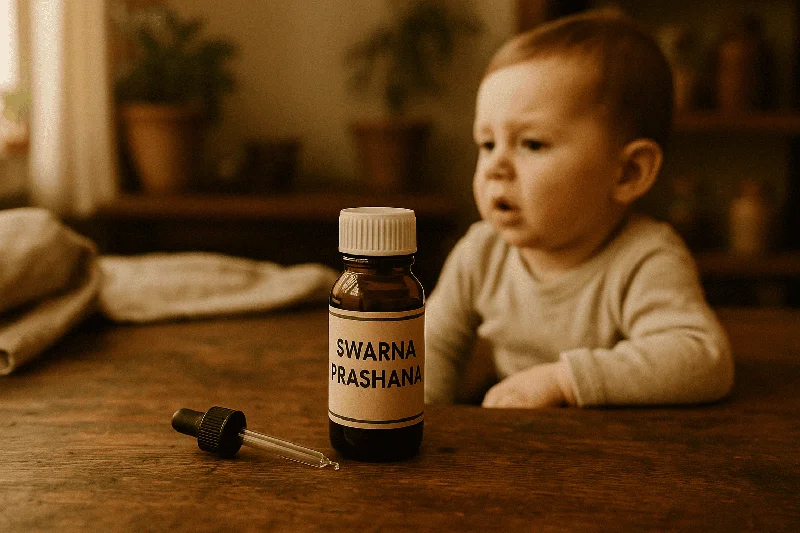
- Swarna Prashana (also spelled Suvarna Prashan) is an ancient Ayurvedic practice of administering a mixture of purified gold ash (Swarna Bhasma), honey, ghee, and herbal extracts to children from birth up to 16 years of age.
- Described in the Kashyapa Samhita — one of the oldest Ayurvedic pediatric texts — it is considered one of the 16 essential Samskaras (sacramental rites) under Jatakarma and is widely practiced across India as a form of natural immunization.
- This guide covers everything you need to know: ingredients, benefits, dosage, scientific evidence, safety concerns, and practical advice that no other resource brings together in one place.
What Is Swarna Prashana and Where Does It Come From?
The term breaks down simply: Swarna means gold, and Prashana means the act of consuming or licking. In clinical practice, Swarna Prashana refers to the oral administration of Swarna Bhasma (calx/ash of gold) mixed with honey and ghee — often fortified with Medhya (brain-boosting) herbs — to infants and children.
The practice originates from Acharya Kashyapa's writings in the Kashyapa Samhita, specifically in the Lehana Adhyaya (chapter on supplementary feeds for children). Kashyapa classified it as a distinct category of pediatric supplementation, seperate from general Jatakarma rituals performed at birth. The original shloka states that Swarna Prashana, when given systematically, bestows Medha (intellect), Agni (digestive fire), Bala (strength), Ayush (longevity), and acts as a shield against diseases.
Swarna Prashana as Part of the 16 Samskaras
- In the broader Vedic framework, Jatakarma Samskara is one of the 16 obligatory purificatory rites (Shodasha Samskaras) performed for a child.
- Swarna Prashana falls within this tradition — the father or a qualified Vaidya would place gold-infused ghee and honey on the newborn's tongue as one of the earliest acts after birth. Over centuries, this evolved into a structured, repeated supplementation protocol extending well beyond the neonatal period.
How Is It Different from Lehana (Supplementary Feeds)?
Kashyapa describes multiple Lehana formulations — herbal pastes and supplements for children. Swarna Prashana is unique because gold is the primary active ingredient rather then just herbs. While other Lehanas target specific conditions (poor appetite, cough), Swarna Prashana is considered a Rasayana (rejuvenative) with broad-spectrum effects on immunity, cognition, and growth.
The Role of Gold Across Life Stages in Ayurveda
- Gold isn't limited to pediatric use in Ayurvedic tradition.
- It appears at virtually every life stage:
- Before conception — in Vajikarana (aphrodisiac) and Rasayana formulations for parents
- During pregnancy — in Pumsavana Karma (rites for healthy fetal development)
- At birth — through Jatakarma Samskara
- Childhood — via Swarna Prashana
- Adulthood and old age — in various Swarna-containing Rasayana preparations
This continuum reflects Ayurveda's deep conviction in gold's biocompatible, life-enhancing properties.
Swarna Prashana Ingredients: What Goes Into the Formulation?
Understanding the composition is critical — both for safety and efficacy. A classical Swarna Prashana formulation contains four core components:
| Ingredient | Sanskrit Name | Role in the Formulation |
|---|---|---|
| Purified gold ash | Swarna Bhasma | Immunomodulator, cognitive enhancer, primary active ingredient |
| Honey | Madhu | Carrier medium (Yogavahi), natural preservative, allergy desensitizer via pollen content |
| Clarified butter (ghee) | Ghrita | Lipid-soluble carrier that enhances absorption of herbal compounds and gold particles |
| Brain-boosting herbs | Medhya Dravyas | Synergistic cognitive and neurological benefits |
Key Herbal Extracts Used
Most practitioners include one or more of these Medhya Rasayana herbs:
- Brahmi (Bacopa monnieri) — Extensively studied for memory enhancement; a 2014 meta-analysis in the Journal of Ethnopharmacology confirmed its positive effects on attention and cognitive processing in children
- Shankhpushpi (Convolvulus pluricaulis) — Traditional nootropic used for anxiety, restlessness, and learning difficulties
- Vacha (Acorus calamus) — Supports speech development and neural function, though some formulations limit its use due to beta-asarone content concerns
Why Honey and Ghee Together?
Ayurveda generally cautions against mixing honey and ghee in equal proportions, considering it Viruddha Ahara (incompatible combination). In Swarna Prashana, they are deliberately used in unequal quantities — typically more honey than ghee — which is considered safe and therapeutically synergistic. Honey acts as a Yogavahi (catalytic carrier) that enhances bioavailability, while ghee carries fat-soluble compounds across the blood-brain barrier.
The Critical Importance of Swarna Bhasma Purity
This is where safety becomes paramount. Swarna Bhasma must undergo rigorous Shodhana (purification) and Marana (incineration) processes before it is safe for consumption. Raw or improperly processed gold can be toxic.
The classical preparation involves:
- 1.Shodhana — Gold is heated and repeatedly quenched in specific liquids (sesame oil, buttermilk, cow urine, Kulattha decoction) to remove physical and chemical impurities
- 2.Marana — Purified gold is ground with herbal juices and subjected to repeated calcination cycles (Puta) at controlled temperatures until it becomes a fine, biocompatible ash
- 3.Quality tests — Authentic Bhasma should pass Varitara (floats on water), Rekhapurna (fills finger lines), and Nischandratva (lusterless) tests
Warning: Never use gold powder, gold leaf, or any non-Bhasma form of gold for Swarna Prashana. Unpurified gold particles can accumulate in tissues and cause heavy metal toxicity. Always source Swarna Bhasma from GMP-certified, AYUSH-approved manufacturers.
Swarna Prashana Benefits for Children
The benefits described in classical texts — and partially supported by modern research — span immunity, cognition, digestion, and overall development.
Immunity Enhancement (Vyadhi Kshamatva)
Swarna Prashana is most popularly known as "Ayurvedic immunization." Gold nanoparticles have demonstrated immunomodulatory properties in modern pharmacological studies. A 2012 study published in AYU Journal found that children receiving Swarna Prashana showed a statistically significant increase in serum IgG levels compared to the control group, suggesting enhanced humoral immunity.
The honey component contributes through trace pollen exposure, which some researchers hypothesize may promote a mild desensitization effect against common environmental allergens — though this mechanism needs more rigorous clinical validation.
Memory, Intellect, and Cognitive Development (Medha Vardhana)
Kashyapa's original text promises that Swarna Prashana makes a child "Medha-agni-bala-vardhana" — enhanced in intellect, digestion, and strength. The Medhya herbs (Brahmi, Shankhpushpi) in the formulation have the strongest modern evidence base here. A randomized controlled trial published in Evidence-Based Complementary and Alternative Medicine (2013) demonstrated that Bacopa monnieri significantly improved memory free recall in children over a 16-week period.
Gold nanoparticles themselves have shown neuroprotective properties in preclinical studies, though direct pediatric human trials specifically on Swarna Bhasma's cognitive effects remain limited.
Digestive Strength (Agni Deepana)
Improved Agni (digestive fire) is consistently reported by practitioners. Children who are picky eaters or have weak digestion often show improved appetite and better nutrient absorption within weeks of starting Swarna Prashana, according to clinical observations at multiple Ayurvedic pediatric centers across India.
Physical Growth and Strength (Bala Vardhana)
The combination of enhanced immunity, better digestion, and improved nutrient absorption naturally supports physical development. Several observational studies at AYUSH-affiliated institutions have reported improvements in height-weight parameters in children receiving regular Swarna Prashana compared to matched controls, though large-scale RCTs are still needed.
Improvement in Sensory Functions
Some classical commentaries and clinical reports note improvements in vision (Chakshushya) and hearing — likely attributable to both the Rasayana properties of gold and the neuro-supportive effects of Medhya herbs. This benefit is less studied but consistently reported anectodally by practitioners.
Reduction in Behavioral Issues
Parents frequently report calmer temperament, fewer tantrums, and reduced hyperactivity in children receiving Swarna Prashana. A small pilot study at a pediatric Ayurveda clinic in Jamnagar observed reduced irritability scores in 68% of participating children over a 3-month period, although the study lacked a double-blind control arm.
Benefits Based on Duration of Administration
Kashyapa Samhita provides a remarkable timeline of cumulative benefits:
| Duration | Promised Benefit |
|---|---|
| 1 month | Child becomes Parama Medhavi (highly intelligent) and Vyadhibhir Na Cha Drishyate (protected from diseases) |
| 6 months | Child becomes Shruta Dhara (capable of retaining and recalling whatever is heard) |
| Regular use until 16 years | Optimal physical, mental, and immunological development throughout childhood |
When to Start Swarna Prashana and How to Give It
Ideal Age to Begin
Swarna Prashana can be started from birth (day 0) and continued up to 16 years. Traditionally, the very first dose was given as part of the Jatakarma Samskara immediately after birth. In modern practice, many parents begin when their child is a few weeks to a few months old.
There is no "too late" to start within the 0–16 age window. Even beginning at age 5 or 10 can provide meaningful benefits, though earlier and longer administration is associated with more pronounced effects.
Dosage by Age Group
| Age Group | Typical Dose | Frequency |
|---|---|---|
| Newborn to 1 year | 1–2 drops | Once daily or on Pushya Nakshatra days |
| 1–5 years | 3–5 drops (approximately 50–100 mg) | Once daily or on Pushya Nakshatra days |
| 5–16 years | 5–10 drops | Once daily or on Pushya Nakshatra days |
Note: Exact dosage varies by manufacturer and practitioner. Always follow the specific product instructions or your Ayurvedic doctor's recommendation.
How to Administer
- Give on an empty stomach in the morning, at least 30 minutes before food or breastfeeding
- Place drops directly on the child's tongue using a clean dropper
- For newborns, the mother can apply drops on a clean fingertip and gently place on the baby's tongue
- Avoid giving with water immediately after — let the formulation absorb sublingually
Why Is Swarna Prashana Given on Pushya Nakshatra?
This is one of the most frequently asked questions, and the answer lies at the intersection of Ayurvedic pharmacology and Jyotish Shastra (Vedic astrology).
Pushya Nakshatra is considered the most auspicious among the 27 Nakshatras (lunar constellations) for nourishment, growth, and healing. The word "Pushya" itself means "to nourish." Classical texts recommend administering Swarna Prashana specifically on Pushya Nakshatra days because:
- 1.Enhanced Potency — Ayurvedic tradition holds that medicines prepared or administered on Pushya Nakshatra gain heightened efficacy
- 2.Lunar Cycle Alignment — Pushya Nakshatra recurs approximately every 27 days, creating a natural monthly dosing schedule
- 3.Practical Benefit — The 27-day cycle ensures consistent, periodic administration without daily compliance burden
Can You Give Swarna Prashana Daily Instead?
- Yes, absolutely. Daily administration is mentioned in the texts and practiced widely. Many Ayurvedic pediatricians actually recommend daily use for the first 30 days as an "intensive course", followed by maintenance dosing on Pushya Nakshatra days.
- Both approaches — daily and Pushya-only — are considered valid. The Pushya Nakshatra schedule is particularly convenient for parents who find daily supplementation difficult to maintain.
Don't wait or self medicate. Start chat with Doctor NOW
Swarna Prashana Side Effects and Safety Considerations
This is perhaps the biggest gap in existing online resources — and one of the most important topics for parents.
Known Side Effects
- When prepared correctly using authentic Swarna Bhasma and administered in recommended doses, Swarna Prashana is considered generally safe with minimal side effects.
- However, reported issues include:
- Mild nausea or loose stools in some children during the first few doses (usually self-limiting)
- Allergic reactions — Rare but possible, particularly to honey (which is contraindicated in children under 12 months per modern pediatric guidelines, though Ayurvedic tradition uses it from birth in medicinal contexts)
- Excessive salivation — Occasionally reported, typically transient
Safety Concerns with Gold Nanoparticles
- Modern toxicology raises legitimate questions.
- A 2020 review in Nanomedicine: Nanotechnology, Biology and Medicine noted that while gold nanoparticles show low acute toxicity, their long-term accumulation in organs (liver, spleen, kidneys) requires more pediatric-specific research.
- The key safety factors are:
- Particle size matters — Properly prepared Swarna Bhasma yields nanoparticles in the 56–80 nm range (per a 2011 characterization study in International Journal of Pharmaceutical Sciences and Research), which show better biocompatibility than larger particles
- Dose matters — Classical doses are extremely small (micrograms of gold), well below any known toxicity thresholds
- Preparation quality matters — This cannot be overstated. Improperly prepared gold formulations are the primary safety risk
When NOT to Give Swarna Prashana
No comprehensive contraindication list exists in classical texts, but based on modern clinical prudence:
- During acute fever or active infection — Wait until the acute phase resolves
- Known allergy to any ingredient — Particularly honey or specific herbs in the formulation
- Concurrent heavy metal chelation therapy — Potential interaction
- Children on immunosuppressive medication — Consult both your pediatrician and Ayurvedic doctor first
- Honey caution for infants — Modern pediatrics warns against honey before 12 months due to botulism risk. If this concerns you, discuss honey-free formulations with your Vaidya, or consult with your child's pediatrician
A Critical Note: Swarna Prashana Is NOT a Replacement for Vaccination
- The term "Ayurvedic immunization" is widely used but can be misleading. Swarna Prashana does not provide specific antibody-mediated protection against diseases like measles, polio, diphtheria, or tetanus the way modern vaccines do.
- It works on a fundamentally different principle — general immune system strengthening (non-specific immunity) rather then pathogen-specific immunization.
Do not skip or delay your child's routine vaccination schedule in favor of Swarna Prashana. The two approaches are complementary, not interchangeable. Most Ayurvedic pediatricians in India recommend both.
What Does Modern Science Say? A Review of the Evidence
Let's be honest about the current state of evidence — it's promising but incomplete.
Available Clinical Studies
A systematic review of Swarna Prashana studies (available through PubMed/PMC) identified several clinical trials, but most share common limitations:
- Small sample sizes — Most studies involve 30–100 participants
- Short duration — Typically 1–6 months of follow-up
- Lack of blinding — Most are open-label or single-blind
- Heterogeneous formulations — Different studies use different compositions, making comparison difficult
That said, the findings are consistently positive across multiple parameters:
| Study/Institution | Key Finding | Limitations |
|---|---|---|
| Jamnagar Ayurved University (2012) | Significant increase in serum IgG and IgM levels in Swarna Prashana group vs control | Small sample (n=54), no placebo blinding |
| IPGT&RA, Gujarat Ayurved University | Improved weight gain and reduced episodes of upper respiratory infections | Open-label design |
| Multiple AYUSH hospital observational studies | Improved appetite, reduced school absenteeism due to illness | Observational only, no randomization |
What's Missing in the Research
- Large multi-center RCTs with adequate blinding, placebo control, and at least 12 months follow-up
- Long-term safety data — Gold bioaccumulation studies in pediatric populations
- Standardized formulation studies — Comparing outcomes with different compositions
- Head-to-head comparisons — Swarna Prashana vs individual components (is the gold necessary, or do the herbs alone provide most benefits?)
The Bottom Line on Evidence
- Swarna Prashana has a strong traditional foundation, biologically plausible mechanism, and consistently positive results in available studies. However, it does not yet meet the evidence standards of large-scale, high-quality RCTs that modern evidence-based medicine demands.
- This does not mean it doesn't work — it means we need better studies to quantify exactly how well it works and confirm long-term safety.
Swarna Prashana for Special Needs Children
An emerging area of interest is Swarna Prashana's use in children with developmental challenges:
- Autism Spectrum Disorder (ASD) — Some Ayurvedic clinics report improvements in social interaction, eye contact, and communication skills. The Medhya herbs (particularly Brahmi and Shankhpushpi) have shown anxiolytic and cognitive effects that could theoretically benefit children on the spectrum.
- ADHD and Hyperactivity — Reduced restlessness and improved attention span are frequently reported. Shankhpushpi, in particular, has traditional use as a calming agent for overstimulated children.
- Speech Delay — Vacha (Acorus calamus) has been used traditionally as a speech-promoting herb, and its inclusion in some Swarna Prashana formulations targets this specific concern.
- Learning Disabilities — The overall Medhya (intellect-enhancing) effect may support children struggling with academic performance.
Important caveat: These applications are based on clinical observations and traditional knowledge, not rigorous clinical trials. Swarna Prashana should be used as a complementary approach alongside conventional therapies (speech therapy, behavioral therapy, occupational therapy) for special needs children — not as a standalone treatment.
Swarna Prashana Price, Storage, and Practical Considerations
Price Range in India
Prices vary significently depending on the manufacturer, gold content, and formulation complexity:
- Standard formulations: ₹150–₹500 per monthly dose (Pushya Nakshatra administration at clinics)
- Premium bottled formulations (100 ml): ₹2,000–₹4,500 + GST
- Bulk/institutional supply (1 litre): ₹8,000–₹15,000+
- Outside India: Prices are typically 2–3x higher due to shipping and import regulations
Storage and Shelf Life
- Store in a cool, dry place away from direct sunlight
- Most formulations have a shelf life of 12–24 months from manufacturing date
- Signs of spoilage: Change in color (darkening), unusual odor, separation of layers that don't re-mix upon shaking, crystallization of honey
- Keep the dropper cap clean and avoid contamination with saliva or food particles
Regulatory Status
- India: Regulated under the AYUSH Ministry; Swarna Bhasma is a recognized Ayurvedic drug in the Ayurvedic Pharmacopoeia of India
- United States: Not FDA-approved as a drug; may be sold as a dietary supplement, though some manufacturers claim FDA facility registration (which is different from drug approval)
- European Union: Falls under traditional herbal medicine regulations; availability varies by country
- Other countries: Legal status varies — check your local regulations before purchasing or importing
Frequently Asked Questions About Swarna Prashana
Can we give Suvarnaprashan daily?
Yes. Both daily administration and Pushya Nakshatra-based (every 27 days) dosing are described in classical texts. Daily dosing may produce faster results, especially in the initial months. Many practitioners recommend a daily "loading phase" of 30 days followed by Pushya Nakshatra maintenance.
Can Swarna Prashana be given to a child with lactose intolerance?
The ghee in Swarna Prashana contains negligible lactose (it is clarified, removing milk solids). Most lactose-intolerant children tolerate ghee without issues. However, if your child has a severe milk protein allergy (not just lactose intolerance), consult your doctor before use.
What if we miss a Pushya Nakshatra dose?
- Simply give it on the next Pushya Nakshatra day. There's no need for a "catch-up" dose.
- The benefits are cumulative over time — one missed session does not reset progress.
Can Swarna Prashana be given alongside antibiotics?
There is no known direct drug interaction. However, it's generally advisable to separate administration by at least 2 hours, and to inform both your pediatrician and Ayurvedic doctor about all medications your child is taking.
Is Swarna Prashana safe during teething?
Yes. There are no contraindications related to teething. The honey in the formulation may actually provide mild soothing effects on irritated gums.
What are the upcoming Swarna Prashana dates in 2025 and 2026?
Pushya Nakshatra dates change monthly based on the lunar calendar. Many Ayurvedic clinics publish updated Pushya Nakshatra calendars on their websites. You can also check any reliable Panchang (Hindu almanac) app for real-time Nakshatra tracking. Search "Pushya Nakshatra dates [year]" for specific schedules.
Where can I find Swarna Prashana near me?
Most Ayurvedic hospitals, AYUSH clinics, and many private Ayurvedic practitioners offer Swarna Prashana, especially on Pushya Nakshatra days. Many clinics organise special Swarna Prashana camps on these days with reduced or free administration for children.
Final Thoughts: Making an Informed Decision
Swarna Prashana represents one of Ayurveda's most elegant contributions to pediatric care — a simple, time-tested formulation with a compelling rationale and encouraging (if still incomplete) scientific support. The tradition has survived for thousands of years because parents and practitioners have consistently observed real benefits in children's health, immunity, and cognitive development.
But making a good decision requires honesty about what we know and what we don't. We know the ingredients have demonstrable pharmacological activity. We know the safety profile is favorable when quality is controlled. We know that thousands of children across India receive it regularly with positive outcomes reported.
- We also know that large-scale, rigorous clinical trials are still needed.
- We know that quality control is essential — and not all products on the market meet the required standards. And we know that Swarna Prashana complements, but does not replace, modern pediatric care and vaccination.
Our recommendation: If you're considering Swarna Prashana for your child, consult with a qualified Ayurvedic practitioner (BAMS or MD Ayurveda), use only GMP-certified products from reputable manufacturers, maintain your child's regular vaccination schedule, and observe your child's response over the first few weeks. The wisdom of Kashyapa and the tools of modern science are not enemies — they're partners in giving your child the best possible start in life.
Scientific Sources
- Immunomodulatory activity of Swarna Prashana (oral administration of gold as electuary) in infants - A randomized controlled clinical trial — Bhaskaran JK et al., 2019, Ayu
- Targeting protein kinase C signaling cascades in alzheimer's disease: emerging neuroprotective roles of aurothioglucose — Kushawaha SK et al., 2026, Inflammopharmacology
- Swarna Prashana - faith in the embrace of research — Verma S et al., 2022, Journal of complementary & integrative medicine
Questions from users
What is the significance of the gold used in Swarna Prashana for children's health?
Jackson
7 days ago
In Swarna Prashana, gold is believed to aid in boosts immunity and enhancing cognitive development in children. Gold's use is rooted in its perceived ability to strengthen the body's resilience and vitality. But, it's good to chat with a Vaidya for personalized advice. Remember, its not a vaccine replacer!
Can Swarna Prashana help with social interactions in children?
Evelyn
17 days ago
Swarna Prashana may help with social interactions in kids, especially when combined with herbs like Brahmi and Shankhpushpi known for cognitive and calming effects. Parents often say it leads to a calmer temperament and reduced hyperactivity, which can support social skills. But keep in mind, it’s mostly based on traditional experience, not a ton of research yet.
What should I know about the long-term safety of Swarna Prashana for my child?
Sydney
26 days ago
For long-term safety, Swarna Prashana's been used in Ayurveda for ages with many positive reports, particularly when the quality is well-regulated. But since we don't have large, rigorous trials, it's best to go with trusted sources and maybe chat with your kid's healthcare provider to be super cautious.
Can Swarna Prashana help improve my child's focus and attention span?
Wesley
35 days ago
Yes, Swarna Prashana could help with focus and attention span. It's known as a Medhya rasayana, which traditionally enhance intellect and cognitive functions. Just keep in mind, it works differently per child. Not a miracle potion, but with a well-balanced diet and routine, it might show positive results over time.
What traditional Ayurvedic texts discuss the benefits of Swarna Prashana for children?
Lincoln
46 days ago
The Kashyapa Samhita is the primary ayurvedic text discussing Swarna Prashana. It's a detailed guide on various traditional practices, especially for pediatric care. If you're curious for more, some practitioners might refer to other texts like Sushruta Samhita, but they mention it more briefly.
Is it safe to give my child Swarna Prashana if they have a pre-existing health condition?
Rae
56 days ago
When considering Swarna Prashana for a kid with a pre-existing condition, it's best to be cautious and chat with an experienced Ayurvedic practitioner or your child's healthcare provider. They'll consider health status and dosha balance to decide if it's safe and beneficial! It's always good to be careful with these things.
Can I use Swarna Prashana for my toddler, or is it only for older children?
Dylan
66 days ago
Yeah, you can definitely use Swarna Prashana for your toddler! It's meant for children from 0 to 16 years old. Just make sure you consult with a qualified Ayurvedic practitioner to get the right guidance and dosage for your little one. And keep an eye out for the Pushya Nakshatra if you wanna follow traditions! 😊
What is the best way to prepare my child for their first Swarna Prashana session?
Kayden
75 days ago
Start by ensuring your child is well-rested and calm before the session. A light meal 1-2 hours before is good, keeps the digestion smooth. Talk to them about the process so they know what to expect, and make sure they're comfortable with the practitioner. Maybe even create a relaxing environment at home after the session too!
Is Swarna Prashana effective for boosting a child's immune system during flu season?
Hannah
85 days ago
Yes, Swarna Prashana can help boost a child's immune system, especially during flu season. It strengthens digestion and metabolism, which indirectly helps the immune response. But be sure to consult an Ayurvedic expert before starting it so its aligns with yor child's unique body type and health.
Can I give Swarna Prashana to my child if they are already taking other supplements?
Nova
94 days ago
Yes, you can give Swarna Prashana along with other supplements, but it's always a good idea to check with an Ayurvedic doctor or pediatrician first. They can help ensure there's no interaction between the different substances and that everything suits your child's unique needs. Plus, it's all about balance and making sure the supplements and Swarna Prashana support rather than counteract each other.
Related articles

Pediatrics
Ayurvedic Medicine for Adenoids – Natural Remedies for Adenoid Health
Discover Ayurvedic medicine for adenoids, including effective herbs, treatments, and lifestyle changes. Learn natural approaches to alleviate adenoid-related issues and promote overall respiratory wellness.
5,736

Pediatrics
Mebarid Syrup
Exploration of Mebarid Syrup
2,484

Pediatrics
How to Relieve Constipation in Babies Quickly: Ayurvedic Remedies and Parental Tips
How to relieve constipation in babies quickly? Learn Ayurvedic and home remedies, causes, and gentle ways to help newborns and breastfed babies feel better fast
4,305

Pediatrics
Bonnisan Drops
Exploration of Bonnisan Drops
9,826

Pediatrics
Ayurvedic Medicine for Constipation in Babies – Gentle Remedies for Infant Digestive Health
Discover safe Ayurvedic remedies for constipation in babies. Learn about gentle herbal formulations, natural detoxification, and supportive digestive practices designed for infants, with expert guidance.
3,926
Pediatrics
Swarna Prashana: Uses, Benefits & Ayurvedic Insights
Explore Swarna Prashana uses, benefits, proper dosage, and scientific evidence. Learn how this Ayurvedic therapy supports child development and immunity.
3,990

Pediatrics
How to Stop Vomiting Immediately: Ayurvedic Home Remedies for Children
Explore how to stop vomiting immediately using home remedies for child. Learn Ayurvedic tips, baby vomiting relief, and safe natural solutions at home
6,382

Pediatrics
Which Oil Is Best for Baby Massage: Ayurvedic Guide for Parents
Discover which oil is best for baby massage based on skin type and season. Compare almond, olive, mustard, coconut, sesame, and Ayurvedic oils for babies
29,015

Pediatrics
Livosin Syrup
Exploration of Livosin Syrup
2,572
Pediatrics
Swarna Bindu Prashana Benefits: A Holistic Immunity Booster for Children
Swarna Bindu Prashana is an ancient Ayurvedic practice aimed at enhancing immunity, brain development, and overall health in children.
2,934
Related consultations on the topic
Legal
Additional Documents
© 2024 Ask Ayurveda. All rights reserved.