Ask Ayurvedic doctor a question and get a consultation online on the problem of your concern in a free or paid mode. More than 2,000 experienced doctors work and wait for your questions on our site and help users to solve their health problems every day.
FREE! Ask Ayurvedic Doctors 24/7

 Fast responses
 1000+ verified doctors
Body DetoxEar, Nose, and Throat DisordersGeriatrics & RejuvenationImmunodeficiencyInfertility TreatmentNutritionOrthopedic DisordersPediatricsRespiratory DisordersSexually Transmitted Diseases (STDs)Surgery RecoveryUrological DisordersVascular DisordersDental DisordersEndocrinological DisordersGastrointestinal DisordersYoga TherapyGeneral MedicineAllergic DisordersCardio DisordersGynecology and ObstetricsCosmetologySkin and Hair DisordersEye DisordersInfectious DiseasesMental DisordersNeurological DisordersOncologyPanchakarmaSexual Health & DisordersSports Medicine
Published on 01/15/25
(Updated on 07/06/26)
4,268
Phalkalyan Ghrita Uses – Versatile Benefits of Herbal Ghee
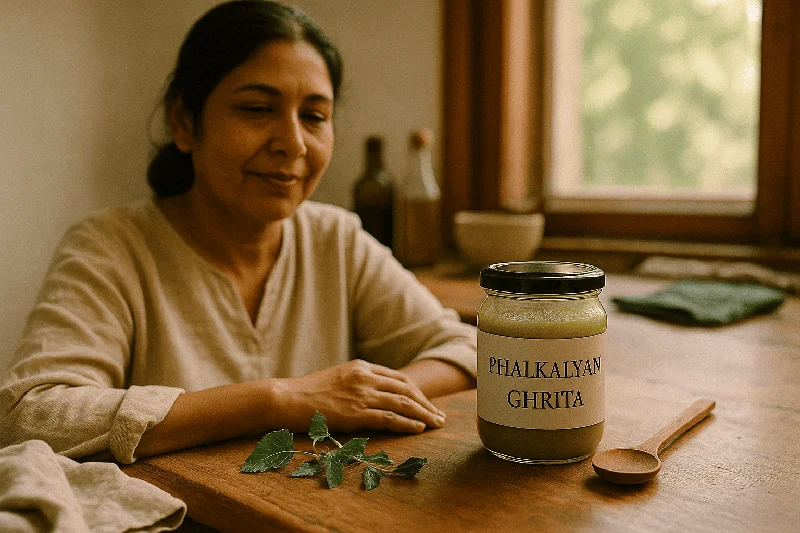
- Phalkalyan Ghrita (also spelled Phal Kalyan Ghrit or Phala Kalyan Ghrita) is a classical Ayurvedic medicated ghee formulation primarily used to support female fertility, prevent recurrent miscarriage, and nourish the developing fetus during pregnancy. Rooted in the ancient text Bhaishajya Ratnavali (Yonivyapad Chikitsa, verses 67/78–84), this polyherbal ghrita combines the deeply penetrating carrier properties of cow's ghee with a synergistic blend of over a dozen fertility-enhancing herbs.
- It acts as a tridosha-shamaka — balancing Vata, Pitta, and Kapha simultaneously — making it one of the most versatile uterine tonics in the Ayurvedic pharmacopoeia.
Whether you're exploring Ayurvedic support for conception, looking for adjunct care alongside modern fertility treatments, or simply trying to understand what this formulation does, this guide covers everything — from classical references and exact ingredient proportions to trimester-specific protocols and dietary guidelines that no other resource currently provides.
What Is Phalkalyan Ghrita?
Phalkalyan Ghrita belongs to the Ghrita Kalpana category of Ayurvedic preparations — medicines processed in clarified butter (ghee). Ghee serves as a lipophilic carrier that enhances the bioavailability of fat-soluble phytochemicals from the herbs, allowing them to cross cellular membranes more effectively. This is why Ayurveda has historically favored ghee-based formulations for deep-tissue nutrition, especially for reproductive tissues (Shukra Dhatu and Artava Dhatu).
Classical Reference: Bhaishajya Ratnavali
The original formulation is documented in the Bhaishajya Ratnavali, one of the most authoritative compilations of Ayurvedic therapeutics, compiled by Govinda Dasji in the 18th century. Specifically, Phalkalyan Ghrita appears in the Yonivyapad Chikitsa chapter (verses 67/78–84), which deals with gynecological disorders and uterine ailments.
The text prescribes it for conditions including:
- Vandhyatva (infertility)
- Garbha Srava (recurrent miscarriage / habitual abortion)
- Garbha Poshana (fetal nourishment)
- General weakness of the reproductive system
This classical grounding gives Phalkalyan Ghrita a level of textual authority that many modern proprietary formulations simply lack.
Meaning of the Name
Breaking down the Sanskrit: Phala means "fruit" (metaphorically, "offspring" or "result"), Kalyan means "auspicious" or "welfare," and Ghrita means "clarified butter." So the name literally translates to "the auspicious ghee that brings the fruit of conception." The naming convention itself reveals the primary therapeutic intent — facilitating healthy conception and pregnancy.
How It Balances Tridosha
Most fertility issues in Ayurveda are attributed to Vata vitiation (causing irregular ovulation, anxiety, dryness of reproductive tissues) with secondary involvement of Pitta (inflammation, hormonal imbalance) or Kapha (PCOS, cysts, sluggish metabolism).
Phalkalyan Ghrita addresses all three:
- Vata: Ghee base + Ashwagandha + Shatavari provide grounding, unctuous qualities
- Pitta: Cooling herbs like Shatavari, Madhuyashti (licorice), and lotus seeds pacify excess heat
- Kapha: Pippali and other light herbs prevent excessive Kapha accumulation
This tridosha-balancing action is why the formulation works across diverse constitutional types — a rare quality in Ayurvedic medicine.
Key Ingredients of Phalkalyan Ghrita with Botanical Names
One of the strengths of this formulation is its multi-herb synergy. Below is the complete ingredient breakdown as per the classical text, with exact proportions.
Herb-by-Herb Breakdown
| Ingredient (Sanskrit) | Botanical / English Name | Quantity | Primary Action |
|---|---|---|---|
| Ashwagandha | Withania somnifera | 12 g | Adaptogenic, strengthens Shukra Dhatu |
| Shatavari | Asparagus racemosus | 12 g + juice (3,072 ml) | Uterine tonic, galactagogue |
| Pippali | Piper longum | 12 g | Bioavailability enhancer, digestive |
| Nagkesar | Mesua ferrea | 12 g | Anti-hemorrhagic, uterine support |
| Madhuyashti (Mulethi) | Glycyrrhiza glabra | 12 g | Anti-inflammatory, hormonal modulator |
| Manjishtha | Rubia cordifolia | 12 g | Blood purifier, improves circulation |
| Anantmool | Hemidesmus indicus | 12 g | Detoxifier, cooling |
| Padmaka | Prunus cerasoides | 12 g | Uterine sedative, anti-bleeding |
| Nilotpala (Blue Lotus) | Nymphaea stellata | 12 g | Cooling, reproductive tonic |
| Devadaru | Cedrus deodara | 12 g | Anti-inflammatory, Vata-pacifying |
| Haridra (Turmeric) | Curcuma longa | 12 g | Anti-inflammatory, purifying |
| Payasya | Ipomoea digitata | 12 g | Nutritive, milk-promoting |
| Cow's Ghee | Clarified butter | 768 g | Carrier (Yogavahi) |
| Cow's Milk | — | 3,072 ml | Medium for processing |
| Shatavari Swarasa | Fresh juice of Asparagus racemosus | 3,072 ml | Liquid medium |
Proportions as Per Classical Text
- The classical ratio follows the standard Ghrita Kalpana guidelines: 1 part ghee : 4 parts liquid (milk + herbal juice) : 1/64 part herbal paste (kalka). The herbs are first powdered into a fine paste, then cooked slowly with ghee, milk, and Shatavari juice until specific readiness signs appear (discussed below in the preparation section).
- Each dry herb is added in equal proportion — 12 grams each — ensuring balanced pharmacological action.
How Phalkalyan Ghrita Works: Mechanism of Action
- This is where most resources fall short.
- Understanding how the formulation works — not just what it does — requires looking at Ayurvedic pharmacology (Dravyaguna) and modern pharmacological parallels.
Ayurvedic Pharmacological Analysis (Rasa-Guna-Virya-Vipaka)
The dominant pharmacological profile of Phalkalyan Ghrita is:
- Rasa (Taste): Predominantly Madhura (sweet) with secondary Tikta (bitter) — sweet taste directly nourishes reproductive tissues
- Guna (Quality): Snigdha (unctuous), Guru (heavy) — counters the dryness and lightness of vitiated Vata
- Virya (Potency): Sheeta (cooling) — reduces inflammatory processes in the uterus
- Vipaka (Post-digestive effect): Madhura — supports tissue building and anabolic processes
- Prabhava (Special action): Garbhasthapana — a unique class of action specifically dedicated to establishing and maintaining pregnancy
The ghee base acts as a Yogavahi — a substance that carries the properties of other ingredients deep into tissues without losing its own qualities. This is particularly important for reaching the Shukra and Artava Dhatu (7th tissue level), which in Ayurveda is the deepest and hardest to nourish.
Modern Pharmacological Parallels
While large-scale randomized controlled trials specifically on Phalkalyan Ghrita are lacking (a gap in current research), individual ingredient studies offer supporting evidence:
- Ashwagandha: A 2015 study published in Evidence-Based Complementary and Alternative Medicine demonstrated that Withania somnifera root extract significantly improved semen quality, hormonal balance, and antioxidant status in infertile men (Ambiye et al., 2013).
- Shatavari: Research published in Biomedicine & Pharmacotherapy (2018) showed that Asparagus racemosus has estrogenic activity, supports follicular development, and enhances uterine weight in animal models.
- Piper longum: Multiple studies confirm piperine's role as a bioenhancer, increasing the bioavailability of co-administered compounds by 30-200% (Kesarwani & Gupta, Asian Pacific Journal of Tropical Biomedicine, 2013).
- Curcumin (from Haridra): Well-documented anti-inflammatory action that may reduce uterine inflammation contributing to implantation failure.
A pilot observational study conducted at Gujarat Ayurved University (published in AYU Journal, 2012) evaluated Phala Ghrita (a closely related formulation) in 30 women with anovulatory cycles and found that 73% showed improved follicular maturation after 3 months of treatment. While this study examined Phala Ghrita rather than Phalkalyan Ghrita specifically, the overlapping ingredient profiles make the findings relevant.
Endocrinal Stimulant Action
Phalkalyan Ghrita acts as an endocrinal stimulant — it gently modulates the hypothalamic-pituitary-ovarian (HPO) axis. The adaptogenic herbs (Ashwagandha, Shatavari) help normalize cortisol levels, which in turn reduces stress-induced suppression of gonadotropin-releasing hormone (GnRH). This cascading effect can improve FSH and LH pulsatility, supporting healthier ovulation patterns.
Benefits and Uses of Phalkalyan Ghrita
For Female Infertility and Conception Support
This is the primary indication. Phalkalyan Ghrita is traditionally prescribed for women struggling with conception due to:
- Anovulation or irregular ovulation
- Poor endometrial thickness
- Unexplained infertility
- Recurrent early pregnancy loss (habitual abortion) — the text specifically mentions giving it to women with a history of miscarriage to achieve stable conception
- Fallopian tube health support
Use in PCOS/PCOD
Though no competitor currently highlights this connection, Phalkalyan Ghrita is highly relevant for Polycystic Ovarian Syndrome. PCOS involves Kapha-mediated cyst formation with Vata-driven hormonal irregularity — precisely the pathological combination this formulation addresses. The Manjishtha component supports hepatic metabolism of excess androgens, while Shatavari provides gentle estrogenic support. Several Ayurvedic practitioners in clinical practice prescribe it alongside Kanchanara Guggulu for PCOS management, though formal studies on this specific combination are needed.
Phalkalyan Ghrita in Pregnancy
Once conception occurs, the formulation transitions into a prenatal tonic role:
- Garbha Poshana: Nourishes the developing fetus through the mother's Rasa Dhatu
- Garbha Sthapana: Stabilizes the pregnancy and reduces risk of miscarriage
- Fetal Intelligence & Immunity: The classical text states it improves Medha (intelligence) and Vyadhikshamatva (immunity) of the unborn child — likely mediated through the nootropic action of Ashwagandha and the immunomodulatory properties of Shatavari
For Male Fertility
Phalkalyan Ghrita is not exclusively a female formulation.
It can be prescribed for men dealing with:
- Oligospermia (low sperm count)
- Asthenospermia (poor sperm motility)
- General sexual debility
The Ashwagandha and Shatavari components directly support spermatogenesis, while the ghee base nourishes Shukra Dhatu. For men, the typical protocol involves taking the ghrita with warm milk for 2–3 months before planned conception.
Preparatory Use in Panchakarma
An often-overlooked application: Phalkalyan Ghrita can be used during Snehapana (internal oleation) as a preparatory procedure for Panchakarma detoxification. When administered in graduated doses over 3–7 days, it saturates the tissues with medicated ghee, loosening deep-seated toxins (Ama) from the reproductive system before they are expelled through Virechana (therapeutic purgation). This is particularly useful for women undergoing fertility-focused Panchakarma protocols.
How to Use Phalkalyan Ghrita: Dosage & Administration
Standard Dosage
| Category | Dose | Frequency | Anupana (Vehicle) |
|---|---|---|---|
| Adult Women (general fertility) | 5–10 g (approx. 1–2 tsp) | Twice daily | Warm milk or warm water |
| Adult Women (pregnancy support) | 5 g (1 tsp) | Once or twice daily | Warm milk |
| Adult Men (fertility support) | 5–10 g | Twice daily | Warm milk with Mishri (rock sugar) |
| Panchakarma Snehapana | 20–50 g (graduated) | Once daily, morning | Plain, on empty stomach |
Important: Always take Phalkalyan Ghrita under the guidance of a qualified Ayurvedic practitioner. The above dosages are general guidelines from classical texts, not prescriptions.
Trimester-Specific Protocol
No existing resource covers this, but classical Garbhini Paricharya (prenatal care) texts provide guidance:
- Pre-conception (3–6 months before): Full dose (10 g, twice daily) to prepare the uterus and improve ovum quality
- First Trimester: Reduced dose (5 g, once daily) with milk — primary goal is pregnancy stabilization
- Second Trimester: 5 g, once or twice daily — focus shifts to fetal nourishment
- Third Trimester: Typically discontinued or switched to other formulations like Dashmoolarishta, unless specifically advised by a physician
- Post-partum: Not routinely continued; Shatavari Ghrita or Phala Ghrita may be preferred instead
Recommended Duration of Course
A complete course typically lasts 2 to 3 months for pre-conception fertility support. For recurrent miscarriage cases, many practitioners recommend starting 3 months before planned conception and continuing through the first trimester. The maximum duration should be determined by your Ayurvedic doctor based on individual assessment.
Don't wait or self medicate. Start chat with Doctor NOW
Pathya-Apathya: Diet & Lifestyle During the Course
This is classical Ayurvedic guidance that significantly impacts the formulation's effectiveness — yet it's conspicuously absent from every competitor resource.
What to Follow (Pathya)
- Diet: Favor warm, freshly cooked meals. Include milk, ghee, almonds, dates, sesame seeds, and whole grains. Sweet, nourishing foods support Shukra/Artava Dhatu.
- Hydration: Drink warm water throughout the day. Avoid ice-cold beverages.
- Sleep: Maintain regular sleep schedule. Adequate sleep is essential for hormonal balance.
- Mental state: Practice meditation, gentle Pranayama (Anulom Vilom, Bhramari). Emotional calm directly supports fertility via the HPO axis.
- Yoga: Gentle asanas like Baddha Konasana, Supta Virasana, and Viparita Karani support pelvic blood flow.
What to Avoid (Apathya)
- Excessive spicy, sour, and fermented foods (aggravate Pitta)
- Stale, leftover, or processed foods (increase Ama)
- Heavy exercise and excessive physical strain
- Late nights and irregular meal timings
- Alcohol and tobacco (directly damage Shukra/Artava Dhatu)
- Excessive screen time before bed (disrupts circadian rhythm, affects melatonin)
Side Effects, Contraindications & Drug Interactions
Potential Side Effects
Phalkalyan Ghrita is generally considered safe when taken in recommended doses under medical supervision.
However:
- Weight gain: Ghee is calorie-dense (~45 calories per teaspoon). Prolonged use without dietary adjustment can lead to weight gain.
- Digestive heaviness: Some individuals with weak Agni (digestive fire) may experience a sense of heaviness, bloating, or mild nausea — especially if taken in excess.
- Elevated cholesterol: Those with pre-existing hypercholesterolemia should exercise caution due to the saturated fat content of the ghee base.
- Hyperglycemia risk: The sweet post-digestive effect and some ingredients may mildly raise blood sugar in diabetic patients.
Contraindications
- Active jaundice or hepatic disorders
- Severe Kapha conditions with Ama (toxin accumulation)
- Acute fever or infection
- Known allergy to any ingredient
- Morbid obesity (BMI > 40)
Compatibility with Modern Medicine
This is a critical gap no competitor addresses.
If you're undergoing IVF, IUI, or hormonal therapy:
- Inform both your Ayurvedic and allopathic doctors before combining Phalkalyan Ghrita with fertility drugs like Clomiphene, Letrozole, or gonadotropin injections
- Shatavari's phytoestrogenic activity could theoretically interact with estrogen-sensitive protocols
- Ashwagandha may potentiate sedative medications
- Allow a 2-hour gap between Phalkalyan Ghrita and any allopathic medication as a general precaution
- No documented adverse interactions exist in published literature, but the absence of evidence is not evidence of absence
Phalkalyan Ghrita vs. Similar Ghrita Formulations
Understanding the differences helps you choose the right formulation for your specific condition.
| Formulation | Primary Indication | Key Differentiator | Classical Source |
|---|---|---|---|
| Phalkalyan Ghrita | Female/male infertility, recurrent miscarriage | Broadest herb profile, tridosha balancing | Bhaishajya Ratnavali |
| Phala Ghrita | Female infertility, ovulation support | Simpler formulation, fewer herbs | Charaka Samhita |
| Shatavari Ghrita | Lactation support, uterine tonic | Shatavari-dominant, strong Pitta-pacifying | Ashtanga Hridaya |
| Kalyanaka Ghrita | Mental disorders, epilepsy, fertility | Strong Medhya (nootropic) action | Ashtanga Hridaya |
| Dadimadi Ghrita | Digestive disorders during pregnancy | Pomegranate-based, anti-emetic | Charaka Samhita |
When to choose Phalkalyan Ghrita over Phala Ghrita: If you have a complex fertility picture involving multiple doshic imbalances, recurrent pregnancy loss, or need both pre-conception and pregnancy support, Phalkalyan Ghrita's broader formulation is generally preferred. Phala Ghrita is more suited for straightforward ovulatory dysfunction.
How Phalkalyan Ghrita Is Prepared (Ghrita Kalpana Process)
Understanding the preparation method is valuable for practitioners and quality-conscious consumers alike.
Step-by-Step Classical Method
- 1.Kalka preparation: All dry herbs are individually cleaned, dried, and ground into a fine paste (Kalka) using water or Shatavari juice
- 2.Liquid preparation: Fresh Shatavari juice is extracted, and cow's milk is procured fresh
- 3.Cooking (Paka): Cow's ghee is heated in a heavy-bottomed vessel. The herbal paste is added first, followed by milk and Shatavari juice
- 4.Slow cooking: The mixture is cooked on low-medium heat with continuous stirring. This process can take 4–8 hours depending on the batch size
- 5.Siddhi Lakshana (Signs of readiness):
- The paste (Kalka) can be rolled into a wick without sticking — Varti Vat Lakshana
- No crackling sound when a drop is placed on fire — Shabda Rahita
- Ghee develops a characteristic aroma of the herbs
- All water content has evaporated
- 6.Filtration: The finished ghrita is filtered through clean muslin cloth while still warm
- 7.Storage: Stored in clean, dry glass or food-grade containers
Quality Standards and Certification
When purchasing commercially manufactured Phalkalyan Ghrita, look for:
- GMP (Good Manufacturing Practice) certification
- AYUSH Ministry manufacturing license
- FSSAI registration number
- Batch number and expiry date clearly printed
- Manufacturer's full address and license number
Storage and Shelf Life
- Shelf life: Typically 2–3 years from manufacturing date when stored properly
- Storage temperature: Below 30°C, in a cool, dry place away from direct sunlight
- After opening: Use clean, dry spoon every time. Moisture contamination is the primary cause of spoilage in ghrita preparations
- Signs of spoilage: Rancid smell, color change to dark brown, mold growth, or sour taste — discard immediately if any of these appear
- Refrigeration: Not required under normal Indian climate conditions if stored properly, but can extend shelf life in humid coastal areas
Frequently Asked Questions (FAQ)
What are the ingredients in Phalkalyan Ghrit?
Phalkalyan Ghrit contains approximately 12-14 herbs including Ashwagandha (Withania somnifera), Shatavari (Asparagus racemosus), Pippali (Piper longum), Nagkesar (Mesua ferrea), Madhuyashti (Glycyrrhiza glabra), Manjishtha (Rubia cordifolia), Anantmool (Hemidesmus indicus), Devadaru (Cedrus deodara), Haridra (Curcuma longa), Padmaka (Prunus cerasoides), and Nilotpala (Nymphaea stellata), processed in cow's ghee with Shatavari juice and cow's milk. See the full table above for exact proportions.
How to use Phalkalyan Ghrita?
Take 5–10 grams (approximately 1–2 teaspoons) twice daily with warm milk or warm water, preferably before meals. The exact dose depends on your constitution, health condition, and the advice of your Ayurvedic physician. For pregnancy support, dosage is typically reduced to 5 grams once daily.
Can Phalkalyan Ghrita be used by men?
Yes. Though primarily known as a female fertility formulation, it is also prescribed for male infertility — particularly oligospermia and asthenospermia. Men typically take 5–10 g twice daily with warm milk for 2–3 months before planned conception.
Is Phalkalyan Ghrita safe during pregnancy?
When prescribed by a qualified Ayurvedic practitioner, it is traditionally considered safe during the first and second trimesters. It is one of the few Ayurvedic formulations specifically designed for use during pregnancy (Garbhasthapana). However, self-medication during pregnancy is strongly discouraged.
Can I take Phalkalyan Ghrita with IVF medications?
There is no published evidence of direct adverse interactions, but the phytoestrogenic content of Shatavari could theoretically influence estrogen-sensitive fertility protocols. Always inform both your fertility specialist and Ayurvedic doctor if you plan to combine treatments.
How long does Phalkalyan Ghrita take to show results?
Most practitioners recommend a minimum course of 2–3 months for fertility support. Improvements in menstrual regularity may be noticed within 1–2 cycles. For recurrent miscarriage prevention, the course typically begins 3 months before planned conception.
Does Phalkalyan Ghrita help with egg quality?
While no direct clinical trial has studied this specific formulation's effect on oocyte quality, the antioxidant properties of its ingredients (particularly Ashwagandha, Shatavari, and Haridra) are well-documented to reduce oxidative stress — a known factor in poor egg quality. The ghee base provides essential fatty acids that support cell membrane integrity.
Conclusion: Is Phalkalyan Ghrita Right for You?
Phalkalyan Ghrita stands as one of Ayurveda's most comprehensive fertility formulations — backed by centuries of classical textual authority and increasingly supported by modern research on its individual ingredients. Its tridosha-balancing action, deep tissue nourishment capability, and dual utility for both pre-conception and pregnancy support make it genuinely unique among Ayurvedic ghrita preparations.
That said, Ayurveda is inherently personalized medicine. What works beautifully for one constitution may need modification for another. The formulation's full potential is unlocked when it's prescribed as part of a holistic protocol — including proper diet (Pathya), lifestyle modifications, and possibly complementary therapies like Panchakarma or Yoga.
Consult a qualified Ayurvedic practitioner before starting Phalkalyan Ghrita, especially if you are pregnant, planning pregnancy, undergoing fertility treatments, or managing chronic conditions like diabetes or cardiovascular disease. Your doctor can tailor the dose, duration, and combination therapy to your unique Prakriti and Vikriti — ensuring the safest and most effective outcomes. This article is for informational purposes only and does not replace professional medical advice. Always seek guidance from a certified Ayurvedic physician or healthcare provider for diagnosis and treatment.
Scientific Sources
- Interlinking diabetes and Alzheimer's disease: A pathway through medicinal plant-based treatments — Pattanaik SK et al., 2025, Journal of ethnopharmacology
- Ethical and legal issues in cross-system practice in India: Past, present and future — Math SB et al., 2015, The National medical journal of India
- Foundations of clinical logagogy — Bühler KE, 2003, Medicine, health care, and philosophy
- Awareness, practice and views about integrating AYUSH in allopathic curriculum of allopathic doctors and interns in a tertiary care teaching hospital in New Delhi, India — Singhal S et al., 2018, Journal of integrative medicine
- Competency-Based Reforms in Ayurveda Education: Challenges and Policy Recommendations for the Implementation of the National Commission for Indian System of Medicine (NCISM) — Kulkarni SP et al., 2025, Cureus
- Biologically based therapy for the intervertebral disk: who is the patient? — Erwin WM, 2013, Global spine journal
- Psychodermatology: An Indian perspective — Shenoi SD et al., 2018, Clinics in dermatology
- The role of alternative medicine in treating postnatal depression — Mantle F, 2002, Complementary therapies in nursing & midwifery
- Prakriti and its associations with metabolism, chronic diseases, and genotypes: Possibilities of new born screening and a lifetime of personalized prevention — Dey S et al., 2014, Journal of Ayurveda and integrative medicine
- Whole Medical Systems the Rehabilitation Setting (Traditional Chinese Medicine, Ayurvedic Medicine, Homeopathy, Naturopathy) — Drake DF et al., 2020, Physical medicine and rehabilitation clinics of North America
- Self-Medication with Modern and Complementary Alternative Medicines in Patients with Chronic Pain — Jangra I et al., 2022, Journal of research in pharmacy practice
- Entrainment and the cranial rhythmic impulse — McPartland JM et al., 1997, Alternative therapies in health and medicine
- Ayurveda and Yoga in Cardiovascular Diseases — Mamtani R et al., 2004, Cardiology in review
- Dermatoses secondary to Asian cultural practices — Lilly E et al., 2012, International journal of dermatology
- Influence of Yoga and Ayurveda on self-rated sleep in a geriatric population — Manjunath NK et al., 2005, The Indian journal of medical research
- A cross comparison between Ayurvedic etiology of Major Depressive Disorder and bidirectional effect of gut dysregulation — Steer E, 2019, Journal of Ayurveda and integrative medicine
- Plants used in Chinese and Indian traditional medicine for improvement of memory and cognitive function — Howes MJ et al., 2003, Pharmacology, biochemistry, and behavior
- Ayurpharmacoepidemiology Perspective: Health Literacy (Knowledge and Practice) Among Older Diabetes Patients Visiting Ayurveda Teaching Hospitals in India — Debnath P et al., 2017, Journal of evidence-based complementary & alternative medicine
- Ayurvedic medicine: An introduction for nurses — Narayanasamy A et al., 2006, British journal of nursing (Mark Allen Publishing)
- Ayurveda: (W)here is the evidence — Narayana DBA et al., 2021, Journal of Ayurveda and integrative medicine
Questions from users
What is the role of meditation in enhancing the effectiveness of Phalkalyan Ghrita?
Caroline
7 days ago
Meditation can play a key role in boosting the benefits of Phalkalyan Ghrita. It helps balance the mind and reduces stress, which can positively affect hormonal health. With a calmer mind and reduced stress, the herbal components of Phalkalyan Ghrita might be absorbed more effectively by the body. It's like giving your mind a little rest, so it works better with everything else. Just think of meditation as tuning the mind to enhance the body's response to the ghee. Hope that helps!
What is the best time of day to take Phalkalyan Ghrita for optimal results?
Jack
16 days ago
Taking Phalkalyan Ghrita before meals, like mentioned in the article, is generally advised. Ideally, you would take it in the morning and in the evening, with warm milk or water. This helps it absorb better and support digestive fire. But, ya know, listen to your body, too. If you find it works better at other times, might be worth sticking with that.
Can Phalkalyan Ghrita help with managing symptoms of PCOS effectively?
Mckenzie
25 days ago
Phalkalyan Ghrita can help manage PCOS by balancing the Kapha and Vata doshas that contribute to its symptoms. It nourishes deeply and has a balancing effect, but it's crucial to consult an Ayurvedic doctor who understand's your unique body constitution for tailored advice. Self-medicating without guidance might not address your specific needs.
Can I use Phalkalyan Ghrita for improving my sleep quality and reducing insomnia?
Charlotte
38 days ago
Yes, Phalkalyan Ghrita might help improve sleep quality and reduce insomnia as it balances Vata dosha, calming the mind. But before adding it to your routine, check in with an Ayurvedic practitioner, especially if you’re pregnant or have pre-existing health conditions, just to stay on the safe side. :)
What is the role of ghee in enhancing the effectiveness of Phalkalyan Ghrita?
Rory
48 days ago
In Phalkalyan Ghrita, ghee acts as a carrier or vehicle (anupana) that enhances the absorption of the herbs into your body. It helps in nourishing the dhatus (tissues) and strengthens the agni (digestive fire), making the herbs more effective. Plus, ghee itself is nourishing and supportive for immunity and skin health!
What is the shelf life of Phalkalyan Ghrita once opened?
Christian
58 days ago
Once opened, Phalkalyan Ghrita usually lasts about 6 months to a year if stored properly in a cool, dry place away from direct sunlight. But it's always good to trust your senses—bad smell or change in texture could mean it's gone off. So keep an eye (or nose) on it, just to be safe!
What is the process for making Phalkalyan Ghrita and how are the ingredients combined?
Allison
67 days ago
Ah, making Phalkalyan Ghrita! It's such a cool process. So, basically, you start by melting ghee and then, it's infused with specific herbs like Shatavari, Ashwagandha, and others that target balancing Vata dosha. The herbs are simmered gently in the ghee to extract their properties. It's crucial to do it slowly to preserve the benefits. Because the process can vary, it's best followed under guidance of an Ayurvedic practitioner to get it just right!
What is the best way to store Phalkalyan Ghrita to maintain its effectiveness?
Henry
77 days ago
To keep Phalkalyan Ghrita effective, store it in a cool, dry place away from direct sunlight, maybe in an airtight container. It doesn't need refrigerating usually. Just make sure it's away from moisture and heat. If the smell or texture changes, that's a sign it might be off. Keep it simple and see what works best for your conditions. 😊
Can Phalkalyan Ghrita be used to support recovery after illness?
Waylon
86 days ago
Yes, Phalkalyan Ghrita can be helpful in supporting recovery after illness. It nourishes body and restores balance, promoting overall health. But it's always best to consult with an Ayurvedic practitioner to get the right dosage and method for your specific situation. Remember, each person's constitution is different.
Is it safe to use Phalkalyan Ghrita during pregnancy?
Yara
96 days ago
Phalkalyan Ghrita is often used in Ayurveda to promote overall wellness and can be beneficial during pregnancy, but it's really important to consult an Ayurvedic doctor before using it while pregnant. Each person's constitution is unique, and they can guide you on dosage and relevance to your specific needs. It's all about finding balance!
Related articles
Nutrition
Fatty Liver Diet Chart Indian: An Ayurvedic Take on What to Eat, When, and Why It Matters
Let’s not sugarcoat this (and I mean that literally): fatty liver is becoming ridiculously common — and yes, especially in India. You might’ve heard your uncle casually mention his liver “getting fatty” while polishing off a third helping of butter-laden
3,847

Nutrition
Patanjali Divya Herbal Peya
Exploration of Patanjali Divya Herbal Peya
6,439

Nutrition
How to Consume Watermelon Seeds: Ayurvedic Guide to Benefits and Safe Use
How to consume watermelon seeds for health benefits? Learn the best ways to eat, roast, and use watermelon seeds, plus Ayurvedic tips for safe daily intake
10,742

Nutrition
Patanjali Divya Sarvakalp Kwath Powder
Exploration of Patanjali Divya Sarvakalp Kwath Powder
3,030

Nutrition
What Are the Benefits of Muskmelon: Ayurvedic and Nutritional Guide
Exploration of Discover the Health and Skin Benefits of Muskmelon
3,146
Nutrition
Vidaryadi Ghritam – Traditional Ayurvedic Medicated Ghee for Holistic Wellness
Discover Vidaryadi Ghritam, a time-honored Ayurvedic medicated ghee formulation designed to rejuvenate tissues, balance doshas, and support nerve and digestive health naturally.
4,008

Nutrition
Is Sabudana Good for Health? Ayurvedic Benefits and Nutrition
Exploration of Is Sabudana a Healthy Addition to Your Diet? Exploring Benefits and Drawbacks
7,019

Nutrition
What Is the Use of Walnut: Ayurvedic Benefits and Daily Applications
Exploration of Discover the Versatile Uses of Walnuts in Health, Beauty, and Ayurveda
3,836

Nutrition
Elaneer Kuzhambu Benefits, Dosage, Ingredients, And Side Effects
Exploration of Elaneer Kuzhambu Benefits, Dosage, Ingredients, And Side Effects
2,174

Nutrition
Curd Benefits for Stomach: What Ayurveda Has to Say (And Why You Should Care)
If you’ve ever reached for a bowl of curd after a heavy meal, you’re not alone. I do it. My grandma did it. Half of India probably does it. But here’s the question we often forget to ask: why does curd feel so comforting to the stomach? And more important
5,441
Related consultations on the topic
Legal
Additional Documents
© 2024 Ask Ayurveda. All rights reserved.