Ask Ayurvedic doctor a question and get a consultation online on the problem of your concern in a free or paid mode. More than 2,000 experienced doctors work and wait for your questions on our site and help users to solve their health problems every day.
FREE! Ask Ayurvedic Doctors 24/7

 Fast responses
 1000+ verified doctors
Body DetoxEar, Nose, and Throat DisordersGeriatrics & RejuvenationImmunodeficiencyInfertility TreatmentNutritionOrthopedic DisordersPediatricsRespiratory DisordersSexually Transmitted Diseases (STDs)Surgery RecoveryUrological DisordersVascular DisordersDental DisordersEndocrinological DisordersGastrointestinal DisordersYoga TherapyGeneral MedicineAllergic DisordersCardio DisordersGynecology and ObstetricsCosmetologySkin and Hair DisordersEye DisordersInfectious DiseasesMental DisordersNeurological DisordersOncologyPanchakarmaSexual Health & DisordersSports Medicine
Published on 01/24/25
(Updated on 07/07/26)
4,658
Swarjika Kshara – Traditional Ayurvedic Alkaline Formulation & Uses
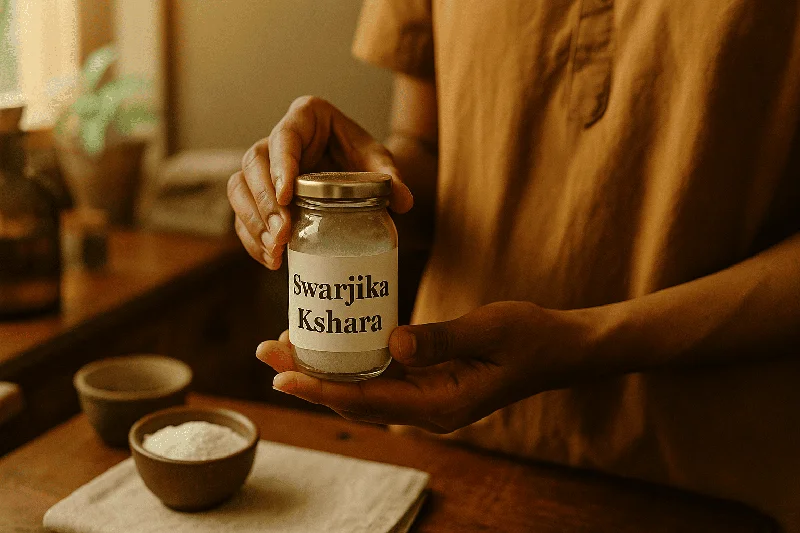
- Swarjika Kshara (also spelled Sarjika Kshara, Sajjikshar, or Svarjiksara) is a traditional Ayurvedic alkaline preparation obtained from the ash of specific desert plants — primarily Fagonia cretica (Ushtrapriya) and Cressa cretica (Rudanti). Chemically, it is a complex mixture dominated by sodium carbonate (Na₂CO₃) and sodium bicarbonate (NaHCO₃) with trace minerals. In classical Ayurveda, it has been valued for centuries as a potent digestive, detoxifying, wound-healing, and skin-cleansing agent. Despite being widely referenced in texts like the Rasatarangini and the Ayurvedic Pharmacopoeia of India (API), genuine plant-derived Swarjika Kshara is increasingly rare — often substituted with commercial baking soda.
- This comprehensive guide covers everything: classical references, botanical sources, step-by-step preparation, chemical analysis, therapeutic uses, dosages, safety, and how to tell the authentic product from a synthetic one.
What Is Swarjika Kshara?
Definition & Sanskrit Etymology
The word "Kshara" comes from the Sanskrit root kṣar — meaning "to melt away" or "to corrode." It refers to caustic alkaline substances that possess the ability to dissolve, cleanse, and destroy morbid tissues. "Swarjika" (or "Sarjika") is a specific type of Kshara named after its natural sourcing from saline-alkaline soils and specific halophytic plants found in arid regions of India, particularly Rajasthan, Gujarat, and Kutch.
In simple English, Swarjika Kshara is best understood as a plant-derived alkaline salt — not a single chemical but a complex mineral-rich preparation.
Classification Among Kshara Types
Ayurveda classifies Ksharas into two major categories:
| Classification | Type | Description |
|---|---|---|
| By Application | Pratisaraniya Kshara | External application — pastes, poultices for wounds, skin conditions, and para-surgical procedures |
| Paniya Kshara | Internal use — taken orally with appropriate anupana (vehicle) for digestive and systemic disorders | |
| By Source | Swarjika Kshara | Obtained from specific plants or natural mineral deposits |
| Yava Kshara | From barley (Hordeum vulgare) ash | |
| Tankana Kshara | Borax-based alkaline preparation | |
| Apamarga Kshara | From Achyranthes aspera ash |
Swarjika Kshara can be used both as Pratisaraniya and Paniya, depending on the purification level and intended therapeutic goal.
Chemical Identity — Beyond "Just Baking Soda"
A common misconception equates Swarjika Kshara with sodium bicarbonate (NaHCO₃) or commercial baking soda. While the dominant alkaline component is indeed sodium carbonate/bicarbonate, authentic plant-derived Swarjika Kshara contains a broader mineral matrix including potassium carbonate (K₂CO₃), calcium, magnesium, silica, iron traces, and various phyto-derived microelements that are entirely absent in synthetic soda.
This distinction matters clinically. The trace mineral profile contributes to its therapeutic breadth — something a laboratory-grade chemical simply cannot replicate.
Historical & Classical References
Sushruta Samhita & Charaka Samhita
- The concept of Kshara therapy originates in the Sushruta Samhita (Sutra Sthana, Chapter 11), where Acharya Sushruta describes Kshara as one of the Anushastras (para-surgical instruments).
- He states:
> "Kṣāraḥ agni-śastra-pratiṣedhe kṣāraḥ praśasyate"
> "Where fire (cautery) and sharp instruments are contraindicated, Kshara is the therapy of choice."
Charaka Samhita references Kshara preparations in the context of Gulma (abdominal lumps), Arsha (piles), and Krimi (parasitic infections). Though Charaka doesn't name "Swarjika" specifically by this term in every instance, the descriptions of naturally occurring alkaline salts from desert soils align with what later commentators identified as Swarjika Kshara.
Rasatarangini & Ayurvediya Rasashastra
The Rasatarangini by Sadananda Sharma (14th Taranga) provides a more explicit description. It lists Swarjika Kshara among the important Ksharas used in Rasashastra (Ayurvedic pharmaceutics) and mentions its role in processing metals and minerals — a critical step in the preparation of Bhasmas (calcined metallic preparations).
The Ayurvediya Rasashastra by Siddhinandan Mishra further elaborates on its dual nature: as a standalone therapeutic agent and as an essential ingredient in compound formulations like Svarjiksara Churna for digestive disorders.
Sharangadhara Samhita & API References
Sharangadhara Samhita (Madhyama Khanda) includes Swarjika Kshara in several formulation recipes, particularly for conditions involving Ama (metabolic toxins) and Agnimandya (digestive weakness). The Ayurvedic Pharmacopoeia of India (API) lists it as an official monograph ingredient, though — and this is an important gap — the API does not provide a fully detailed, reproducible Standard Manufacturing Procedure (SMP), which has led to significant quality variation in the market.
Plant Sources of Swarjika Kshara
Ushtrapriya — Fagonia cretica Linn. (Botanical Profile)
Fagonia cretica is a small, spiny, branching undershrub belonging to the family Zygophyllaceae. The name "Ushtrapriya" literally means "beloved of camels" in Sanskrit — camels are known to graze on this thorny plant in desert regions. Morphology: The plant grows 30–60 cm tall with trifoliate leaves, small pink to purple flowers, and spiny stipules. Stems are green and angular, often tinged reddish-brown.
- Habitat & Distribution: Found abundantly across the Thar Desert (Rajasthan), Kutch (Gujarat), Sindh region, Baluchistan, and parts of North Africa and the Mediterranean.
- It thrives in arid, sandy, and saline soils — exactly the conditions that concentrate alkaline minerals in plant tissues.
Kshara Yield: Research published in the International Journal of Ayurveda and Pharma Research (2018) reports that the ash content of Fagonia cretica whole plant yields approximately 18.46% Kshara after complete processing (incineration, extraction, filtration, and evaporation).
Rudanti — Cressa cretica Linn. (Botanical Profile)
Cressa cretica is a small, densely hairy perennial herb of the Convolvulaceae family, commonly found in salt marshes and coastal saline soils. Morphology: Grows up to 10–30 cm with small, ovate, sessile, grey-green leaves densely covered in trichomes. White or pinkish small flowers appear in terminal clusters. The entire plant has a characteristically salty taste. Habitat & Distribution: Widespread in saline flats of Rajasthan, Gujarat (especially Rann of Kutch), coastal Maharashtra, and extends to Middle East and Mediterranean salinas. Kshara Yield: The same comparative study reported a significantly higher yield — approximately 47.41% Kshara from Cressa cretica. This makes Rudanti the more efficient botanical source for commercial-scale Kshara production.
Comparative Yield Data
| Parameter | Fagonia cretica (Ushtrapriya) | Cressa cretica (Rudanti) |
|---|---|---|
| Ash content (whole plant) | ~22–25% | ~50–55% |
| Final Kshara yield | ~18.46% | ~47.41% |
| pH of Kshara solution (1% w/v) | 10.2–10.8 | 10.5–11.2 |
| Dominant alkaline salts | Na₂CO₃, NaHCO₃ | Na₂CO₃, NaHCO₃, K₂CO₃ |
| Availability | Moderate (seasonal) | Moderate (saline habitats) |
Other Traditional Sources
Classical texts also mention natural mineral deposits found in certain alkaline lake beds and efflorescent soils of the Rann of Kutch and Sambhar Lake (Rajasthan) as direct sources of crude Swarjika Kshara — without requiring plant incineration. However, such mineral-sourced material typically requires additional purification (Shodhana) before therapeutic use.
How Is Swarjika Kshara Prepared? (Standard Manufacturing Procedure)
Classical Method — Step-by-Step Process
The traditional preparation follows a well-defined sequence described across multiple texts. Here is a consolidated, reproducible Standard Manufacturing Procedure (SMP) based on Rasatarangini, API guidelines, and contemporary standardization research:
Step 1: Selection & Collection of Raw Herbs
Collect the whole plant of Cressa cretica or Fagonia cretica during the post-monsoon season (October–December) when mineral accumulation in plant tissues is highest. The plants should be healthy, free from fungal infection, and collected from genuinely saline habitats.
Step 2: Drying
Spread collected plant material in a well-ventilated shaded area for 5–7 days until completely dry. Moisture content should be reduced to below 10%.
Step 3: Incineration (Dahana)
- Burn the dried plant material in an open pit or iron vessel until it is completely reduced to white-grey ash (bhasma). The temperature during open incineration typically ranges from 600–800°C.
- Ensure complete combustion — no blackened or unburnt residue should remain.
Step 4: Alkaline Extraction (Ksharodaka)
Add the cooled ash to six times its weight of clean water. Stir vigorously and allow to stand for 12–24 hours, stirring occasionally. The water-soluble alkaline salts dissolve into solution.
Step 5: Filtration
Filter the solution through a clean, fine cotton cloth (traditionally 4 layers) or muslin. Repeat filtration 3–4 times until the filtrate is perfectly clear and free of particulate matter. This clear alkaline solution is called Ksharodaka or Ksharajala.
Step 6: Evaporation & Crystallization
Heat the filtered alkaline solution in a wide-mouthed iron or stainless steel vessel on a moderate flame. Evaporate slowly with continuous stirring to prevent bumping. As water evaporates, a white crystalline or amorphous solid deposits. Continue heating until all moisture is driven off.
Step 7: Final Product & Storage
The resultant white, hygroscopic powder is the finished Swarjika Kshara. Store immediately in an airtight glass or food-grade plastic container — the product is highly hygroscopic and will absorb atmospheric moisture rapidly.
Quality Parameters of the Final Product
| Quality Parameter | Expected Value |
|---|---|
| Appearance | White to off-white powder/crystals |
| Taste | Strongly alkaline, soapy |
| pH (1% aqueous solution) | 10.0–11.5 |
| Solubility in water | Freely soluble |
| Loss on drying | < 5% |
| Acid-insoluble ash | < 1% |
| Heavy metals (Pb, Hg, As, Cd) | Within API limits |
Chemical Composition & Analytical Profile
This is where most existing resources fall short. Let's look at what modern analytical chemistry reveals about authentic plant-derived Swarjika Kshara.
Elemental & Mineral Composition
Based on ICP-OES (Inductively Coupled Plasma Optical Emission Spectrometry) analysis of Swarjika Kshara prepared from Cressa cretica, the following elemental profile has been documented:
- Sodium (Na): 28–35% — dominant cation, present as Na₂CO₃ and NaHCO₃
- Potassium (K): 4–8% — present as K₂CO₃
- Calcium (Ca): 1.5–3.0% — present as CaCO₃
- Magnesium (Mg): 0.5–1.2%
- Silica (SiO₂): 0.8–2.0%
- Iron (Fe): 0.01–0.05% (trace)
- Sulphate (SO₄²⁻): 1.0–2.5%
- Chloride (Cl⁻): 2.0–4.0%
XRD & FTIR Data
X-Ray Diffraction (XRD): Confirms the presence of thermonatrite (Na₂CO₃·H₂O) and trona (Na₃(CO₃)(HCO₃)·2H₂O) as the dominant crystalline phases in plant-derived Swarjika Kshara — these are naturally occurring sodium carbonate minerals. FTIR (Fourier Transform Infrared Spectroscopy): Shows characteristic absorption bands at ~1450 cm⁻¹ (carbonate C-O stretch), ~880 cm⁻¹ (carbonate out-of-plane bend), and ~1640 cm⁻¹ (bound water). Notably, plant-derived samples show additional minor peaks between 1000–1100 cm⁻¹ suggesting the presence of silicate and organo-mineral complexes absent in synthetic sodium bicarbonate.
Plant-Derived vs Synthetic — How to Differentiate
| Feature | Authentic (Plant-Derived) | Synthetic (Baking Soda) |
|---|---|---|
| Color | Off-white to slightly yellowish | Pure white |
| Taste | Alkaline with slight earthy/mineral undertone | Clean alkaline, no undertone |
| pH (1% solution) | 10.5–11.5 | 8.3–8.6 (NaHCO₃) or 11.3–11.8 (pure Na₂CO₃) |
| Multi-mineral content | Present (K, Ca, Mg, Si, Fe traces) | Absent (only Na) |
| FTIR pattern | Multiple peaks (complex matrix) | Clean, sharp peaks (single compound) |
| Hygroscopicity | Highly hygroscopic | Moderately hygroscopic |
| Cost | ₹800–2,000/kg | ₹40–80/kg |
If the product you purchased is pure white, very cheap, and dissolves to a pH of exactly 8.3 — it's almost certainly just baking soda.
Don't wait or self medicate. Start chat with Doctor NOW
Therapeutic Properties & Pharmacological Actions
Rasa Panchaka (Ayurvedic Pharmacology Profile)
| Parameter | Description |
|---|---|
| Rasa (Taste) | Katu (Pungent), Lavana (Saline) |
| Guna (Qualities) | Tikshna (Sharp/Penetrating), Ushna (Hot), Laghu (Light) |
| Virya (Potency) | Ushna (Hot) |
| Vipaka (Post-digestive effect) | Katu (Pungent) |
| Dosha Karma | Kapha-Vata Shamaka (pacifies Kapha and Vata); may aggravate Pitta in excess |
What Is Swarjika Kshara Used for in Ayurveda?
The therapeutic applications span both internal medicine and external procedures:
Digestive Disorders: This is the primary classical indication. Swarjika Kshara kindles Agni (digestive fire), dissolves Ama (toxins), and relieves Ajirna (indigestion), Adhmana (bloating), Amlapitta (acid reflux — used carefully in small doses with appropriate vehicle), and Gulma (abdominal masses). Skin Conditions: Externally applied as a paste (with water, honey, or ghee as a base), it addresses Dadru (ringworm), Kitibha (psoriasis-like lesions), Vicharchika (eczema), warts, and non-healing ulcers. Its alkaline pH creates an environment hostile to fungal and bacterial growth. Urinary Calculi (Ashmari): Classical texts specifically recommend Swarjika Kshara for dissolving urinary stones — the alkaline nature helps in breaking down calcium oxalate and uric acid crystals. Wound Healing & Para-Surgical Use: In Kshara Karma — Ayurveda's para-surgical technique — alkaline preparations are applied to hemorrhoids, fistulae, and abnormal growths. While Apamarga Kshara is more commonly referenced for Kshara Sutra therapy, Swarjika Kshara serves as an adjunct preparation, particularly in wound bed preparation and post-procedure care. Respiratory Conditions: Used internally for Kasa (cough) and Shwasa (dyspnea/asthma) where Kapha accumulation is the dominant pathology.
Antimicrobial Activity — Modern Evidence
A 2020 in-vitro study published in the Journal of Ayurveda and Integrative Medicine evaluated the antibacterial activity of traditionally prepared Kshara formulations (including Swarjika-type preparations) against common pathogens. Results showed significant inhibition zones against Staphylococcus aureus (12–16 mm), Escherichia coli (10–14 mm), and moderate activity against Pseudomonas aeruginosa. The mechanism is attributed primarily to the high pH creating an inhospitable environment for microbial survival, combined with the osmotic effect of concentrated mineral salts.
Antifungal activity against Candida albicans and dermatophytes has also been reported, which corroborates the traditional use in skin mycoses.
Role in Kshara Karma (Para-Surgical Procedures)
Kshara Karma is one of Ayurveda's most clinically validated para-surgical techniques, described by Sushruta as superior to both Shastra (surgical instruments) and Agni (cauterization) due to its ability to simultaneously cut, scrape, and heal.
In the context of Kshara Sutra — the medicated thread used for fistula-in-ano — Swarjika Kshara can be used in the preparation of the alkaline solution that coats the thread, alongside Apamarga Kshara and Snuhi Kshira (latex of Euphorbia neriifolia). It's not the primary Kshara for this purpose, but its solubility and consistent alkalinity make it useful as a standardizing agent in the coating process.
Dosage, Administration & Formulations
Exact Dosages for Internal Use
| Condition | Dose | Anupana (Vehicle) | Frequency | Duration |
|---|---|---|---|---|
| Indigestion / Bloating | 250–500 mg | Warm water or buttermilk | Twice daily, after meals | 7–14 days |
| Urinary calculi | 500 mg–1 g | Coconut water or Varuna Kwatha | Twice daily | 21–30 days (under supervision) |
| Cough with Kapha | 250–500 mg | Honey + warm water | Twice daily | 7–10 days |
| As a Rasashastra processing agent | As per formulation recipe | — | — | — |
Important: These dosages represent general classical guidelines. Individual dose must be determined by a qualified Ayurvedic practitioner based on the patient's Prakriti, Agni bala, disease severity, and concomitant medications.
Key Compound Formulations Containing Swarjika Kshara
- Svarjiksara Churna — for digestive complaints
- Shankhavati — classical tablet for Grahani (IBS-like conditions)
- Kshara combinations with Nimbukamlam (dried lemon extract) — popular OTC formulations for acidity and gas
- Various Bhasma preparations — where Swarjika Kshara serves as a processing agent during Shodhana and Marana
Comparison: Swarjika Kshara vs Other Ksharas
No other resource provides this comparison.
Here's a detailed breakdown:
| Parameter | Swarjika Kshara | Yava Kshara | Tankana Kshara | Apamarga Kshara |
|---|---|---|---|---|
| Source | Cressa cretica / Fagonia cretica | Hordeum vulgare (Barley) | Natural borax mineral | Achyranthes aspera |
| Primary Chemical | Na₂CO₃ / NaHCO₃ | K₂CO₃ | Na₂B₄O₇ | K₂CO₃ + KOH |
| pH | 10.5–11.5 | 11.0–12.0 | 9.0–9.5 | 12.0–13.0 |
| Caustic Strength | Moderate | Moderate–High | Mild | High |
| Primary Internal Use | Digestive disorders, calculi | Digestive, urinary | Cough, Kapha disorders | Rarely internal |
| Primary External Use | Skin conditions, mild wounds | Skin conditions | Genital/oral conditions | Kshara Sutra, hemorrhoids, fistula |
| Dosha Action | Kapha-Vata ↓ | Kapha ↓ | Kapha ↓ | Kapha-Vata ↓ (strong) |
| Safety Profile | Moderate (well tolerated) | Moderate | Good | Requires caution (caustic) |
Side Effects, Safety & Precautions
Are There Any Side Effects of Using Swarjika Kshara?
Yes, like any potent Ayurvedic preparation, Swarjika Kshara can cause adverse effects if misused:
- Oral irritation or gastric burning — if taken in excess or without proper anupana
- Skin irritation, redness, or chemical burn — if applied externally in too-high concentration or left on sensitive skin too long
- Aggravation of Pitta disorders — excessive use can worsen hyperacidity, bleeding disorders, and inflammatory conditions
- Electrolyte imbalance — prolonged unsupervised internal use may alter sodium-potassium balance
Is Swarjika Kshara Safe for Sensitive Skin?
For sensitive skin, a patch test is mandatory. Apply a dilute paste (mix a pinch with ample ghee or coconut oil) on a small area of the inner forearm. Wait 30 minutes. If no redness, burning, or itching occurs, proceed cautiously with therapeutic application. Never apply undiluted Kshara directly to sensitive or broken skin without professional guidance.
Contraindications
- Pregnancy and lactation
- Children under 12 (unless specifically prescribed)
- Active gastrointestinal bleeding
- Severe Pitta-predominant conditions
- Open deep wounds (without medical supervision)
- Patients on sodium-restricted diets or with hypertension
Drug Interactions
Swarjika Kshara, being a strongly alkaline substance, can potentially interact with:
- Acidic medications — may neutralize drugs requiring acidic environments for absorption (e.g., certain antifungals like ketoconazole)
- Antacids and PPIs — compounding alkaline effect, risking metabolic alkalosis
- Iron supplements — alkaline pH may reduce iron absorption
- Lithium — sodium-containing preparations can affect lithium levels
Always inform your Ayurvedic and allopathic doctor about all medications being taken concurrently.
Market Reality & Quality Control
The Falsification Problem
Here's an uncomfortable truth about the Indian Ayurvedic market: a significant proportion of "Sajjikshar" sold commercially — especially at low price points on platforms like Amazon and local herb shops — is simply repackaged industrial sodium bicarbonate or washing soda. It costs ₹40–80/kg to produce synthetically versus ₹800–2,000/kg for authentic plant-derived material. The economic incentive for substitution is enormous.
How to Identify Authentic Swarjika Kshara
- 1.Check the price — if it's under ₹300/kg, it's almost certainly synthetic
- 2.Examine color and texture — authentic product has a slightly off-white, sometimes yellowish tinge with irregular crystal sizes; synthetic is uniformly pure white
- 3.Taste test (small amount) — authentic has a complex, earthy-alkaline taste; synthetic tastes cleanly of baking soda
- 4.Ask for a Certificate of Analysis (CoA) — reputable manufacturers should provide testing data including heavy metals, pH, and multi-element analysis
- 5.GMP certification — purchase only from GMP-certified Ayurvedic manufacturers listed with AYUSH Ministry
Where Can I Obtain Authentic Swarjika Kshara?
- Licensed Ayurvedic pharmacies with GMP certification
- Directly from Ayurvedic hospitals and Panchakarma centers
- Established brands that specialize in classical formulations (not just herbal supplements)
- Research institution outlets (e.g., Gujarat Ayurveda University, National Institute of Ayurveda)
Avoid unbranded loose powder sold in local markets without any labeling or batch information.
Can Swarjika Kshara Be Used at Home?
Yes — but with significant caveats. For mild external applications like a dilute face wash or skin toner (a pinch dissolved in a cup of water), home use is generally safe for non-sensitive skin types after a patch test.
For internal use, self-medication is strongly discouraged. The dosage window between therapeutic and irritating is narrow. An experienced Ayurvedic physician should determine dose, duration, and appropriate combination based on your individual constitution.
For Kshara Karma or any para-surgical application — absolutely never attempt at home. This requires clinical training, sterile conditions, and post-procedure monitoring.
Frequently Asked Questions (FAQ)
What is the common English name for Swarjika Kshara?
There isn't a perfect English equivalent. It is most commonly referred to as "natural alkaline salt," "plant-derived sodium carbonate," or simply transliterated as "Sajjikshar." Some texts translate it as "barilla alkali" — a term historically used for plant-derived sodium carbonate in European chemistry.
Can Sajjikshar be used for hair?
- Traditional Ayurvedic practice does include the use of alkaline preparations for hair. Swarjika Kshara, in very dilute solutions, has been used as a hair rinse to remove excess oil, product buildup, and address dandruff. However, due to its high pH, it can be damaging to hair proteins if used frequently or in concentrated form.
- A safer approach: dissolve 1/4 teaspoon in 1 liter of water as an occasional clarifying rinse, not more than once every 2 weeks.
What is the difference between Swarjika Kshara and Nimbukamlam?
- Nimbukamlam (dried citrus/lemon extract, essentially citric acid) is actually the acidic counterpart to Swarjika Kshara.
- Many classical formulations combine the two — the alkaline Kshara with the acidic Nimbukamlam — to create an effervescent, pH-balanced preparation for digestive complaints. Think of it as Ayurveda's original "antacid fizz."
How long does Swarjika Kshara last? What is its shelf life?
When stored properly in an airtight container away from moisture and direct sunlight, authentic Swarjika Kshara remains potent for 2–3 years. However, if exposed to humidity, it will rapidly absorb moisture, cake, and lose its free-flowing nature — though its chemical potency remains largely intact even then.
Is Swarjika Kshara the same as Sajji Mitti?
Not exactly. Sajji Mitti refers to the crude natural mineral deposit (impure sodium carbonate/bicarbonate found in alkaline soils), while Swarjika Kshara specifically refers to the purified, processed product — whether derived from plants or from purification of Sajji Mitti. The crude mineral form requires Shodhana (purification) before therapeutic use.
Conclusion
Swarjika Kshara represents one of Ayurveda's most scientifically fascinating preparations — a plant-derived alkaline formulation whose therapeutic logic aligns remarkably well with modern understanding of pH-dependent antimicrobial activity, mineral supplementation, and tissue remodeling. Its applications range from simple digestive support to complex para-surgical procedures.
The biggest challenge today is not a lack of clinical potential, but a crisis of authenticity. With the vast majority of commercial "Sajjikshar" being synthetic substitutes, practitioners and patients must demand transparency: proper sourcing documentation, Certificate of Analysis, and GMP compliance.
If you're considering using Swarjika Kshara — whether for digestive issues, skin conditions, or as part of a Panchakarma protocol — consult a qualified Ayurvedic physician first. The right preparation, in the right dose, through the right vehicle, for the right person: that's the Ayurvedic principle that makes this ancient alkaline salt truly powerful.
Scientific Sources
- Curiosity and Creative Experimentation Among Psychiatrists in India — Lang C et al., 2024, Culture, medicine and psychiatry
- Severe Lead Toxicity Due to Ayurvedic Medicine in a Child with Type 1 Diabetes Mellitus — Roy K et al., 2022, Indian journal of pediatrics
- Transmission modes of COVID-19 disease pandemic in the light of ancient wisdom of Ayurveda medicine: a review — Joshi N et al., 2021, Journal of complementary & integrative medicine
- Herbal Immunomodulators - A Remedial Panacea for Designing and Developing Effective Drugs and Medicines: Current Scenario and Future Prospects — Tiwari R et al., 2018, Current drug metabolism
- Ayurvedic medicine — Bodeker GC, 1991, CMAJ : Canadian Medical Association journal = journal de l'Association medicale canadienne
- Utilization of Ayurveda in health care: an approach for prevention, health promotion, and treatment of disease.Part 1--Ayurveda, the science of life — Sharma H et al., 2007, Journal of alternative and complementary medicine (New York, N.Y.)
- Editorial: Special issue on Ayurveda — Mukherjee PK et al., 2017, Journal of ethnopharmacology
- Healthcare the Ayurvedic way — Jayasundar R, 2012, Indian journal of medical ethics
- Merger of ayurveda and tissue culture-based functional genomics: inspirations from systems biology — Deocaris CC et al., 2008, Journal of translational medicine
- Rational use of Ashwagandha in Ayurveda (Traditional Indian Medicine) for health and healing — Joshi VK et al., 2021, Journal of ethnopharmacology
- Medical histories — Dance A, 2016, Nature
- Application of diet-derived taste active components for clinical nutrition: perspectives from ancient Ayurvedic medical science, space medicine, and modern clinical nutrition — Kulkarni AD et al., 2014, Current pharmaceutical design
- A comprehensive review on Phyto-MAP: A novel approach of drug discovery against Mycobacterium avium subspecies paratuberculosis using AYUSH heritage — Srivastava V et al., 2024, Journal of ethnopharmacology
- Neuronutrient impact of Ayurvedic Rasayana therapy in brain aging — Singh RH et al., 2008, Biogerontology
- Medical science in ancient Indian culture with special reference to Atharvaveda — Narayana A, 1995, Bulletin of the Indian Institute of History of Medicine (Hyderabad)
- Withania somnifera (L.) Dunal - Modern perspectives of an ancient Rasayana from Ayurveda — Mukherjee PK et al., 2021, Journal of ethnopharmacology
- Bacopa monnieri: Preclinical and Clinical Evidence of Neuroactive Effects, Safety of Use and the Search for Improved Bioavailability — Gościniak A et al., 2025, Nutrients
- Rise of Siddha medicine: causes and constructions in the Madras Presidency (1920-1930s) — Kanagarathinam DV et al., 2023, Medical history
- Ayurvedic and Chinese Herbs against Coronaviruses — Gasmi A et al., 2024, Current pharmaceutical design
- Deep meditation as a valid "scientific" method: A flawed argument — Patwardhan K, 2025, Indian journal of medical ethics
Questions from users
How long does it take for Kshara preparations to show results?
Landon
6 days ago
Kshara preparations, which are alkaline substances derived from the ashes of medicinal plants, may show effects in a few days to a couple of weeks, depending on the specific health condition they are being used to treat. A typical timeline is not well-established because it varies with the type of Kshara, the condition treated, and individual response. For dermatological issues or digestive health improvements, some users report results within a week. If no improvement is seen in 2-4 weeks, or if adverse effects occur, consulting a healthcare professional is advisable. Ayurveda suggests using Kshara judiciously to balance its potent effects.
What is the role of alkaline preparations like Swarjika Kshara in Ayurvedic para-surgical techniques?
Olivia
15 days ago
Swarjika Kshara is a type of alkaline preparation used in Ayurveda's para-surgical techniques like Kshara Karma. It helps treat conditions like hemorrhoids and fistulae by breaking down abnormal growths and promoting tissue healing. In these treatments, it acts kinda like a chemical cautery, removing unwanted tissue safely. Always important to use it under guidance 'cause of its potency!
What is the botanical significance of Fagonia cretica in Ayurvedic practices?
Lincoln
24 days ago
Fagonia cretica is cherished in Ayurveda for its detoxifying and wound-healing properties. It aids digestion and cleanses the skin. Linked with desert soils and alkaline salts, it might balance doshas and support agni. If you're curious about its use for specific conditions, it'd be good to check with a knowledgeable practitioner.
What is the historical significance of kshara in Ayurvedic medicine?
Summer
39 days ago
Kshara in Ayurveda has a long history, kinda like a natural cleansing superstar. It's used for detoxifying the body, treating skin issues like ulcers and inflammation, and supporting overall balance. With its alkaline nature, it helps remove toxins, which is key in maintaining health. Just make sure it's used under an expert's guidance.
What is the process of preparing Swarjika Kshara according to traditional Ayurvedic methods?
Levi
48 days ago
Preparing Swarjika Kshara, called an alkaline ash, traditionally involves burning specific herbs like Apamarga, to create ash. This ash is then filtered and mixed with water, boiled, and purified to achieve the final product. The detailed process might vary, so consulting with a certified practitioner for safe prep and use is crucial!
Can I mix Swarjika Kshara with other natural ingredients for skin treatment?
Tanner
58 days ago
Sure, you can mix Swarjika Kshara with other natural ingredients, but it's best to be cautious. It’s got alkaline properties, so blending it with something acidic might not work well. To be safe, consult with an Ayurvedic practitioner first to make sure the combo is good for your skin and dosha. Tryng patch test could help too!
Can I use Swarjika Kshara for detoxification, and how does it work?
Claire
68 days ago
Yes, Swarjika Kshara can be used for detoxification, but it's important to do so under the guidance of a qualified practitioner. It helps by balancing pitta dosha and promoting detoxification at a cellular level. But it’s pretty potent, so working with an expert ensures you are using it safely and effectively for your unique needs!
Is it safe to use Swarjika Kshara on acne-prone skin?
Elijah
77 days ago
Using Swarjika Kshara on acne-prone skin can be a bit tricky. It's a strong substance that should definitely be used with caution. If you're considering it, make sure to consult a qualified Ayurvedic practitioner first. They can guide you on how to dilute and apply it properly to minimize any risk. Better safe than sorry, right?
What is the role of Ayurvedic practitioners in the preparation of Swarjika Kshara?
Michael
87 days ago
Ayurvedic practitioners play a crucial role in preparing Swarjika Kshara. They ensure that the right herbs are used, follow the specific methods for making it, and tailor it to body's needs. It's essential they oversee this process to maintain safety and effectiveness—since kshara needs careful handling due to its potency.
What is the recommended dilution ratio for using Swarjika Kshara on the skin?
Kayden
96 days ago
Swarjika Kshara is a powerful treatment and usually needs to be diluted before applying it on the skin. Unfortunately, the exact dilution ratio isn't mentioned in the article. It's important to consult a qualified Ayurvedic practitioner to determine the right dilution for your specific needs and skin type. Stay safe!
Related articles

Body Detox
How to Detox Adrenal Glands Naturally: Ayurvedic Cleansing Guide
Learn how to detox adrenal glands naturally with Ayurvedic herbs, diet, and lifestyle tips. Discover remedies for adrenal fatigue and stress-related burnout
3,163

Body Detox
How to Reduce Vata from the Body Without Losing Your Mind (or Your Appetite)
In Ayurveda — that ancient, often misunderstood science from India that goes way deeper than turmeric lattes — Vata is one of the three doshas. Doshas are like energies or forces that make up your constitution. Vata is made of air and ether. So think: mov
2,768

Body Detox
Gandmool Meaning – Astrological Insights into Ganda Mool Nakshatras
Discover the meaning of Gandmool, an esteemed Ayurvedic herb known for its potent medicinal properties, detoxification benefits, and its role in enhancing overall wellness.
6,802

Body Detox
Vimliv Syrup: Benefits, Dosage & Science-Backed Insights
Discover the proven benefits, proper dosage, side effects, and scientific research behind Vimliv Syrup, the powerful Ayurvedic liver tonic.
2,945

Body Detox
Maha Manjishtadi Kashayam – Benefits, Dose, Side Effects, Ingredients, Reference
Exploration of Maha Manjishtadi Kashayam – Benefits, Dose, Side Effects, Ingredients, Reference
3,652

Body Detox
Vata Dosha Remedies That Actually Work: Ayurvedic Diet, Lifestyle & Real-World Advice to Feel Grounded Again
It’s not just an “Ayurveda thing.” It's a real-life thing. And yeah — Ayurveda has some wildly practical, deeply ancient, and surprisingly soothing ways to bring you back to center. This guide? Not another floaty wellness blog. This is the stuff that work
3,050

Body Detox
Can We Drink Water After Eating Watermelon? Ayurvedic Perspective and Facts
Wondering if you can drink water after eating watermelon? Learn the Ayurvedic view, possible side effects, and how long you should wait for better digestion
11,550

Body Detox
How to Clean Stomach in Morning: Natural Tips, Drinks, and Yoga
Learn how to clean stomach in morning with natural drinks, Ayurvedic tips, and yoga. Discover what to drink in the morning to clean your stomach fast
4,008

Body Detox
Mahatiktam Kashayam Benefits, Dosage, Side Effects, Ingredients, Reference
Exploration of Mahatiktam Kashayam Benefits, Dosage, Side Effects, Ingredients, Reference
2,170

Body Detox
Guggulu Marichadi Thailam: Benefits & Scientific Insights
Discover the Ayurvedic benefits, applications, proper usage, and scientific insights of Guggulu Marichadi Thailam, a traditional herbal oil for holistic healing.
2,845
Related consultations on the topic
Legal
Additional Documents
© 2024 Ask Ayurveda. All rights reserved.