Ask Ayurvedic doctor a question and get a consultation online on the problem of your concern in a free or paid mode. More than 2,000 experienced doctors work and wait for your questions on our site and help users to solve their health problems every day.
FREE! Ask Ayurvedic Doctors 24/7

 Fast responses
 1000+ verified doctors
Body DetoxEar, Nose, and Throat DisordersGeriatrics & RejuvenationImmunodeficiencyInfertility TreatmentNutritionOrthopedic DisordersPediatricsRespiratory DisordersSexually Transmitted Diseases (STDs)Surgery RecoveryUrological DisordersVascular DisordersDental DisordersEndocrinological DisordersGastrointestinal DisordersYoga TherapyGeneral MedicineAllergic DisordersCardio DisordersGynecology and ObstetricsCosmetologySkin and Hair DisordersEye DisordersInfectious DiseasesMental DisordersNeurological DisordersOncologyPanchakarmaSexual Health & DisordersSports Medicine
Published on 02/27/25
(Updated on 07/07/26)
4,151
Updhatu in Ayurveda – Understanding the Concept and Its Importance

- Updhatu in Ayurveda refers to secondary tissues (sub-tissues) that are derived from the seven primary Dhatus during the process of tissue metabolism.
- Unlike the main Dhatus — which nourish the next tissue in the metabolic chain — Upadhatus serve specialized physiological roles without producing a subsequent tissue. There are traditionally seven to eight Upadhatus described across classical texts, and understanding them is essential for diagnosing and treating a wide range of diseases, from lactation failure to joint disorders.
In this comprehensive guide, we'll break down every Upadhatu, explain how they form, explore their clinical relevance, and cover therapeutic approaches that no other resource currently addresses. Whether you're an Ayurvedic student, practitioner, or a curious patient, this article will give you the deepest understanding of Upadhatu available online.
What Is Updhatu? — Definition & Etymology
The term Updhatu (also spelled Upadhatu, उपधातु) is a compound Sanskrit word.
Let's disect it:
- Upa (उप) — secondary, subordinate, near, subsidiary
- Dhatu (धातु) — tissue, that which supports or sustains the body
So Upadhatu literally means "a tissue that is subordinate to or derived from a primary Dhatu." These sub-tissues are formed as by-products during Dhatu Parinama (tissue transformation) but do not participate in nourishing the next Dhatu in the metabolic sequence.
Sanskrit Meaning of Upadhatu (Upa + Dhatu)
Acharya Dalhana, the famous commentator on Sushruta Samhita, defines Upadhatu as:
> Upadhātavaḥ dhātūnām upajīvanaḥ
> — The Upadhatus are those which are sustained by (and dependent upon) the Dhatus.
The key differentiator: Dhatus give rise to the next Dhatu in the chain (Rasa → Rakta → Mamsa → Meda → Asthi → Majja → Shukra), but Upadhatus are terminal products — they serve their function without transforming further.
Classical References (Shloka with Translation)
The most commonly cited reference for the enumeration of Upadhatus comes from Sharangdhara Samhita (Prathama Khanda 5/13-17):
> "Rasād stanyaṃ tato raktaṃ, raktāt sirā tataḥ kandarāḥ |
> Māṃsād vasā tataḥ tvak cha, medaso snāyu sandhayaḥ ||"
Translation: From Rasa Dhatu arise Stanya (breast milk) and Aartava (menstrual blood); from Rakta Dhatu arise Sira (blood vessels) and Kandara (tendons); from Mamsa Dhatu arise Vasa (muscle fat) and Twak (skin layers); from Meda Dhatu arise Snayu (ligaments) and Sandhi (joints).
Charaka Samhita (Chikitsa Sthana 15/16-17) also mentions certain Upadhatus, though Charaka's enumeration differs slightly from Sharangdhara's — a discrepancy we'll explore later in this article.
List of All Upadhatu and Their Parent Dhatu
Here is the complete mapping of Dhatus to their respective Upadhatus as described primarily in Sharangdhara Samhita:
| Parent Dhatu | Upadhatu 1 | Upadhatu 2 | Modern Correlation |
|---|---|---|---|
| Rasa (Plasma/Lymph) | Stanya (Breast Milk) | Aartava (Menstrual Blood/Ovum) | Lactation fluid; Endometrial lining/Ovum |
| Rakta (Blood) | Sira (Blood Vessels) | Kandara (Tendons) | Veins, arteries, capillaries; Tendons & aponeuroses |
| Mamsa (Muscle) | Vasa (Muscle Fat) | Twak (Skin) | Subcutaneous/intramuscular fat; Dermis & epidermis |
| Meda (Adipose Tissue) | Snayu (Ligaments/Sinews) | Sandhi (Joints) | Ligaments, fascia; Synovial joints |
| Asthi (Bone) | — | — | No Upadhatu described |
| Majja (Marrow) | — | — | No Upadhatu described |
| Shukra (Reproductive) | Ojas (as per some Acharyas) | — | Immunity/vital essence |
Rasa Dhatu → Stanya (Breast Milk) & Aartava (Menstrual Blood)
Stanya is the breast milk produced in women, nourished directly by Rasa Dhatu. This is why Ayurveda places enormous emphasis on the quality of Ahara (diet) consumed by a lactating mother — because the food first transforms into Rasa, which then nourishes Stanya. Aartava refers to the menstrual blood and, more broadly, the female reproductive component (ovum). Since Aartava is derived from Rasa Dhatu according to Sharangdhara, its quality directly depends on the quality of plasma and lymphatic fluid in the body.
> Clinical note: In many women with Rasa Kshaya (depletion of plasma), both lactation problems and menstrual irregularities co-occur — validating this classical relationship.
Rakta Dhatu → Sira (Blood Vessels) & Kandara (Tendons)
Sira encompasses all types of blood vessels — arteries, veins, and capillaries. In modern anatomical terms, this correlates with the entire vascular network. Sushruta described 700 Siras in the body, classifying them by Dosha predominance (Vataja, Pittaja, Kaphaja, and Raktaja Sira). Kandara refers to tendons and aponeuroses — the fibrous connective tissues that attach muscles to bones. Sushruta enumerated 16 Kandaras in the body.
Mamsa Dhatu → Vasa (Muscle Fat) & Twak (Skin)
Vasa is the intramuscular fat or the fatty tissue closely associated with muscle. In western anatomy, this corresponds roughly to intramuscular adipose tissue and subcutaneous fat deposits closely linked with muscle metabolism. Twak (skin) is described in six or seven layers across different classical texts. Sushruta described six layers of skin (Udakadhara, Asrigdhara, etc.), while other Acharyas mention seven. The skin acts as a protective barrier, sensory organ, and plays a role in temperature regulation.
Meda Dhatu → Snayu (Ligaments) & Sandhi (Joints)
- Snayu includes ligaments, sinews, and fascial structures.
- Sushruta categorized 900 Snayus in four types: Pratanvati (flat/expanded), Vrutta (round), Sushira (hollow), and Prithula (broad).
Sandhi (joints) are the articulation points between bones. Sushruta described 210 Sandhis classified into 8 types based on their structure (Kora, Ulukhala, Samudga, Pratara, Tunnasevani, Vayasatunda, Mandala, and Shankhavarta).
Asthi, Majja & Shukra — Why No Upadhatu?
- This is a question students often struggle with.
- The last three Dhatus — Asthi (bone), Majja (bone marrow), and Shukra (reproductive tissue) — do not produce Upadhatus according to most classical authorities.
Why? There are several explanations offered by commentators:
- 1.Metabolic completion theory: By the time Ahara Rasa transforms through six Dhatus, its potency is significantly refined. The remaining transformational energy is channeled entirely into producing the next Dhatu rather than generating side-products.
- 2.Structural density: Asthi and Majja are deeply situated, dense tissues where the metabolic by-products are absorbed back rather than forming independent structures.
- 3.Shukra's special status: Being the final and most refined Dhatu, Shukra's energy is reserved for reproduction and Ojas formation.
Ojas as Upadhatu of Shukra — Sharangdhara's View
This is a fascinating and somewhat controversial point. Sharangdhara Samhita (Prathama Khanda 5/16-17) mentions Ojas as the Upadhatu of Shukra Dhatu:
> "Shukrasya upadhātuḥ ojaḥ"
- However, Charaka considers Ojas to be the Sara (essence) of all seven Dhatus — not merely a by-product of Shukra.
- This creates a philosophical divergence: Is Ojas a sub-tissue of one Dhatu, or the quintessential extract of all seven?
Most contemporary Ayurvedic scholars reconcile this by suggesting that while Ojas receives contributions from all Dhatus, its final formation and most significant nourishment occurs at the Shukra level — hence Sharangdhara's classification.
How Are Upadhatus Formed and Nourished?
Understanding Upadhatu formation requires understanding the broader process of Dhatu Parinama (tissue transformation).
Role of Dhatwagni in Upadhatu Nourishment
Each Dhatu possesses its own Dhatwagni — a tissue-specific metabolic fire responsible for processing incoming nutrients. When Dhatwagni acts on the Ahara Rasa (nutritive fluid), it produces three things:
- 1.Sthayi Dhatu — the stable, mature form of that tissue
- 2.Upadhatu — the secondary tissue (by-product)
- 3.Dhatu Mala — the waste product of that tissue
For example, when Rasa Dhatwagni processes incoming nutrients:
- Sthayi Rasa (stable plasma) is formed
- Stanya and Aartava (Upadhatus) are produced
- Kapha (Dhatu Mala) is generated as waste
This means that the health of each Upadhatu is directly dependent on the strength of the corresponding Dhatwagni. Mandagni (weak metabolic fire) at any Dhatu level will produce poorly formed Upadhatus.
Hypothesis 1 — Independent Formation + Parental Nourishment
According to this theory, Upadhatus are independently formed during embryological development (Garbhavakranti Kala). Once formed, they are continually nourished by their parent Dhatu throughout life.
This explains why Upadhatus exist as distinct anatomical structures (blood vessels, joints, skin) that are clearly present from birth — they don't "appear" with each metabolic cycle but are maintained by ongoing nourishment.
Hypothesis 2 — Simultaneous Formation in Dhatu Parinama
The alternative hypothesis suggests that Upadhatus are formed simultaneously with the next Dhatu during each cycle of Dhatu Parinama. In other words, when Rasa transforms into Rakta, the "leftover" or "side-stream" of this transformation becomes the Upadhatu.
This theory aligns well with the Kshira-Dadhi Nyaya (milk-to-curd analogy) of tissue formation, where the entire previous Dhatu transforms and the Upadhatu represents a specific fraction of this transformation.
Ahara Rasa → Dhatu → Upadhatu → Mala: The Complete Chain
Here's a simplified flow of the entire metabolic chain:
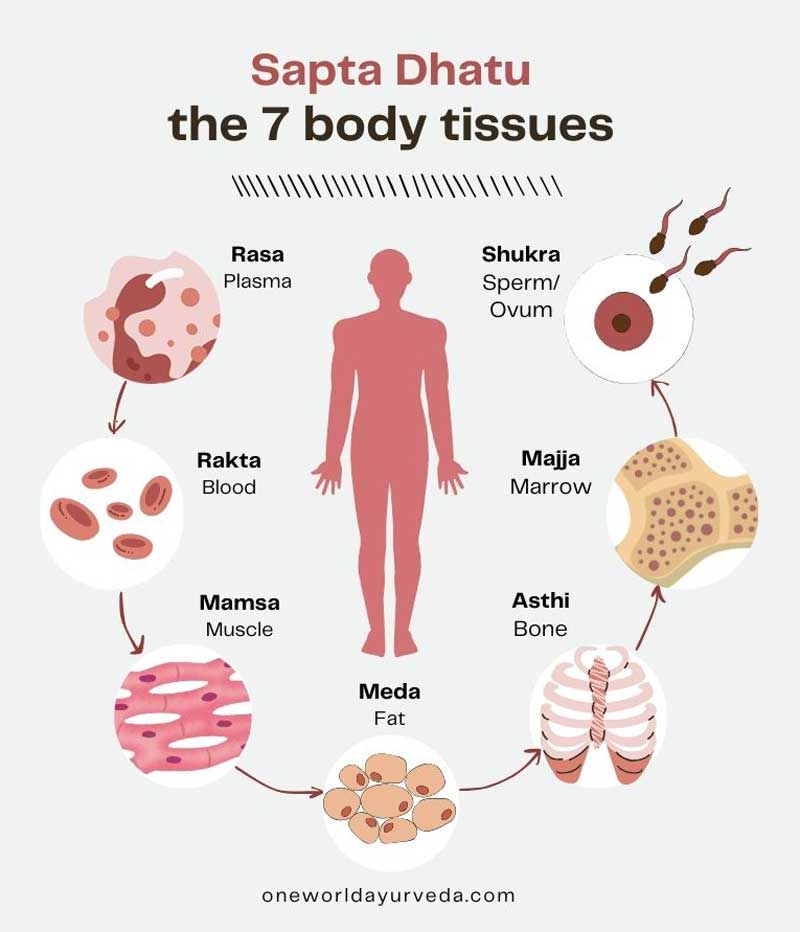
Food → Jatharagni → Ahara Rasa → Rasa Dhatu (+ Stanya/Aartava + Kapha) → Rakta Dhatu (+ Sira/Kandara + Pitta) → Mamsa Dhatu (+ Vasa/Twak + Kha Mala) → Meda Dhatu (+ Snayu/Sandhi + Sweda) → Asthi (+ no Upadhatu + Kesha/Loma) → Majja (+ no Upadhatu + Akshi Vit) → Shukra (+ Ojas)
Each step requires its specific Dhatwagni and proper Srotasa (channel) functioning. A blockage or dysfunction at any point cascades downstream, affecting all subsequent Dhatus and their Upadhatus.
Functions of Each Upadhatu (Physiological Roles)
Stanya — Lactation & Infant Nutrition
- Stanya provides complete nutrition to the newborn. Ayurveda describes ideal Stanya as having proper color (slightly yellowish-white), odor (natural sweet smell), consistency, and taste.
- It should disperse evenly when dropped in water — a classical test described in Sushruta Samhita.
Aartava — Reproductive Health & Fertility
Aartava governs menstrual health, ovulation, and fertility. Shuddha Aartava (pure menstrual blood) is described as resembling the color of lac juice (Laksha Rasa), rabbit's blood, or red lotus — bright red without foul odor. Its regularity indicates healthy Rasa Dhatu metabolism.
Sira — Circulation & Nutrient Transport
Siras serve as channels for blood and nutrient transport throughout the body. Their integrity ensures proper perfusion of all tissues. Sira Dushti (vitiation of blood vessels) leads to conditions we'll discuss in the pathology section.
Kandara — Structural Support & Movement
Kandaras anchor muscles to bones and transmit the force of muscular contraction to the skeletal system. Without healthy Kandaras, movement becomes restricted and painful.
Vasa — Lubrication & Tissue Protection
Vasa provides lubrication to muscles and internal organs. It facilitates smooth muscle movement and protects delicate structures. Its depletion leads to dryness, cracking, and pain in the musculoskeletal system.
Twak — Protection, Sensation & Complexion
Twak is the body's largest organ, responsible for protection from external pathogens, temperature regulation, tactile sensation (Sparsha Gyanendriya), and complexion (Varna). Ayurveda considers skin health as a direct reflection of Mamsa Dhatu quality.
Snayu — Binding & Structural Integrity
Snayus bind together bones, muscles, fat, and joints. They provide structural integrity and prevent dislocation. Their strength determines the overall resilience of the musculoskeletal frame.
Sandhi — Joint Mobility & Shock Absorption
Sandhis enable movement between bones and provide shock absorption. They contain Shleshaka Kapha (joint fluid analogous to synovial fluid) that lubricates the articular surfaces.
Difference Between Dhatu and Updhatu in Ayurveda
This is one of the most asked questions among Ayurvedic students.
Here's a clear comparision:
| Criteria | Dhatu | Upadhatu |
|---|---|---|
| Number | 7 (Sapta Dhatu) | 7-8 (depending on text) |
| Tissue transformation | Nourishes the next Dhatu | Does NOT produce subsequent tissue |
| Mala production | Produces Dhatu Mala | Does not produce specific Mala |
| Metabolic fire | Has own Dhatwagni | Does not have independent Agni |
| Nourishment source | Previous Dhatu or Ahara Rasa | Parent Dhatu only |
| Poshya-Poshaka relationship | Both Poshya and Poshaka | Only Poshya (receiver) |
| Role in body | Primary structural & functional | Supportive & specialized |
| Effect of loss | Life-threatening if depleted | Localized dysfunction |
- Key takeaway: Dhatus are the backbone of bodily structure and function. Upadhatus are specialized, localized tissues that depend entirely on their parent Dhatu for sustenance.
- Think of Dhatus as trunk of a tree and Upadhatus as branches — they emerge from the trunk but don't grow further branches themselves.
Don't wait or self medicate. Start chat with Doctor NOW
Pathology of Upadhatu: Vriddhi (Excess) and Kshaya (Depletion)
This is an area where existing literature is surprisingly thin. Let's systematically explore what happens when each Upadhatu undergoes pathological increase or decrease.
Stanya & Aartava Disorders
| Upadhatu | Kshaya (Depletion) | Vriddhi (Excess) |
|---|---|---|
| Stanya | Agalactia (Stanya Kshaya), poor infant nutrition, delayed growth | Galactorrhea, Stanya Atipravritti |
| Aartava | Amenorrhea, infertility, PCOD-like symptoms | Menorrhagia, metrorrhagia, Aartava Atipravritti |
Sira & Kandara Disorders
| Upadhatu | Kshaya (Depletion) | Vriddhi (Excess/Dushti) |
|---|---|---|
| Sira | Poor circulation, pallor, numbness | Varicose veins (Sira Granthi), hemorrhoids, spider veins |
| Kandara | Tendon weakness, hypermobility, easy tears | Tendon stiffness, restricted movement, calcific tendinitis |
Vasa & Twak Disorders
| Upadhatu | Kshaya (Depletion) | Vriddhi (Excess) |
|---|---|---|
| Vasa | Dryness, muscle cramps, cracking joints | Lipomas, fatty deposits, sluggishness |
| Twak | Dry skin, fissures, reduced sensation | Skin thickening, hyperkeratosis, excessive oiliness |
Snayu & Sandhi Disorders
| Upadhatu | Kshaya (Depletion) | Vriddhi (Excess/Dushti) |
|---|---|---|
| Snayu | Ligament laxity, frequent sprains, joint instability | Fibrosis, restricted mobility, contractures |
| Sandhi | Joint looseness, subluxation, cracking sounds | Joint swelling (Sandhi Shotha), stiffness, Sandhivata (osteoarthritis) |
How Doshic Imbalance Affects Upadhatu
Vitiated Doshas (Vata, Pitta, Kapha) affect Upadhatus through their parent Dhatu:
- Vata vitiation → primarily causes Kshaya (depletion) of Upadhatus, leading to dryness, cracking, wasting
- Pitta vitiation → causes inflammation, burning, and qualitative changes in Upadhatus
- Kapha vitiation → causes excessive accumulation, swelling, and stagnation in Upadhatus
Treatment Approaches for Upadhatu Disorders
No existing resource comprehensively covers the therapeutic management of Upadhatu disorders. Here's a clinical framework.
Herbal Remedies for Specific Upadhatu Imbalances
| Upadhatu | Key Herbs | Rationale |
|---|---|---|
| Stanya | Shatavari, Jivanti, Vidarikanda | Galactagogues that enhance Rasa Dhatu |
| Aartava | Ashoka, Lodhra, Kumari (Aloe) | Regulate menstrual flow via Rasa nourishment |
| Sira | Sariva, Manjistha, Guduchi | Rakta Shodhana (blood purification) strengthens vessels |
| Kandara | Bala, Ashwagandha, Rasna | Strengthen connective tissue via Rakta and Mamsa |
| Vasa/Twak | Kumkuma (Saffron), Chandana, Nimba | Nourish skin; balance Mamsa Dhatu fire |
| Snayu/Sandhi | Guggulu, Shallaki, Nirgundi | Anti-inflammatory, joint-protective, Meda-balancing |
Panchakarma Procedures for Upadhatu Correction
- Basti (Medicated Enema): The most important procedure for Vata-related Upadhatu Kshaya. Anuvasana Basti with Dhanwantaram Taila strengthens Snayu, Kandara, and Sandhi.
- Virechana (Purgation): Indicated when Pitta vitiates Rakta-derived Upadhatus (Sira, Kandara). Helps in conditions like varicose veins and tendonitis.
- Nasya: Indicated for Upadhatu disorders above the clavicle.
- Abhyanga (Oil Massage): Regular external oleation with Dhanwantaram or Kshirabala Taila directly nourishes Twak, Snayu, and Sandhi.
Dietary Guidelines (Ahara for Upadhatu Health)
Since all Upadhatus ultimately depend on Ahara Rasa (nutritive juice from digestion), dietary optimization is fundamental:
- For Stanya/Aartava support: Milk, ghee, sweet juicy fruits, Shatavari Kalpa
- For Sira/Kandara strength: Iron-rich foods, pomegranate, beetroot, dates
- For Vasa/Twak nourishment: Moderate healthy fats (ghee, sesame oil), adequate hydration
- For Snayu/Sandhi integrity: Calcium-rich foods, sesame seeds, bone broths, warm unctuous foods
Upadhatu and Prakriti (Constitutional Influence)
The state of your Upadhatus is significantly influenced by your Prakriti (constitutional type):
- Vata Prakriti individuals tend toward Upadhatu Kshaya — they often have visible veins, thin skin, cracking joints, and lighter menstrual flow. They need consistent oleation and nourishment.
- Pitta Prakriti individuals tend toward inflammatory Upadhatu conditions — they may experience heavy periods, skin redness, and tender tendons. Cooling, anti-inflammatory approaches work best.
- Kapha Prakriti individuals tend toward Upadhatu excess — they may develop thick skin, heavy breasts, stiff joints with swelling, and excessive menstrual flow. Lightening and drying therapies are indicated.
Understanding your Prakriti helps predict which Upadhatus are most vulnerable and allows for preventive care — a uniquely Ayurvedic advantage.
Differences Between Classical Sources on Upadhatu Classification
Different Acharyas hold slightly different positions on Upadhatu.
No existing resource compares these systematically:
| Point of Difference | Charaka | Sushruta | Sharangdhara | Vagbhata |
|---|---|---|---|---|
| Term "Upadhatu" used explicitly? | No (uses Prasada/Kitta concept) | Mentions some Upadhatus indirectly | Yes, explicitly lists all | Partially, through commentators |
| Stanya & Aartava source | Rasa | Rasa | Rasa | Rasa |
| Number of Upadhatus listed | Not specifically enumerated | Mentions structures but not as formal Upadhatu list | 7-8 | Varies by commentary |
| Ojas classification | Sara of all 7 Dhatus | Para Ojas vs. Apara Ojas | Upadhatu of Shukra | Sara of all Dhatus |
| Twak (Skin) layers | 6 layers | 6-7 layers | As Upadhatu of Mamsa | 6 layers |
The most commonly followed classification in contemporary Ayurvedic education comes from Sharangdhara Samhita, which provides the clearest and most systematic enumeration.
Diagnostic Assessment of Upadhatu Health (Pariksha Methods)
An experienced Ayurvedic physician assesses Upadhatu health through:
- 1.Darshana (Inspection): Skin color and texture (Twak assessment), visible veins and their patterns (Sira assessment), joint swelling or deformity (Sandhi assessment)
- 2.Sparshana (Palpation): Tendon tension and tenderness (Kandara), ligament laxity tests (Snayu), joint crepitus and range of motion (Sandhi), skin turgor and moisture (Twak)
- 3.Prashna (Questioning): Menstrual history (Aartava), lactation adequacy (Stanya), joint stiffness patterns, skin complaints
- 4.Nadi Pariksha (Pulse Diagnosis): Subtle changes in pulse quality can indicate Dhatu-level imbalances that subsequently affect Upadhatus. A Vata-dominant pulse at the Mamsa level, for instance, might suggest Twak or Vasa Kshaya.
Frequently Asked Questions (FAQ)
What is the difference between Dhatu and Updhatu in Ayurveda?
Dhatus are the seven primary tissues that form the structural foundation of the body and nourish the next Dhatu in sequence. Upadhatus are secondary tissues derived from these Dhatus during metabolism — they serve specialized functions but do not nourish subsequent tissues or produce their own metabolic waste (Mala).
How many Upadhatus are there in total?
Most texts describe 7 Upadhatus (Stanya, Aartava, Sira, Kandara, Vasa, Twak, Snayu, and Sandhi — which actually makes 8). If Ojas is included as the Upadhatu of Shukra per Sharangdhara, the count reaches 9. The discrepancy arises from different classical authorities using slightly different classification systems.
What are the 7 types of Kala and how do they relate to Upadhatu?
Kala refers to the membrane-like structures that separate Dhatus from one another and from the Ashaya (visceral organs). There are 7 Kalas described in Sushruta Samhita. While Kalas are not Upadhatus themselves, they play a crucial role in Upadhatu formation by facilitating the filtration and separation of Dhatu Sara (essence) from Dhatu Kitta (waste), which influences how Upadhatus receive their nourishment.
What is the role of Upadhatu in Rasashastra?
In Rasashastra (Ayurvedic pharmaceutics and alchemy), the term "Upadhatu" takes on a completely different meaning — it refers to secondary minerals like Makshika (chalcopyrite), Vimala (iron pyrite), Shilajit, etc. These are mineral substances that are "subordinate" to the primary metals (Dhatus like gold, silver, copper). This is a distinct usage from the physiological context discussed in this article.
How are Upadhatus formed in the body?
Upadhatus form through the action of Dhatwagni (tissue-specific metabolic fire) on Ahara Rasa (nutritive fluid). When Dhatwagni processes the incoming nutrients at each Dhatu level, three products emerge: the mature Dhatu, the Upadhatu (by-product), and the Dhatu Mala (waste). This process is continuous and occurs throughout life.
What is Updhatu in Ayurveda in Hindi?
उपधातु (Upadhatu) आयुर्वेद में गौण धातुओं को कहते हैं जो सप्त धातुओं के पाचन के दौरान बनती हैं। ये धातुओं से पोषित होती हैं लेकिन अगली धातु का निर्माण नहीं करतीं। स्तन्य, आर्तव, सिरा, कण्डरा, वसा, त्वक्, स्नायु और सन्धि — ये प्रमुख उपधातुएं हैं।
Conclusion: Why Understanding Upadhatu Matters for Your Health
- The concept of Upadhatu in Ayurveda reveals the extraordinary depth of ancient Indian medical thinking.
- These sub-tissues are not merely academic curiosities — they represent real, clinically relevant structures whose health directly impacts your daily life. From the quality of a mother's breast milk to the integrity of your knee joints, from healthy skin to properly functioning blood vessels, Upadhatus touch virtually every aspect of physical wellbeing.
By understanding which parent Dhatu nourishes which Upadhatu, an Ayurvedic practitioner can trace seemingly unrelated symptoms back to a common root cause. A patient presenting with both dry skin and muscle cramps? That points to Mamsa Dhatu and its Upadhatus. Someone with varicose veins and tendon problems? Look at Rakta Dhatu.
This systemic, root-cause approach is what makes Ayurveda remarkably effective for chronic conditions that modern medicine often treats symptomatically.
If you're experiencing symptoms related to any Upadhatu — whether it's joint pain, skin disorders, menstrual irregularities, or circulation problems — consider consulting a qualified Ayurvedic practitioner who can assess your Dhatu and Upadhatu health comprehensively and design a personalized treatment protocol.
Scientific Sources
- Ayurveda for Animals — Dohmen L, 2025, The Veterinary clinics of North America. Small animal practice
- Establishment of the mechanism of purification and levigation of green chemistry-assisted biocomposites of red ochre (Gairika): synthesis, characterization, and antibacterial, prebiotic, antioxidant, and antacid activities of the traditional Ayurvedic medicine Laghu Sutashekhara Rasa — Charde V et al., 2023, Frontiers in chemistry
- Screening of anti-cancerous potential of classical Raudra rasa and modified Raudra rasa modified with hiraka bhasma (nanodiamond) through FTIR & LC-MS analysis — Dash MK et al., 2022, Journal of complementary & integrative medicine
- Preparation and physicochemical characterization of ingredients of Indian traditional medicine, Mahamrutyunjaya Rasa — Rai P et al., 2017, Journal of Ayurveda and integrative medicine
- Pharmaceutical characterization and exploration of Arkeshwara rasa in MDA-MB-231 cells — Jayakumar R et al., 2024, Journal of Ayurveda and integrative medicine
- Understanding hypertension in the light of Ayurveda — Menon M et al., 2018, Journal of Ayurveda and integrative medicine
- Pathophysiology of Covid-19 and host centric approaches in Ayurveda — Pandkar PD et al., 2022, Journal of Ayurveda and integrative medicine
- Ayurvedic Approaches to Holistic Management of Polycystic Ovary Syndrome (PCOS) — Pardhekar AD et al., 2024, Journal of pharmacy & bioallied sciences
- Confessions of an Ayurveda professor — Patwardhan K, 2023, Indian journal of medical ethics
- Effectiveness of herbal drug Terminalia Arjuna in chronic venous insufficiency - A prospective observational study — Pratap Shankar KM et al., 2024, Journal of vascular nursing : official publication of the Society for Peripheral Vascular Nursing
- A review on balya action mentioned in Ayurveda — Mahesh TS et al., 2014, Journal of Ayurveda and integrative medicine
- Ayurvedic management of systemic sclerosis - A case report — Parmar JR et al., 2024, Journal of Ayurveda and integrative medicine
- A placebo-controlled clinical evaluation of Kharjurapaka in Mamsakshaya — Dhoke SP et al., 2015, Ayu
- Efficacy of traditional Indian diet (Ayush ahara) on muscle strength and Sarcopenia: A scoping review — Katkar R et al., 2026, Journal of Ayurveda and integrative medicine
- An immediate pain relief with Agnikarma therapy for acute episode of migraine headache-a case report — Balakrishnan P et al., 2024, Journal of Ayurveda and integrative medicine
- The Mediterranean diet, plasma metabolome, and cardiovascular disease risk — Li J et al., 2020, European heart journal
- The Mediterranean Diet for Irritable Bowel Syndrome : A Randomized Clinical Trial — Bamidele JO et al., 2025, Annals of internal medicine
- Understanding Atherosclerotic Cardiovascular disease in the light of Ayurveda — Menon M et al., 2025, Journal of Ayurveda and integrative medicine
- Alterations in the Oral Microbiome Associated With Diabetes, Overweight, and Dietary Components — Shaalan A et al., 2022, Frontiers in nutrition
- Management of tennis elbow by Agnikarma — Mahanta V et al., 2013, Journal of Ayurveda and integrative medicine
- Effect of Majja Basti (therapeutic enema) and Asthi Shrinkhala (Cissus quadrangularis) in the management of Osteoporosis (Asthi-Majjakshaya) — Gupta AK et al., 2012, Ayu
- Role of poly-herbo-mineral combination in management of kunakha (paronychia) — Timande H et al., 2025, Journal of medical case reports
- An approach to avascular necrosis by Saghṛta kṣīrabasti — Chaganti S et al., 2013, Ancient science of life
- Effect of Grīvā Vasti in management of Grīvā Asthi Sandhi Gata Vāta (Cervical Spondylosis) — Pandey YK et al., 2013, Ancient science of life
Questions from users
What are the symptoms of imbalanced Rakta Dhatu in Ayurveda?
Patrick
3 days ago
Symptoms of an imbalanced Rakta Dhatu, according to Ayurveda, may include skin disorders like acne or rashes, circulatory issues, and excessive bleeding during menstruation. These imbalances might also manifest as burning sensations, inflammation, or hot flashes. Treatment typically involves dietary changes, herbal supplements, and lifestyle modifications aiming to balance the blood tissues. It's best to consult an Ayurvedic practitioner for a personalized assessment and protocol. If symptoms persist or worsen, seeking advice from a medical professional is essential.
What is Vasa and how does it affect muscle health in Ayurveda?
Hannah
12 days ago
Vasa is that fatty tissue within muscles, kind of like muscle fat. In Ayurveda, it plays a crucial role in nourishing and lubricating muscles, helping them function smoothly. If Vasa becomes imbalanced or obstructed, it can affect muscle health and even influence other tissues. Keep an eye on your diet and lifestyle to maintain healthy Vasa!
What is the role of hydration in supporting the health of Rasa and Updhatu?
Presley
30 days ago
Hydration is super important for Rasa (lymph) as it helps transport nutrients and removes waste, keeping cells healthy. For Updhatu, which are secondary tissues, good hydration supports their proper nourishment and development. Maintaining proper hydration helps everything flow smoothly, enabling the tissues to function optimally. Keep sipping that water!
Is it safe to practice yoga and meditation daily for improving Updhatu health?
Jackson
39 days ago
Absolutely! Yoga and meditation can be great for improving Updhatu health. The daily practice helps reduce stress, balance doshas, enhance the flow of prana (energy), and support the tissue formation process. Just listen to your body and don't push yourself too hard. If it feels good and suits your lifestyle, you're on the right track!
What lifestyle changes can I make to support the production of healthy Updhatu?
Zara
48 days ago
For supporting healthy Updhatu, focus on a balanced diet with whole foods appropriate for your dosha, regular detox practices, and maintaining good digestion (agni). Try staying active with exercises suited to your body-type, getting 7-8 hours of sleep, and managing stress with yoga or meditation. Remember, adjusting these to fit your individual constitution will give you the best results!
What is the connection between Updhatu and the immune system in Ayurvedic medicine?
Christian
58 days ago
In Ayurveda, Updhatu are secondary tissues that aid in immunity. They help in nourishing and supporting primary tissues, known as Dhatus, and through this, maintain health and balance. Think of Updhatus as helpers—like how Ashwagandha or Shatavari enhance vitality—they support the body's natural defense by carrying nutrients and detoxifying waste.
What is the importance of bone marrow in the context of Updhatu and overall health?
Thomas
68 days ago
Bone marrow, as an Updhatu from Asthi (bones), plays a key role in nourishing and strengthening bones. It helps produce blood cells, essential for immunity and overall vitality. If there's an imbalance in this Updhatu, it could affect both bone health and immune function. Ayurveda often looks to balance doshas and enhance agni to support healthy bone marrow function.
What is the role of Updhatu in maintaining emotional vitality and mental clarity?
Lincoln
77 days ago
Updhatus help support your emotional vitality and mental clarity by maintaining balance between primary and secondary tissues. Think of 'em like connectors—taking signals from primary Dhatus and helping the body communicate more smoothly. When they're in balance, mental focus and emotional steadiness improve a lot. Maybe look into diet or lifestyle tweaks that help optimize your Updhatus, focusing on nerve and bone health. ☺️
Can I use natural oils to help with dry skin and joint lubrication?
Michael
87 days ago
Yes, using natural oils like sesame oil or coconut oil can be great for dry skin and joint lubrication! In Ayurveda, oils from Medas (fat tissue) are believed to help moisturize skin and lubricate joints. Just be sure to choose oils that suit your dosha type, and applying them during a warm self-massage (abhyanga) can be even more beneficial. Stay hydrated too, it's important!
What is the connection between sleep quality and the health of Updhatus in Ayurveda?
Matthew
96 days ago
Sleep quality in Ayurveda is deeply connected to the health of Updhatus! Good sleep helps maintain balance in the dhatus, ensuring that updhatus—the secondary tissues—are formed properly. Poor sleep can weaken agni (digestive fire) and lead to imbalances, impacting both dhatus and updhatus. So, getting restful sleep supports overall harmony in the body!
Related articles

General Medicine
Yuvatyadi Tailam: Herbal Oil for Women’s Health and Vitality
Discover Yuvatyadi Tailam, an Ayurvedic herbal oil for rejuvenation and wellness. Learn about its traditional uses, key ingredients, application methods, and precautions to promote balanced health.
3,195

General Medicine
Yograj Guggul Benefits, Dosage, How to Use, Side Effects, Ingredients, Reference
Exploration of Yograj Guggul Benefits, Dosage, How to Use, Side Effects, Ingredients, Reference
5,321

General Medicine
What Causes Low Blood Sugar Without Diabetes?
What causes low blood sugar without diabetes? Explore non-diabetic hypoglycemia symptoms, causes, and Ayurvedic remedies to restore energy and balance
1,838

General Medicine
Exploring the Three Sub-Pillars of Health in Ayurveda
Ayurveda is an ancient holistic healing system that has been practiced for thousands of years, originating in India.
4,415

General Medicine
Jawahar Mohra Pishti Benefits, Dosage, Ingredients, Side Effects
Exploration of Jawahar Mohra Pishti Benefits, Dosage, Ingredients, Side Effects
1,984

General Medicine
Panchmahabhoot in Ayurveda – The Five Element Theory in Traditional Healing
Discover the profound insights of Panchmahabhoot in Ayurveda, exploring the five elements that form the foundation of Ayurvedic medicine and their applications in health, balance, and healing.
4,052

General Medicine
Mukta Sukti Bhasma Benefits, Dosage, Ingredients, Side Effects
Exploration of Mukta Sukti Bhasma Benefits, Dosage, Ingredients, Side Effects
1,837

General Medicine
Kumarayasava – Uses, Dose, Side Effects, Ingredients
Exploration of Kumarayasava – Uses, Dose, Side Effects, Ingredients
1,338
General Medicine
What to Eat After Virechana: A Real Talk on Recovery, Rasas, and Rice Gruels
So, you've just gone through Virechana, huh? One of Ayurveda’s most potent detox therapies — the big purge, literally. Congratulations, seriously. That’s not something you casually do on a weekend. And now, you're sitting there, maybe a little light-heade
6,817
General Medicine
Shashilekha Vati: Benefits & Ayurvedic Uses
Discover the benefits, proper dosage, uses, and scientific research behind Shashilekha Vati, a potent Ayurvedic herbal supplement for health.
4,361
Related consultations on the topic
Legal
Additional Documents
© 2024 Ask Ayurveda. All rights reserved.