Marichadi Taila: Benefits, Dosage & Science-Backed Insights
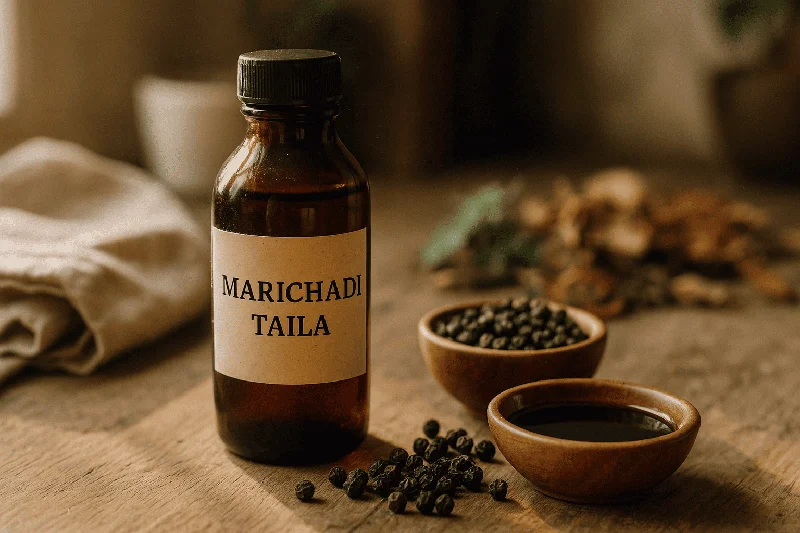
Marichadi Taila is a classical Ayurvedic medicated oil primarily used for chronic skin diseases, respiratory conditions like sinusitis and nasal polyps, and inflammatory joint disorders. Referenced in the Sharangdhara Samhita (Madhyamakhanda 9/148-152), this powerful formulation uses mustard oil as its base and harnesses the therapeutic potency of Maricha (Black Pepper), Nimba (Neem), Haridra (Turmeric), and over a dozen other herbs to balance aggravated Kapha dosha — the root cause of most obstinate skin and respiratory pathologies in Ayurveda.
Whether you're dealing with eczema that won't resolve, stubborn psoriasis patches, chronic sinusitis, or looking for a traditional oil for Nasya therapy, this guide covers everything: full ingredient breakdown, the Ayurvedic mechanism of action, detailed application protocols, how it compares to Brihat Marichadi Taila and other skin oils, safety during pregnancy, and what clinical evidence actually exists. Let's get into it.
What Is Marichadi Taila? Definition and Classical Reference
- Marichadi Taila (also spelled Marichyadi Thailam) is a polyherbal medicated oil described in the Sharangdhara Samhita, one of the three minor treatises (Laghu Trayi) of Ayurveda.
- The name derives from its principal ingredient — Maricha (Piper nigrum, Black Pepper) — combined with the suffix "adi" meaning "and others," plus "Taila" meaning oil.
Classical Indications (Sanskrit Terminology)
The original Sanskrit verse lists the following conditions for which this oil is prescribed:
- Kushtha — obstinate skin diseases including leprosy-spectrum disorders
- Vicharchika — eczema / weeping dermatitis
- Pama — scabies and itchy eruptions
- Shvitra — leucoderma / vitiligo
- Rakta-Mandal — red circular patches on skin
- Kachu — itching dermatoses
- Dadru — ringworm and fungal skin infections
These are collectively classified under Kushtha Roga in Ayurveda, a broad category encompassing nearly all chronic dermatological conditions.
Pharmacological Profile (Rasa Panchaka)
No competitor currently provides the complete pharmacodynamic profile of Marichadi Taila in Ayurvedic terms.
Here it is:
| Parameter | Property |
|---|---|
| Rasa (Taste) | Predominantly Katu (Pungent), with Tikta (Bitter) undertones |
| Guna (Quality) | Ushna (Hot), Tikshna (Penetrating), Laghu (Light) |
| Virya (Potency) | Ushna (Hot) |
| Vipaka (Post-digestive effect) | Katu (Pungent) |
| Dosha Karma | Kapha-Vata Shamaka (pacifies Kapha primarily, Vata secondarily) |
| Taste & Smell | Pungent taste; strong characteristic odor of mustard oil and Gomutra (cow's urine) |
This hot, penetrating, and pungent nature is precisely what makes Marichadi Taila effective against Kapha-dominant skin conditions, which tend to be moist, oozing, itchy, and chronic in nature.
Marichadi Taila Ingredients: Complete Breakdown With Individual Benefits
The formulation contains approximately 16–18 key ingredients. Below is a detailed analysis of each component and its specific therapeutic contribution — something that transforms this oil from a simple blend into a synergistic formula.
Herbal Ingredients
| # | Sanskrit Name | Botanical Name | Key Role in Formula |
|---|---|---|---|
| 1 | Maricha | Piper nigrum | Primary herb; bioenhancer that improves skin penetration of other compounds; strong anti-inflammatory and antimicrobial |
| 2 | Nimba | Azadirachta indica | Potent antifungal and blood purifier; bitter taste clears Pitta-Kapha toxins from skin |
| 3 | Haridra | Curcuma longa | Curcumin-rich; clinically proven anti-inflammatory; accelerates wound healing |
| 4 | Daruharidra | Berberis aristata | Contains berberine; antibacterial against S. aureus and dermatophytes |
| 5 | Karanja | Pongamia pinnata | Traditional dermatological herb; karanjin compound shows UV-protective and antifungal action |
| 6 | Chakramarda | Cassia tora | Specific for Dadru (ringworm); antifungal chrysophanol content |
| 7 | Saptaparna | Alstonia scholaris | Anti-inflammatory and antipyretic; supports chronic inflammatory skin conditions |
| 8 | Chitraka | Plumbago zeylanica | Deepana (digestive fire enhancer); improves metabolism at tissue level |
| 9 | Kushtha | Saussurea lappa | Specific for skin diseases; anti-allergic and anti-histaminic properties |
| 10 | Vidanga | Embelia ribes | Antiparasitic; clears Krimi (microbial/parasitic) component of skin disease |
| 11 | Kana (Pippali) | Piper longum | Another bioenhancer; synergizes with Maricha for enhanced penetration |
| 12 | Sarshapa | Brassica juncea | Base oil; inherently warming, antimicrobial, and rubefacient |
Liquid Media (Drava Dravya)
| Ingredient | Purpose |
|---|---|
| Gomutra (Cow's urine) | Acts as a bioenhancer (similar to modern pharmaceutical excipients); traditionally believed to amplify the potency of herbal extracts; referenced in multiple classical texts as Rasayana and Kushtha-nashaka |
| Kanji (Fermented rice water) | Acidic pH helps in extraction of alkaloids; traditional solvent medium |
| Sarshapa Taila (Mustard oil) | Base oil; its inherent Ushna Virya and Tikshna Guna complement the formula's Kapha-dissolving action |
> Note on the smell: Many users report a strong, somewhat unpleasant odor — this is primarily due to Gomutra and mustard oil. It's completely normal and actually indicative of an authentically prepared product. The smell diminishes significantly after washing.
Method of Preparation (Traditional)
The oil is prepared following the classical Taila Paka Vidhi (oil cooking method) described in Sharangdhara Samhita:
- Kalka (fine paste) is prepared from the herbal ingredients listed above
- Drava dravya (liquid media) — Gomutra and Kanji — are measured at 4 times the quantity of oil
- Mustard oil is taken as the Sneha (lipid base)
- All three are combined and cooked on mild heat (Mridu Agni)
- The mixture is stirred continuously until the oil reaches Madhyama Paka (medium stage of cooking), indicated by specific physical tests — the paste rolls into a wick without sticking, and water droplets crackle when dropped into the oil
- The oil is filtered through clean muslin cloth and stored in glass or food-grade containers
This process ensures that the fat-soluble active compounds from the herbs are extracted into the oil base, while water-soluble compounds from Gomutra and Kanji facilitate extraction of alkaloids and flavonoids.
Marichadi Taila Benefits: Skin, Respiratory, and Joint Health
Benefits for Skin Diseases
This is the primary domain of Marichadi Taila. The classical indications are overwhelmingly dermatological.
Conditions where it shows the most benefit:
- Eczema (Vicharchika): The combination of Nimba, Haridra, and Karanja addresses the itching-oozing-inflammation cycle characteristic of eczema. A 2013 study published in the Journal of Ethnopharmacology confirmed that Azadirachta indica extracts significantly reduce inflammatory cytokines (IL-6, TNF-α) involved in dermatitis.
- Psoriasis (Kitibha Kushtha): The Ushna Virya of the entire formulation counters the Vata-Kapha pathology underlying psoriasis. Mustard oil base provides natural moisturization to dry, flaky plaques.
- Scabies (Pama): Vidanga's antiparasitic action targets the Sarcoptes scabiei mite, while Karanja and Nimba provide secondary antimicrobial cover.
- Fungal infections / Ringworm (Dadru): Chakramarda is the star ingredient here — its antifungal chrysophanol has shown efficacy against Trichophyton species in laboratory studies.
- Leucoderma (Shvitra): Traditional use includes application on depigmented patches, though clinical evidence for repigmentation is limited.
Benefits for Respiratory Conditions (Via Nasya)
When administered as nasal drops (Nasya Karma), Marichadi Taila addresses:
- Chronic sinusitis (Dushta Pratishyaya): The penetrating (Tikshna) nature of Maricha and Pippali helps clear accumulated Kapha from sinuses
- Nasal polyps (Nasarsha): Regular Nasya application may help reduce polyp size by resolving the underlying Kapha-Meda accumulation
- Allergic rhinitis (Vataja Pratishyaya): Anti-allergic properties of Kushtha and anti-inflammatory action of Haridra provide relief from nasal congestion and sneezing
- Chronic cough and bronchial asthma: The warming nature of the oil, when absorbed through nasal mucosa, can help liquefy and expel bronchial secretions
Benefits for Joint Pain and Inflammation
While not the primary indication, external massage with Marichadi Taila provides relief in:
- Rheumatoid arthritis (Amavata) — particularly in early stages with Kapha-dominant symptoms (stiffness, swelling)
- Osteoarthritis with morning stiffness
- General musculoskeletal pain aggravated by cold weather
A 2016 study in the International Journal of Rheumatic Diseases found that topical application of mustard oil-based formulations significantly improved joint mobility and reduced pain scores in osteoarthritis patients over an 8-week period.
How to Use Marichadi Taila: Dosage and Application Methods
External Application for Skin Conditions
- Patch test first: Apply a small amount on the inner forearm. Wait 30 minutes. If no excessive burning or allergic reaction, proceed.
- Apply a thin layer of oil directly on the affected skin area
- Gently massage in circular motions for 5–10 minutes
- Leave on for 30–60 minutes (or as directed by your physician)
- Wash off with lukewarm water and a mild herbal cleanser
- Frequency: Typically once or twice daily
- Duration: Minimum 4–6 weeks for visible results in chronic conditions; up to 3 months for conditions like psoriasis
Combining With Steam Therapy (Swedana)
An important Ayurvedic principle that most guides get wrong or skip entirely: Marichadi Taila should be applied BEFORE steam therapy, not after. The oil application (Abhyanga) followed by steam (Swedana) follows the classical Purvakarma sequence. The steam opens pores and enhances absorption of the medicated oil deep into the skin layers (Dhatus). Applying oil after steam is far less effective.
Precaution for Foot Application
If you apply this oil on your feet — which is common for certain dermatological conditions affecting the soles — be extremely careful about slippery floors. Mustard oil makes surfaces very slick. Wash your feet thoroughly before walking on tiled or marble floors. This is a practical safety tip that sounds trivial but has caused real injuries.
Nasya (Nasal Administration) Protocol
This is where most guides just say "use as nasal drops" without telling you how.
Here's the detailed protocol:
| Step | Detail |
|---|---|
| Preparation | Warm the oil slightly by placing the bottle in warm water (approximately 37–40°C / body temperature). Never heat directly on flame. |
| Position | Lie down with head tilted back, or hang your head off the edge of a bed. A small pillow under the shoulders helps. |
| Dosage | 2–4 drops per nostril for Pratimarsha Nasya (daily maintenance); 6–8 drops per nostril for Marsha Nasya (therapeutic, under supervision) |
| Procedure | Instill drops slowly. Remain in position for 1–2 minutes. Breathe gently through the mouth. |
| Post-procedure | Sit up slowly. Spit out any oil that trickles to the throat (do not swallow). Mild steam inhalation afterward helps. |
| Timing | Morning, on empty stomach, after brushing teeth and washing face |
| Course | 7–14 days for acute conditions; up to 21 days for chronic sinusitis/polyps. Rest for one week, then repeat if needed. |
> Important: Marsha Nasya (higher dose) should only be performed under supervision of a qualified Ayurvedic practitioner. Self-administration is acceptable only for Pratimarsha Nasya (2 drops per nostril).
Understanding the Ayurvedic Mechanism: How Marichadi Taila Works on Doshas
Most resources simply state "balances Kapha dosha" without explaining why or how. Let's fix that.
The Samprapti (Pathogenesis) of Kushtha Roga
According to Charaka Samhita (Chi. 7), all skin diseases involve the vitiation of three doshas, three dhatus (Rasa, Rakta, Mamsa), and four dushyas. However, Kapha plays the dominant role in chronic, recurrent, oozing, and itchy skin conditions because:
- Kapha's qualities — heavy (Guru), oily (Snigdha), cold (Sheeta), slow (Manda) — cause accumulation of metabolic waste (Ama) in the skin
- This Ama blocks the Srotas (microchannels) in skin tissue
- Blocked channels lead to impaired nutrition of skin cells → manifesting as discoloration, scaling, oozing, and itching
- Simultaneously, Kapha's Manda quality makes the disease chronic and resistant to treatment
How Each Ingredient Breaks This Pathological Chain
| Pathological Step | Marichadi Taila's Counter-Action | Key Ingredients |
|---|---|---|
| Kapha accumulation | Ushna Virya (hot potency) liquefies and mobilizes stagnant Kapha | Maricha, Pippali, Chitraka |
| Ama (toxin) formation | Deepana-Pachana (digestive/metabolic) action burns Ama at tissue level | Chitraka, Maricha, Vidanga |
| Srotas blockage | Tikshna Guna (penetrating quality) clears blocked channels | Maricha, Pippali, Gomutra |
| Krimi (microbial) involvement | Krimighna (antimicrobial) action destroys pathogenic organisms | Nimba, Vidanga, Chakramarda |
| Rakta Dushti (blood vitiation) | Raktashodhaka (blood-purifying) herbs correct blood tissue | Nimba, Haridra, Daruharidra |
| Chronicity (Manda Guna of Kapha) | Tikshna and Ushna properties accelerate healing | Entire formulation works synergistically |
This is why Marichadi Taila is so effective for Kapha-dominant skin conditions — it systematically addresses every link in the pathological chain rather than just suppressing symptoms.
Marichadi Taila vs Brihat Marichadi Taila: Key Differences
This is a comparison that no existing resource provides adequately, yet it's one of the most common sources of confusion for both practitioners and patients.
| Parameter | Marichadi Taila | Brihat Marichadi Taila |
|---|---|---|
| Reference | Sharangdhara Samhita, Madhyamakhanda 9/148-152 | Bhaishajya Ratnavali / Chakradatta |
| Number of ingredients | 12–16 herbs | 25–30+ herbs (expanded formula) |
| Additional key ingredients | — | Vatsanabha (Aconitum ferox), Langali (Gloriosa superba), additional Chitraka, Snuhi Kshira |
| Base oil | Sarshapa Taila (Mustard oil) | Sarshapa Taila or Tila Taila (Sesame oil) |
| Potency | Moderate-to-strong | Stronger due to inclusion of potentially toxic herbs |
| Primary indications | General Kushtha, Vicharchika, Pama, Dadru | Severe / refractory Kushtha, Shvitra (leucoderma), deep-seated chronic conditions |
| Safety profile | Relatively safe for self-use (external) | Requires strict medical supervision due to Vatsanabha and Langali |
| Availability | Widely available (Kottakkal, Nagarjuna, SDM) | Less commonly manufactured; specialty product |
| Price range | ₹150–350 for 200ml | ₹250–500 for 200ml |
| Suitability for Nasya | Yes, commonly used | Generally not recommended for Nasya due to stronger irritant potential |
Bottom line: If you're dealing with mild-to-moderate skin conditions or need an oil for Nasya therapy, standard Marichadi Taila is the appropriate choice. Brihat Marichadi Taila is reserved for severe, treatment-resistant dermatological conditions and should only be used under professional guidance.
Marichadi Taila vs. Other Ayurvedic Skin Oils
Another gap in existing content — how does this oil stack up against other popular Ayurvedic skin oils?
| Feature | Marichadi Taila | Pinda Taila | Eladi Tailam | Nalpamaradi Tailam |
|---|---|---|---|---|
| Best for | Kapha-dominant skin disease (oozing, itchy, chronic) | Pitta-dominant skin conditions (burning, red, inflammatory) | General skin nourishment, complexion | Skin brightening, pigmentation, tan |
| Dosha action | Kapha-Vata Shamaka | Pitta Shamaka | Tridosha (mild) | Pitta-Kapha Shamaka |
| Virya | Ushna (Hot) | Sheeta (Cool) | Sheeta (Cool) | Mildly Sheeta |
| Use in Nasya | Yes | No | Rarely | No |
| Base oil | Mustard | Sesame | Coconut/Sesame | Coconut |
| Smell | Strong, pungent | Mild | Pleasant | Pleasant, turmeric-like |
| Suitable for sensitive skin | No (do patch test) | Yes | Yes | Yes |
Choose Marichadi Taila when: the condition is chronic, has Kapha features (white/pale discoloration, oozing, thick scaling, itching worse in cold/damp weather), or you need Nasya therapy for sinusitis.
Side Effects, Precautions, and Drug Interactions
Known Side Effects
- Burning sensation on sensitive skin — this is actually somewhat expected due to the Ushna Virya, but should be mild and temporary. If severe burning occurs, wash off immediately.
- Contact dermatitis in individuals allergic to any component (rare but possible with Gomutra sensitivity)
- Strong odor — not a side effect per se, but can cause nausea in smell-sensitive individuals
- Skin staining — Haridra (turmeric) can temporarily stain light-coloured skin and fabrics
Precautions
- Always perform a patch test before first use
- Keep away from eyes — the pungent ingredients can cause severe irritation
- Store in a cool, dark place. Shelf life is typically 3 years from date of manufacture
- Not for internal consumption — this is strictly an external-use oil
- Open wounds: Do not apply on deep open wounds or actively bleeding lesions
Is Marichadi Taila Safe During Pregnancy and Lactation?
External application on small areas is generally considered safe, but with important caveats:
- Avoid applying on the abdomen, breasts, or large body surface areas during pregnancy
- The Ushna Virya (hot potency) of the oil theoretically could aggravate Pitta, which is already elevated during pregnancy
- Nasya therapy is contraindicated during pregnancy as per classical Ayurvedic texts (Ashtanga Hridaya, Sutrasthana 2)
- During lactation, avoid application on or near the breast area to prevent infant exposure
- Always consult your Ayurvedic physician and obstetrician before use during pregnancy
Drug Interactions
This is a topic no competing resource addresses. While topical oils generally have lower systemic absorption compared to oral medications, consider the following:
- Topical corticosteroids: Do not apply Marichadi Taila simultaneously with steroid creams on the same area. The Tikshna quality of the oil may enhance steroid absorption beyond intended levels. Separate applications by at least 4–6 hours.
- Immunosuppressive medications (for psoriasis/eczema): Inform your doctor if you're using Methotrexate, Cyclosporine, or biologics — adding strong topical herbal formulations should be coordinated with your treatment team.
- Other Ayurvedic internal medicines: Marichadi Taila actually synergizes well with internal Kushtha-nashaka formulations like Khadirarishta, Gandhaka Rasayana, or Arogyavardhini Vati. This combination (internal + external) is the classical approach.
- Blood thinners: Maricha and Pippali are bioenhancers. While topical absorption is limited, if applied over large body areas for extended periods, they could theoretically enhance the absorption of concomitant oral medications. Exercise caution.
Trusted Manufacturers and Price
Several reputable Ayurvedic pharmaceutical companies manufacture Marichadi Taila:
| Manufacturer | Approximate Price (200ml) | Notes |
|---|---|---|
| Kottakkal Arya Vaidya Sala | ₹180–250 | Gold standard; Kerala tradition |
| Nagarjuna Ayurveda | ₹150–220 | Widely available in South India |
| SDM Ayurveda (Udupi) | ₹120–180 | Popular in Karnataka |
| AVP (Arya Vaidya Pharmacy) | ₹170–230 | Coimbatore-based; excellent quality control |
When purchasing, verify: manufacturing license number, batch number, expiry date (should be within 3 years of manufacture), and that the product is manufactured under GMP (Good Manufacturing Practices) certification.
Frequently Asked Questions (FAQ)
How long does it take for Marichadi Taila to show results?
For skin conditions: expect initial improvement (reduced itching, less oozing) within 2–3 weeks of consistent daily application. Significant visible improvement typically takes 6–8 weeks. Chronic conditions like psoriasis may require 3+ months. For Nasya in sinusitis, relief can begin within 5–7 days.
Can Marichadi Taila be used on all skin types?
It is most suitable for normal-to-oily skin types, particularly those with Kapha constitution. Individuals with very dry, sensitive, or Pitta-dominant skin may experience excessive irritation. A patch test is non-negotiable. If you have rosacea or very thin skin, this oil is probably not the right choice for you.
Is Marichadi Taila safe for children?
For external application on children above 5 years — yes, with caution. Use a thinner layer and monitor for any adverse reaction. Nasya therapy in children requires specific pediatric dosing (1–2 drops maximum) and should only be performed by a qualified practitioner. Not recommended for infants or toddlers.
Can Marichadi Taila help with dandruff?
While not a classical indication, the antifungal properties of Nimba and Chakramarda — combined with the Kapha-dissolving nature of the formulation — make it potentially useful for severe, fungal-origin dandruff (seborrheic dermatitis of the scalp). Apply to scalp 30 minutes before washing. However, dedicated anti-dandruff formulations like Neelibhringadi Taila may be more appropriate for routine dandruff.
Can I use Marichadi Taila with conventional medications?
- Yes, with coordination. See the detailed Drug Interactions section above.
- The key rule: do not layer it with topical steroids or retinoids simultaneously on the same skin area. For internal medications, topical oil use is generally safe, but always inform all your healthcare providers about everything you're using.
What are the ingredients in Maha Marichyadi Oil?
Maha Marichyadi Oil (Brihat Marichadi Taila) contains all ingredients of standard Marichadi Taila plus additional potent herbs including Vatsanabha (Aconitum ferox), Langali (Gloriosa superba), Snuhi Kshira (Euphorbia neriifolia latex), and several others. See the detailed comparison table above. Due to the inclusion of potentially toxic ingredients, it requires strict medical supervision.
Can Marichadi Taila be used for hair growth?
There is no classical reference supporting Marichadi Taila specifically for hair growth. Some practitioners use it for scalp conditions (fungal infections, psoriasis of the scalp) which, once treated, may indirectly support hair regrowth in affected areas. But if hair growth is your primary goal, formulations like Bhringamalakadi Taila or Neelibhringadi Taila are far more appropriate.
Conclusion
Marichadi Taila is one of Ayurveda's most potent topical formulations for chronic, stubborn skin diseases — especially those with Kapha-dominant features like oozing, itching, and thick scaling. Its additional utility in Nasya therapy for sinusitis and nasal polyps makes it genuinely versatile. The key to getting results is consistent application over adequate time (minimum 4–6 weeks), correct technique (especially for Nasya), and ideally combining external application with appropriate internal medications under professional guidance.
- Don't self-diagnose chronic skin conditions. What looks like eczema could be fungal, what looks like psoriasis could be lichen planus.
- Get a proper diagnosis first — then use Marichadi Taila as part of a comprehensive, individualized treatment plan designed by a qualified Ayurvedic physician.
If you're unsure whether Marichadi Taila is right for your specific condition, consult with a certified Ayurvedic doctor who can assess your Prakriti, current Dosha imbalance, and recommend the most appropriate formulation and protocol for you.
Scientific Sources
- Green synthesized cobalt nanoparticles from Trianthema portulacastrum L. as a novel antimicrobials and antioxidants — Prakash A et al., 2024, Preparative biochemistry & biotechnology
- Modulating prime molecular expressions and in vitro wound healing rate in keratinocyte (HaCaT) population under characteristic honey dilutions — Chaudhary A et al., 2015, Journal of ethnopharmacology
- A Comprehensive Review on Physiological Effects of Curcumin — Ahsan R et al., 2020, Drug research
- Effectiveness of herbal drug Terminalia Arjuna in chronic venous insufficiency - A prospective observational study — Pratap Shankar KM et al., 2024, Journal of vascular nursing : official publication of the Society for Peripheral Vascular Nursing
- Antiviral Activity of Svarnvir-IV Tablet Assayed for Activity Against SARS-CoV-2 In Vitro — Reddy KR et al., 2023, Cureus
- Mimusops elengi (Bakula) Gelatinolytic Protease and its Plasmin-like Action on the Blood Clot — Gowda NGS et al., 2022, Current protein & peptide science
- Healing potential of Calotropis procera on dermal wounds in Guinea pigs — Rasik AM et al., 1999, Journal of ethnopharmacology
- Relationships among classifications of ayurvedic medicine diagnostics for imbalances and western measures of psychological states: An exploratory study — Mills PJ et al., 2019, Journal of Ayurveda and integrative medicine
- Concept of chronopharmacology in ayurveda — Arora D et al., 2000, Ancient science of life
- Exploring the efficacy of panchavalkal extract and Zinc-Copper Bhasma in promoting wound healing in incision and excision wound models in the rat — Pathak PC et al., 2024, Journal of ethnopharmacology
- Ethnopharmacological approaches to wound healing--exploring medicinal plants of India — Kumar B et al., 2007, Journal of ethnopharmacology
- Ethnomedicinal values of Boerhaavia diffusa L. as a panacea against multiple human ailments: a state of art review — Das S et al., 2023, Frontiers in chemistry
- Modulation of bone turnover by Cissus quadrangularis after ovariectomy in rats — Guerra JM et al., 2019, Journal of bone and mineral metabolism
- High resolution-mass spectrometry (hR-MS) profiling of Apamarga Ksharodaka (herbal alkaline water from Achyranthes aspera Linn.) and computational screening of bioactive phytochemicals for wound healing applications — Garg AK et al., 2025, Natural product research
- Untouchable healing: a Dalit Ayurvedic doctor from Nepal suffers his country's ills — Cameron MM, 2009, Medical anthropology
- Hegemony versus pluralism: Ayurveda and the Movement for Global Mental Health — Halliburton M, 2023, Anthropology & medicine
- An ayurvedic approach in the management of Siragatavata complicated with Dusta Vrana — Singh SK et al., 2021, Journal of Ayurveda and integrative medicine
- Leucorrhoea Relief: Harnessing the Power of Ayurveda for Natural Healing - A Case Report — Chaudhari BV et al., 2024, Journal of pharmacy & bioallied sciences
- Triphala incorporated collagen sponge--a smart biomaterial for infected dermal wound healing — Kumar MS et al., 2010, The Journal of surgical research
- Wound-healing potential of the root extract of Albizzia lebbeck — Joshi A et al., 2013, Planta medica
Ask Ayurvedic doctor a question and get a consultation online on the problem of your concern in a free or paid mode.
More than 2,000 experienced doctors work and wait for your questions on our site and help users to solve their health problems every day.
Related articles