Ask Ayurvedic doctor a question and get a consultation online on the problem of your concern in a free or paid mode. More than 2,000 experienced doctors work and wait for your questions on our site and help users to solve their health problems every day.
FREE! Ask Ayurvedic Doctors 24/7

 Fast responses
 1000+ verified doctors
Body DetoxEar, Nose, and Throat DisordersGeriatrics & RejuvenationImmunodeficiencyInfertility TreatmentNutritionOrthopedic DisordersPediatricsRespiratory DisordersSexually Transmitted Diseases (STDs)Surgery RecoveryUrological DisordersVascular DisordersDental DisordersEndocrinological DisordersGastrointestinal DisordersYoga TherapyGeneral MedicineAllergic DisordersCardio DisordersGynecology and ObstetricsCosmetologySkin and Hair DisordersEye DisordersInfectious DiseasesMental DisordersNeurological DisordersOncologyPanchakarmaSexual Health & DisordersSports Medicine
Published on 12/11/24
(Updated on 07/04/26)
3,514
Nagaradi Lepa Choornam: An Ayurvedic Remedy for Skin Health
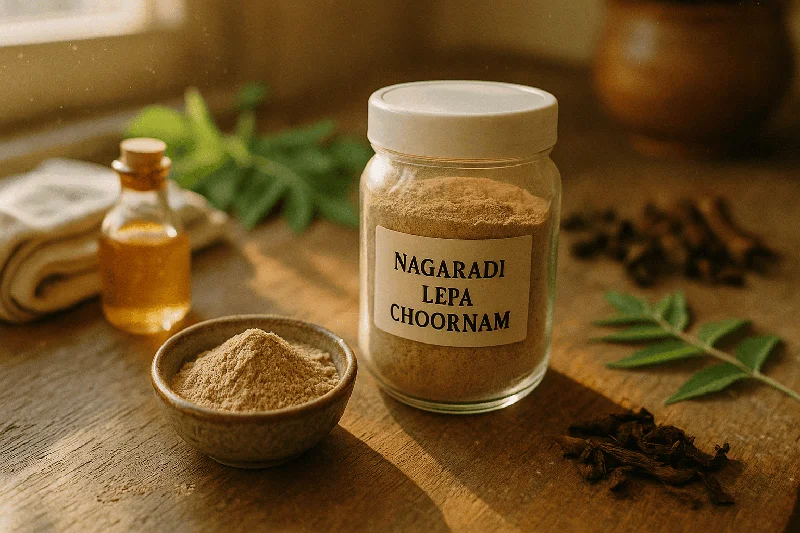
Nagaradi Lepa Choornam is an Ayurvedic polyherbal powder (choornam) formulated exclusively for external application as a medicinal paste (lepa). Rooted in the classical text Sahasrayogam, it is primarily used to manage musculoskeletal injuries — sprains, ligament tears, soft tissue swelling, and inflammatory joint conditions. Unlike what some sources claim about skin-health benefits, the traditional and pharmacologically validated use of this formulation centers on its potent anti-inflammatory, analgesic, and decongestant properties when applied over injured or inflamed tissues.
- If you're looking for a time-tested Ayurvedic external remedy for pain and swelling after a sprain, sports injury, or tendon strain, Nagaradi Lepa Choornam is one of the most widely prescribed options in Kerala Ayurveda and beyond.
- This guide covers everything — from the original Sanskrit shloka to the pharmacological mechanisms behind each ingredient, practical application instructions, brand comparisons, and the scientific evidence that supports its use.
What Is Nagaradi Lepa Choornam?
- Nagaradi Lepa Choornam is a finely powdered herbal compound designed to be mixed with a liquid medium (typically coconut water or lukewarm water) to form a thick paste. This paste is then applied topically over the affected area.
- The word "Nagaradi" derives from Nagara — the Sanskrit name for dry ginger (Zingiber officinale) — which is the lead ingredient. "Lepa" means a medicinal paste for external application, and "Choornam" simply means powder.
It belongs to the category of Lepa Yogas (external paste formulations) in Ayurvedic pharmacology, and it is never taken internally.
Origin and Classical Reference (Sahasrayogam)
The formula originates from Sahasrayogam, one of the most important compendiums of Ayurvedic formulations from the Kerala tradition. Sahasrayogam (literally "a thousand formulations") is a compilation that has been a cornerstone reference for Ayurvedic physicians in South India for centuries. Nagaradi Lepa Choornam appears in the Lepa Prakaranam (chapter on external paste formulations) of this text.
The formulation is classified under treatments for Vata-Kaphaja conditions involving the Asthi (bone), Mamsa (muscle), and Snayu (ligament/tendon) dhatus. It addresses conditions falling under the Bahya Roga Marga (external disease pathway) in Ayurvedic pathology.
Sanskrit Shloka and Translation
The original verse from Sahasrayogam describes the formulation as follows:
> "Nagaradevadaru guggulu kundurushka tankana choornam lepa vidhaanam"
This shloka enumerates the core ingredients — Nagara (dry ginger), Devadaru (Cedrus deodara), Guggulu (Commiphora mukul), Kundurushka (Boswellia serrata/Commiphora myrrha — more on this discrepancy below), and Tankana (purified borax). These are to be powdered individually and blended in equal parts to prepare the lepa choornam.
Dosha Balance and Ayurvedic Properties
Nagaradi Lepa Choornam is primarily Tridoshahara in its action, although it has the strongest effect on Vata and Kapha doshas.
| Ayurvedic Property | Details |
|---|---|
| Rasa (Taste) | Katu (Pungent), Tikta (Bitter) |
| Guna (Quality) | Laghu (Light), Ruksha (Dry), Tikshna (Penetrating) |
| Virya (Potency) | Ushna (Hot) |
| Vipaka (Post-digestive effect) | Katu (Pungent) |
| Dosha Karma | Vata-Kapha Shamaka |
| Roga Marga | Bahya (External pathway) |
| Dushya (Tissues affected) | Mamsa, Asthi, Snayu, Rakta |
The Ushna Virya (hot potency) and Tikshna Guna (penetrating quality) allow the active compounds to permeate through the skin and reach deeper tissues — making it effective for sub-dermal inflammation and swelling.
Nagaradi Choornam Ingredients: Complete Composition with Pharmacological Analysis
All five competitors in top search results mention the ingredients, but none explain why each ingredient is included or how they work at a molecular level. Let's fix that.
Core Ingredients Table
| Sanskrit Name | Botanical / Chemical Name | Part Used | Primary Pharmacological Action |
|---|---|---|---|
| Nagara (Shunti) | Zingiber officinale | Rhizome | COX-2 inhibition, TNF-α suppression |
| Devadaru | Cedrus deodara | Heartwood | Anti-inflammatory, analgesic (himachalol) |
| Guggulu | Commiphora mukul | Oleo-gum resin | NF-κB pathway modulation, anti-edematous |
| Kundurushka | Boswellia serrata (or Commiphora myrrha — see note) | Gum resin | 5-LOX inhibition via boswellic acids |
| Tankana (Suhaga) | Purified Borax (Sodium borate) | Mineral | Antiseptic, enhances tissue penetration |
The Kundurushka Discrepancy: Boswellia or Myrrh?
This is an important point that no competitor addresses. There is a notable inconsistency across manufacturers and references regarding "Kundurushka":
- Vaidyaratnam, Sitaram Ayurveda, and SNA Oushadhasala list Kundurushka as Purified Borax (Tankana) or associate it with Commiphora myrrha (Myrrh).
- Some scholarly references interpret Kundurushka as Boswellia serrata (Indian Frankincense) and omit Tankana entirely from the formula.
This distinction matters clinically. Boswellia serrata contains boswellic acids (particularly AKBA — 3-O-acetyl-11-keto-β-boswellic acid), which are potent 5-lipoxygenase (5-LOX) inhibitors with documented anti-inflammatory action. Commiphora myrrha, while also anti-inflammatory, works through different pathways. If you are purchasing this product, check the ingredient label of the specific manufacturer to know which interpretation they follow.
How Each Ingredient Works: The Pharmacological Mechanism
Zingiber officinale (Dry Ginger): A 2015 systematic review published in Nutrients demonstrated that gingerols and shogaols — the bioactive compounds in ginger — inhibit cyclooxygenase-2 (COX-2) and suppress pro-inflammatory cytokines including TNF-α and IL-1β. When applied topically, these compounds reduce local prostaglandin synthesis, directly decreasing pain and swelling at the site of injury. Cedrus deodara (Devadaru): The heartwood contains himachalol and atlantone, sesquiterpenes with demonstrated analgesic and anti-inflammatory properties. A study in the Indian Journal of Pharmacology (2012) showed significant anti-inflammatory activity comparable to indomethacin in animal models. Commiphora mukul (Guggulu): Guggulsterones (Z and E isomers) modulate the NF-κB signaling pathway — a master regulator of inflammation. This mechanism was characterized in a landmark 2003 study published in Science by Bhatt et al. External application of guggulu resin has been a staple in Ayurvedic orthopedic practice for centuries. Boswellia serrata (Kundurushka): AKBA specifically inhibits 5-lipoxygenase, an enzyme responsible for leukotriene synthesis. A 2011 meta-analysis in BMC Complementary and Alternative Medicine confirmed its efficacy in reducing inflammation in osteoarthritis — the mechanism is equally relevant for acute soft tissue injuries. Tankana (Purified Borax): Acts as an antiseptic agent and, crucially, as a penetration enhancer. Borax alters the lipid matrix of the stratum corneum, facilitating deeper absorption of the herbal actives into subcutaneous tissues. It also provides mild antimicrobial protection to the applied area.
How to Use Nagaradi Lepa Choornam: Step-by-Step Application Guide
This is where most online resources fall short — they mention "apply as paste" but give no practical details. Here is a comprehensive protocol.
Materials Needed
- Nagaradi Lepa Choornam powder (quantity based on affected area)
- Fresh coconut water (preferred) OR lukewarm water
- A clean non-metallic bowl (glass or ceramic)
- A wooden or plastic spatula for mixing
- Clean cotton cloth or gauze for bandaging (optional)
Preparation and Application Steps
Step 1: Measure the powder. For a typical joint area (ankle, knee, wrist), take approximately 15–20 grams (about 2 tablespoons) of powder. For larger areas (lower back, thigh), use 30–40 grams. Step 2: Mix to the right consistency. Add the liquid medium gradually — approximately 1 part liquid to 2 parts powder. Stir continuously until you achieve a thick, smooth paste resembling the consistency of wet clay or hummus. It should hold its shape when scooped but not be crumbly. Step 3: Apply the paste. Spread evenly over the affected area with a thickness of approximately 3–5 mm. The paste should fully cover the swollen or painful region and extend about 1–2 cm beyond its borders.
- Step 4: Let it dry. Leave the paste undisturbed for 30–45 minutes.
- As it dries, you will feel a gentle warming sensation — this is normal and indicates the Ushna Virya action. If you experience intense burning or itching, remove immediately.
Step 5: Remove gently. Moisten the dried paste slightly with lukewarm water and wipe off with a soft cotton cloth. Do not scrub or pull. Wash the area gently with lukewarm water afterwards.
How Often Can I Apply It?
- Acute injuries (first 48–72 hours): Apply 2–3 times daily
- Sub-acute phase (3–14 days): Apply 1–2 times daily
- Chronic conditions (arthritis, tendinitis): Apply once daily or as directed by your physician
Can It Be Used for Sprains?
Yes — sprains are among the primary classical indications. For grade I and grade II ligament sprains, Nagaradi Lepa Choornam can be applied immediately after the initial RICE (Rest, Ice, Compression, Elevation) protocol. For grade III sprains (complete tears), consult an orthopedic specialist before relying solely on any external application.
Best Liquid Media for Different Conditions
| Condition | Recommended Medium | Reason |
|---|---|---|
| Acute sprain/injury with heat | Fresh coconut water | Cooling, reduces Pitta aggravation |
| Chronic joint stiffness | Lukewarm water | Enhances Vata pacification |
| Post-surgical swelling | Triphala kashayam (decoction) | Additional anti-inflammatory synergy |
| Sports injury with muscle spasm | Dhanyamla (fermented grain water) | Enhances penetration, Vata-Kapha action |
Nagaradi Lepa Choornam Benefits and Indications
Primary Musculoskeletal Benefits
The formulation is classically indicated for:
- Ligament sprains and strains — reduces inflammation and promotes healing of connective tissue
- Soft tissue swelling (Shotha) — powerful anti-edematous action through multiple pathways
- Tendinitis and bursitis — reduces localized inflammation around tendons and bursae
- Fracture-associated swelling — supportive care during bone healing (not a fracture treatment itself)
- Joint pain in osteoarthritis — symptomatic relief of inflammatory flare-ups
- Post-operative orthopedic swelling — reduces residual edema after surgical intervention
Application in Sports Injuries
This is an area no competitor has explored in depth. Athletes and sports medicine practitioners in Kerala routinely use Nagaradi Lepa Choornam for:
Specific Sports Injury Protocols
Ankle Sprains (most common): Apply immediately after initial cold compression. Continue twice daily for 5–7 days alongside rest. Studies suggest that ginger and boswellia components can reduce recovery time by supporting faster resolution of inflammatory exudates. Tennis Elbow / Golfer's Elbow (Epicondylitis): Apply over the lateral or medial epicondyle daily for 2–3 weeks. Can be combined with Kottamchukkadi Thailam massage before applying the lepa. Hamstring Strains: Apply generously over the posterior thigh. Cover with a cotton bandage to prevent smearing. Remove after 45 minutes. Repeat daily. Rotator Cuff Tendinitis: Apply over the anterior and lateral shoulder. Especially effective when used after Elakizhi (herbal poultice) therapy.
How Long Does It Take to Show Results?
Most patients report initial pain relief within 1–2 applications. Visible reduction in swelling is typically seen within 2–3 days of regular use. For chronic conditions like osteoarthritis, sustained benefit usually requires 2–4 weeks of consistent application.
- Nagaradi Lepa Choornam vs Other External Ayurvedic Remedies: A Detailed Comparison
No competitor provides a side-by-side comparison. This table helps practitioners and patients choose the right formulation.
| Feature | Nagaradi Lepa Choornam | Kottamchukkadi Choornam | Murivenna Oil | Rasnadi Choornam |
|---|---|---|---|---|
| Form | Powder → paste | Powder → paste or kizhi | Oil | Powder → paste |
| Application | Lepa (paste) | Lepa or Kizhi | Oil massage | Lepa |
| Primary Action | Anti-inflammatory, anti-edematous | Analgesic, anti-inflammatory | Wound healing, fracture support | Sinusitis, headache, Vata disorders |
| Best For | Sprains, swelling, ligament injuries | Muscle pain, arthritis, stiffness | Open wounds, fractures | Head and neck conditions |
| Dosha Target | Vata-Kapha | Vata-Kapha | Vata | Vata-Kapha |
| Classical Source | Sahasrayogam | Sahasrayogam | Chikitsamanjari | Sahasrayogam |
| Can Use on Open Wounds? | ❌ No | ❌ No | ✅ Yes | ❌ No |
| Heat Sensation | Mild-Moderate | Moderate-Strong | Mild | Mild |
Key Takeaway: Choose Nagaradi Lepa Choornam when the primary concern is acute swelling and inflammation from a recent injury. For chronic pain with stiffness, Kottamchukkadi may be more appropriate. For wounds and fractures, Murivenna is the better choice.
Side Effects, Contraindications, and Precautions
Known Side Effects
- Nagaradi Lepa Choornam is generally well-tolerated when used as directed.
- However, some individuals may experience:
- Mild skin irritation or redness — common in Pitta-predominant individuals; usually resolves within 30 minutes of removal
- Burning sensation — if severe, remove immediately and wash with cool water
- Allergic contact dermatitis — rare, but possible in individuals sensitive to Borax or specific resins
- Skin dryness — due to the Ruksha (dry) quality; apply coconut oil after removal if needed
Detailed Contraindications
This section is a significant gap across all competitor content.
| Contraindication | Reason |
|---|---|
| Open wounds or broken skin | Borax and penetrating herbs can cause intense burning and tissue damage in open wounds |
| Pregnancy | Several ingredients (Guggulu, Tankana) are contraindicated in pregnancy even for external use due to potential systemic absorption |
| Children under 5 years | Immature skin barrier increases risk of irritation; use only under strict medical supervision |
| Known allergy to ginger, frankincense, or borax | Risk of severe contact dermatitis |
| Active skin infection (bacterial or fungal) at application site | Can trap infection under the paste layer, worsening the condition |
| Immediately after hot fomentation | Skin pores are maximally dilated; may cause excessive absorption and irritation |
Can Children Use Nagaradi Lepa Choornam?
Children above 5 years can use it under medical supervision, but the application time should be reduced to 15–20 minutes (instead of 30–45 minutes for adults). Always perform a patch test on a small area first. For children under 5, consult a qualified Ayurvedic physician before use.
Compatibility with Allopathic Medicines
External application of Nagaradi Lepa Choornam generally does not interfere with oral allopathic medications. However, if you are using topical NSAIDs (like diclofenac gel), corticosteroid creams, or transdermal patches on the same area, avoid simultaneous application. Space them at least 4–6 hours apart. Always inform both your Ayurvedic and allopathic physicians about all treatments being used.
Don't wait or self medicate. Start chat with Doctor NOW
Method of Preparation and Storage Guidelines
Traditional Preparation Method
- 1.Individual processing: Each ingredient is dried and powdered separately to a fine consistency (at least 80 mesh sieve).
- 2.Purification of Tankana: Raw borax is purified (Shodhana) by heating until it swells and becomes porous (Phutitha Tankana), then powdered.
- 3.Guggulu processing: Guggulu is purified using Triphala kashayam to remove impurities, then dried and powdered.
- 4.Blending: All powdered ingredients are combined in equal proportions (Sama Bhaga) and mixed thoroughly for uniform distribution.
- 5.Final sieving: The blended powder is passed through a fine sieve one final time to ensure homogeneity.
Shelf Life, Storage, and Signs of Spoilage
| Storage Parameter | Recommendation |
|---|---|
| Shelf life (sealed) | 6 months from date of manufacture (as per Ayurvedic pharmacopoeia standards for churnas) |
| Shelf life (after opening) | 3–4 months if stored properly |
| Storage conditions | Cool, dry place away from direct sunlight; temperature below 30°C |
| Container | Airtight glass or food-grade plastic container. Avoid metal containers (oxidation risk) |
| Humidity | Keep away from moisture — the powder is hygroscopic and will clump |
Signs the powder has expired or degraded:
- Loss of aromatic smell (fresh powder has a distinctly pungent, resinous aroma)
- Clumping or hardening despite dry storage
- Change in color from brownish-yellow to grey or dark brown
- Presence of mold, insects, or fungal growth
- Paste no longer produces warming sensation upon application
Manufacturers, Pricing, and Brand Comparison
- Several reputed Ayurvedic pharmacies in Kerala manufacture Nagaradi Lepa Choornam.
- Here is a comparison that will help you choose:
| Brand | Pack Size | Approximate Price (₹) | Key Differentiator |
|---|---|---|---|
| Vaidyaratnam Oushadhasala | 50 g | ₹80–90 | Most widely available; traditional manufacturing |
| Sitaram Ayurveda | 50 g | ₹85–95 | GMP certified; consistent quality |
| SNA Oushadhasala | 50 g | ₹75–85 | Physician-run pharmacy; classical formulation |
| Santhigiri Ayurveda | 50 g | ₹90–100 | Research-backed; available online pan-India |
| Kottakkal Arya Vaidya Sala | 50 g | ₹80–90 | Oldest and most trusted brand name |
Prices are approximate as of 2025 and may vary based on location and retailer. Tip: If buying online, verify the manufacturing date. Given the 6-month shelf life, this is more important than with oils or tablets. A product manufactured 4 months ago has only 2 months of optimal potency remaining.
Complementary Therapies: Combining Nagaradi Lepa with Other Treatments
Ayurvedic Procedures That Pair Well
- Abhyanga (Oil Massage): Perform gentle oil massage with Kottamchukkadi Thailam or Dhanwantharam Thailam first, then apply the lepa. The oil pre-conditions the skin for better absorption.
- Elakizhi / Podikizhi (Herbal Poultice): The kizhi therapy can be performed in the morning and the lepa applied in the evening. Do not combine simultaneously.
- Pizhichil (Oil Bath): Can be done on alternate days with lepa application days.
Diet and Lifestyle Recommendations During Treatment
- Avoid: Cold, sour, and excessively salty foods; cold beverages; heavy exercise on the injured area; exposure to cold wind
- Include: Warm soups, turmeric milk, anti-inflammatory spices (ginger, cumin, fenugreek); adequate protein for tissue repair
- Lifestyle: Gentle oil massage to the head (Murdhni Taila); adequate sleep; avoid suppression of natural urges
- Yoga: Gentle Nadi Shuddhi Pranayama for systemic inflammation reduction; avoid aggressive asanas involving the injured area
Frequently Asked Questions (FAQ)
What Is Nagaradi Lepa Choornam Sitaram?
- Nagaradi Lepa Choornam Sitaram refers to the product manufactured by Sitaram Ayurveda, a well-known GMP-certified Ayurvedic pharmaceutical company based in Thrissur, Kerala. Their formulation follows the classical Sahasrayogam reference.
- It is the same formulation as other manufacturers — the brand name simply indicates the producer.
Is Nagaradi Lepa Choornam for Internal Use?
No. Absolutely not. This formulation is strictly for external application as a paste (lepa). It contains purified borax (Tankana), which is not safe for oral consumption in the quantities present in this formula. Internal use can cause gastrointestinal irritation and toxicity. If you need an internal anti-inflammatory Ayurvedic medicine, consult your physician for alternatives like Yogaraja Guggulu or Rasnasapthakam Kashayam.
What Are the Equivalent or Alternative Medicines?
If Nagaradi Lepa Choornam is unavailable, these alternatives serve similar purposes:
- Baladhathryadi Tailam — oil for external application on inflammatory swelling
- Balaguluchyadi Tailam — oil-based alternative for Vata-predominant conditions
- Murivenna — better suited when there are open wounds alongside swelling
- Kottamchukkadi Choornam — similar powder formulation with stronger analgesic focus
Can I Use It Daily for Chronic Arthritis?
- Yes, but with caveats. For chronic conditions, daily application for up to 4 weeks is generally considered safe. After 4 weeks, take a 1-week break before resuming.
- Monitor the skin for dryness or irritation — apply a thin layer of coconut oil after removing the lepa if the skin feels dry. Long-term management of arthritis requires a comprehensive treatment plan including internal medicines, dietary changes, and periodic Panchakarma therapies.
Where Can I Find the Nagaradi Choornam Reference or PPT?
The original reference is in Sahasrayogam, Lepa Prakaranam chapter. Academic presentations (PPTs) on this formulation are sometimes available through Ayurvedic university repositories — try searching the digital libraries of Kottakkal Ayurveda College or Gujarat Ayurved University. For scholarly purposes, the formulation is also referenced in Bhaishajya Ratnavali under external applications for Shotha (swelling).
Conclusion
Nagaradi Lepa Choornam is a classical Ayurvedic formulation with genuine pharmacological rationale behind its time-tested use. The combination of COX-2 inhibiting ginger, 5-LOX blocking boswellia, NF-κB modulating guggulu, and penetration-enhancing borax creates a multi-targeted anti-inflammatory action that modern single-compound topical drugs often cannot match.
Whether you're dealing with a weekend sports injury, recovering from orthopedic surgery, or managing chronic joint inflammation, this formulation — when used correctly and under appropriate guidance — can be a valuable part of your treatment protocol.
Always consult a qualified Ayurvedic practitioner before starting any new treatment, especially if you are pregnant, treating a child, or managing a complex medical condition. Ayurveda works best when treatments are personalized to your unique Prakriti and disease presentation. Have questions about Nagaradi Lepa Choornam or need personalized advice? Consult with our verified Ayurvedic physicians for guidance tailored to your specific condition.
Scientific Sources
- Extraction of medicinal principles with milk — Sharma AV, 1994, Ancient science of life
- Visualization and quantitative analysis of pulse diagnosis in ayurveda - iind report — Uebaba K et al., 1993, Ancient science of life
- Research on curcumin: A meta-analysis of potentially malignant disorders — Ara SA et al., 2016, Journal of cancer research and therapeutics
- An update on Ayurvedic herb Convolvulus pluricaulis Choisy — Agarwa P et al., 2014, Asian Pacific journal of tropical biomedicine
- Asparagus racemosus--ethnopharmacological evaluation and conservation needs — Bopana N et al., 2007, Journal of ethnopharmacology
- Boswellic acids (components of frankincense) as the active principle in treatment of chronic inflammatory diseases (https://pubmed.ncbi.nlm.nih.gov/12244881/) — Ammon HP, 2002, Wiener medizinische Wochenschrift (1946)
- Ethnobotanical, phytochemical, toxicology and anti-diabetic potential of Senna occidentalis (L.) link; A review — Lum Nde A et al., 2022, Journal of ethnopharmacology
- Ayurveda management of pulmonary mycosis: an integrative approach: a case report — Shankar P et al., 2023, Journal of medical case reports
- A Review: Prevention, Treatment and Management of Tuberculosis through Combinational Approaches of Different Indian Systems of Medicine — Sharma P et al., 2020, Drug research
- Why and how? Addressing to the two most pertinent questions about pharmacovigilance in Ayurveda — Rastogi S, 2011, International journal of Ayurveda research
- Ayurveda treatment in management of snoring, obesity and type 2 Diabetes Mellitus: A case report — Nakanekar A et al., 2022, Journal of Ayurveda and integrative medicine
- A comprehensive review on the implications of Yogic/Sattvic diet in reducing inflammation in type 2 diabetes — Vallazhath A et al., 2025, Nutrition & diabetes
- Herbal products as skincare therapeutic agents against ultraviolet radiation-induced skin disorders — Sharma RR et al., 2022, Journal of Ayurveda and integrative medicine
- Biogenic Synthesis of Copper-Based Nanomaterials Using Plant Extracts and Their Applications: Current and Future Directions — Vincent J et al., 2022, Nanomaterials (Basel, Switzerland)
- Evolution of dietary preferences and the innate urge to heal: Drug discovery lessons from Ayurveda — Shrungeswara AH et al., 2019, Journal of Ayurveda and integrative medicine
- Efficacy of a Multimodal Ayurveda Regimen in the Management of Primary Knee Osteoarthritis: Protocol for an Open-Label Randomized Controlled Trial — Rai AK et al., 2025, JMIR research protocols
- Unconventional antidiabetic agents (https://pubmed.ncbi.nlm.nih.gov/17484443/) — Rustenbeck I, 2007, Medizinische Monatsschrift fur Pharmazeuten
- Use of vegetable oils in dermatology: an overview — Sarkar R et al., 2017, International journal of dermatology
- An updated review on phytochemistry and molecular targets of Withania somnifera (L.) Dunal (Ashwagandha) — Bashir A et al., 2023, Frontiers in pharmacology
- Contribution of Ayurveda in foundation of basic tenets of bioethics — Tawalare KA et al., 2014, Ayu
Questions from users
What is the recommended shelf life of Nagaradi Lepa Choornam and how should I store it?
Reid
4 days ago
Nagaradi Lepa Choornam usually has a shelf life of about 6 months. Keep it in a cool, dry place, away from direct sunlight and moisture to maintain its potency. Storing it in an airtight container can also help preserve its quality. Always remember to check with your Ayurvedic doctor for specific storage advice based on your situation!
How often should I apply Nagaradi Lepa Choornam for best results?
Gabriella
14 days ago
For best results, you can apply Nagaradi Lepa Choornam once daily. Let it dry for about 30–45 minutes before removing. If your condition is chronic, using it daily for up to 4 weeks is usually safe! Just keep an eye on how your skin reacts, and consider stopping or consulting a practitioner if any irritation occurs.
Can I use Boswellia serrata for joint pain relief and how does it work?
Mason
23 days ago
Yes, you can use Boswellia serrata for joint pain relief. It works by inhibiting the enzyme 5-lipoxygenase, which is involved in inflammation. Try applying it as a paste on the affected joints and give it a few weeks to see how it helps. Just make sure to not mix it directly with other topical treatments like NSAIDs.
Can I use Nagaradi Lepa Choornam on my scalp for dandruff?
Abigail
32 days ago
Nagaradi Lepa Choornam is traditionally used for swelling or elbow pains, and it's applied externally on epicondyles. Its formulation includes certain components like purified borax that might not be ideal for the scalp, especially for long-term use or for dandruff. I would suggest consulting with an Ayurvedic practitioner familiar with your prakriti to see if it's suitable for your specific needs!
What is the history and origin of Nagaradi Lepa Choornam in Ayurvedic practices?
Audrey
44 days ago
Nagaradi Lepa Choornam has roots in ancient Indian texts, used traditionally in Ayurveda for skin conditions. It's one of the many herbal combinations valued for its healing and rejuvenating properties, made of various herbs that support skin health and balance doshas. Exact origins? Hard to pin down, but it's definitely part of Ayurvedic heritage!
Can Nagaradi Lepa Choornam help with dark circles and under-eye puffiness?
Harper
54 days ago
Yes, Nagaradi Lepa Choornam might help with dark circles and under-eye puffiness due to its anti-inflammatory and detoxifying properties, mainly from its key ingredient Nagara (dry ginger). These qualities can soothe and reduce inflammation, which might improve those issues. However, always patch test first and consider the root causes like stress or sleep. Each person's skin is different, and balancing your dosha is also crucial for best results!
What is the preparation method for making Nagaradi Lepa Choornam at home?
Gabriella
64 days ago
Nagaradi Lepa Choornam can be made at home, but the precise proportions might vary. Generally, it involves mixing powdered herbs like turmeric, sandalwood, and other Ayurvedic herbs based on your dosha and skin type. Combine these with a bit of water or rosewater to form a paste. Try experimenting with small batches to see what works best for your skin!
Is Nagaradi Lepa Choornam suitable for all skin types, or are there restrictions?
Oakley
73 days ago
Nagaradi Lepa Choornam is generally great for most skin types, but people with sensitive skin should be a bit cautious. It’s wise to do a patch test first to see how your skin reacts. If you're having pitta imbalance (like heat-related skin issues), it might be too warming, so tailor it to your unique skin needs!
Can I use Nagaradi Lepa Choornam for eczema or is it not recommended?
Avery
83 days ago
You can definetly try Nagaradi Lepa Choornam for eczema, as it's known for healing and soothing skin ailments. Just remember, eczema can be quite individual, what works for one person might not work for another. It might be worth doing a patch test or consulting with an Ayurvedic practitioner for personal advice.
Is it safe to use Nagaradi Lepa Choornam during pregnancy or breastfeeding?
Anthony
93 days ago
Ah, pregnancy and breastfeeding can be unique times for skincare choices. It's best to avoid using Nagaradi Lepa Choornam during these phases without checking with a healthcare professional first. Even natural products should be vetted because of potential sensitivities, or ingredient interactions. Always prioritize safety and consult your doc.
Related articles

Skin and Hair Disorders
How to Use Navara Rice for Skin Whitening and Glow
How to use navara rice for skin whitening? Discover navara rice benefits, how to apply navara rice powder for skin, and its natural glow-enhancing properties
7,950

Skin and Hair Disorders
How to Make Face Scrub at Home?
Learn how to make face scrub at home using natural ingredients like coffee, sugar, rice, and oatmeal. Discover the best DIY scrubs for dry, oily, glowing skin
8,129
Skin and Hair Disorders
5 Ayurvedic Herbs to Prevent Hair Fall and Boost Regrowth
Hair, often called crowning glory, is an integral part of our identity and self-expression. Yet, the relentless battle against hair fall is a challenge faced by many.
5,147
Skin and Hair Disorders
Dashanga Lepa Uses: Ayurvedic Remedy for Pain and Swelling
Explore the uses and benefits of Dashanga Lepa, an Ayurvedic herbal paste. Learn how it alleviates pain, inflammation, and skin issues through traditional therapeutic applications.
3,981

Skin and Hair Disorders
Kumkumadi Lepam How To Use – Traditional Ayurvedic Beauty Remedy Guide
Learn how to use Kumkumadi Lepam, a traditional Ayurvedic beauty remedy known for its skin rejuvenation and brightening properties. Follow our detailed guidelines and usage instructions for optimal results.
4,406

Skin and Hair Disorders
How to Use Haritaki Powder: Ayurvedic Guide for Health, Skin, and More
Learn how to use Haritaki powder for health, weight loss, skin, and hair. Discover Ayurvedic benefits, methods of use, and precautions for daily consumption
13,905
Skin and Hair Disorders
Lomasathana Thailam: Ayurvedic Medicine for Unwanted Hair
Discover how Ayurveda addresses unwanted hair through Lomasathana Thailam and other natural solutions. Learn benefits, usage tips, and insights based on traditional Ayurvedic wisdom.
8,913

Skin and Hair Disorders
How Do You Treat a Hot Water Burn at Home: Ayurvedic Remedies and First Aid
Exploration of Effective Home Treatments for Hot Water Burns: Tips and Remedies
4,046
Skin and Hair Disorders
Effective Xanthelasma Treatment in Ayurveda for Clearer Skin
Explore xanthelasma treatment in Ayurveda - natural remedies, holistic approaches, benefits, and Ayurvedic insights. Discover effective Ayurvedic treatments for xanthelasma and enhance your wellness naturally.
3,052

Skin and Hair Disorders
Aragwadhadi Kashayam Benefits, Dose, Side Effects, Ingredients
Exploration of Aragwadhadi Kashayam Benefits, Dose, Side Effects, Ingredients
1,571
Related consultations on the topic
Legal
Additional Documents
© 2024 Ask Ayurveda. All rights reserved.