FREE! Ask Ayurvedic Doctors 24/7

 Fast responses
 1000+ verified doctors
Shubhra Bhasma: The Ayurvedic Wonder for Holistic Healing
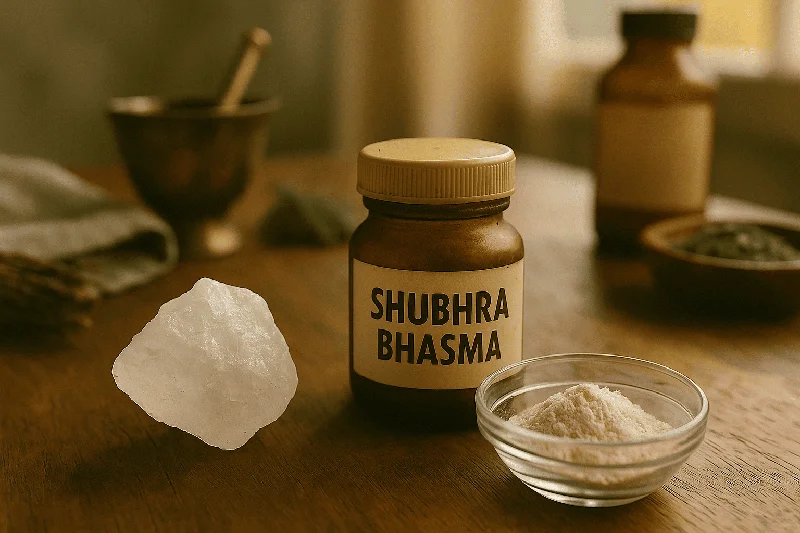
- Shubhra Bhasma is an Ayurvedic mineral formulation prepared from potash alum (Fitkari) through classical purification and incineration processes. Known widely as Sphatika Bhasma, Calx of Alum, Tuvari Bhasma, Kankshi Bhasma, or Phataki Bhasma, it has been used for centuries to manage respiratory disorders, bleeding conditions, skin diseases, and digestive complaints.
- This comprehensive guide covers everything you need to know — from its chemical composition and preparation method to its therapeutic benefits, dosage, safety concerns, and aspects that most other sources completely overlook.
What Is Shubhra Bhasma?
Shubhra Bhasma is a calcined ash (Bhasma) derived from aluminium potassium sulphate — commonly known as potash alum or Fitkari in Hindi. In Ayurvedic pharmacology, it falls under the category of Sudha Varga (mineral preparations), and its therapeutic value has been documented across multiple classical texts.
The word "Shubhra" translates to "white" or "bright" in Sanskrit, referring to the crystalline, white appearance of raw alum before processing. Once subjected to rigorous Shodhana (purification) and Marana (incineration), the raw alum transforms into a fine, biologically active powder that can be safely ingested in precise doses.
Synonyms and Alternative Names
Shubhra Bhasma goes by several names across different Ayurvedic traditions and regions:
| Name | Language / Context |
|---|---|
| Sphatika Bhasma | Sanskrit (most common synonym) |
| Tuvari Bhasma | Sanskrit |
| Kankshi Bhasma | Sanskrit |
| Phataki Bhasma | Regional Ayurvedic texts |
| Calx of Alum | English pharmacological name |
| Fitkari Bhasma | Hindi colloquial |
| Saurashtri Bhasma | Some classical references |
Historical Background and Classical References
Unlike many modern Ayurvedic products, Shubhra Bhasma has deep roots in classical literature. It finds detailed mention in Rasa Tarangini by Sadananda Sharma (a key 18th-century text on Rasa Shastra), where its Shodhana and Marana procedures are described with specific shlokas. References also appear in Rasa Ratna Samucchaya, one of the most authoritative treatises on Ayurvedic mineral processing, and in Ayurveda Prakasha.
- In Rasa Tarangini, Sphatika (alum) is classified under Maharasa or Uparasa categories depending on the edition, and its role in treating Raktapitta (bleeding disorders) and Kasa (cough) is highlighted extensively.
- These are not vague references — they include specific formulations, adjuvants (Anupana), and contraindications.
Chemical Formula and Composition
The primary ingredient of Shubhra Bhasma is potash alum with the chemical formula:
K₂SO₄·Al₂(SO₄)₃·24H₂O
This is essentially a double sulphate of aluminium and potassium, a hydrated salt. During the Marana process, the water of crystallization is driven off, and the compound undergoes thermal decomposition. The final Bhasma primarily contains aluminium oxide (Al₂O₃) and potassium sulphate (K₂SO₄) in a finely divided, biologically assimilable form.
How Is Shubhra Bhasma Prepared?
- The preparation of Shubhra Bhasma follows a two-stage classical process: Shodhana (purification) followed by Marana (incineration/calcination).
- Getting these steps right is absolutely critical — poorly prepared Bhasma can be ineffective or even harmful.
Shodhana (Purification Process)
Shodhana removes physical and chemical impurities from raw alum.
The general method described in classical texts involves:
- 1.Dissolution: Raw potash alum crystals are dissolved in clean water with gentle heating until fully liquefied.
- 2.Filtration: The solution is filtered through a clean cloth to remove insoluble impurities, debris, and foreign matter.
- 3.Recrystallization: The filtered solution is slowly cooled, allowing purified alum to recrystallize. This recrystallized alum is considered "Shuddha Sphatika" (purified alum).
- Some texts recommend repeating this cycle 3–7 times to ensure thorough purification.
- The medium used for Shodhana may vary — certain traditions use Kanji (fermented rice water) or lime water instead of plain water to enhance the purification.
Marana (Calcination / Incineration Process)
Marana converts the purified alum into Bhasma through controlled, high-temperature incineration:
- The purified alum is first heated in an iron vessel or earthen pot to dehydrate it completely, turning it into a white, spongy mass called Phatkari Phool (burnt alum).
- This dehydrated alum is then ground finely with specific herbal juices (Bhavana Dravya) — commonly Kumari Swarasa (aloe vera juice) or Nimbu Swarasa (lemon juice) — to form small pellets or cakes.
- These pellets are placed in a Sharava Samputa (two sealed earthen plates) and subjected to Gajaputa or Laghu Puta (specific grades of heat using dried cow dung cakes as fuel).
- After cooling, the product is retrieved, re-ground, and the process is repeated for multiple cycles (typically 3–7 Putas) until the Bhasma achieves the desired fineness and passes quality tests.
How to Identify a Well-Prepared Bhasma (Quality Tests)
This is something most sources completely ignore, yet it is perhaps the most practical information for consumers. Classical Ayurveda prescribes specific Bhasma Pariksha (quality tests):
- Varitara Test: A properly prepared Bhasma should float on the surface of water when gently sprinkled. If it sinks, it indicates incomplete calcination.
- Rekhapurna Test: When a small amount of Bhasma is rubbed between the thumb and index finger, it should enter the fine lines (dermatoglyphics) of the skin — indicating particle size finer than approximately 50 micrometers.
- Apunarbhava Test: The finished Bhasma should not revert to its metallic or crystalline form when heated with reducing agents. This confirms irreversible transformation.
- Nishchandratva: The Bhasma should be completely lusterless — no shiny or crystalline particles visible.
If you're purchasing Shubhra Bhasma commercially, choose products from manufacturers who follow GMP standards and ideally mention compliance with the Ayurvedic Pharmacopoeia of India (API).
What Are the Ayurvedic Properties of Shubhra Bhasma?
Understanding the Ayurvedic pharmacological profile (Dravyaguna) of Shubhra Bhasma helps practitioners determine when and how to prescribe it.
| Property (Sanskrit) | Description |
|---|---|
| Rasa (Taste) | Kashaya (Astringent), Madhura (Sweet), Amla (Sour) |
| Guna (Quality) | Laghu (Light), Ruksha (Dry) |
| Virya (Potency) | Sheeta (Cooling) |
| Vipaka (Post-digestive effect) | Katu (Pungent) |
| Dosha Karma | Primarily Kapha-Pitta Shamaka (pacifies Kapha and Pitta) |
Key Pharmacological Actions (Karma)
Classical Ayurvedic texts attribute numerous therapeutic actions to Shubhra Bhasma, including:
- Raktadoshahara — Blood purifier / corrects vitiated blood
- Kasahara — Alleviates cough
- Deepana — Enhances digestive fire
- Pachana — Aids digestion of Ama (toxins)
- Varnya — Improves complexion
- Shothahara — Anti-inflammatory
- Raktastambhana — Hemostatic (stops bleeding)
- Krimighna — Antimicrobial / antiparasitic
- Stambhana — Binding / astringent action on tissues
- Jwaraghna — Antipyretic
- Vedanasthapana — Analgesic
The cooling potency and astringent taste together explain why this Bhasma is particularly effective in Pitta-dominant bleeding disorders and inflammatory conditions.
What Is the Use of Shubhra Bhasma? (Therapeutic Benefits)
Shubhra Bhasma's therapeutic scope is remarkably wide. Below are its major indications, organized by system.
Respiratory Disorders
This is perhaps the most well-documented domain for Shubhra Bhasma.
It is used in:
- Chronic bronchitis and bronchial asthma — helps reduce mucus production and bronchospasm
- Whooping cough (Pertussis) — particularly useful in the spasmodic phase
- Chronic cough (Kasa) with thick, sticky sputum
- Pneumonia — classical texts describe its use across different stages
Shubhra Bhasma in Different Stages of Pneumonia
An interesting classical application involves stage-specific use in pneumonia:
| Stage | Pathology | Role of Shubhra Bhasma |
|---|---|---|
| Consolidation | Lung tissue begins to fill with fluid | Early intervention to reduce Kapha accumulation |
| Red Hepatization | Lungs become red and liver-like due to blood infiltration | Combined with Pitta-pacifying adjuvants |
| Grey Hepatization | RBC breakdown, fibrin deposition | Helps in resolution of inflammatory exudate |
| Resolution | Gradual clearing | Supports recovery and prevents recurrence |
For respiratory conditions, it is often combined with Sitopaladi Churna, honey, or Vasavaleha as adjuvants.
Bleeding Disorders (Hemostatic Action)
Shubhra Bhasma's astringent and cooling properties make it highly effective in managing various types of bleeding:
- Menorrhagia (heavy menstrual bleeding) — combined with Praval Pishti and Ashokarishta
- Metrorrhagia (intermenstrual bleeding)
- Epistaxis (nosebleeds / Nasagata Raktapitta)
- Bleeding hemorrhoids (Raktarsha) — often prescribed with Bolbaddha Ras
- Hemoptysis (coughing up blood)
- Hematuria (blood in urine)
The mechanism here relates to its Raktastambhana (hemostatic) and Sheeta Virya (cooling potency) which constricts blood vessels and promotes clot formation.
Skin Diseases
Shubhra Bhasma is used both internally and externally for skin conditions:
- Eczema — internal use combined with topical application mixed with coconut oil
- Herpes (Visarpa) — reduces vesicle formation and pain
- Vitiligo / Leucoderma (Shwitra) — long-term use as part of multi-drug protocols
- Non-healing wounds and ulcers — external dusting promotes granulation
- Itching and allergic dermatitis
Can Sphatika Bhasma Be Used Externally?
Yes. For external use, Shubhra Bhasma can be mixed with appropriate bases:
- For wounds: Dusted directly as a fine powder or mixed with ghee
- For eczema and itching: Mixed with coconut oil or sesame oil for local application
- For leucorrhea (Shweta Pradara): Used in vaginal douche preparations under practitioner supervision
- For ear discharge (Otorrhoea): Insufflated in very small quantities into the ear canal after cleaning
Digestive Disorders
- Hyperacidity (Amlapitta) — the cooling and astringent properties neutralize excess Pitta
- Abdominal distension and bloating
- Chronic diarrhea — owing to its Stambhana (binding) action
- Loss of appetite — acts as a Deepana (appetizer)
Gynecological Conditions
Beyond menstrual bleeding, Shubhra Bhasma addresses:
- Irregular menstruation — combined with Ashokarishta and Praval Pishti
- Leucorrhea — both oral and external routes
- Uterine debility — as a supporting formulation
Abdominal Pain in Lead Poisoning
A less commonly known but clinically significant use — described in Rasa Tarangini and other texts — involves treating abdominal colic from lead intoxication. Shubhra Bhasma is combined with Karpur (camphor) and Ahiphena (opium, used in micro-doses historically) along with laxatives like Swadishta Virechan Churna or Panchsakar Churna to relieve the intense colicky pain. This is a specialized application strictly under expert supervision.
Blood Purification and Detoxification
Shubhra Bhasma's Raktadoshahara property positions it as a blood purifier in Ayurvedic practice. It is believed to remove Ama (metabolic toxins) from the blood, which underlies its benefit across skin diseases, bleeding disorders, and chronic infections.
Dosage and Method of Administration
Standard Adult Dosage
The typical therapeutic dose of Shubhra Bhasma is:
125 mg to 250 mg (approximately 1–2 Ratti), once or twice daily
It should always be taken with a suitable Anupana (vehicle/adjuvant), which varies based on the condition being treated:
| Condition | Anupana (Vehicle) |
|---|---|
| Cough and asthma | Honey + Sitopaladi Churna |
| Bleeding disorders | Honey + Praval Pishti |
| Hyperacidity | Honey + Yashtimadhu Churna |
| Skin diseases | Ghee or warm milk |
| Diarrhea | Buttermilk or curd |
| Menstrual disorders | Ashokarishta or Lodhra Kwatha |
Dosage for Children
For children above 5 years, the dose is generally reduced to 65 mg to 125 mg, given with honey. It should not be administered to infants without explicit guidance from a qualified Ayurvedic practitioner. For children below 5, most practitioners prefer to avoid mineral Bhasmas altogether unless absolutely necessary.
Dosage for Elderly Patients
Elderly patients, particularly those with compromised renal or hepatic function, should start at the lowest effective dose (125 mg once daily) and be monitored regularly.
Side Effects and Safety Concerns
Known Side Effects
When taken in prescribed doses and for appropriate durations, Shubhra Bhasma is generally well tolerated. However, excessive dosage or prolonged unsupervised use can lead to:
- Dryness of mouth (Mukha Shosha)
- Gastritis and stomach irritation
- Intestinal inflammation in sensitive individuals
- Nausea and occasional vomiting
- Ulceration of mucous membranes with overdose
- Constipation due to its astringent, binding nature
The Aluminium Safety Question
Here's something no other Ayurvedic source seems to address — and it's an important topic.
Shubhra Bhasma is derived from aluminium potassium sulphate, which means the final product contains aluminium compounds. In Western toxicology, chronic aluminium exposure has been linked to concerns about:
- Neurotoxicity and potential association with neurodegenerative conditions
- Renal accumulation in patients with compromised kidney function
- Bone metabolism disruption with long-term exposure
However, several factors provide context:
- Dose matters enormously. The therapeutic dose of Shubhra Bhasma (125–250 mg) contains far less aluminium than what many people ingest daily through antacids, processed food, or cookware.
- Bhasma processing transforms the compound. Classical Marana is not simple heating — repeated cycles of grinding, levigation with herbal juices, and high-temperature calcination alter the particle size to nano-level and potentially change bioavailability and toxicity profiles. A 2017 study published in the Journal of Ayurveda and Integrative Medicine demonstrated that properly prepared Bhasmas have distinct physicochemical properties compared to their raw mineral sources.
- Duration of use is typically short. Traditional Ayurvedic practice prescribes Shubhra Bhasma for limited periods (typically 2–8 weeks), not as a lifelong supplement.
- Patients with kidney disease should exercise extra caution. Impaired renal clearance could lead to aluminium accumulation.
The bottom line: while the theoretical concern is valid, properly prepared Shubhra Bhasma used in correct doses for short durations under medical supervision is considered safe in the Ayurvedic tradition. But patients should still discuss this with their practitioner, especially if they have pre-existing kidney or neurological conditions.
Is Shubhra Bhasma Safe During Pregnancy and Lactation?
Pregnancy: Generally not recommended unless specifically prescribed by an experienced Ayurvedic physician who can weigh the risk-benefit ratio. The astringent and drying properties could potentially affect fetal development or uterine tone. Lactation: Limited safety data available. Most practitioners advise avoiding it during breastfeeding as a precautionary measure.
Interaction with Modern (Allopathic) Medicines
Another significant gap in existing literature. While no formal drug-interaction studies exist specifically for Shubhra Bhasma, the following theoretical interactions should be considered:
- Antacids containing aluminium: Concurrent use may increase total aluminium intake.
- Tetracycline and fluoroquinolone antibiotics: Aluminium compounds can chelate these antibiotics and reduce their absorption.
- Iron supplements: Aluminium can interfere with iron absorption.
- Cardiac glycosides (Digoxin): Altered gastrointestinal motility from Bhasma could theoretically affect drug absorption.
- Anticoagulants (Warfarin): Since Shubhra Bhasma has hemostatic properties, it may counteract anticoagulant therapy.
Practical advice: Maintain a gap of at least 2 hours between Shubhra Bhasma and any allopathic medication. Always inform both your Ayurvedic and allopathic doctors about all medicines you're taking.
Shubhra Bhasma vs Other Bhasmas: A Comparative Overview
To help you understand where Shubhra Bhasma fits among commonly used mineral Bhasmas, here's a side-by-side comparison:
| Parameter | Shubhra Bhasma | Tankan Bhasma | Kapardika Bhasma | Mukta Bhasma |
|---|---|---|---|---|
| Source | Potash Alum | Borax | Cowrie Shell | Pearl |
| Primary Action | Hemostatic, Astringent | Expectorant, Mucolytic | Antacid, Digestive | Antacid, Calcium supplement |
| Key Indications | Bleeding, cough, skin | Cough with thick mucus, oral diseases | Hyperacidity, GERD | Acidity, anxiety, calcium deficiency |
| Virya | Sheeta (Cool) | Ushna (Hot) | Sheeta (Cool) | Sheeta (Cool) |
| Dosha Action | Kapha-Pitta Shamaka | Kapha-Vata Shamaka | Pitta Shamaka | Pitta Shamaka |
| Approximate Dose | 125–250 mg | 125–250 mg | 250–500 mg | 30–125 mg |
| Cost Range | ₹80–₹200 (10 gm) | ₹50–₹150 (10 gm) | ₹60–₹120 (10 gm) | ₹300–₹1,500 (1–5 gm) |
This comparison makes it clear that while all these are mineral Bhasmas, their indications and mechanisms differ significantly. Shubhra Bhasma's unique combination of hemostatic and anti-Kapha actions sets it apart.
Storage, Shelf Life, and Diet Recommendations
Storage Conditions
- Store in amber-colored glass bottles or food-grade airtight containers
- Keep in a cool, dry place away from direct sunlight and moisture
- Do not store in plastic or metal containers as these can react with the Bhasma over time
- Keep out of reach of children
Shelf Life
- When stored properly, Shubhra Bhasma retains its potency for an indefinite period according to most Ayurvedic texts.
- The classical principle states: "Bhasma does not expire if properly prepared and stored." However, modern GMP-certified manufacturers typically print a shelf life of 5 years on commercial products.
Pathya-Apathya (Diet and Lifestyle Guidelines)
During Shubhra Bhasma therapy, following Pathya (beneficial practices) and avoiding Apathya (harmful ones) can significantly enhance results:
Recommended (Pathya):
- Light, easily digestible food (Khichdi, moong dal, rice)
- Warm water throughout the day
- Seasonal fruits, especially Amla (Indian gooseberry)
- Adequate rest during respiratory illness
To Be Avoided (Apathya):
- Spicy, sour, and excessively salty food
- Cold beverages and ice cream
- Heavy, fried foods
- Excessive physical exertion during active bleeding conditions
- Alcohol and smoking (which aggravate both Pitta and Kapha)
Available Brands and Price Range
Several reputable Ayurvedic manufacturers produce Shubhra Bhasma / Sphatika Bhasma in India:
| Brand | Quantity | Approximate Price (₹) |
|---|---|---|
| Krishna Gopal Ayurved Bhawan | 10 gm | ₹80–₹120 |
| Sadhana Ayurvedics | 10 gm | ₹100–₹150 |
| Uma Ayurveda | 10 gm | ₹90–₹140 |
| Baidyanath | 10 gm | ₹100–₹180 |
| Dabur (if available) | 5 gm | ₹80–₹130 |
Always purchase from licensed pharmacies or authorised online retailers. Look for the AYUSH license number on the packaging and verify the manufacturing date.
Frequently Asked Questions (FAQ)
What is the difference between Shubhra Bhasma and Sphatika Bhasma?
There is no difference. Shubhra Bhasma and Sphatika Bhasma are two names for the exact same formulation — both refer to the calcined ash of potash alum. The name used depends on the regional tradition or classical text being followed. Some texts use "Shubhra" while others prefer "Sphatika."
Can Sphatika Bhasma be used for skin conditions?
Yes, it can be used both internally and externally for various skin conditions including eczema, vitiligo, herpes, dermatitis, and non-healing wounds. For internal use, it is typically taken with ghee or milk. For external application, it is mixed with coconut oil or applied as a fine powder directly on ulcers and wounds to promote healing.
How is Sphatika Bhasma traditionally applied to wounds?
The Bhasma is dusted directly onto clean wound surfaces as a fine powder. Its strong astringent action constricts blood vessels, stops bleeding, and creates a protective layer that promotes granulation tissue formation. For deeper wounds, it may be mixed with ghee and applied as a paste. In all cases, basic wound hygiene should be maintained.
Are there any precautions or contraindications associated with Sphatika Bhasma?
- Yes. It should be avoided or used cautiously in patients with chronic kidney disease, known aluminium sensitivity, or severe dehydration. It is generally not advised during pregnancy. Overdose can cause gastric irritation, dry mouth, constipation, and mucosal ulceration.
- Never self-prescribe — always consult a qualified Ayurvedic practitioner.
How long does it take for Shubhra Bhasma to show results?
This depends on the condition. For acute cough and respiratory issues, relief may be noticeable within 3–5 days. For bleeding disorders, improvement is often seen within 1–2 weeks. Chronic conditions like vitiligo or eczema may require 4–8 weeks of consistent therapy alongside dietary and lifestyle modifications.
What is the relation between Shubhra Bhasma and Chandraprabha Vati?
While both are Ayurvedic formulations, they are distinct preparations. Chandraprabha Vati is a multi-ingredient tablet used primarily for urinary disorders, diabetes, and reproductive health. However, some classical formulations of Chandraprabha Vati do include Shubhra (alum) as one of their ingredients, which contributes to its astringent and detoxifying properties.
Conclusion: Is Shubhra Bhasma Right for You?
Shubhra Bhasma stands out as a versatile, time-tested Ayurvedic mineral preparation with a remarkable range of therapeutic applications — from stubborn respiratory conditions and uncontrollable bleeding to chronic skin diseases and digestive complaints. Its documented history in classical texts like Rasa Tarangini, combined with its well-defined preparation protocols and quality parameters, gives it a level of credibility that few mineral formulations can match.
That said, it is not a casual supplement to be taken without guidance. The aluminium content, potential for side effects with misuse, and interactions with modern medicines make qualified medical supervision essential.
If you're considering Shubhra Bhasma for any health condition, consult a registered Ayurvedic practitioner (BAMS or MD Ayurveda) who can evaluate your Prakriti, current health status, and specific needs before prescribing an appropriate dose and duration. Self-medication with any Bhasma is strongly discouraged.
Disclaimer: This article is for informational purposes only and should not be considered medical advice. Always consult a qualified healthcare professional before starting any new treatment.
Scientific Sources
- Current Strategies and Drug Targets in the Management of Type 2 Diabetes Mellitus — Kaur P et al., 2018, Current drug targets
- Edible rose flowers: A doorway to gastronomic and nutraceutical research — Hegde AS et al., 2022, Food research international (Ottawa, Ont.)
- Modulation of gut microbiota with Ayurveda diet and lifestyle: A review on its possible way to treat type 2 diabetes — Chauhan A et al., 2022, Ayu
- Strengthening AYUSH Integration with Preventive Medicine — Saxena V et al., 2024, Indian journal of community medicine : official publication of Indian Association of Preventive & Social Medicine
- Ayurveda management of pulmonary mycosis: an integrative approach: a case report — Shankar P et al., 2023, Journal of medical case reports
- Mapping the Mind-Body Connections: A Two-decade Bibliometric Exploration of Yoga and Psychoneuroimmunology — Dhanasekar H et al., 2026, Annals of neurosciences
- Ritucharya: Answer to the lifestyle disorders — Thakkar J et al., 2011, Ayu
- Recognizing novel drugs against Keap1 in Alzheimer's disease using machine learning grounded computational studies — Mukerjee N et al., 2022, Frontiers in molecular neuroscience
- Neuroadaptability and Habit: Modern Medicine and Ayurveda — Wallace RK et al., 2021, Medicina (Kaunas, Lithuania)
- Plant- and Nutraceutical-based Approach for the Management of Diabetes and its Neurological Complications: A Narrative Review — Öztürk Y et al., 2019, Current pharmaceutical design
- Ayurvedic management of neurological deficits post COVID-19 vaccination - A report of two cases — Pratap Shankar KM et al., 2023, Journal of Ayurveda and integrative medicine
- A review of antidiabetic active thiosugar sulfoniums, salacinol and neokotalanol, from plants of the genus Salacia — Morikawa T et al., 2021, Journal of natural medicines
- Investigating Ayurvedic Strategies: An In-Depth Examination of Managing Diabetes across Different Types — Balkrishna A et al., 2025, Current diabetes reviews
- Why the "sugars" in traditional Unani formulations are a pivotal component: A viewpoint perspective — Fazil M et al., 2022, Journal of integrative medicine
- MicroRNAs: Key modulators of inflammation-associated diseases — Chatterjee B et al., 2024, Seminars in cell & developmental biology
- Some excerpts from Charaka Samhita - An ancient treatise on Ayurveda & healthy living — Katiyar CK et al., 2017, Journal of ethnopharmacology
- Diet and lifestyle-related factors associated with Apathyanimittaja Prameha (type 2 diabetes): A cross-sectional survey study — Shukla A et al., 2018, Ayu
- Ayurveda and Epigenetics — Sharma H et al., 2020, Medicina (Kaunas, Lithuania)
- Reversal of type 2 diabetes mellitus through integrated Ayurveda dietary protocol - A case report — Kumari S et al., 2024, Journal of Ayurveda and integrative medicine
- Efficacy of Sharapunkhadi powder (a polyherbal formulation) and lifestyle modification in the management of nonalcoholic fatty liver disease-A randomized placebo-controlled clinical trial — Remya E et al., 2020, Ayu
Ask Ayurvedic doctor a question and get a consultation online on the problem of your concern in a free or paid mode.
More than 2,000 experienced doctors work and wait for your questions on our site and help users to solve their health problems every day.
Related articles