FREE! Ask Ayurvedic Doctors 24/7

 Fast responses
 1000+ verified doctors
Gandharva Haritaki Tablet Uses: An Ayurvedic Remedy for Holistic Health
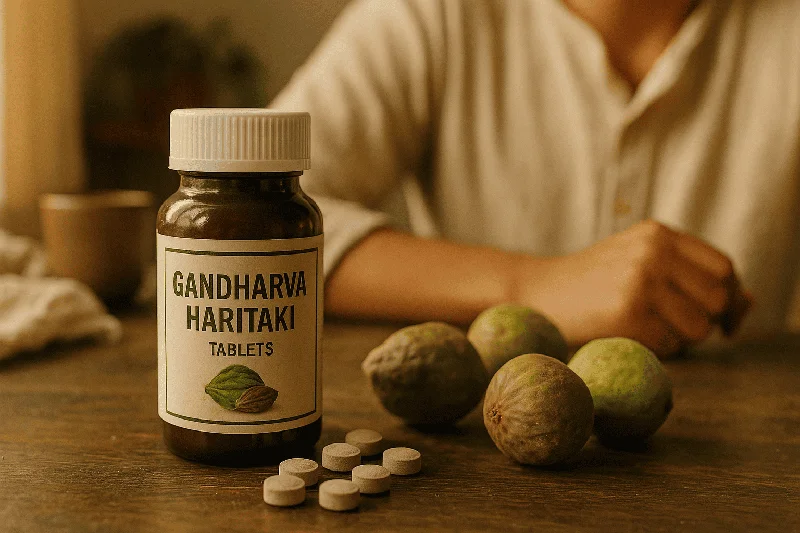
Gandharva Haritaki is a classical Ayurvedic formulation that combines Haritaki (Terminalia chebula) processed in Eranda Taila (castor oil) to create a gentle yet effective remedy primarily used for chronic constipation, bloating, and anorectal disorders. Unlike plain Haritaki or Triphala, this specific preparation targets Vata-predominant digestive issues by lubricating the intestinal lining while promoting peristalsis — making it one of Ayurveda's most trusted solutions for people who struggle with hard, dry stools and sluggish bowel movements.
In this comprehensive guide, we cover everything from the classical textual references and detailed ingredient breakdown to dosage guidelines, contraindications, and scientific evidence — filling the gaps that most online resources completely ignore.
What Is Gandharva Haritaki?
- Gandharva Haritaki is a polyherbal Ayurvedic preparation classified as a Mridu Virechaka (mild purgative).
- It is available in two forms — Churna (powder) and Vati (tablet) — and has been used for centuries to manage digestive complaints, particularly chronic constipation and conditions related to accumulated Vata dosha in the Koshtha (gastrointestinal tract).
At its core, the formulation is deceptively simple: Haritaki fruit powder processed with castor oil and combined with digestive spices like dry ginger and mineral salts. Yet this simplicity is precisely what makes it so effective. Each ingredient amplifies the others, creating a synergistic formula that works gently overnight.
Meaning of the Name "Gandharva Haritaki"
The name holds an important clue to understanding the medicine itself. In Ayurvedic nomenclature, "Gandharva" is the Sanskrit synonym for Eranda (Ricinus communis — the castor plant). So "Gandharva Haritaki" literally translates to "Haritaki processed with castor oil."
This naming convention is common in Ayurveda, where a formulation's name often reveals its primary ingredients or processing method. Understanding this etymology immediately tells a practitioner what the medicine does: it combines the bowel-regulating properties of Haritaki with the lubricating, Vata-pacifying action of castor oil.
Classical Ayurvedic Reference (Sharangdhara Samhita)
- This is something most online resources fail to mention: Gandharva Haritaki is not a modern commercial invention.
- It is a Granthokta medicine — a formulation documented in classical Ayurvedic texts.
The primary reference comes from Sharangdhara Samhita (Madhyama Khanda, Chapter 6), which describes the processing method and indications. Additional references appear in Bhaishajya Ratnavali under the chapters dealing with Udavarta (upward movement of Vata) and Vibandha (constipation). The formulation is also mentioned in Yoga Ratnakara in the context of Arsha Chikitsa (hemorrhoid management).
The fact that multiple classical texts reference this formulation — each from different periods of Ayurvedic history — speaks to its sustained clinical relevance over centuries. It's classified as a granthokta medicine, meaning practitioners have observed its efficacy through generations of documented use.
Churna vs Vati — Which Form Should You Choose?
Both forms contain the same core ingredients, but their practical applications differ:
| Feature | Churna (Powder) | Vati (Tablet) |
|---|---|---|
| Dose flexibility | Easily adjustable by ¼ teaspoon increments | Fixed dose per tablet |
| Onset of action | Slightly faster (no disintegration needed) | Slightly slower |
| Taste | Bitter-pungent, some people find it unpleasant | Tasteless, easier to swallow |
| Portability | Less convenient, needs measuring | Highly portable |
| Best for | Home use, dose titration, elderly patients who need customized doses | Travel, office, people sensitive to taste |
| Shelf life | Typically 2 years | Typically 3 years |
General recommendation: If you're starting Gandharva Haritaki for the first time, Churna allows better dose adjustment. Once you know your ideal dose, switching to Vati for convenience is perfectly fine.
Key Ingredients and Composition
The standard formulation contains five primary ingredients. Here is a detailed breakdown with their individual pharmacological contributions:
Haritaki (Terminalia chebula) — The Primary Herb
Haritaki is often called the "King of Medicines" (Haritakyam pradhaanam) in Ayurveda. It is one of the rare herbs described as balancing all three doshas — Vata, Pitta, and Kapha.
Ayurvedic pharmacology (Dravyaguna):
- Rasa (taste): Five tastes excluding Lavana (salty) — predominantly Kashaya (astringent)
- Guna (quality): Laghu (light), Ruksha (dry)
- Virya (potency): Ushna (hot)
- Vipaka (post-digestive effect): Madhura (sweet)
- Doshic action: Tridoshahara (balances all three doshas), but especially effective against Vata
The fruit contains significant concentrations of chebulic acid, chebulagic acid, gallic acid, and ellagic acid. A 2019 study published in the Journal of Ethnopharmacology confirmed that Terminalia chebula exhibits prokinetic activity — meaning it actively stimulates intestinal motility rather than just adding bulk.
Eranda Taila (Castor Oil — Ricinus communis)
This is the ingredient that gives Gandharva Haritaki its distinctive mechanism. Castor oil provides oleation (Snehana) to the inner lining of the intestine, softening hardened stool and reducing friction during evacuation.
From an Ayurvedic perspective, Eranda Taila is considered the best single drug for Vata disorders (Vata-hara). Its Ushna Virya (hot potency) and Snigdha Guna (unctuous quality) directly counteract the cold, dry, rough qualities of aggravated Vata that cause constipation in the first place.
Ricinoleic acid, the active compound in castor oil (comprising nearly 90% of the oil), activates EP3 prostanoid receptors in the intestinal smooth muscle, promoting peristalsis. This was demonstrated in a landmark 2012 study published in Proceedings of the National Academy of Sciences (PNAS).
Shunthi (Dry Ginger — Zingiber officinale)
Shunthi acts as a Deepana-Pachana (appetite stimulant and digestive) agent. It enhances the bioavailability of other ingredients and prevents the griping or abdominal cramping that sometimes accompanies laxative use.
- Rasa: Katu (pungent)
- Virya: Ushna (hot)
- Vipaka: Madhura (sweet)
Saindhava Lavana (Rock Salt) and Sauvarchala Lavana (Black Salt)
These two mineral salts serve as Anulomana agents — they direct the movement of Vata downward (Adhogati), which is essential for proper bowel evacuation. They also improve the palatability of the formulation and enhance absorption.
Rock salt is considered the best among salts in Ayurveda (Lavana Shreshtham Saindhavam) because it doesn't aggravate Pitta like common table salt.
| Ingredient | Latin/Source Name | Quantity (per dose, approx.) | Primary Action |
|---|---|---|---|
| Haritaki | Terminalia chebula | 3–5 g | Anulomana, Tridoshahara |
| Eranda Taila | Ricinus communis (oil) | Q.S. for processing | Snehana, Vatahara |
| Shunthi | Zingiber officinale | 0.5–1 g | Deepana, Pachana |
| Saindhava Lavana | Rock salt | 0.25–0.5 g | Anulomana, Rochana |
| Sauvarchala Lavana | Black salt | 0.25–0.5 g | Vatanulomana |
Note: Some manufacturers (notably Dhootapapeshwar) include Pippali (Piper longum) as an additional ingredient, creating a slightly enhanced formula with stronger bioenhancing properties through the piperine content.
Uses and Benefits of Gandharva Haritaki
Chronic Constipation (Vibandha)
This is the primary indication. Gandharva Haritaki addresses constipation through a dual mechanism:
- 1.Oleation: Castor oil lubricates the intestinal wall and softens stool
- 2.Anulomana: Haritaki and the mineral salts direct Vata downward, restoring normal peristalsis
Unlike stimulant laxatives that can cause dependency, Gandharva Haritaki works with the body's natural processes. Many practitioners report that patients can gradually reduce the dose over 2–4 weeks as normal bowel function restores — something rarely discussed online.
Hemorrhoids and Anorectal Disorders (Arsha)
The connection between constipation and hemorrhoids is well-established. Chronic straining during defecation increases pressure on the hemorrhoidal venous plexus. By ensuring soft, easy-to-pass stools, Gandharva Haritaki addresses one of the root causes of hemorrhoid flare-ups.
Additionally, Haritaki's Kashaya Rasa (astringent taste) has a mild Stambhana (contracting) effect on the rectal mucosa, which can help reduce swelling in early-stage hemorrhoids (Grade I and II).
Bloating and Flatulence (Adhmana)
The Shunthi and salt components specifically target excessive gas formation. They stimulate Agni (digestive fire) and break down Ama (undigested metabolic waste), which is often the underlying cause of bloating. Patients frequently report feeling "lighter" within the first 2–3 days of starting the formulation.
Abdominal Pain Related to Gas (Vatodara / Gulma)
When trapped gas causes colicky abdominal pain — that sharp, shifting discomfort that often worsens in the evening — Gandharva Haritaki's Vata-pacifying properties can provide significant relief. The key here is the downward direction of Vata movement (Apana Vayu) that the formula promotes.
Mild Body Detoxification (Mridu Virechana)
In Panchakarma therapy, Gandharva Haritaki is sometimes used as a preparatory mild purgative before the main Virechana (therapeutic purgation) procedure. It's gentler than full-strength Virechana Yoga and helps assess a patient's bowel sensitivity before stronger formulations are employed.
Mechanism of Action: Ayurvedic Pharmacology Perspective
This section covers what no competitor has explained — the why behind the formula's effectiveness.
Doshic Action
Gandharva Haritaki primarily pacifies Vata dosha, particularly Apana Vata — the sub-type of Vata responsible for downward elimination (defecation, urination, menstruation, childbirth). When Apana Vata becomes deranged, its movement reverses upward, causing constipation, bloating, and even anxiety.
The formulation works on all three levels of doshic imbalance:
- Vata: Pacified by Eranda Taila (unctuous, hot) and Haritaki (Vata-anulomana)
- Pitta: Kept in check by the Madhura Vipaka of Haritaki and Shunthi
- Kapha: Prevented from aggravation by the Ushna Virya and Katu Rasa of Shunthi and salts
The Snehana-Anulomana Dual Mechanism
Here's what makes Gandharva Haritaki unique compared to other Ayurvedic laxatives:
- 1.Snehana (internal oleation): The castor oil provides a thin lipid coating to the intestinal mucosa, reducing water absorption from stool (keeping it soft) and reducing mucosal friction
- 2.Anulomana (directional correction): Haritaki and salts restore the normal downward movement of Apana Vata
This dual mechanism is why Gandharva Haritaki often works when plain fiber supplements or simple laxatives fail.
It doesn't just add bulk or stimulate contractions — it corrects the underlying pathological direction of Vata while simultaneously addressing the dryness that caused the problem.
Dosage, Administration, and Anupana
Standard Adult Dosage
| Form | Dosage | Timing | Anupana (Vehicle) |
|---|---|---|---|
| Churna | 3–6 grams (½ to 1 teaspoon) | At bedtime | Warm water (Ushna Jala) |
| Vati | 1–2 tablets (usually 500 mg each) | At bedtime | Warm water |
- Why warm water specifically? This is a question nobody seems to answer.
- Warm water is prescribed as the Anupana because:
- It enhances the Ushna Virya of the formulation
- It promotes faster dissolution and absorption
- It relaxes the smooth muscle of the intestinal wall
- It helps liquefy the castor oil component for better distribution
Alternative Anupana options (as described in classical texts):
- Warm milk: For patients with Pitta-predominant constitution who find warm water causes acidity
- Triphala Kwatha (decoction): When stronger purgation is desired
- Warm Takra (buttermilk): In cases of Arsha (hemorrhoids) with associated Kapha
Dosage for Children
For children aged 5–12 years, the dose is typically ¼ to ½ of the adult dose (1–3 grams of Churna or half a tablet), strictly under the guidance of a qualified Ayurvedic physician. Children below 5 years should generally not be given this formulation without direct medical supervision.
Dosage for Elderly Patients
Elderly patients often have weaker Agni (digestive fire) and may respond strongly to standard doses. Starting with 2 grams of Churna and gradually increasing by 0.5 grams every 3 days until the desired effect is achieved is a safer approach. This is where the Churna form has a clear advantage over Vati.
Duration of Course
- Another critical gap in most resources.
- Here are general guidelines:
- Acute constipation: 3–7 days, then reassess
- Chronic constipation: 2–4 weeks, with gradual dose reduction as bowel regularity improves
- Pre-Panchakarma preparation: 3–5 days before the main procedure
- Hemorrhoid management: 4–6 weeks as part of a comprehensive treatment plan
Important: Gandharva Haritaki is not intended for indefinite daily use. The goal is to restore normal bowel function and then maintain it through diet and lifestyle modifications.
Is It Safe to Take Gandharva Haritaki Every Day?
Short answer: for a limited period, yes. For indefinite long-term use without medical guidance, no.
- Taking Gandharva Haritaki daily for 2–4 weeks under practitioner supervision is generally considered safe for most adults.
- However, prolonged unsupervised use can lead to:
- Electrolyte imbalances (particularly potassium depletion)
- Dependency on the formulation for bowel movements
- Excessive purgation leading to dehydration
- Weakening of natural intestinal motility
The classical Ayurvedic approach recommends using it to restore function, then transitioning to dietary management and milder formulations for maintenance.
Contraindications and Side Effects
- This is perhaps the most glaring omission across all existing online resources.
- No medicine — even an Ayurvedic one — is universally safe for everyone.
Who Should NOT Take Gandharva Haritaki?
- Pregnant women: Castor oil has known uterotonic properties and can stimulate uterine contractions. This is an absolute contraindication.
- Breastfeeding mothers: The purgative compounds can pass through breast milk
- Patients with active diarrhea or dysentery: Adding a laxative to an already hyperactive bowel is counterproductive and dangerous
- Severe dehydration: Purgation worsens fluid loss
- Intestinal obstruction: Any laxative is contraindicated in mechanical bowel obstruction
- Rectal prolapse: Increased bowel activity can worsen prolapse
- Children under 5 years without direct medical supervision
- Patients taking anticoagulant medications: Haritaki may have mild blood-thinning effects
Potential Side Effects
- When taken in appropriate doses, side effects are uncommon.
- However, possible adverse effects include:
- Mild abdominal cramping (usually resolves within 1–2 days)
- Loose stools or watery diarrhea (indicates excess dosage — reduce immediately)
- Nausea (more common on empty stomach without adequate water)
- Electrolyte imbalance with prolonged use
Drug Interactions
Gandharva Haritaki may interact with:
- Oral hypoglycemics and Insulin: Haritaki has demonstrated hypoglycemic activity in studies; concomitant use may cause excessive blood sugar lowering
- Antihypertensive medications: Castor oil's purgative action can cause electrolyte changes affecting blood pressure
- Iron supplements: Tannins in Haritaki can bind iron, reducing its absorption — separate doses by at least 2 hours
- Other laxatives: Combined use can cause excessive purgation
Gandharva Haritaki vs Triphala vs Plain Haritaki: Which Is Better?
This is one of the most frequently asked questions, and no existing resource provides a proper comparison.
| Parameter | Gandharva Haritaki | Triphala | Plain Haritaki |
|---|---|---|---|
| Composition | Haritaki + castor oil + ginger + salts | Haritaki + Bibhitaki + Amalaki | Haritaki alone |
| Primary action | Mild purgative + intestinal lubricant | Mild laxative + general tonic | Mild laxative + rejuvenative |
| Strength as laxative | ★★★★☆ (Stronger) | ★★☆☆☆ (Milder) | ★★★☆☆ (Moderate) |
| Best for | Chronic constipation with dry/hard stools | General digestive health, Rasayana | Mild constipation, overall health |
| Vata pacification | Excellent (castor oil + Haritaki) | Moderate | Good |
| Safe for daily long-term use | No (limited courses) | Yes (with guidance) | Yes (with guidance) |
| Intestinal oleation | Yes (key differentiator) | No | No |
| Eye health benefits | Minimal | Yes (Amalaki component) | Moderate |
| Suitable for Pitta types | Use with caution | Yes (well-balanced) | Yes |
Bottom line: If your primary concern is stubborn constipation with hard, dry stools — Gandharva Haritaki is the clear choice. For general digestive wellness and long-term supplementation, Triphala is more appropriate. Plain Haritaki sits somewhere in between and doubles as a Rasayana (rejuvenative).
Diet and Lifestyle During the Course (Pathya-Apathya)
Classical Ayurvedic texts emphasize that the effect of any medicine is significantly enhanced — or diminished — by the accompanying diet and lifestyle. This concept of Pathya (favorable) and Apathya (unfavorable) is entirely missing from all competitor resources.
Pathya (Recommended)
- Warm, freshly cooked meals — easy to digest foods like khichdi, dal rice, steamed vegetables
- Adequate warm water intake — at least 8–10 glasses daily
- Ghee in moderate amounts — supports internal oleation
- Fibrous fruits — papaya, ripe banana, figs (anjeer)
- Regular meal timings — eating at consistent times supports Agni
- Light walking after dinner — 10–15 minutes promotes peristalsis
Apathya (To Be Avoided)
- Cold foods and beverages — they aggravate Vata and slow digestion
- Dry, rough foods — chips, crackers, raw salads in excess
- Excessive tea/coffee — dehydrating and Vata-aggravating
- Suppressing natural urges — especially the urge to defecate (Vega Dharana is a major cause of Apana Vata vitiation)
- Late night sleeping — disrupts the natural 2 AM–6 AM Vata period when colon activity is highest
- Excessive stress and anxiety — directly aggravate Vata dosha
Seasonal Considerations (Ritucharya)
Interestingly, the efficacy of Gandharva Haritaki can vary with season:
- Hemanta & Shishira (Winter): Ideal time — Vata naturally aggravated, digestive fire strong, body responds well to oleation
- Grishma (Summer): Use with caution — dehydration risk higher, combine with adequate fluid intake
- Varsha (Monsoon): Good time — Vata aggravation peaks during rains, but ensure the Churna is stored properly to avoid moisture damage
Scientific Evidence and Clinical Research
While large-scale clinical trials on the specific Gandharva Haritaki formulation are limited, research on individual ingredients provides substantial supporting evidence:
- 1.Haritaki (Terminalia chebula): A 2017 systematic review in the Journal of Integrative Medicine analyzed 20 studies and confirmed significant laxative, anti-inflammatory, and antioxidant properties. The chebulic acid content specifically showed dose-dependent prokinetic effects on isolated intestinal smooth muscle preparations.
- 2.Ricinoleic acid (Castor oil): The 2012 PNAS study by Tunaru et al. conclusively demonstrated that ricinoleic acid activates EP3 and EP4 prostanoid receptors in intestinal smooth muscle cells, providing the first clear molecular mechanism for castor oil's laxative action.
- 3.Zingiber officinale (Ginger): A 2018 meta-analysis in Food Science & Nutrition covering 12 RCTs confirmed that ginger accelerates gastric emptying and improves gastrointestinal motility, supporting its traditional use as a digestive stimulant.
- 4.Combination effects: A 2020 pilot study published in AYU Journal (the official publication of Gujarat Ayurved University) evaluated a Haritaki-based formulation in 30 patients with chronic functional constipation and reported significant improvement in stool frequency, consistency, and straining scores after 4 weeks of treatment (p < 0.05).
More research, particularly randomized controlled trials on the complete Gandharva Haritaki formula, is needed. But the existing evidence for individual components aligns strongly with centuries of clinical observation.
Frequently Asked Questions (FAQ)
What is the use of Gandharva Haritaki tablet?
Gandharva Haritaki tablet is primarily used for chronic constipation, bloating, flatulence, and anorectal conditions like early-stage hemorrhoids. It works as a mild purgative that lubricates the intestinal lining and promotes normal downward movement of stool. The tablet form is simply a more convenient version of the traditional Churna.
गांधर्व हरीतकी में एरंड तैल क्यों डाला जाता है?
एरंड तैल (castor oil) आंतों की भीतरी परत को स्निग्ध (lubricated) बनाता है, जिससे सूखा और कठोर मल नरम होकर आसानी से बाहर निकलता है। आयुर्वेद में एरंड को "गंधर्व" कहा जाता है — इसीलिए इस योग का नाम "गांधर्व हरीतकी" पड़ा। वात दोष को शांत करने के लिए एरंड तैल सर्वोत्तम माना गया है।
Can Gandharva Haritaki be taken during pregnancy?
No. Gandharva Haritaki is contraindicated during pregnancy. The castor oil component has uterotonic properties that can stimulate uterine contractions and potentially cause complications. Pregnant women with constipation should consult their healthcare provider for safer alternatives like Isabgol (psyllium husk) with warm milk.
How long does Gandharva Haritaki take to work?
Most users experience the first bowel movement within 6–10 hours of taking the dose at bedtime. So if you take it at 10 PM, expect results by early morning (4–8 AM). For chronic constipation, consistent improvement in bowel regularity typically develops over 5–7 days of regular use.
जानिए क्यों है हरीतकी (हरड) प्रकृति का अनुपम उपहार?
हरीतकी को आयुर्वेद में "हरितकी सर्वरोगहरी" कहा गया है — अर्थात यह सभी रोगों को हरने वाली है। इसमें पाँच रस (कषाय प्रधान), उष्ण वीर्य, और मधुर विपाक होने से यह त्रिदोषशामक है। यह पाचन, विरेचन, रसायन, और मेध्य (बुद्धिवर्धक) — चारों कर्मों में उपयोगी है।
What is the difference between Gandharva Haritaki Churna and Vati?
Both contain the same ingredients. Churna (powder) allows flexible dose adjustments and absorbs slightly faster. Vati (tablet) is more convenient for travel and avoids the bitter taste. For first-time users, Churna is recommended to fine-tune the dose; once stabilized, Vati is perfectly effective.
Can I take Gandharva Haritaki with other Ayurvedic medicines?
- Generally yes, but timing matters. Avoid combining it with other laxatives (risk of excessive purgation) and separate it from iron supplements by 2 hours (tannins in Haritaki can reduce iron absorption).
- If you're on any prescription medication — Ayurvedic or allopathic — always inform your practitioner about all medications you're taking.
Conclusion
Gandharva Haritaki remains one of Ayurveda's most elegantly designed formulations — a perfect example of how a few well-chosen ingredients, combined with classical processing knowledge, can address a common yet debilitating health complaint. Its dual Snehana-Anulomana mechanism makes it distinctly more effective than simple laxatives for Vata-type constipation with dry, hard stools.
However, like any medicine, it requires informed use. Understanding the correct dosage for your constitution, following appropriate dietary guidelines, knowing when to stop, and being aware of contraindications — these factors make the difference between genuine healing and potential harm.
If you're considering Gandharva Haritaki, consult a qualified Ayurvedic practitioner who can assess your Prakriti (constitution), current doshic imbalance, and overall health status before prescribing. Self-medication, while tempting given the availability of these products online, misses the personalized approach that makes Ayurveda truly effective. This article is for educational purposes only and should not replace professional medical advice. Always consult a qualified healthcare provider before starting any new medication or supplement.
Scientific Sources
- The role of alternative medicine in treating postnatal depression — Mantle F, 2002, Complementary therapies in nursing & midwifery
- Medical histories — Dance A, 2016, Nature
- Healthcare the Ayurvedic way — Jayasundar R, 2012, Indian journal of medical ethics
- Give truth a chance — Krishna GL, 2023, Indian journal of medical ethics
- Ayurveda and gynecological disorders — Jadhav AN et al., 2005, Journal of ethnopharmacology
- Molecular approach to ayurveda — Tripathi YB, 2000, Indian journal of experimental biology
- Ayurvedic Ingredients in Dermatology: A Call for Research — Singh N et al., 2025, Journal of cosmetic dermatology
- Studies on the Determination of Antioxidant Activity and Phenolic Content of Plant Products in India (2000-2017) — Sharma RK et al., 2019, Journal of AOAC International
- Knowledge, attitude, perception and satisfaction level of Ayurveda and allopathy in India: A systematic literature review — Hazra S et al., 2025, Explore (New York, N.Y.)
- Scientific evaluation of Ayurvedic drugs - the use of N-of-1 clinical trials — Chatterjee A et al., 2024, Indian journal of medical ethics
- Herbal Immunomodulators - A Remedial Panacea for Designing and Developing Effective Drugs and Medicines: Current Scenario and Future Prospects — Tiwari R et al., 2018, Current drug metabolism
- Toxic heavy metals and undeclared drugs in Asian herbal medicines — Ernst E, 2002, Trends in pharmacological sciences
- Cissampelos pareira L.: A review of its traditional uses, phytochemistry, and pharmacology — Kumari S et al., 2021, Journal of ethnopharmacology
- Investigating Ayurvedic Strategies: An In-Depth Examination of Managing Diabetes across Different Types — Balkrishna A et al., 2025, Current diabetes reviews
- Sleep medicine in ayurveda — Kumar VM et al., 2016, Sleep medicine reviews
- Ayurvedic medicine: An introduction for nurses — Narayanasamy A et al., 2006, British journal of nursing (Mark Allen Publishing)
- Revisiting the tridosha paradigm of Ayurveda — Krishna GL, 2025, Indian journal of medical ethics
- Interaction of Indian Culture and Ayurveda with Modern Medicine — Chandalia HB, 2025, The Journal of the Association of Physicians of India
- Transmission modes of COVID-19 disease pandemic in the light of ancient wisdom of Ayurveda medicine: a review — Joshi N et al., 2021, Journal of complementary & integrative medicine
- Editorial: Special issue on Ayurveda — Mukherjee PK et al., 2017, Journal of ethnopharmacology
Ask Ayurvedic doctor a question and get a consultation online on the problem of your concern in a free or paid mode.
More than 2,000 experienced doctors work and wait for your questions on our site and help users to solve their health problems every day.
Related articles