FREE! Ask Ayurvedic Doctors 24/7

 Fast responses
 1000+ verified doctors
Tuvaraka Taila – Ayurvedic Oil for Skin & Joint Health
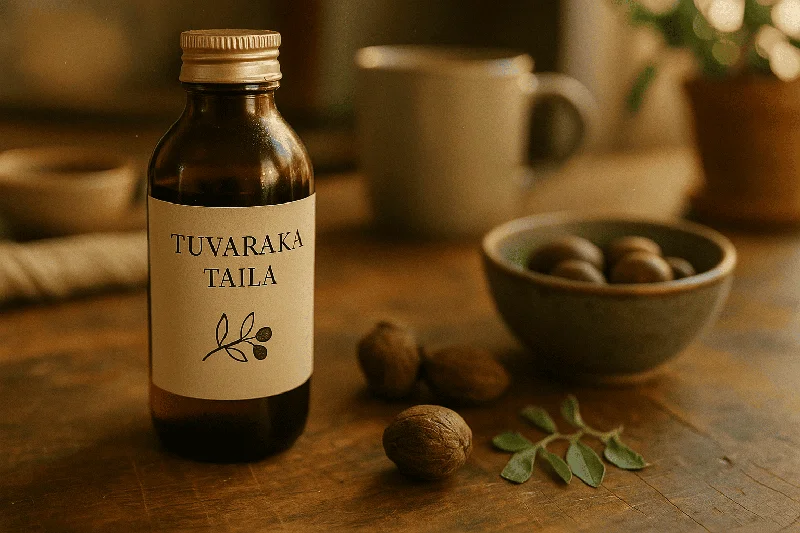
Tuvaraka Taila is a classical Ayurvedic medicated oil prepared primarily from the seeds of Hydnocarpus laurifolia (chaulmoogra tree) processed in a sesame oil base with supportive herbs. It has been prescribed for centuries in the management of chronic skin diseases — including leprosy (Kushtha), psoriasis, eczema, and dermatitis — as well as inflammatory joint conditions. Referenced in foundational texts like the Bhaishajya Ratnavali, Sharangadhara Samhita, and Chakradatta, this formulation remains one of the most important external-use oils in Ayurvedic dermatology and Panchakarma practice today.
If you're looking for a single, comprehensive resource on this oil — what it contains, how it works, how to use it, and what modern science says — you're in the right place.
What Is Tuvaraka Taila?
Definition and Overview
Tuvaraka Taila (also spelled Tuvrak Taila or Tuvraka Taila) is a Sneha Kalpana — a medicated oil preparation — classified under external-use therapeutic oils in Ayurveda. The word "Tuvaraka" refers to the chaulmoogra tree (Hydnocarpus laurifolia), and "Taila" means oil. The formulation is designed to deliver the potent anti-dermatosis properties of chaulmoogra directly through the skin via transdermal absorption.
Unlike simple carrier oils, Tuvaraka Taila undergoes a specific Ayurvedic pharmaceutical process called Taila Paka Vidhi (oil cooking method), where herbal decoctions and pastes are cooked into a base oil until specific quality markers — called Siddhi Lakshana — are achieved. This process transforms a crude oil into a bioavailable therapeutic medium.
Classical References (Sharangadhara Samhita, Bhaishajya Ratnavali, Chakradatta)
The formulation appears across multiple classical compendia:
- Bhaishajya Ratnavali — Kushtharogadhikara chapter, where it is indicated for 18 types of Kushtha (skin diseases)
- Chakradatta — Described as a primary external treatment for Dadru (ringworm), Vicharchika (eczema), and Shvitra (vitiligo)
- Sharangadhara Samhita — Provides the pharmaceutical methodology for Sneha Kalpana under which this Taila is prepared
- Ashtanga Hridaya (Vagbhata) — References Tuvaraka in the context of Kushtha Chikitsa
Sushruta classified Tuvaraka among Ubhayato Bhagahara drugs — substances that can be used in both Vamana (emesis) and Virechana (purgation) therapies, indicating its significance extends beyond topical application.
Key Sanskrit Shlokas with Translation
One important shloka from the Bhaishajya Ratnavali (Kushtha Chikitsa) reads:
> तुवरकतैलं कुष्ठघ्नं कण्डूदाहविनाशनम्
> दद्रुविचर्चिकाशोफव्रणरोपणमुत्तमम्
Translation: "Tuvaraka Taila is a destroyer of Kushtha (skin diseases), alleviator of itching (Kandu) and burning sensation (Daha). It is excellent for treating ringworm (Dadru), eczema (Vicharchika), swelling (Shopha), and wound healing (Vrana Ropana)."
From the Sharangadhara Samhita (Madhyama Khanda, Chapter 9), the general Sneha Paka methodology applicable to this Taila:
> कल्कद्रवस्नेहसम्बन्धे १:४:१६ इति स्नेहपाकप्रमाणम् ||
Translation: "The standard proportion for oil preparation is 1 part paste (Kalka), 4 parts liquid (Drava), and 16 parts oil (Sneha)."
Historical Context and Traditional Use
Origins in Classical Ayurvedic Texts
The use of chaulmoogra oil in treating skin diseases dates back to the era of Sushruta (approximately 6th century BCE), making it one of the oldest recorded dermatological treatments in human history. Sushruta's Sushruta Samhita mentions Tuvaraka seeds in the management of Kushtha Roga, which was a broad term encompassing leprosy, psoriasis, and other chronic dermatoses.
By the time of Vagbhata (7th century CE), the formulation had become more standardized, with specific herbal adjuncts added to enhance efficacy.
Regional Variations and Folk Traditions
Over centuries, regional adaptations emerged across different parts of India:
- Kerala tradition (Ashtavaidya lineage): Tuvaraka Taila is often combined with Kanjika (fermented rice water) in pre-Panchakarma Snehana for Kushtha patients
- Tamil Nadu Siddha practice: Known as Maravattu Ennai, a similar preparation uses locally sourced Hydnocarpus wightiana
- Odisha tradition: Folk healers in tribal belts of Odisha historically applied crude chaulmoogra oil directly, which later evolved into the refined Taila form
The Colonial-Era Rediscovery
Interestingly, chaulmoogra oil gained global attention in the early 20th century when British colonial physicians in India documented its anti-leprosy effects. In 1920, Alice Ball, a chemist at the University of Hawaii, developed an injectable ethyl ester form of chaulmoogric acid — directly inspired by the Ayurvedic use of Tuvaraka. This remained the primary treatment for Hansen's disease until the development of sulphone drugs in the 1940s.
Ingredients and Composition
Tuvaraka (Hydnocarpus laurifolia) — Botanical Profile
The primary ingredient, Hydnocarpus laurifolia (Syn: H. wightiana, H. pentandra), is a medium-to-large evergreen tree found in the Western Ghats, Eastern Ghats, and parts of Southeast Asia.
| Feature | Description |
|---|---|
| Family | Achariaceae (formerly Flacourtiaceae) |
| Common Names | Chaulmoogra (English), Tuvaraka/Tuvraka (Sanskrit), Maravetti (Tamil), Gorli (Marathi) |
| Height | 15–20 meters |
| Leaves | Alternate, oblong-lanceolate, 15–25 cm long |
| Fruit | Globose, 7–10 cm diameter, woody shell, containing 20–30 seeds |
| Seed Oil Content | 45–55% by weight |
| Habitat | Evergreen and semi-evergreen forests at 200–900 m elevation |
| Key Growing Regions | Kerala, Karnataka, Tamil Nadu, Maharashtra, Odisha, Andhra Pradesh |
The part used in Tuvaraka Taila is primarily the seed oil, obtained by cold-pressing or expeller pressing the dried seeds.
Base Oil (Sesame Oil) and Its Role
Tila Taila (sesame oil, Sesamum indicum) serves as the base oil. In Ayurveda, sesame oil is considered the best medium for medicated oil preparations because:
- It has Yogavahi property — the ability to absorb and potentiate the qualities of herbs processed in it
- Contains natural antioxidants (sesamin, sesamol, sesamolin) that prevent rancidity
- Penetrates skin tissue (Twak Dhatu) rapidly, enabling transdermal delivery
- Balances Vata dosha, which governs pain perception and skin integrity
Complete List of Ingredients with Classical Proportions
While formulations vary slightly between texts, the standard Bhaishajya Ratnavali version includes:
| Ingredient (Sanskrit) | Botanical/English Name | Part Used | Proportion |
|---|---|---|---|
| Tuvaraka | Hydnocarpus laurifolia | Seed oil / Kalka | Primary |
| Tila Taila | Sesamum indicum (Sesame oil) | Oil | Base (16 parts) |
| Haridra | Curcuma longa (Turmeric) | Rhizome | Kalka ingredient |
| Daruharidra | Berberis aristata (Indian Barberry) | Stem | Kalka ingredient |
| Kushtha | Saussurea costus (Costus) | Root | Kalka ingredient |
| Karanja | Pongamia pinnata (Indian Beech) | Seed | Kalka ingredient |
| Chakramarda | Cassia tora (Sickle Senna) | Seed | Kalka ingredient |
| Nimba | Azadirachta indica (Neem) | Leaf/Bark | Drava (decoction) |
| Aragvadha | Cassia fistula (Golden Shower) | Pulp | Drava |
| Gomutra | Cow's urine | — | Drava (liquid medium) |
- Note: Some formulations replace Gomutra with herbal Kashaya (decoction).
- The Kalka-to-Drava-to-Sneha ratio follows the standard 1:4:16 proportion as described in Sharangadhara Samhita.
Active Compounds and Mechanism of Action (Phytochemistry)
The therapeutic power of Tuvaraka Taila comes from a synergistic combination of bioactive compounds:
- Chaulmoogric acid (C₁₈H₃₂O₂) — a cyclopentenyl fatty acid unique to Hydnocarpus species; demonstrates potent antimycobacterial and anti-dermatophytic activity
- Hydnocarpic acid — structurally similar to chaulmoogric acid; inhibits bacterial cell wall synthesis
- Gorlic acid — another cyclopentenyl fatty acid with anti-inflammatory properties
- Solasodine (from adjunct herbs) — steroidal alkaloid with anti-inflammatory and immunomodulatory effects
- Sesamol & Sesamin (from sesame oil) — powerful antioxidants that protect skin from oxidative damage
- Curcumin (from Haridra) — well-documented anti-inflammatory, antibacterial, and wound-healing compound
- Berberine (from Daruharidra) — broad-spectrum antimicrobial alkaloid
The mechanism involves transdermal delivery: when applied to skin, the lipophilic sesame oil base carries these active compounds through the stratum corneum into the dermal layer. Chaulmoogric acid specifically disrupts the lipid metabolism of mycobacteria and fungi, while curcumin and berberine address inflammatory cascades (particularly NF-κB and COX-2 pathways).
Ayurvedic Pharmacology (Dravyaguna)
Rasa, Guna, Virya, Vipaka
| Property | Value | Clinical Significance |
|---|---|---|
| Rasa (Taste) | Tikta (Bitter), Kashaya (Astringent), Katu (Pungent) | Bitter taste is specifically Kushtha-hara (anti-dermatosis) |
| Guna (Quality) | Ushna (Hot), Tikshna (Penetrating), Ruksha (Dry) | Penetrating quality aids deep tissue absorption |
| Virya (Potency) | Ushna (Hot) | Stimulates metabolism in skin tissue; counteracts Kapha stagnation |
| Vipaka (Post-digestive effect) | Katu (Pungent) | Supports detoxification and waste elimination |
| Prabhava (Special action) | Kushthaghna | Specific anti-dermatosis action beyond what pharmacological properties predict |
Doshic Action — Influence on Tridosha
Tuvaraka Taila primarily pacifies Kapha and Vata doshas:
- Kapha Shamana: Its Ushna Virya and Tikshna Guna counteract the cold, heavy, sticky qualities of aggravated Kapha — which manifests as oozing, itchy, chronic skin lesions
- Vata Shamana: The oil base (Sneha) and warm potency address Vata-type skin dryness, cracking, and pain
- Pitta considerations: Due to its heating nature, it should be used cautiously in Pitta-dominant conditions or combined with cooling herbs like sandalwood or vetiver in such cases
In terms of Dhatu (tissue) action, it primarily works on Rasa Dhatu (plasma/lymph), Rakta Dhatu (blood), and Mamsa Dhatu (muscle), which are the tissues most involved in skin disease pathology according to Ayurveda.
Therapeutic Uses and Benefits of Tuvaraka Taila
What Is the Use of Tuvrak Oil for Skin?
This is the primary domain of Tuvaraka Taila.
Its applications in skin conditions include:
1. Kushtha (Leprosy / Chronic Dermatosis)
Historically the most important indication. A 2017 review published in the Journal of Ayurveda and Integrative Medicine confirmed that chaulmoogra-based preparations show significant antimycobacterial activity against Mycobacterium leprae, validating centuries of traditional use.
2. Psoriasis (Kitibha Kushtha)
Applied externally in combination with internal Shodhana therapies, Tuvaraka Taila helps reduce scaling, erythema, and plaque thickness. Clinical practitioners typically recommend 4–8 week courses.
3. Eczema / Dermatitis (Vicharchika)
The oil's anti-inflammatory and anti-pruritic properties make it effective for weeping and dry eczema. The berberine and curcumin components address the underlying inflammation.
4.Fungal Infections — Ringworm (Dadru)**
Chaulmoogric acid and hydnocarpic acid have demonstrated antifungal activity against common dermatophytes including Trichophyton rubrum and Microsporum canis.
5. Vitiligo (Shvitra)
While not a first-line treatment, Tuvaraka Taila is used adjunctively in Shvitra management to stimulate melanocyte activity when combined with Bakuchi (Psoralea corylifolia) preparations.
6. Wound Healing (Vrana Ropana)
The combination of antimicrobial and tissue-regenerative properties supports healing of non-responding chronic wounds and ulcers.
Benefits for Joint Health and Pain Management
While primarily a dermatological oil, Tuvaraka Taila is also used externally for:
- Inflammatory arthritis (Amavata): Applied warm over affected joints, the Ushna Virya and Tikshna Guna help reduce joint swelling and stiffness
- Cervical spondylosis: As observed in clinical practice, application over the cervical region combined with Nasya therapy has shown improvement in pain scores and range of motion
- Sciatica (Gridhrasi): Used in localized Abhyanga before fomentation (Swedana)
Role in Panchakarma (Shodhana Chikitsa)
Tuvaraka Taila plays a specific role within Panchakarma protocols for skin diseases:
Dermatological Panchakarma Protocol
- 1.Snehana (Oleation): Tuvaraka Taila is applied externally as part of Abhyanga for 7–14 days pre-Panchakarma to mobilize toxins from skin tissue
- 2.Swedana (Fomentation): Following oil application, mild steam therapy helps the oil penetrate deeper
- 3.Vamana or Virechana: Based on dosha predominance — Kapha-dominant Kushtha requires Vamana; Pitta-dominant requires Virechana
- 4.Post-Panchakarma application: The Taila is continued externally during the Samsarjana Krama (post-purification diet phase) to support tissue regeneration
- 5.Nasya therapy: In some traditions, a purified version of this oil is used for nasal administration to address allergic rhinitis and sinusitis that coexist with skin conditions
Step-by-Step Preparation Process (Sneha Kalpana)
This is a detail most references overlook. Here's the classical method, based on the Sharangadhara Samhita Taila Paka Vidhi:
Ingredients Required (Standard Batch)
- Tuvaraka seed paste (Kalka): 1 part (e.g., 100 g)
- Herbal decoction (Kashaya) of Nimba, Aragvadha, etc.: 4 parts (400 ml)
- Tila Taila (sesame oil): 16 parts (1600 ml)
- Additional Kalka herbs (Haridra, Daruharidra, Kushtha, etc.) ground to fine paste
Process Steps
Step 1 — Kashaya Preparation: Boil coarse powders of Nimba bark, Aragvadha pulp, and other Drava ingredients in 16 parts water. Reduce to 1/4th. Filter. This becomes the liquid medium. Step 2 — Kalka Preparation: Grind fresh or dried Tuvaraka seeds along with Haridra, Daruharidra, Karanja, and Chakramarda seeds into a smooth paste using minimal water. Step 3 — Oil Cooking (Taila Paka): Combine the sesame oil, Kalka, and Kashaya in a wide-mouthed iron or steel vessel. Heat on a mild, consistent flame (Mrdu Agni). Stir continuously. Step 4 — Monitoring Paka Stages:
- Mrdu Paka (soft stage): Kalka feels waxy when rolled between fingers — suitable for Nasya use
- Madhyama Paka (medium stage): Kalka forms a wick-like consistency, doesn't stick to fingers — ideal for external application (this is the standard for Tuvaraka Taila)
- Khara Paka (hard stage): Kalka becomes brittle — used when stronger penetration is needed
Step 5 — Siddhi Lakshana (Signs of Completion):
- All water content has evaporated (no crackling sound when a drop of water is added)
- Kalka can be rolled into a varti (wick) without sticking
- The oil develops a characteristic colour and aroma
- Foam subsides completely
Step 6 — Filtration: Filter the hot oil through clean muslin cloth. Press the Kalka to extract remaining oil. Discard residue. Total cooking time: Approximately 6–12 hours depending on batch size and flame intensity.
Simplified Home Preparation (With Cautions)
For those wanting to make a basic version at home:
- Take 100 ml cold-pressed sesame oil
- Add 1 tablespoon of Tuvaraka seed powder and ½ teaspoon each of turmeric powder and neem leaf powder
- Heat on lowest flame for 45–60 minutes, stirring regularly
- Allow to cool, filter through cloth
Important caution: Home preparations lack standardized potency and sterility. They should never be used on open wounds or for Nasya. Always prefer professionally manufactured oil for therapeutic use.
Dosage and Method of Application
External Application (Standard)
| Parameter | Recommendation |
|---|---|
| Amount per application | 5–15 ml (approximately 1–3 teaspoons), depending on area |
| Frequency | Once or twice daily |
| Duration of single application | Leave on for 30–60 minutes before washing, or overnight as advised |
| Course duration | Minimum 4 weeks; 8–12 weeks for chronic conditions |
| Method | Apply lukewarm oil in circular motions over affected area |
| Best time | Morning (before bath) or evening (before sleep) |
Application for Specific Conditions
For Psoriasis/Eczema: Apply a thin layer over plaques/patches. Do not rub aggressively. Cover with cotton cloth if overnight application. Combine with sunlight exposure (10–15 minutes morning sun) for enhanced effect. For Fungal Infections: Apply twice daily on clean, dry skin. Continue for 2 weeks after visible clearance to prevent recurrence. For Joint Pain: Warm the oil slightly (not hot). Massage firmly over the joint for 10–15 minutes. Follow with hot fomentation using a warm towel or steam.
Seasonal Considerations (Ritucharya)
- Best seasons for use: Hemanta (early winter) and Shishira (late winter) — Vata-Kapha seasons when skin diseases tend to flare
- Caution in summer: Reduce quantity and frequency during Greeshma Ritu (summer) due to the oil's heating potency
- Monsoon use: Particularly beneficial during Varsha Ritu when fungal infections are prevalent
Comparative Analysis: Tuvaraka Taila vs. Other Ayurvedic Skin Oils
| Feature | Tuvaraka Taila | Eladi Tailam | Karanja Taila | Marichyadi Taila |
|---|---|---|---|---|
| Primary Ingredient | Hydnocarpus laurifolia | Ela (Cardamom) + herbs | Pongamia pinnata | Maricha (Black pepper) |
| Primary Dosha Action | Kapha-Vata | Pitta-Vata | Kapha-Vata | Kapha-Vata |
| Best For | Chronic dermatosis, leprosy, psoriasis | Pigmentation, burns, Pitta skin | Scabies, parasitic infections | Neuralgic pain, stiffness |
| Virya | Ushna (Hot) | Sheeta (Cool) | Ushna (Hot) | Ushna (Hot) |
| Safe in Pitta conditions? | Use with caution | Yes — excellent | Use with caution | No |
| Wound healing | Excellent | Good | Moderate | Poor |
| Anti-fungal strength | Strong | Mild | Strong | Mild |
| Availability | Moderate | Widely available | Moderate | Less common |
Side Effects, Contraindications, and Safety
Known Side Effects
Tuvaraka Taila is generally safe for external use when applied as directed.
However:
- Skin irritation: Some individuals may experience mild redness or burning, especially on sensitive skin. Always perform a patch test on a small area of the inner forearm first.
- Contact dermatitis: Rare, but possible in individuals allergic to sesame or any ingredient herb
- Staining: The oil has a yellowish-brown colour that can stain clothing and bedsheets
Contraindications
- Open, bleeding wounds: Do not apply on actively bleeding or deeply infected wounds
- Severe Pitta aggravation: Conditions with acute inflammation, burning, and redness may worsen initially
- Pregnancy: Not recommended during pregnancy without direct supervision from a qualified Ayurvedic practitioner. The Ushna Virya and some ingredient herbs may have uterine stimulant effects.
- Lactation: External use on non-breast areas is generally considered safe, but consult a physician
- Infants and children under 5: Not recommended due to sensitive skin and risk of inadvertent ingestion
Drug Interactions
- Homeopathic medicines: Strong-smelling oils can potentially antidote homoeopathic remedies. Maintain a gap of at least 30 minutes.
- Topical corticosteroids: Can be used alongside, but apply at different times of day. Do not mix.
- Oral Ayurvedic medicines: No known interactions; often prescribed together with internal formulations like Arogyavardhini Vati or Gandhaka Rasayana for comprehensive management
- Western topical medications: Inform your dermatologist if using alongside prescription creams
Modern Scientific Research
Key Studies and Findings
Antimicrobial Activity: A 2014 study published in the Indian Journal of Pharmaceutical Sciences demonstrated that Hydnocarpus oil exhibited significant antibacterial activity against Staphylococcus aureus and Pseudomonas aeruginosa — common pathogens in skin infections — with MIC values comparable to standard antibiotics. Anti-inflammatory Effect: Research published in Phytomedicine (2016) confirmed that chaulmoogric acid suppresses pro-inflammatory cytokines (TNF-α, IL-6) in human keratinocyte cell lines, providing a molecular basis for its traditional anti-inflammatory use. Insecticidal Activity: A 2019 study in the Journal of Ethnopharmacology found that Hydnocarpus seed extracts showed promising insecticidal and larvicidal properties, suggesting potential use in managing parasitic skin infestations. Anti-diabetic Potential: Preliminary research (published in BMC Complementary Medicine and Therapies, 2020) reported that Hydnocarpus wightiana seed extracts demonstrated alpha-glucosidase inhibitory activity, hinting at potential metabolic benefits beyond skin health. This remains an area of active investigation. Wound Healing: A 2018 animal study in Ancient Science of Life showed that topical application of a chaulmoogra-based formulation accelerated wound contraction by 40% compared to controls over a 14-day period.
Quality, Storage, and Buying Guide
Organoleptic Characteristics of Quality Tuvaraka Taila
When purchasing, look for these markers of a genuine, well-prepared product:
| Parameter | Quality Indicator |
|---|---|
| Colour | Deep golden-yellow to amber-brown |
| Consistency | Smooth, moderately viscous; not too thin or too thick |
| Odour | Characteristic herbal smell — slightly pungent, not rancid |
| Taste (if tested) | Bitter with astringent undertone |
| Clarity | Should be clear without sediment (properly filtered) |
| Touch | Slightly warm sensation when applied; absorbs within 15–20 minutes |
How to Identify Adulterated or Low-Quality Oil
- Rancid or fishy smell — indicates oxidation or poor-quality base oil
- Excessively thin consistency — may be diluted with mineral oil
- No herbal colour — may lack adequate herb processing
- Sediment or particulate matter — improper filtration
- Unusually low price — genuine Tuvaraka seeds are relatively expensive due to limited wild harvest; very cheap products are suspect
Storage and Shelf Life
- Container: Store in dark glass bottles (amber or cobalt blue). Avoid plastic containers as oil can leach chemicals from plastic over time.
- Temperature: Cool, dry place away from direct sunlight. Room temperature (20–30°C) is ideal for Indian conditions.
- Shelf life: Properly prepared and stored Tuvaraka Taila remains effective for 18–24 months from date of manufacture. Some traditional preparations in Kerala claim longer shelf life due to additional preservation techniques.
- Signs of spoilage: Rancid smell, change in colour to very dark brown/black, visible mold, unusual sedimentation. Discard immediately if any of these appear.
Frequently Asked Questions (FAQ)
What is the English name of Tuvaraka?
The English name for the Tuvaraka plant is Chaulmoogra (also spelled Chaulmooga or Chaulmugra). The botanical name is Hydnocarpus laurifolia or Hydnocarpus wightiana. The tree belongs to the family Achariaceae and is native to the Western Ghats of India and parts of Southeast Asia.
Which oil is best for Virechana?
- For Virechana (therapeutic purgation), Eranda Taila (castor oil) is traditionally considered the best choice due to its strong Virechana property.
- However, Tuvaraka Taila has a supporting role — Sushruta classified Tuvaraka under Ubhayato Bhagahara drugs, meaning it can facilitate both Vamana and Virechana. In Kushtha-specific Virechana protocols, Tuvaraka Taila may be used during the pre-procedural Snehana (oleation) phase to prepare the skin tissues.
Is Tuvrak oil safe for daily use?
- For most adults without specific contraindications, daily external application for defined therapeutic courses (4–12 weeks) is generally safe. However, indefinite daily use without medical guidance is not recommended.
- Take periodic breaks — typically a week's gap after every 4 weeks of use.
- Listen to your skin: if irritation develops, reduce frequency or discontinue.
Can Tuvaraka Taila be used for scalp conditions?
Yes. It can be applied to the scalp for conditions like seborrheic dermatitis, scalp psoriasis, and fungal infections. Apply 5–10 ml to the scalp, massage gently, leave for 1–2 hours, then wash with a mild herbal shampoo. Due to its strong smell and colour, plan accordingly.
What is Tuvaraka Rasayana?
Tuvaraka Rasayana is a different formulation from Tuvaraka Taila — it is an internal preparation (typically a paste or powder form) using Tuvaraka seeds processed with other Rasayana herbs. It is used as a rejuvenative and internal detoxifiant for chronic skin diseases. This is a specialized preparation that should only be used under strict medical supervision due to the potential toxicity of raw chaulmoogra seeds when taken internally.
Is Chitrak hot or cold?
Chitrak (Plumbago zeylanica) is hot (Ushna Virya) in nature. While not a primary ingredient of Tuvaraka Taila, it is sometimes used in companion internal formulations for skin diseases. Its heating potency makes it a strong Kapha-pacifying and digestive-stimulating herb.
Conclusion: Integrating Tuvaraka Taila Into Your Wellness Routine
Tuvaraka Taila stands as a remarkable example of Ayurvedic pharmaceutical wisdom — a formulation with roots stretching back over two millennia that has been validated, at least partially, by modern pharmacological research. Its unique combination of cyclopentenyl fatty acids, antimicrobial compounds, and anti-inflammatory agents delivered through a bioavailable sesame oil base makes it a genuinely effective therapeutic tool for chronic skin conditions and inflammatory disorders.
However, Ayurveda emphasizes that no single medicine works in isolation. For best results, Tuvaraka Taila should be part of a comprehensive treatment approach that includes appropriate diet (Pathya-Apathya), lifestyle modifications, internal medications where needed, and ideally Panchakarma detoxification for chronic cases.
Important: Always consult a qualified Ayurvedic physician (BAMS or MD Ayurveda) before starting Tuvaraka Taila, especially if you have pre-existing conditions, are pregnant, or are taking other medications. Self-medication, while tempting, can lead to suboptimal results or avoidable side effects. If you found this guide helpful, consider sharing it with someone who might benefit from understanding this powerful Ayurvedic formulation. Your skin's healing journey deserves the best of both ancient wisdom and informed, evidence-based practice.
Scientific Sources
- A complex, nonlinear dynamic systems perspective on Ayurveda and Ayurvedic research — Rioux J, 2012, Journal of alternative and complementary medicine (New York, N.Y.)
- Rational use of Ashwagandha in Ayurveda (Traditional Indian Medicine) for health and healing — Joshi VK et al., 2021, Journal of ethnopharmacology
- Curiosity and Creative Experimentation Among Psychiatrists in India — Lang C et al., 2024, Culture, medicine and psychiatry
- Comparing the concept of "Removing Worms" between traditional Chinese medicine and Ayurveda -- An example of Qiye Qingnian Powder(https://pubmed.ncbi.nlm.nih.gov/39394793/) — Zhang RS et al., 2024, Zhonghua yi shi za zhi (Beijing, China : 1980)
- The history of the discovery of blood circulation: unrecognized contributions of Ayurveda masters — Patwardhan K, 2012, Advances in physiology education
- Ayurvedic and Chinese Herbs against Coronaviruses — Gasmi A et al., 2024, Current pharmaceutical design
- Integrative Skin Care: Dermatology and Traditional and Complementary Medicine — Bodeker G et al., 2017, Journal of alternative and complementary medicine (New York, N.Y.)
- Ayurveda and yoga in cardiovascular diseases — Mamtani R et al., 2005, Cardiology in review
- An assessment of the ayurvedic concept of cancer and a new paradigm of anticancer treatment in Ayurveda — Singh RH, 2002, Journal of alternative and complementary medicine (New York, N.Y.)
- A case for testing and modifying theory in Ayurveda: Author's response — Patwardhan K, 2023, Indian journal of medical ethics
- Severe Lead Toxicity Due to Ayurvedic Medicine in a Child with Type 1 Diabetes Mellitus — Roy K et al., 2022, Indian journal of pediatrics
- Cannabis: A Neurological Remedy or a Drug of Abuse in India — Biswas P et al., 2017, CNS & neurological disorders drug targets
- Role of selected Indian plants in management of type 2 diabetes: a review — Saxena A et al., 2004, Journal of alternative and complementary medicine (New York, N.Y.)
- A review of antidiabetic active thiosugar sulfoniums, salacinol and neokotalanol, from plants of the genus Salacia — Morikawa T et al., 2021, Journal of natural medicines
- A Systematic Review and Meta-Analysis of Ayurvedic Herbal Preparations for Hypercholesterolemia — Gyawali D et al., 2021, Medicina (Kaunas, Lithuania)
- Inflammation and ROS in arthritis: management by Ayurvedic medicinal plants — Prasad S et al., 2021, Food & function
- Cancer--an ayurvedic perspective — Balachandran P et al., 2005, Pharmacological research
- From nature's bounty to drug discovery: Leveraging phytochemicals and molecular approaches to combat multi-drug-resistant (MDR) tuberculosis — Nalam SM et al., 2024, The Indian journal of tuberculosis
- Glimpses of the advancement of medical science as depicted in the Mahäbhärata — Mitra J, 1995, Bulletin of the Indian Institute of History of Medicine (Hyderabad)
- A biostatistical approach to ayurveda: quantifying the tridosha — Joshi RR, 2004, Journal of alternative and complementary medicine (New York, N.Y.)
Ask Ayurvedic doctor a question and get a consultation online on the problem of your concern in a free or paid mode.
More than 2,000 experienced doctors work and wait for your questions on our site and help users to solve their health problems every day.
Related articles