FREE! Ask Ayurvedic Doctors 24/7

 Fast responses
 1000+ verified doctors
Patra Pottali Sweda – Traditional Ayurvedic Herbal Steam Therapy for Holistic Healing
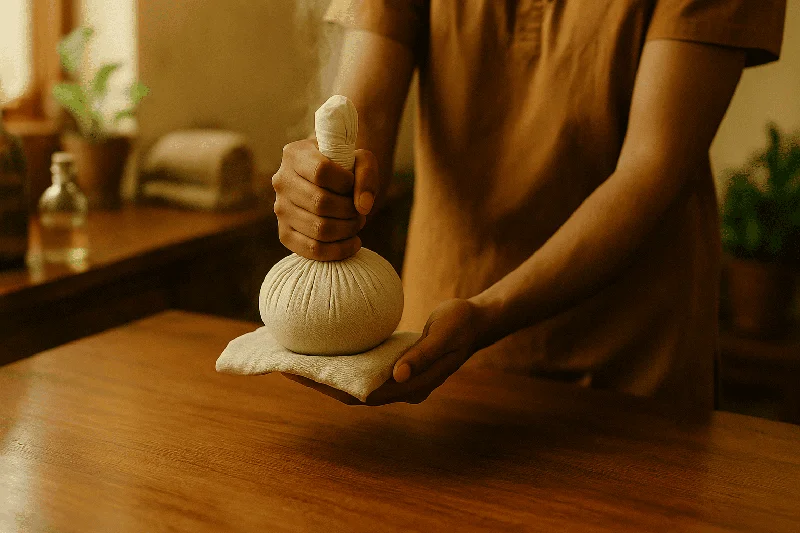
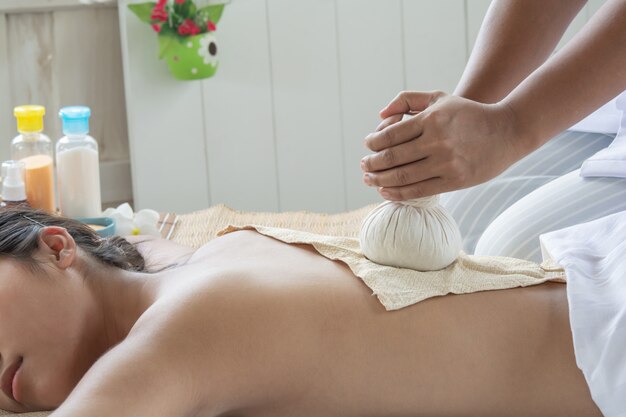
Patra Pottali Sweda is an Ayurvedic fomentation therapy in which fresh medicinal leaves, herbal powders, and grated coconut are fried in medicated oil, tied into a cloth bolus (pottali), heated, and rhythmically pressed over the body to induce therapeutic sweating. Known as Ela Kizhi in the Kerala Panchakarma tradition and classified under Snigdha Pinda Sweda (unctuous bolus sudation), this treatment is one of the most effective external therapies for managing musculoskeletal pain, joint stiffness, and neuro-muscular disorders rooted in Vata-Kapha imbalance.
- Unlike generic hot compress treatments, Patra Pottali Sweda combines pharmacological action of the herbs with controlled thermotherapy — the volatile oils released from heated leaves penetrate deep tissues (Mamsa, Asthi, and Majja Dhatus), loosen metabolic toxins (Ama), and restore the directional flow of Vata dosha.
- Below is the most comprehensive guide available — covering etymology, classical references, step-by-step procedure, specific herbal formulations, clinical evidence, contraindications, cost, and seasonal recommendations.
What Is Patra Pottali Sweda?
Etymology and Alternate Names
The term breaks down from Sanskrit as follows:
| Sanskrit Word | Meaning |
|---|---|
| Patra | Leaf |
| Pottali (or Pinda) | Bolus / pouch |
| Sweda | Sweat / fomentation |
So the literal translation is "sweating therapy using a bolus of leaves."
You'll encounter several alternate names depending on the region and textual tradition:
- Ela Kizhi — Malayalam name used in Kerala Panchakarma centres (Ela = leaf, Kizhi = bolus)
- Patra Pinda Sweda — widely used in North Indian Ayurvedic hospitals
- Patra Pinda Pottali Sweda — full technical name in academic papers
- Leaf-Bolus Sudation — English translation used in research publications
All refer to the same core procedure. The variation in naming can sometimes confuse patients, but the ingredients and technique remain consistent across traditions.
Place in the Swedana Classification
Acharya Charaka, in Charaka Sutra Sthana 22/12, describes Swedana as one of the essential preparatory therapies (Poorvakarma) and categorizes it broadly into:
- Sagni Sweda — fomentation using fire/heat (Patra Pottali Sweda falls here)
- Niragni Sweda — fomentation without direct fire (e.g., exercise, heavy blankets, sunlight)
Within Sagni Sweda, further classification includes:
- Snigdha Sweda — unctuous/oily sudation (used when Vata is predominant without significant Ama)
- Ruksha Sweda — dry sudation (used when Ama, Meda, or Kapha are predominant)
- Patra Pottali Sweda is a Snigdha Pinda Sweda — the bolus is saturated with medicated oil, making it inherently unctuous.
- This is critical: the oily nature pacifies Vata dosha specifically, which is the primary driver of pain ("Vata is the only dosha that causes pain" — Ashtanga Hridaya Sutra 1/7).
The Ama Factor: When to Choose Snigdha vs. Ruksha Sweda
This is a nuance most online resources miss entirely. If the patient presents with significant Ama (metabolic toxins) — indicated by coated tongue, heaviness, sluggish digestion, elevated Kapha — the clinician may first opt for Ruksha Sweda (like Valuka Sweda or Churna Pinda Sweda) to dry and mobilize Ama. Only after Ama is reduced does Snigdha Sweda like Patra Pottali Sweda become appropriate.
Applying Snigdha Sweda on an Ama-dominant condition can actually worsen symptoms by "locking in" the toxins. This is why a proper Prakriti and Vikriti assessment by a qualified Ayurvedic physician is non-negotiable before starting treatment.
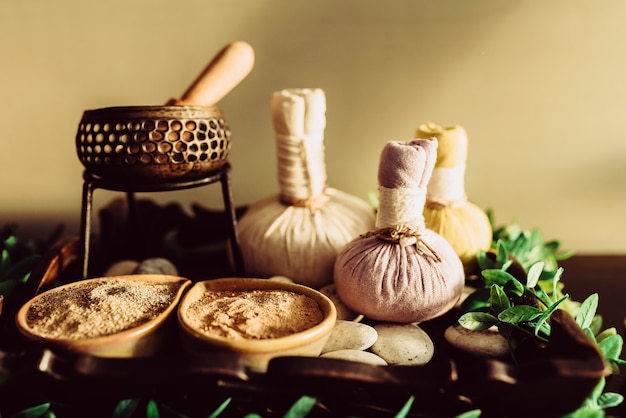
Patra Pinda Sweda Ingredients: Complete List of Leaves, Powders & Oils
Medicinal Leaves and Their Properties
The herbal leaves are the backbone of the bolus. Here is the complete list referenced across classical texts and contemporary practice:
| Leaf (Sanskrit Name) | Botanical Name | Key Therapeutic Property |
|---|---|---|
| Eranda Patra | Ricinus communis | Vata-shamana, anti-inflammatory, analgesic |
| Nirgundi Patra | Vitex negundo | Potent anti-arthritic, nervine tonic |
| Arka Patra | Calotropis procera | Deep penetrating, reduces swelling |
| Dhatura Patra | Datura metel | Strong analgesic, antispasmodic |
| Shigru Patra | Moringa oleifera | Anti-inflammatory, rich in antioxidants |
| Chincha Patra | Tamarindus indica | Amla (sour) rasa aids Vata pacification |
| Karanja Patra | Pongamia pinnata | Anti-microbial, Kapha-reducing |
| Tambula Patra | Piper betle | Carminative, improves local circulation |
| Kumari Patra | Aloe vera | Cooling, anti-inflammatory (used selectively) |
- Why these specific leaves? Each leaf possesses Ushna Virya (hot potency) and Vata-Kaphahara properties.
- When heated in oil, their volatile compounds — particularly terpenoids, flavonoids, and alkaloids — become bioavailable and penetrate the skin through open sweat pores. Nirgundi and Eranda are almost always the primary leaves; others are added based on the condition.
Herbal Powders Used in the Bolus
- Rasnadi Churna (powder of Pluchea lanceolata)
- Kottam (Saussurea lappa) — anti-inflammatory
- Jatamansi churna — nervine sedative
- Haridra (turmeric) — curcumin-based anti-inflammatory
- Saindhava Lavana (rock salt) — draws out toxins, enhances sweating
- Grated coconut — acts as a heat-retention medium and provides lauric acid
Medicated Oils for Heating the Bolus
The choice of oil is condition-specific — not arbitrary.
Here's what experienced practitioners typically select:
| Oil | Primary Indication |
|---|---|
| Kottamchukkadi Tailam | Joint stiffness, Vata disorders, cervical spondylosis |
| Dhanwantharam Tailam | Neuromuscular conditions, post-partum care |
| Sahacharadi Tailam | Lower limb disorders, sciatica (Gridhrasi) |
| Bala Tailam | General Vata disorders, muscle weakness |
| Murivenna | Sports injuries, soft tissue trauma |
| Ksheerabala Tailam | Neurological conditions, facial paralysis |
| Tila Tailam (plain sesame oil) | General purpose, base oil for mixing |
A 2019 observational study published in the Journal of Ayurveda and Integrated Medical Sciences (JAIMS) found that Patra Pinda Sweda with Sahacharadi Tailam showed significant reduction in pain scores (VAS scale) in 30 patients with Gridhrasi over a 14-day treatment protocol.
Step-by-Step Patra Pottali Sweda Procedure
Purvakarma (Pre-Procedure)
- 1.Patient Assessment — The physician evaluates Prakriti (constitution), Vikriti (current imbalance), Bala (strength), Agni (digestive fire), and the specific disorder. Pulse diagnosis (Nadi Pariksha) is performed.
- 2.Selection of Ingredients — Based on the diagnosis, specific leaves, oils, and churnas are selected.
- 3.Abhyanga (Oil Massage) — The patient receives a full-body or localised oil massage for 10–15 minutes using the chosen medicated oil. This opens pores, relaxes superficial muscles, and prepares the tissues to receive heat.
- 4.Bolus Preparation — Fresh leaves are chopped, mixed with herbal powders, grated coconut, lemon pieces, and rock salt. The mixture is fried in medicated oil until warm and aromatic. It's then tied in a muslin cloth to form a compact bolus (approximately 500g each). Two to four boluses are prepared — so one pair can be heating while the other is in use.
Pradhana Karma (Main Procedure)
- 5.Temperature Testing — The therapist tests the bolus temperature on the back of their own hand first. Ideal surface temperature is 40–45°C (comfortable warmth, not burning).
- 6.Application Technique — The bolus is pressed and dabbed (not dragged) over the body in rhythmic strokes, following the direction of body hair (anuloma gati). The strokes move from proximal to distal on extremities, and use circular motions around joints.
- 7.Reheating Cycle — When the bolus cools (every 3–5 minutes), it is reheated by dipping it in the warm medicated oil kept on a low flame. The process continues cyclically.
- 8.Zone-by-Zone Application:
- Back and Spine: 8–10 minutes
- Each Upper Extremity: 5–7 minutes
- Each Lower Extremity: 7–10 minutes
- Neck and Shoulders: 5–7 minutes
- Affected area (localized treatment): Additional 10–15 minutes of focused application
- 9.Duration: Total session lasts 45–60 minutes of active bolus application (excluding Abhyanga time).
Paschat Karma (Post-Procedure)
- 10.Rest Period — Patient rests in a warm room for 15–20 minutes, allowing the medicated oils to absorb.
- 11.Wiping/Bath — Residual oil is gently wiped with a warm towel.
- A warm water bath may be given after 30 minutes — never cold water.
- 12.Dietary Advice — Light, warm, easily digestible food (such as rice gruel or khichdi) is recommended. Cold foods, curd, and heavy meals are to be avoided for 2–3 hours post-procedure.
Signs of Proper, Inadequate & Excessive Sweating
Classical texts describe three outcomes — recognizing them is essential for treatment quality:
| Sign | Sanskrit Term | Description |
|---|---|---|
| Proper sweating | Samyak Swinna Lakshana | Relief from cold sensation, reduced pain and stiffness, softness of skin, feeling of lightness |
| Inadequate sweating | Aswinna Lakshana | Persistent stiffness, heaviness, cold sensation, no perspiration visible |
| Excessive sweating | Ati Swinna Lakshana | Aggravation of Pitta (burning sensation), excessive thirst, dizziness, fainting, skin redness |
If Ati Swinna Lakshana appears, the procedure must be stopped immediately and cooling measures applied.
Patra Pottali Sweda Benefits: Therapeutic & Wellness Effects
The benefits operate on multiple levels — doshic, tissue-level, and systemic:
- Pain Relief (Vedana Shamana): Heat combined with herbal volatile oils acts as a natural analgesic. The mechanism involves vasodilation, increased blood flow, and reduced nerve sensitivity at the site.
- Reduction of Stiffness (Stambha Nashana): Stiffness is a cardinal Vata symptom. The unctuous heat softens contracted muscles, fascia, and tendons.
- Anti-Inflammatory Action: Nirgundi leaves contain vitexin and casticin — compounds shown to inhibit COX-2 and TNF-alpha pathways in a 2017 Phytomedicine study.
- Improved Circulation (Raktavaha Srotas Shuddhi): Thermotherapy causes local vasodilation, improving oxygen and nutrient delivery to damaged tissues.
- Detoxification: Sweating is the body's natural toxin elimination route. In Ayurvedic terms, Sweda removes Ama and clears Srotas (body channels).
- Vata-Kapha Balance: The treatment's Ushna (hot), Snigdha (oily), and Tikshna (penetrating) gunas directly counteract the Sheeta (cold), Ruksha (dry), and Manda (slow) qualities of aggravated Vata and Kapha.
- Muscle and Joint Strengthening: Regular courses improve tissue nourishment (Dhatu Poshana), particularly of Mamsa (muscle) and Asthi (bone) Dhatus.
- Neurological Benefits: The heat and herbal oils improve nerve conductivity, making this therapy effective in conditions like sciatica and peripheral neuropathy.
Patra Pottali Sweda Indications: Conditions Where It Helps
Musculoskeletal Disorders
- Sandhivata (Osteoarthritis) — especially knee and hip joint
- Amavata (Rheumatoid Arthritis) — after Ama has been managed with Langhana/Ruksha therapies
- Gridhrasi (Sciatica)
- Kati Shoola (Low back pain / Lumbar spondylosis)
- Greeva Stambha (Cervical spondylosis)
- Avabahuka (Frozen shoulder)
- Manya Stambha (Torticollis)
- Sports injuries — sprains, muscle tears, ligament strains (post-acute phase)
Neuromuscular & Other Conditions
- Peripheral neuropathy
- Muscle spasms and cramps
- Post-stroke hemiplegia (as adjuvant therapy)
- Obesity-related joint stress
- Chronic fatigue and fibromyalgia-type presentations
- General Vata aggravation (insomnia, anxiety, body aches)
A clinical trial published in AYU Journal (2018) involving 60 patients with Sandhivata demonstrated that Patra Pinda Sweda combined with Abhyanga showed statistically significant improvement in pain (p<0.01), joint tenderness, and walking time compared to the control group receiving only oral medication.
Duration, Course, Cost & Seasonal Recommendations
How Long Is a Session and a Full Course?
| Parameter | Typical Recommendation |
|---|---|
| Single session duration | 45–60 minutes (excluding Abhyanga) |
| Full course | 7, 14, or 21 days (based on severity) |
| Frequency | Daily during active treatment course |
| Maintenance | Once weekly or fortnightly after the course |
| Time of day | Ideally morning (before 11 AM), on empty or light stomach |
Patra Pinda Sweda Cost in India
Costs vary widely depending on the city and institution:
| Setting | Approximate Cost per Session |
|---|---|
| Government Ayurvedic Hospital | ₹200–₹500 |
| Private Ayurvedic Clinic (Tier-2 city) | ₹800–₹1,500 |
| Premium Wellness Centre (Metro) | ₹2,000–₹3,500 |
| Kerala Panchakarma Resort | ₹2,500–₹4,000 |
| Package (5 sessions) | ₹5,000–₹11,000 |
Note: Prices are approximate and may vary based on the oils and herbs used, therapist expertise, and geographic location.
Best Season (Ritucharya Context)
Patra Pottali Sweda is most effective during:
- Hemanta Ritu (Early Winter) and Shishira Ritu (Late Winter) — when Vata naturally aggravates due to cold, dry atmospheric conditions
- Varsha Ritu (Monsoon) — Vata is strongly aggravated per Ayurvedic seasonal theory
It should be performed cautiously or avoided during:
- Greeshma Ritu (Peak Summer) — Pitta is already elevated; excessive heating therapies can cause Ati Swinna Lakshana
- During active fever or acute inflammatory flare-ups regardless of season
Patra Pottali Sweda vs Other Kizhi Therapies: Comparison Table
| Feature | Patra Pinda Sweda (Ela Kizhi) | Churna Pinda Sweda (Podikizhi) | Shastika Shali Pinda Sweda (Njavara Kizhi) | Valuka Sweda (Sand Bolus) |
|---|---|---|---|---|
| Bolus Content | Medicinal leaves + herbal powders + coconut + oil | Herbal powders only | Medicated rice (Njavara) cooked in milk + decoction | Hot sand |
| Nature | Snigdha (Unctuous) | Ruksha (Dry) | Snigdha (Unctuous) | Ruksha (Dry) |
| Primary Dosha Target | Vata, Vata-Kapha | Kapha, Kapha-Vata, Ama conditions | Vata, Vata-Pitta | Kapha, Ama, Meda (fat) |
| Best For | Joint pain, stiffness, sciatica | Inflammation with Ama, obesity | Muscle wasting, neurological weakness, rejuvenation | Swelling, fluid retention, acute stiffness |
| Nourishing Effect | Moderate | Minimal | High (Brimhana) | Minimal |
This comparison is crucial for patients — many confuse Ela Kizhi with Njavara Kizhi, but they serve quite different therapeutic purposes.
Contraindications, Side Effects & Risks
Who Should NOT Undergo Patra Pottali Sweda?
- Pregnant women
- Patients with active fever (Jwara)
- Open wounds, cuts, or skin ulcers in the treatment area
- Active skin infections (fungal, bacterial, or viral)
- Severe uncontrolled hypertension
- Bleeding disorders or patients on anticoagulant therapy
- Extreme debility or emaciation (Karshya)
- Alcoholic intoxication
- Pitta-dominant conditions with active inflammation (e.g., acute gout flare)
- Immediately after heavy meals
Potential Side Effects if Improperly Performed
- Burns — if bolus temperature is not tested properly or exceeds 50°C
- Pitta Aggravation — burning sensation, skin redness, excessive thirst
- Dehydration — particularly in elderly patients or those with poor fluid intake
- Dizziness or Fainting — from excessive sweating or performing the therapy in a poorly ventilated room
- Skin Allergy — rare, but possible reaction to Dhatura or Arka leaves in sensitive individuals
These risks are almost entirely avoidable with a trained therapist and proper physician supervision. Self-administration at home is generally not recommended due to the precise temperature control and knowledge of anatomy required.
Preparing for Your Session: What to Do at Home
Many patients ask what they should do before arriving at the clinic.
Here's a practical checklist:
- 1.Eat light — Have a very light meal (like toast or fruit) at least 90 minutes before the session. Never come on a completely full stomach.
- 2.Hydrate well — Drink warm water through the day before your appointment. Avoid cold or iced beverages.
- 3.Avoid heavy exercise — No gym or intense physical activity for 4–6 hours before treatment.
- 4.Wear loose clothing — You will be given a treatment gown, but loose clothes make changing easier.
- 5.Inform your doctor about all current medications, allergies, and recent surgeries.
- 6.Avoid alcohol for at least 24 hours before the procedure.
Post-session at home: Avoid exposure to cold wind, air conditioning, and cold showers for 2–3 hours. Rest is ideal.
If possible, consume warm, Vata-pacifying foods — moong dal khichdi, warm soups, cooked vegetables.
Parallel Ayurvedic Medicines Often Prescribed Alongside
Patra Pottali Sweda is rarely used in isolation.
Physicians typically combine it with:
- Internal Medicines: Rasnadi Kashayam, Yogaraja Guggulu, Maharasnadi Kashayam, Dashamoola Kashayam, Simhanada Guggulu (for Amavata)
- External Oils (for Abhyanga before Sweda): As listed in the oils section above
- Other Panchakarma Therapies: Basti (medicated enema, especially Kati Basti for low back pain), Nasya (nasal medication for cervical conditions), Lepana (herbal paste application)
The synergistic effect of combining internal medicines with external therapies like Patra Pottali Sweda consistently shows better outcomes than either approach alone — a finding supported by multiple clinical studies published in the International Journal of Ayurveda Research.
Frequently Asked Questions (FAQ)
What is Pottali Sweda?
- Pottali Sweda is the broader category of bolus-based sudation therapy in Ayurveda.
- The bolus can contain various materials — leaves (Patra Pottali), herbal powders (Churna Pottali), sand (Valuka Pottali), or medicated rice (Shastika Shali Pottali). Patra Pottali Sweda is one specific type within this family.
Is Patra Pinda Sweda safe to do daily?
Yes, during an active treatment course it is typically performed daily for 7–21 consecutive days. However, this should only be done under medical supervision. Daily self-treatment at home without professional guidance is not recommended.
Can Patra Pottali Sweda be done at home?
Technically possible but not advisable. The procedure requires precise temperature control, knowledge of anatomical landmarks and marma points, proper ingredient preparation, and clinical judgement about when to stop. Incorrect temperature or application technique can cause burns or Pitta aggravation.
What is the difference between Ela Kizhi and Njavara Kizhi?
Ela Kizhi (Patra Pinda Sweda) uses medicinal leaves and is primarily analgesic and anti-inflammatory — ideal for pain and stiffness. Njavara Kizhi uses cooked Njavara rice and is primarily nourishing (Brimhana) — ideal for muscle wasting, neurological weakness, and rejuvenation. They target different therapeutic goals.
Can I undergo Patra Pottali Sweda while taking allopathic medicines?
In most cases, yes. Ayurvedic external therapies like Patra Pottali Sweda generally do not interact with oral allopathic medications. However, always inform your Ayurvedic physician about all medications you are taking — particularly blood thinners, anti-hypertensives, and immunosuppressants.
What are the Patra Pinda Sweda classical references?
Key references include Charaka Samhita Sutra Sthana Chapter 22 (Langhanabrimhaniya Adhyaya), Sushruta Samhita Chikitsa Sthana Chapter 32, and Ashtanga Hridaya Sutra Sthana Chapter 17. Specific formulations vary across Kerala and North Indian traditions.
How do I book an appointment for Patra Pottali Sweda?
Most Ayurvedic hospitals and Panchakarma centers in India offer online booking through their websites. Government Ayurvedic hospitals typically require in-person registration. Kerala-based centers often offer comprehensive Panchakarma packages that include Patra Pinda Sweda as part of a customized treatment plan.
Conclusion: Is Patra Pottali Sweda Right for You?
Patra Pottali Sweda represents one of Ayurveda's most elegant external therapies — combining the pharmacological potency of medicinal leaves with the physiological benefits of controlled thermotherapy. For anyone struggling with chronic musculoskeletal pain, joint stiffness, or Vata-dominant conditions, this therapy offers meaningful, clinically backed relief when performed by a qualified practitioner.
- The key is proper diagnosis.
- Not every pain condition warrants Snigdha Sweda — and not every patient is a suitable candidate. Work with a certified Ayurvedic physician who can assess your Prakriti, rule out contraindications, and design a treatment protocol tailored to your specific condition.
- Ready to experience the healing power of Patra Pottali Sweda? Consult with our verified Ayurvedic doctors to determine if this therapy is right for your condition.
- Ask your question now — it's free, and you'll get a personalized response from a certified practitioner within hours.
Scientific Sources
- Bangladeshi medicinal plant dataset — Borkatulla B et al., 2023, Data in brief
- Therapeutic Applications of Neem (Azadirachta indica): A Narrative Review — Mehnaz S et al., 2024, Advances in mind-body medicine
- The Antimicrobial Potential of the Neem Tree Azadirachta indica — Wylie MR et al., 2022, Frontiers in pharmacology
- Neem (Azadirachta indica): An indian traditional panacea with modern molecular basis — Gupta SC et al., 2017, Phytomedicine : international journal of phytotherapy and phytopharmacology
- Anti-COVID-19 potential of Azadirachta indica (Neem) leaf extract — Eze MO et al., 2022, Scientific African
Ask Ayurvedic doctor a question and get a consultation online on the problem of your concern in a free or paid mode.
More than 2,000 experienced doctors work and wait for your questions on our site and help users to solve their health problems every day.
Related articles