FREE! Ask Ayurvedic Doctors 24/7

 Fast responses
 1000+ verified doctors
Dashamoola Kwatha Churna Benefits – Powerful Ayurvedic Remedy for Health
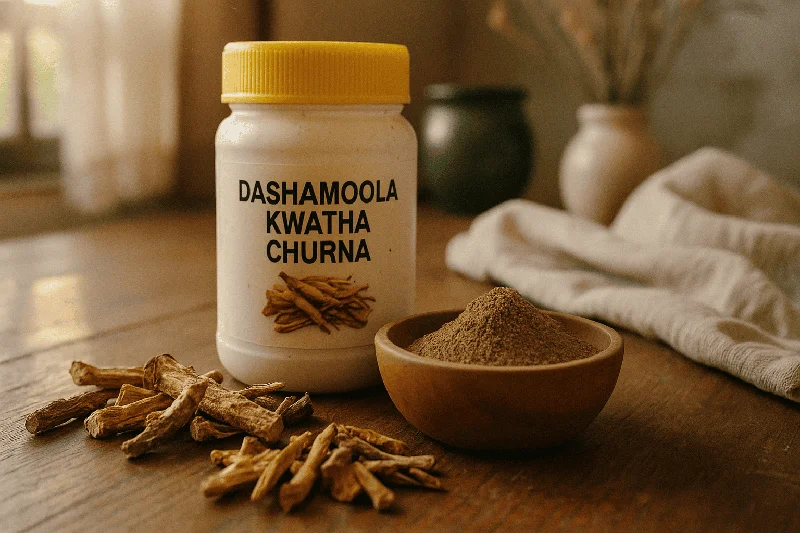
Dashamoola Kwatha Churna is a classical Ayurvedic coarse powder made from ten medicinal roots — five major (Brihat Panchamoola) and five minor (Laghu Panchamoola) — designed specifically for preparing therapeutic decoctions (kwatha). It is one of the most trusted formulations in Ayurveda for managing inflammatory conditions, respiratory disorders, musculoskeletal pain, and Vata-Kapha imbalances. Unlike a fine churna you swallow directly, this coarse-grade powder is boiled in water, reduced to a concentrated liquid, and then consumed — a process that extracts the deepest healing compounds from these ten roots.
If you've been searching for clear, evidence-backed information on what this formulation actually does, how to prepare it at home, the right dosage, and who should avoid it, you're in the right place. This guide covers everything the classical texts describe and what modern research supports.
What Is Dashamoola Kwatha Churna?
The name itself tells the story. "Dasha" means ten, "moola" means roots, "kwatha" means decoction, and "churna" means powder. So Dashamoola Kwatha Churna is literally a powder of ten roots meant for boiling into a decoction.
- This formulation has been documented in several foundational Ayurvedic texts for centuries.
- It isn't a modern invention or a proprietary blend — it's a time-tested classical formula with precise ratios.
Meaning of "Dashamoola" — The Ten Roots
The Dashamoola group is one of the most important gana (category) in Ayurvedic pharmacology.
These ten roots are divided into two subgroups of five each:
- Brihat Panchamoola (five major/large roots): These come from large trees and are primarily heavy, grounding, and Vata-pacifying.
- Laghu Panchamoola (five minor/small roots): These come from smaller plants and herbs, adding lighter, more penetrating therapeutic actions.
Together, they create a synergistic formula that neither subgroup can achieve alone. The combination balances potency with subtlety.
Classical References — Sharangdhara Samhita, Charaka Samhita & Ashtanga Hridayam
Dashamoola is referenced across multiple classical texts:
- Charaka Samhita (Sutra Sthana, Chapter 4) lists Dashamoola as a Shothahara (anti-inflammatory) and Vedanasthapana (analgesic) group.
- Sushruta Samhita describes Dashamoola kwatha in the context of post-surgical care and wound management.
- Ashtanga Hridayam by Vagbhata mentions Dashamoola in Vatavyadhi Chikitsa (treatment of Vata disorders) and in formulations for Basti karma.
- Sharangdhara Samhita (Madhyama Khanda, Chapter 2) provides the standard method for kwatha preparation — the classical 1:4 or 1:8 reduction ratio that we'll discuss in the dosage section.
The shloka commonly associated with Dashamoola lists: Bilva, Agnimantha, Shyonaka, Kashmari, Patala, Shalaparni, Prishniparni, Brihati, Kantakari, Gokshura — these ten roots in equal parts.
Kwatha Churna vs Kashayam vs Fine Churna — Key Differences
This is a distinction that confuses many people, and honestly, none of the product pages out there explain it well.
| Feature | Kwatha Churna | Kashayam (Ready Liquid) | Fine Churna |
|---|---|---|---|
| Form | Coarse powder (#40–#60 mesh) | Pre-made liquid decoction | Fine powder (#80–#120 mesh) |
| How to Use | Boil in water, strain, then drink | Drink directly (may dilute) | Swallow with water/honey |
| Potency | Highest — fresh extraction each time | Moderate — may contain preservatives | Lower for water-soluble compounds |
| Shelf Life | 2 years (dry powder) | 3–6 months typically | 2 years |
| Classical Preference | Most traditional method | Convenient modern adaptation | Different therapeutic use |
| Best For | Maximum therapeutic extraction | Patients who can't prepare daily | Conditions needing direct gut action |
The coarse grind of kwatha churna is intentional. It allows water to penetrate the plant material during boiling and extract alkaloids, tannins, saponins, and volatile oils more efficiently than a fine powder could when simply mixed in water.
The 10 Ingredients of Dashamoola Kwatha Churna
Understanding each root's individual contribution helps you appreciate why this formula works so powerfully as a whole.
Brihat Panchamoola (Five Major Roots)
These are the heavy-hitters — roots from large trees that provide deep-tissue penetration and strong Vata-shamana action.
| Sanskrit Name | Botanical Name | Key Action |
|---|---|---|
| Bilva | Aegle marmelos | Digestive, anti-diarrheal, Vata-Kapha pacifying |
| Agnimantha | Premna mucronata | Anti-inflammatory, deepana (appetizer), anti-obesity |
| Shyonaka | Oroxylum indicum | Analgesic, anti-inflammatory, useful in respiratory disorders |
| Kashmari (Gambhari) | Gmelina arborea | Rasayana (rejuvenative), diuretic, cardioprotective |
| Patala | Stereospermum suaveolens | Febrifuge, anti-allergic, bronchodilator properties |
Bilva root is perhaps the most recognizable — it's the same tree whose leaves are offered to Lord Shiva. But it's the root bark that works medicinally here, offering bitter and astringent compounds that calm intestinal inflammation. Agnimantha literally means "fire churner." Its root stimulates Agni (digestive fire) while simultaneously reducing Ama (toxins) — a rare dual action. Shyonaka root bark contains oroxylin A and baicalein, flavonoids studied for their COX-2 inhibitory effects (similar mechanism to modern anti-inflammatory drugs, but gentler). Gambhari acts as a Medhya Rasayana (brain tonic) alongside its anti-inflammatory role, making the overall formula supportive of neurological health too. Patala contributes bronchodilatory action, which is why Dashamoola kwatha is so effective in respiratory conditions — this root opens up airways.
Laghu Panchamoola (Five Minor Roots)
These lighter roots add precision, targeting specific channels (srotas) in the body.
| Sanskrit Name | Botanical Name | Key Action |
|---|---|---|
| Shalaparni | Desmodium gangeticum | Anti-asthmatic, nervine tonic, Vata-shamaka |
| Prishniparni | Uraria picta | Febrifuge, hemostatic, anti-inflammatory |
| Brihati | Solanum indicum | Expectorant, Kapha-reducing, useful in sinusitis |
| Kantakari | Solanum xanthocarpum | Potent expectorant, anti-asthmatic, voice-clearing |
| Gokshura | Tribulus terrestris | Diuretic, lithotriptic (dissolves stones), reproductive tonic |
Kantakari deserves special mention. A 2013 study published in the Journal of Ethnopharmacology demonstrated its significant bronchodilatory and anti-histaminic activity, validating its classical use in asthma and chronic cough. Gokshura adds a urinary-tract dimension to the formula. It promotes healthy urine flow, reduces urinary calculi, and supports prostate health — benefits you won't get from most anti-inflammatory formulations.
Together, these ten roots cover virtually every major body system: digestive, respiratory, musculoskeletal, nervous, urinary, and reproductive.
Medicinal Properties — Ayurvedic and Modern Pharmacology
Rasa, Guna, Virya, Vipaka (Ayurvedic Pharmacology)
| Parameter | Value |
|---|---|
| Rasa (Taste) | Tikta (Bitter), Kashaya (Astringent), Madhura (Sweet) |
| Guna (Quality) | Laghu (Light), Ruksha (Dry) |
| Virya (Potency) | Ushna (Hot) |
| Vipaka (Post-digestive effect) | Katu (Pungent) |
The combination of Ushna Virya (heating potency) with bitter and astringent tastes makes this formula particularly effective at breaking down Ama (metabolic toxins) while simultaneously calming Vata dosha.
Dosha Karma — Vata-Kapha Shamaka
Dashamoola Kwatha Churna is primarily a Vata-Kapha Shamaka — it pacifies both Vata and Kapha doshas.
- Vata management: The heavy, warm, and grounding qualities of the Brihat Panchamoola roots directly counteract Vata's cold, light, and mobile nature.
- Kapha management: The bitter, astringent, and drying qualities — especially from Kantakari, Brihati, and Agnimantha — reduce excess Kapha accumulation in the lungs and joints.
- Pitta consideration: Due to its Ushna Virya, individuals with strong Pitta prakriti or active Pitta conditions (acid reflux, bleeding disorders) should use this formulation with caution or under guidance.
Modern Pharmacological Actions
Research has increasingly validated what Ayurveda has known for millennia:
- Anti-inflammatory: A 2017 study in Pharmacognosy Research showed Dashamoola extract significantly inhibited carrageenan-induced paw edema in experimental models, comparable to standard anti-inflammatory drugs.
- Analgesic: The formula demonstrated dose-dependent pain relief in hot plate and tail-flick analgesic models.
- Antioxidant: A 2019 study published in the Journal of Ayurveda and Integrative Medicine reported strong DPPH radical scavenging activity and significant total phenolic content in Dashamoola decoction.
- Antipyretic: Multiple roots in the formula (Prishniparni, Patala) have documented fever-reducing activity.
- Rejuvenative (Rasayana): The combination promotes tissue regeneration and cellular repair, which modern science attributes to its antioxidant and immunomodulatory effects.
Health Benefits of Dashamoola Kwatha Churna
Musculoskeletal Health — Joint Pain, Arthritis, Sciatica
This is probably the most common reason people reach for Dashamoola kwatha. The formula's Vata-pacifying and anti-inflammatory actions make it highly effective for:
- Rheumatoid and osteoarthritis: Reduces joint swelling, morning stiffness, and pain
- Sciatica (Gridhrasi): Classical Ayurvedic texts specifically recommend Dashamoola kwatha for Gridhrasi, where Vata aggravation compresses the sciatic nerve
- Cervical and lumbar spondylosis: Regular use helps manage chronic spine-related pain
- Fibromyalgia and generalized body aches: The warming, penetrating quality reaches deep muscle tissue
For musculoskeletal conditions, the kwatha is often prescribed both internally (as a decoction) and externally (as a warm fomentation or in Basti therapy).
Respiratory Health — Asthma, Bronchitis, Chronic Cough
The Laghu Panchamoola roots — especially Kantakari and Brihati — are powerful expectorants and bronchodilators.
Dashamoola kwatha helps with:
- Bronchial asthma (Tamaka Shwasa): Reduces bronchospasm and clears mucus from airways
- Chronic bronchitis: The anti-inflammatory action reduces bronchial wall thickening
- Productive cough with thick mucus: The Kapha-reducing properties liquify and expel stubborn phlegm
- Sinusitis and nasal congestion: Especially when combined with steam inhalation
Digestive and Abdominal Health
Dashamoola kwatha strengthens Agni (digestive fire) without aggravating Pitta excessively.
It's useful for:
- Abdominal distension and bloating (Adhmana): Particularly Vata-type bloating with gas
- Post-partum recovery: Classical texts recommend Dashamoola kwatha for new mothers to restore digestive strength, reduce uterine inflammation, and pacify Vata that gets aggravated during delivery
- Irritable bowel with Vata predominance: Cramping, irregular bowel movements, gurgling
Neurological and Mental Health Support
The nervine tonic properties — particularly from Shalaparni and Gambhari — support:
- Stress-related tension headaches
- Insomnia caused by Vata aggravation: The grounding effect calms an overactive mind
- Generalized anxiety with physical symptoms: Muscle tension, restlessness, palpitations
Urological Health
Thanks to Gokshura's inclusion, the formula also supports:
- Urinary tract infections (Mutrakrichra): Promotes urine flow and reduces burning
- Kidney and bladder stones: Gokshura's lithotriptic action helps dissolve small calculi
- Benign prostatic hyperplasia: Supportive role in managing urinary symptoms
How to Use Dashamoola Kwatha Churna — Preparation and Dosage
This section is critical, and it's something almost no product page explains properly. The classical method of kwatha preparation directly affects the medicine's potency.
Step-by-Step Preparation of the Decoction
According to Sharangdhara Samhita (Madhyama Khanda, Chapter 2), the standard kwatha preparation follows a 1:16 ratio reduced to 1:4:
- 1.Measure: Take 1 part Dashamoola Kwatha Churna (typically 10–15 grams or about 1 tablespoon)
- 2.Add water: Add 16 parts water (approximately 200 ml for 12 g of powder)
- 3.Soak (optional but recommended): Soak the powder in water for 1–2 hours or overnight for better extraction
- 4.Boil: Bring to a boil on medium flame, then reduce to low heat
- 5.Reduce: Continue simmering until the liquid reduces to 1/4th of the original volume (approximately 50 ml)
- 6.Strain: Filter through a clean cotton cloth or fine strainer while still warm
- 7.Drink: Consume lukewarm on an empty stomach
Important: Do not use an aluminum vessel. Use stainless steel, clay, or glass.
Standard Dosage
| Patient Category | Single Dose | Frequency | Best Time |
|---|---|---|---|
| Adults (general) | 40–50 ml of prepared kwatha | Twice daily | Before meals (empty stomach) |
| Adults (mild conditions) | 30 ml of prepared kwatha | Once daily | Morning, empty stomach |
| Elderly patients | 20–30 ml of prepared kwatha | Twice daily | Before meals |
| Children (above 8 years) | 10–15 ml of prepared kwatha | Once daily | As advised by physician |
| Children below 8 | Not recommended without direct physician supervision | — | — |
Dosage Adjustments for Specific Conditions
- Acute joint pain/inflammation: Higher dose (50 ml, twice daily) for 7–14 days, then taper
- Respiratory maintenance: Moderate dose (30 ml, once daily) for 30–60 days
- Post-partum care: 30–40 ml twice daily for 15–30 days post-delivery, traditionally with a pinch of Pippali churna
Anupana — What to Take It With
The anupana (vehicle/adjuvant) significantly influences where the medicine acts in the body:
| Anupana | Best For |
|---|---|
| Warm water | General use, Vata conditions |
| Honey (1 tsp mixed in lukewarm kwatha) | Kapha conditions — respiratory, obesity |
| Ghee (1/2 tsp) | Pitta-associated inflammation, burning sensations |
| Eranda Taila (castor oil, 5 ml) | Severe Vata, constipation with joint pain |
| Shunthi (dry ginger) powder | Ama-predominant conditions, digestive weakness |
Role in Panchakarma Therapies
Dashamoola kwatha isn't just an oral medicine. It plays a vital role across multiple Panchakarma procedures.
Basti Karma (Medicated Enema Therapy)
This is the single most important Panchakarma application of Dashamoola kwatha. In Niruha Basti (decoction enema), Dashamoola kwatha forms the primary liquid base. It is combined with honey, rock salt, sesame oil, and herbal paste (kalka) to create a medicated enema that:
- Directly pacifies Vata in its primary seat — the colon (Pakwashaya)
- Eliminates accumulated toxins from the lower GI tract
- Provides systemic anti-inflammatory effects through rectal absorption
Charaka Samhita (Siddhi Sthana, Chapter 3) specifically mentions Dashamoola Niruha Basti for conditions like Gridhrasi (sciatica), Katishoola (low back pain), and Sandhivata (osteoarthritis).
Other Panchakarma Applications
- Parisheka Sweda (pouring sudation): Warm Dashamoola kwatha is continuously poured over affected joints for pain relief
- Avagaha Sweda (tub bath): The patient sits in a tub of warm Dashamoola kwatha — particularly effective for pelvic pain, hemorrhoids, and post-partum recovery
- Dhoomapana support: Though not used directly as smoke, the kwatha is consumed before and after Dhoomapana (medicated smoking) to manage Vata
- Post-Vamana and post-Virechana care: Administered as a supportive decoction during Samsarjana Krama (gradual diet resumption after purification)
Seasonality — When Is Dashamoola Kwatha Most Effective?
Ayurveda emphasizes Ritucharya (seasonal regimen), and Dashamoola kwatha aligns with specific seasons:
| Season | Dosha Tendency | Dashamoola Relevance |
|---|---|---|
| Varsha (Monsoon) — July to September | Vata aggravation peaks | Most beneficial — directly counters monsoon-aggravated Vata |
| Hemanta (Early Winter) — November to January | Kapha begins to accumulate | Helpful for preventing respiratory Kapha buildup |
| Shishira (Late Winter) — January to March | Kapha accumulation | Useful, especially for joint stiffness in cold weather |
| Grishma (Summer) — May to July | Pitta predominance | Use with caution — Ushna Virya may aggravate Pitta. Reduce dose or add cooling anupana |
The monsoon season is when this formulation truly shines. As humidity rises and temperatures fluctuate, Vata dosha becomes highly unstable. Many people experience flare-ups of arthritis, sciatica and respiratory issues during this period — exactly the conditions Dashamoola kwatha addresses best.
Contraindications, Side Effects & Drug Interactions
This is a section that almost nobody provides. But it's essential for safe use.
Who Should Avoid Dashamoola Kwatha Churna?
- Pregnant women: The Ushna Virya and some constituent herbs (particularly Kantakari) may stimulate uterine contractions. Strictly avoid unless prescribed by a qualified Ayurvedic physician for specific indications.
- People with active bleeding disorders: Pitta-aggravating potential may worsen bleeding tendencies — menorrhagia, bleeding piles in active phase, peptic ulcers with active bleed.
- Severe Pitta Prakriti with active Pitta conditions: Acid reflux (Amlapitta), burning urination, hot flushes — use only with Pitta-balancing anupana and physician guidance.
- Extreme dehydration or Ruksha (dry) constitution: The Ruksha guna may further deplete moisture. Combine with ghee or use Ksheera Paka (milk decoction) method instead.
Potential Side Effects
When used in proper doses and for appropriate conditions, side effects are rare.
However, possible issues include:
- Mild gastric irritation or acidity (especially in Pitta individuals)
- Increased thirst or dryness of mouth
- Loose stools in sensitive individuals (especially if combined with Eranda Taila)
- Dizziness in rare cases — usually indicates the dose is too high
Interactions With Other Medications
- With allopathic anti-inflammatories (NSAIDs): Additive effect — may increase risk of gastric irritation. Space them at least 2 hours apart.
- With antihypertensives: Gokshura has mild diuretic action; combined with diuretic drugs, it may cause electrolyte imbalances. Monitor under physician guidance.
- With blood thinners (Warfarin, Aspirin): Some constituent herbs have mild antiplatelet activity. Consult your doctor before combining.
- With other Ayurvedic Ushna Virya formulations: Avoid stacking multiple heating formulations simultaneously to prevent Pitta aggravation.
Dashamoola Kwatha Churna vs Other Formulations — A Quick Comparison
| Feature | Dashamoola Kwatha Churna | Dashmularishta | Dashamoola Taila | Dashamoola Ghrita |
|---|---|---|---|---|
| Form | Coarse powder for decoction | Fermented liquid (self-generated alcohol) | Medicated oil | Medicated ghee |
| Route | Oral (decoction) | Oral | External application | Oral / Basti |
| Alcohol Content | None | 5–10% (self-generated) | None | None |
| Best For | Acute Vata-Kapha conditions, Panchakarma | General Vata, post-partum, tonic use | Joint pain, muscle pain (external) | Vata with Pitta, neurological conditions |
| Potency | Highest extraction | Moderate (but better shelf life) | External use only | Moderate (lipid-soluble compounds) |
| Who Should Avoid | See contraindications above | Alcohol-intolerant, diabetics (sugar content) | Open wounds | Kapha-predominant obesity |
Frequently Asked Questions (FAQ)
What is Dashamoola powder used for?
Dashamoola powder (whether as kwatha churna or fine churna) is used primarily for managing inflammatory conditions, joint pain, respiratory disorders, post-partum recovery, and Vata-Kapha imbalances. In Panchakarma, it's a key component of Basti (medicated enema) therapy. Its applications span from arthritis and sciatica to asthma and digestive complaints.
What is the reference text for Dashamoola Kwatha?
The primary classical references include Charaka Samhita (Sutra Sthana, Chapter 4), Sushruta Samhita, and Ashtanga Hridayam. The method of kwatha preparation is codified in Sharangdhara Samhita (Madhyama Khanda, Chapter 2), which prescribes the 1:16 water ratio reduced to 1/4th. The Dashamoola group itself is a well-established gana referenced across virtually all major Ayurvedic texts.
Can I take Dashamoola Kwatha Churna daily?
For chronic conditions like arthritis or recurrent respiratory issues, daily use for 30–90 days is common under physician guidance. However, continuous long-term use without breaks is not recommended. A typical cycle involves 60 days on, 15 days off, then reassess. For acute conditions, shorter intensive courses of 7–14 days are preferred.
What is the shloka for Dashamoola?
The commonly cited shloka is: "Bilva Agnimantha Shyonakau Kashmarya Patala tatha | Shalaparni Prishniparnyau Brihati Kantakarika | Gokshurashcha Dashamoolam..." — listing all ten root drugs that constitute the Dashamoola group. Variations exist across texts, with some substituting Brihati for Sariva depending on the regional tradition.
Is Dashamoola Kwatha Churna safe for children?
Children above 8 years can take a reduced dose (10–15 ml of prepared decoction) under professional supervision. For younger children, it is generally not recommended as a self-medication. Pediatric Ayurvedic practice (Kaumarabhritya) may use Dashamoola in modified formulations like Ksheera Paka (milk decoction) which is gentler on a child's digestive system.
How does Dashamoola Kwatha Churna differ from Dashmularishta?
- The core ingredients are the same ten roots. The key difference is form and preparation.
- Kwatha Churna is boiled fresh each time — no preservatives, no alcohol, maximum potency. Dashmularishta undergoes fermentation (Sandhana Kalpana), producing self-generated alcohol (5–10%), which acts as a preservative and enhances absorption of certain compounds. Dashmularishta is more convenient and is often preferred as a general tonic, especially post-partum. Kwatha Churna is preferred for acute therapeutic situations and in Panchakarma.
Can I use Dashamoola Kwatha externally?
Yes. Warm Dashamoola decoction can be used for Parisheka (pouring over joints), Avagaha (sitz bath for pelvic conditions), and as a base for warm compresses. For external use, the decoction can be made slightly more concentrated — use a 1:8 reduction ratio instead of 1:4.
Conclusion — Why Dashamoola Kwatha Churna Deserves a Place in Your Wellness Routine
Few Ayurvedic formulations match the breadth of Dashamoola Kwatha Churna. It addresses pain, inflammation, respiratory distress, digestive weakness, and urological complaints — all with ten roots working in concert. The fact that it's documented in texts over a thousand years old, and validated by modern pharmacological research, speaks to its enduring relevance.
But remember: Ayurveda is personalized medicine. Your Prakriti, your current Vikriti, the season, and your specific condition all determine whether this formulation is right for you, what dose to take, and what anupana to use. Self-medication can help for mild, well-understood conditions. For anything chronic or complex, consult a qualified Ayurvedic practitioner who can tailor the treatment to your unique constitution.
If you're considering adding Dashamoola Kwatha Churna to your health regimen, start with a lower dose, observe how your body responds, and adjust accordingly. And if you're a practitioner looking for bulk quantities, most reputable manufacturers offer 100 g, 500 g, and 1 kg packaging options to suit clinical and personal use.
Disclaimer: This article is for educational purposes only and does not replace professional medical advice. Always consult a qualified Ayurvedic physician or healthcare provider before starting any new herbal formulation, especially if you are on existing medication, pregnant, or nursing.
Scientific Sources
- A critical review on two types of Laghupanchamula — Ghildiyal S et al., 2012, Ayu
- Anti-inflammatory profile of Aegle marmelos (L) Correa (Bilva) with special reference to young roots grown in different parts of India — Rajaram A et al., 2018, Journal of Ayurveda and integrative medicine
- The protective role of Aegle marmelos on aspirin-induced gastro-duodenal ulceration in albino rat model: a possible involvement of antioxidants — Das SK et al., 2012, Saudi journal of gastroenterology : official journal of the Saudi Gastroenterology Association
- A comparative experimental study to evaluate Mutrala (diuretic) activity of Bilva Moola and Patra (Aegle marmelos Corr.) — Parmar NA et al., 2014, Ayu
- Pharmacological potentials of Premna integrifolia L — Mali PY, 2016, Ancient science of life
- Evaluation of anti-inflammatory and immunomodulatory effects of Premna integrifolia extracts and assay-guided isolation of a COX-2/5-LOX dual inhibitor — Azad R et al., 2018, Fitoterapia
- Botanical identity of plant sources of Daśamūla drugs through an analysis of published literature — Aparna S et al., 2012, Ancient science of life
- Premna integrifolia L.: A review of its biodiversity, traditional uses and phytochemistry — Mali PY, 2015, Ancient science of life
- Clinical efficacy of Shilajatu (Asphaltum) processed with Agnimantha (Clerodendrum phlomidis Linn.) in Sthaulya (obesity) — Pattonder RK et al., 2011, Ayu
Ask Ayurvedic doctor a question and get a consultation online on the problem of your concern in a free or paid mode.
More than 2,000 experienced doctors work and wait for your questions on our site and help users to solve their health problems every day.
Related articles