Ask Ayurvedic doctor a question and get a consultation online on the problem of your concern in a free or paid mode. More than 2,000 experienced doctors work and wait for your questions on our site and help users to solve their health problems every day.
FREE! Ask Ayurvedic Doctors 24/7

 Fast responses
 1000+ verified doctors
Body DetoxEar, Nose, and Throat DisordersGeriatrics & RejuvenationImmunodeficiencyInfertility TreatmentNutritionOrthopedic DisordersPediatricsRespiratory DisordersSexually Transmitted Diseases (STDs)Surgery RecoveryUrological DisordersVascular DisordersDental DisordersEndocrinological DisordersGastrointestinal DisordersYoga TherapyGeneral MedicineAllergic DisordersCardio DisordersGynecology and ObstetricsCosmetologySkin and Hair DisordersEye DisordersInfectious DiseasesMental DisordersNeurological DisordersOncologyPanchakarmaSexual Health & DisordersSports Medicine
Published on 03/05/25
(Updated on 06/18/26)
2,622
Mayur Piccha Bhasma – Rare Ayurvedic Calcined Formulation for Detoxification & Rejuvenation
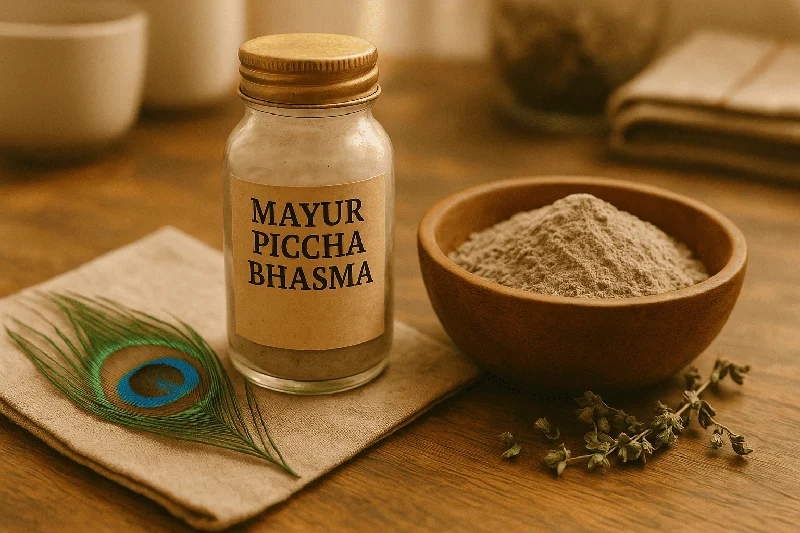
Mayur Piccha Bhasma is a classical Ayurvedic calcined preparation made from purified peacock feathers (Pavo cristatus), processed through specific incineration techniques described in ancient pharmaceutical texts. It is primarily indicated for Hikka (hiccough), Chardi (vomiting), and Shwasa (dyspnoea/asthma) — conditions rooted in aggravated Kapha and Vata doshas. Despite being a relatively rare formulation, it appears in several authoritative Ayurvedic compendiums including Siddhayoga Sangraha, Bhaishajya Samhita, and Bhaishajya Ratnavali. This article is the most comprehensive guide you'll find on its pharmacology, preparation methods, physico-chemical profile, clinical uses, safety considerations, and more.
What Is Mayur Piccha Bhasma?
Mayur Piccha Bhasma (also spelled Mayūrapuccha Bhasma or Mayurpiccha Bhasma) is a Bhasma — a calcined ash — prepared by subjecting peacock feathers to controlled high-temperature incineration, either over a ghee flame or through the classical Gajapuṭa method. The resulting fine, light ash is then used therapeutically in small doses, often combined with honey, ghee, or herbal adjuvants.
- Unlike metallic or mineral Bhasmas (such as Lauha Bhasma or Tamra Bhasma), Mayur Piccha Bhasma falls into the category of Prāṇija Dravya (animal-origin substances).
- The raw material — peacock feather — is rich in beta-keratin, which upon systematic incineration converts into a complex matrix of bio-available inorganic elements including calcium, potassium, sodium, magnesium, iron, and sulfur compounds.
The word Mayūrapuccha literally translates to "peacock tail" in Sanskrit. The formulation has been in use for centuries, though it remains less commercially prominent than metallic Bhasmas.
Synonyms and Nomenclature
This preparation goes by several names across different Ayurvedic texts and regional traditions:
| Name | Language / Context |
|---|---|
| Mayur Piccha Bhasma | Hindi (commonly used) |
| Mayūrapuccha Bhasma | Sanskrit (classical) |
| Mayur Shikha Bhasma | Alternative Sanskrit name |
| Shikhipiccha Bhasma | Synonym (Shikhi = peacock) |
| Mayur Chandrika Bhasma | Alternative name (Chandrika = crest/feather spot) |
| Calx of Peacock Feather | English pharmaceutical term |
People often ask, "What is Mayur Chandrika Bhasma?" — it is essentially the same preparation. The term Chandrika refers to the eye-like spot on a peacock feather, and in some texts the terms are used interchangeably.
Classical Ayurvedic References
Mayur Piccha Bhasma is referenced in at least three major Ayurvedic pharmaceutical texts:
- Siddhayoga Sangraha (Hikka-Shwasa Adhikara) — describes the Ghee Flame method of preparation
- Bhaishajya Samhita (Agni Sansthaagar Kalpana section) — details the Gajapuṭa method with specific herbal adjuvants
- Bhaishajya Ratnavali (Hikka Shwasa Chikitsa, 16/12) — contains a Sanskrit shloka prescribing the formulation
The shloka from Bhaishajya Ratnavali (16/12) reads:
> "Mayūrapucchabhasma tu hiccāśvāsavināśanam |
> Madhunā sahitaṁ līḍhaṁ sarddhapippalikaṁ hitam ||"
This verse establishes the formulation's primary indication — destroying Hikka (hiccough) and Shwasa (dyspnoea) — and recommends administration with honey and Pippali (long pepper).
Ayurvedic Pharmacology (Rasa Panchaka)
One significant gap in existing literature is the complete Ayurvedic pharmacological profile of Mayur Piccha Bhasma. No competing resource has systematically outlined the Rasa Panchaka. Based on classical principles and the formulation's therapeutic actions, the following profile can be inferred:
| Parameter | Value | Rationale |
|---|---|---|
| Rasa (Taste) | Kashaya (Astringent), Tikta (Bitter) | Characteristic of many animal-origin Bhasmas with Kapha-pacifying action |
| Guna (Quality) | Laghu (Light), Ruksha (Dry) | Consistent with ash-form preparations; enables quick absorption |
| Virya (Potency) | Ushna (Hot) | Necessary for its bronchodilatory and anti-spasmodic action |
| Vipaka (Post-digestive effect) | Katu (Pungent) | Supports Kapha reduction and Agni (digestive fire) enhancement |
| Prabhava (Special action) | Hiccough and vomiting cessation | As stated in Bhaishajya Ratnavali |
Doshic Action (Kapha-Vata Shamaka)
Mayur Piccha Bhasma primarily acts as a Kapha-Vata Shamaka — it pacifies both Kapha and Vata doshas.
This dual action explains its efficacy in conditions where:
- Kapha obstruction causes bronchospasm, excessive mucous, and nausea (as in Shwasa and Chardi)
- Vata derangement produces involuntary spasmodic movements (as in Hikka/hiccough)
The Ushna Virya penetrates and liquefies accumulated Kapha, while the Laghu and Ruksha Gunas facilitate its expulsion. The Katu Vipaka ensures that post-digestion, the medicine continues to reduce Kapha-dosha at the tissue level.
In Pitta-predominant constitutions or conditions, it should be used cautiously — ideally with cooling Anupanas like milk or ghee.
Ingredients and Raw Materials
Peacock Feather (Pavo cristatus) — Properties and Significance
The primary ingredient is the feather of the Indian peafowl (Pavo cristatus), India's national bird. Peacock feathers are composed primarily of beta-keratin, a structural protein also found in reptilian scales and bird claws. This protein is notable for its sulfur-rich amino acid content (particularly cysteine), which contributes to the sulfur compounds found in the final Bhasma.
Upon incineration, the organic keratin matrix decomposes, leaving behind an inorganic ash rich in several bioactive elements. A 2015 physico-chemical analysis published in the International Journal of Ayurveda and Pharma Research identified the following elements in Mayur Piccha Bhasma:
- Calcium (Ca) — bone and tissue support
- Potassium (K) — electrolyte balance
- Sodium (Na) — cellular function
- Iron (Fe) — oxygen transport
- Magnesium (Mg) — enzymatic reactions
- Sulfur (S) — derived from keratin's cysteine residues
Adjuvant Herbs Used in Gajapuṭa Method
The Gajapuṭa preparation method (from Bhaishajya Samhita) requires peacock feathers to be treated with Bhavana (levigation) using fresh juices of specific herbs before incineration:
| Herb | Botanical Name | Role in Preparation |
|---|---|---|
| Palasha | Butea monosperma | Provides alkaline medium; enhances calcium release |
| Dronapushpi | Leucas cephalotes | Anti-microbial; aids in purification of raw material |
| Chakramarda | Cassia tora | Antifungal properties; contributes to Bhasma's therapeutic profile |
These herbs are not mere fillers. Their fresh juices serve as Bhavana Dravyas that chemically interact with the feather material during trituration and subsequent incineration, influencing the final elemental composition of the Bhasma.
Methods of Preparation (Pharmaceutical Process)
Two distinct methods of preparing Mayur Piccha Bhasma are described in classical texts. Understanding both is essential for practitioners and researchers.
Ghee Flame Method (Siddhayoga Sangraha)
This is the simpler of the two methods:
- 1.Collection: Clean, naturally shed peacock feathers are collected
- 2.Purification: Feathers are washed and dried thoroughly
- 3.Incineration: Feathers are held over a burning ghee flame (Ghrita Deepa Shikha) until completely reduced to ash
- 4.Collection of ash: The resulting white-grey ash is collected, finely powdered, and stored
The process is relatively quick and does not require a Puṭa (traditional kiln). However, the temperature exposure is inconsistent, and the resulting Bhasma may have higher moisture content.
Gajapuṭa Method (Bhaishajya Samhita)
This method is more elaborate and produces a superior-quality Bhasma:
- 1.Purification: Peacock feathers are cleaned and cut into small pieces
- 2.Bhavana (Levigation): Feather pieces are triturated with fresh juices of Palasha, Dronapushpi, and Chakramarda until a homogenous paste forms
- 3.Chakrikas (Pellet formation): The paste is shaped into flat, round pellets (chakrikas) and sun-dried
- 4.Sharava Sampuṭa: Dried pellets are placed in an earthen saucer, covered with another saucer, sealed with multani mitti (fuller's earth) cloth
- 5.Gajapuṭa: The sealed assembly is subjected to Gajapuṭa — a specific quantum of heat using approximately 1,000 cow dung cakes, generating sustained temperatures of roughly 900–1000°C
- 6.Self-cooling: After the fire extinguishes naturally, the apparatus is allowed to cool completely (Svāṅgaśīta)
- 7.Collection and powdering: The Bhasma is retrieved, finely triturated, and stored in airtight containers
Comparison of Both Methods
A comparative physico-chemical study (published in Journal of Ayurveda and Integrated Medical Sciences, 2018) revealed significant differences:
| Parameter | Ghee Flame Method | Gajapuṭa Method |
|---|---|---|
| Colour | Grey-white | White with slight yellowish tinge |
| Moisture Content | Higher (~4.2%) | Lower (~2.1%) |
| Total Ash Value | ~78% | ~89% |
| pH | 9.2 (alkaline) | 9.8 (more alkaline) |
| Inorganic Elements | Fewer, lower concentration | Greater diversity and concentration |
| Particle Fineness | Moderate | Very fine (passes through 200# sieve) |
| Rekhapurnatva | Partial | Complete (fills finger lines) |
Key finding: The Gajapuṭa method produces a Bhasma with significantly higher mineral content, lower moisture, and better compliance with classical Bhasma Pariksha standards. The sustained high temperature of Gajapuṭa ensures more complete organic matter degradation and superior conversion of keratin into bioactive inorganic compounds.
Quality Tests for Bhasma (Bhasma Pariksha)
Classical Ayurvedic texts prescribe several tests to verify proper Bhasma formation:
- Rekhapurnatva — the Bhasma should be so fine that it fills the lines (rekha) of the fingerprint when rubbed between thumb and index finger
- Varitara — a pinch of Bhasma placed on still water should float, indicating lightness and complete incineration
- Dadhi Pariksha — when Bhasma is sprinkled over fresh curd (dadhi), it should not cause discoloration. If the curd changes color, the Bhasma is incompletely processed and potentially harmful
- Nishchandratva — the Bhasma should be lusterless (no metallic shine), indicating full conversion from organic to inorganic form
- Apunarbhavatva — the Bhasma should not revert to its original form when re-heated
Physico-Chemical and Modern Scientific Analysis
Organoleptic Characters
| Character | Observation |
|---|---|
| Colour | Greyish-white (Ghee Flame) / Off-white (Gajapuṭa) |
| Texture | Very fine, smooth powder |
| Odour | Faint, characteristic (slightly smoky) |
| Taste | Mildly astringent, earthy |
| Touch | Non-gritty, impalpable on fingertip |
Physical Constants
Based on analytical studies:
- Total Ash Value: 78–89% (method-dependent)
- Acid-insoluble Ash: 12–18%
- Water-soluble Ash: 22–28%
- pH: 9.2–9.8 (alkaline)
- Specific Gravity: 1.8–2.2
- Moisture Content: 2.1–4.2%
- Loss on Drying: 3.5–5.0%
Modern Instrumental Analysis (XRD, SEM, ICP-OES)
Advanced analytical techniques reveal the scientific basis of Mayur Piccha Bhasma's activity:
- XRD (X-Ray Diffraction): Shows predominantly amorphous carbon matrix with crystalline calcium carbonate (CaCO₃) and calcium phosphate phases
- SEM (Scanning Electron Microscopy): Reveals nano-to-micro-sized particles (50–500 nm range in Gajapuṭa Bhasma), which may enhance bioavailability
- ICP-OES (Inductively Coupled Plasma Optical Emission Spectroscopy): Confirms presence of Ca, K, Na, Mg, Fe, S, P, and trace elements like Zn and Mn
The clinical significance of this elemental profile is worth noting. Calcium and magnesium have known smooth muscle relaxant properties, which could explain the anti-spasmodic action in hiccough. Sulfur compounds derived from keratin degradation may contribute to mucolytic activity in respiratory conditions. The alkaline pH could help neutralize excess gastric acid in vomiting.
This is where the bridge between traditional Ayurvedic claims and modern pharmacology becomes fascinating — the Bhasma isn't just burnt feathers, it's a carefully engineered mineral-rich nanoparticulate preparation.
Don't wait or self medicate. Start chat with Doctor NOW
Medicinal Uses and Benefits of Mayur Piccha Bhasma
What Is the Medicinal Use of Peacock Feather in Ayurveda?
The peacock feather, once converted to Bhasma, acquires therapeutic properties quite different from the raw material.
The primary classical indications are:
Hikka (Hiccough)
This is the foremost indication mentioned across all classical texts. Hiccough (Hikka) is classified under Vata-Kapha disorders in Ayurveda. The antispasmodic property of Mayur Piccha Bhasma acts on the Pranavaha Srotas (respiratory channels) and diaphragmatic musculature to arrest involuntary spasmodic contractions. Traditionally dosed with honey and Pippali churna for maximum effect.
Chardi (Vomiting / Emesis)
- The antiemetic action of this Bhasma is well-documented in classical literature. It pacifies upward-moving Vata (Udana Vayu) and reduces Kapha-induced gastric irritation.
- Useful in both acute and chronic vomiting — including morning sickness (though pregnancy use requires strict medical supervision, more on that below).
Shwasa (Dyspnoea / Bronchial Asthma)
- Mayur Piccha Bhasma is indicated in Tamaka Shwasa (bronchial asthma) where Kapha accumulation in the airways causes breathing difficulty. The Ushna Virya and Katu Vipaka help liquify and expel bronchial secretions.
- The mineral content — particularly calcium and magnesium — may exert bronchodilatory effects.
Kasa (Chronic Cough and Bronchitis)
Especially effective in Kaphaja Kasa (productive cough), where thick, sticky mucous is the predominant complaint. Often combined with Sitopaladi Churna or Talisadi Churna for enhanced efficacy.
Mechanism of Action — How Does It Actually Work?
No competitor has adequately explained the pharmacodynamics of this formulation.
Here's what we understand:
- 1.Keratin Pyrolysis: At temperatures above 800°C, beta-keratin undergoes complete thermal decomposition. The organic peptide chains break down, releasing carbon (as CO₂) and leaving behind inorganic mineral residues in a nano-particulate, amorphous form
- 2.Enhanced Bioavailability: The nano-sized particles (confirmed via SEM) can cross biological membranes more easily than conventional mineral supplements
- 3.Alkaline Buffering: The pH of 9.2–9.8 neutralizes excess gastric acid, directly addressing the pathophysiology of Amlapitta-related vomiting
- 4.Smooth Muscle Relaxation: Calcium and magnesium ions modulate smooth muscle contraction-relaxation cycles in bronchial and diaphragmatic muscles
- 5.Mucolytic Action: Sulfur-derived compounds may thin bronchial secretions, facilitating expectoration
Think of it this way — the ancient process of Puṭa essentially creates a bio-mineral complex that modern science would recognize as a multi-mineral nanoparticulate supplement with specific tissue tropism for the respiratory and gastrointestinal systems.
Dosage, Anupana, and Administration
Standard Dosage
| Category | Dosage | Frequency |
|---|---|---|
| Adults | 125–250 mg (1–2 Ratti) | 2–3 times daily |
| Children (above 5 years) | 60–125 mg (½–1 Ratti) | 1–2 times daily |
| Elderly | 125 mg (1 Ratti) | 2 times daily |
1 Ratti ≈ 125 mg Duration: Typically prescribed for 2–4 weeks. Can be extended to 8 weeks under medical supervision.
Anupana (Carrier Substances) for Different Conditions
The choice of Anupana significantly influences where and how the Bhasma acts:
| Condition | Recommended Anupana | Rationale |
|---|---|---|
| Hikka (Hiccough) | Honey + Pippali Churna | As per Bhaishajya Ratnavali shloka; Pippali enhances bioavailability |
| Chardi (Vomiting) | Honey alone or with fresh ginger juice | Honey is antiemetic; ginger is Vamana-nigraha |
| Shwasa (Asthma) | Honey + Sitopaladi Churna | Sitopaladi enhances respiratory tract action |
| Kasa (Chronic cough) | Warm water + Ghee | Ghee lubricates airways; warm water acts as vehicle |
| General Kapha conditions | Honey | Default Kapha-reducing Anupana |
Best Time to Take
- Before meals (empty stomach) for respiratory conditions
- After meals for gastrointestinal complaints (vomiting, nausea)
- With warm water in the morning for general detoxification
Safety, Side Effects, and Contraindications
Toxicological Profile
This is perhaps the most critical gap in existing literature. While some sources casually state "no known side effects," responsible medical communication demands a thorough safety assessment.
Heavy Metal Concerns: Unlike metallic Bhasmas (Naga, Parada, Tamra), peacock feather Bhasma is not expected to contain significant levels of toxic heavy metals (lead, mercury, arsenic, cadmium) since the source material is organic. However, environmental contamination of feathers is possible if peacocks were exposed to polluted habitats. Recommended Safety Testing:
- Lead (Pb): should be < 10 ppm
- Mercury (Hg): should be < 1 ppm
- Arsenic (As): should be < 3 ppm
- Cadmium (Cd): should be < 0.3 ppm
Always purchase from manufacturers who provide Certificate of Analysis (CoA) with heavy metal testing results. AYUSH GMP-certified manufacturers are preferable.
Contraindications
| Condition | Recommendation |
|---|---|
| Pregnancy | Use only under strict Ayurvedic physician supervision. While some practitioners recommend it for pregnancy-related vomiting, insufficient safety data exists for routine use |
| Lactation | Avoid unless prescribed by a qualified physician |
| Children under 5 | Not recommended due to lack of pediatric safety data |
| Pitta-predominant conditions | Use cautiously — the Ushna Virya may aggravate Pitta. Combine with cooling Anupana |
| Hepatic / Renal impairment | Use with caution; dose adjustment may be required |
| Known hypersensitivity | Discontinue if allergic reaction occurs |
Drug Interactions
Mayur Piccha Bhasma may interact with:
- Antacids and PPIs — the alkaline pH of Bhasma may additively reduce stomach acid, potentially affecting absorption of pH-dependent drugs
- Calcium channel blockers — theoretical additive effect due to calcium content
- Bronchodilators — may have synergistic effects; dose adjustments may be needed
- Homeopathic medicines — generally considered compatible, but consult both practitioners
- Other Ayurvedic Bhasmas — can be combined (e.g., with Shankha Bhasma for vomiting), but total Bhasma load should be monitored
Comparison with Similar Bhasmas
Understanding where Mayur Piccha Bhasma fits among related formulations helps practitioners make informed choices:
| Parameter | Mayur Piccha Bhasma | Shankha Bhasma | Praval Bhasma | Godanti Bhasma |
|---|---|---|---|---|
| Source | Peacock feather | Conch shell | Coral | Gypsum |
| Primary Indication | Hikka, Chardi, Shwasa | Amlapitta, Chardi | Shwasa, Kasa, Pitta disorders | Jwara, Headache |
| Dosha Action | Kapha-Vata shamaka | Pitta-Kapha shamaka | Pitta shamaka | Pitta shamaka |
| Virya | Ushna | Sheeta | Sheeta | Sheeta |
| Key Advantage | Specific for hiccough + respiratory | Superior for acidity | Best for Pitta-type respiratory issues | Primarily for fever |
| Availability | Rare / Limited | Widely available | Widely available | Widely available |
When to choose Mayur Piccha Bhasma over others: When the presentation involves hiccough with respiratory distress (Hikka + Shwasa combination), particularly in Kapha-Vata constitutions. No other single Bhasma addresses this specific symptom combination as effectively.
Storage, Shelf Life, and Legal Status
Shelf Life and Storage
- Shelf life: Bhasmas, when properly prepared and stored, have an indefinite shelf life according to classical Ayurveda. However, modern AYUSH regulations typically assign a 5-year expiry from date of manufacture
- Storage conditions: Store in airtight glass or food-grade plastic containers. Keep in a cool, dry place away from direct sunlight and moisture. Do not refrigerate
- Signs of degradation: Clumping, color change, musty odor, or failure to float on water (loss of Varitara property) indicate compromised quality
Regulatory and Legal Status
- India: Classified as an Ayurvedic medicine under Schedule E of the Drugs and Cosmetics Act, 1940. Available without prescription (OTC) but best used under physician guidance. Falls under AYUSH Ministry regulation
- International: Not approved as a medicine in the US, EU, or UK. May be imported as a dietary supplement in some jurisdictions. Check local regulations before purchasing internationally
- Wildlife Protection Note: Peacock feathers used in Bhasma preparation must be naturally shed. The Indian peafowl is the national bird, and hunting is strictly prohibited under the Wildlife Protection Act, 1972. However, collection of naturally molted feathers is legally permissible
Commercial Availability and Price
Mayur Piccha Bhasma is manufactured by select Ayurvedic pharmacies:
- Available from companies like Baidyanath, and some smaller GMP-certified AYUSH pharmacies
- Price range: ₹80–₹250 for 2.5–10g packs (varies by manufacturer and method)
- Due to its niche indications, it is not as widely stocked as common Bhasmas. May need to be ordered specifically from Ayurvedic pharmacies
Clinical Evidence and Research Gaps
It must be honestly acknowledged that no randomized controlled clinical trials currently exist for Mayur Piccha Bhasma.
The evidence base consists of:
- 1.Classical textual references — multiple mentions across at least three authoritative Ayurvedic compendia (strong traditional evidence)
- 2.Physico-chemical analytical studies — at least 2–3 published studies characterizing the Bhasma's composition (2015, 2018)
- 3.Anecdotal clinical experience — generations of Ayurvedic practitioners have used this formulation for Hikka-Shwasa-Chardi complex
- 4.Case reports — limited individual case reports in Ayurvedic journals
What is needed: Multi-center, double-blind, placebo-controlled clinical trials evaluating efficacy in chronic hiccough (a condition poorly served by modern medicine), bronchial asthma, and chemotherapy-induced nausea. This represents a significant research opportunity.
Frequently Asked Questions (FAQ)
What is Mayur Chandrika Bhasma?
Mayur Chandrika Bhasma is another name for Mayur Piccha Bhasma. "Chandrika" refers to the eye-like spot on peacock feathers. Both names refer to the same classical Ayurvedic calcined preparation used primarily for hiccough, vomiting, and respiratory disorders.
What is Mayur Chandrika known for?
- Mayur Chandrika (peacock feather) is known in Ayurveda for its unique therapeutic potential when converted to Bhasma form.
- It is especially renowned for treating intractable hiccough — a condition for which modern medicine offers limited options. It is also valued for its anti-emetic and bronchodilatory properties.
What is Mandur Bhasma used for?
Mandur Bhasma is a completely different preparation made from iron oxide (Mandura/iron rust). It is primarily used for Pandu Roga (anaemia), hepato-splenic disorders, and edema. It should not be confused with Mayur Piccha Bhasma, which is derived from peacock feather and indicated for respiratory and gastrointestinal conditions.
Can Mayur Piccha Bhasma be used during pregnancy?
Some traditional practitioners recommend it for pregnancy-related vomiting (Garbhini Chardi), but there is insufficient modern safety data for routine use in pregnancy. Always consult a qualified Ayurvedic physician before using any Bhasma during pregnancy or lactation.
How is Mayur Piccha Bhasma different from simply burning a peacock feather?
The difference is substantial. Simply burning a feather over an open fire produces inconsistent ash with variable composition, higher moisture, and potential contaminants. The classical Gajapuṭa method involves specific herbal pre-treatment, controlled temperature exposure (~900–1000°C), and quality testing — resulting in a standardized, nano-particulate, therapeutically active Bhasma. It's the difference between crude charcoal and pharmaceutical-grade activated carbon.
Where can I buy authentic Mayur Piccha Bhasma?
Look for AYUSH GMP-certified manufacturers. It is available through Ayurvedic pharmacies and select online retailers. Verify that the product comes with batch number, expiry date, and ideally a Certificate of Analysis. Brands like Baidyanath manufacture this formulation.
Conclusion
Mayur Piccha Bhasma is a sophisticated, albeit underutilized, Ayurvedic formulation with specific and well-defined classical indications — primarily for Hikka, Chardi, and Shwasa. Its preparation involves a remarkable transformation of organic keratin into a bio-available mineral complex through centuries-old incineration technology that modern science is only beginning to understand.
While the clinical evidence base remains largely traditional, the physico-chemical data supporting its composition and the clear pharmacological rationale for its mechanism of action make it a formulation deserving of both greater clinical adoption and rigorous modern research.
If you're a practitioner, consider Mayur Piccha Bhasma when encountering the Hikka-Shwasa-Chardi symptom complex, especially in Kapha-Vata constitutions where conventional Bhasmas fall short. If you're a patient, never self-medicate with any Bhasma preparation — consult a qualified Ayurvedic physician who can assess your Prakriti, Vikriti, and design an appropriate treatment protocol including the right Anupana and dosage. This article is for educational purposes only and does not replace professional medical advice. Always consult a certified Ayurvedic practitioner before starting any Bhasma therapy.
Scientific Sources
- Use of Ayurveda in promoting dental health and preventing dental caries — Telles S et al., 2009, Indian journal of dental research : official publication of Indian Society for Dental Research
- Ayurvedic Profiling of Alzheimer's Disease — Bredesen DE et al., 2017, Alternative therapies in health and medicine
- Genome-wide analysis correlates Ayurveda Prakriti — Govindaraj P et al., 2015, Scientific reports
- Merger of ayurveda and tissue culture-based functional genomics: inspirations from systems biology — Deocaris CC et al., 2008, Journal of translational medicine
- New insights into circadian aspects of health and disease — Singh RB et al., 2002, The Journal of the Association of Physicians of India
- Acute and subacute oral toxicity evaluation of Ayurvedic formulation Tapyadi loha in rats — Hinge PH et al., 2024, Drug and chemical toxicology
- Whole Medical Systems the Rehabilitation Setting (Traditional Chinese Medicine, Ayurvedic Medicine, Homeopathy, Naturopathy) — Drake DF et al., 2020, Physical medicine and rehabilitation clinics of North America
- Management of Parkinson's disease in Ayurveda: Medicinal plants and adjuvant measures — Pathak-Gandhi N et al., 2017, Journal of ethnopharmacology
- The role of alternative medicine in treating postnatal depression — Mantle F, 2002, Complementary therapies in nursing & midwifery
- Three bodies of practice in a traditional South Indian martial art — Zarrilli PB, 1989, Social science & medicine (1982)
- Ayurpharmacoepidemiology en Route to Safeguarding Safety and Efficacy of Ayurvedic Drugs in Global Outlook — Debnath P et al., 2017, Journal of evidence-based complementary & alternative medicine
- The Microbiome in Health and Disease from the Perspective of Modern Medicine and Ayurveda — Wallace RK, 2020, Medicina (Kaunas, Lithuania)
- From ancient medicine to modern medicine: ayurvedic concepts of health and their role in inflammation and cancer — Garodia P et al., 2007, Journal of the Society for Integrative Oncology
- Dentistry and Ayurveda--III (basics-ama, immunity, ojas, rasas, etiopathogenesis and prevention) — Amruthesh S, 2007, Indian journal of dental research : official publication of Indian Society for Dental Research
- Chyawanprash: A review of therapeutic benefits as in authoritative texts and documented clinical literature — Narayana DB et al., 2017, Journal of ethnopharmacology
- Health for all by 2000 AD: the role of Ayurveda — Ghai S et al., 1994, The Nursing journal of India
- Ayurvedic medicine for schizophrenia — Agarwal V et al., 2007, The Cochrane database of systematic reviews
- Contention and collaboration: the tenuous encounter of modern Ayurveda and Western medicine in the twentieth and twenty-first centuries — Katial JM, 2024, Medical humanities
- Search of novel model for integrative medicine — Patwardhan B et al., 2014, Chinese journal of integrative medicine
- Treatment of fibromyalgia at the Maharishi Ayurveda Health Centre in Norway.A six-month follow-up study — Rasmussen LB et al., 2009, Clinical and experimental rheumatology
Questions from users
Can I use Mayur Piccha Bhasma for boosting mental clarity and energy levels?
Hailey
14 days ago
Yes, Mayur Piccha Bhasma can support mental clarity and energy levels, thanks to its rejuvenative effects and vitality boosting properties mentioned in the article. Just make sure you talk with a qualified ayurvedic practitioner first to make sure it suits your personal constitution or any imbalances you might have. Keep in mind benefits might take time to show, so patience is key :)
Is it safe to use Mayur Piccha Bhasma for long-term detoxification?
Kendall
23 days ago
Using Mayur Piccha Bhasma for long-term detoxification can be effective, but it's really important to be cautious. Prolonged use of any potent remedy should be under the guidance of a qualified Ayurvedic practitioner to ensure it suits your prakriti. Monitoring your doshas & any agni imbalances over time is key. If you're unsure, I'd recommend checking with a professional!
What is the process of making Mayur Piccha Bhasma in Ayurvedic medicine?
Luke
32 days ago
Making Mayur Piccha Bhasma starts with obtaining purified peacock excreta. It's then calcined—basically heated and processed—after soaking it with specific herbal decoctions to remove impurities. This combo helps balance Vata and Pitta doshas, aiding detox and metabolism. For detailed steps, I'd recommend consulting a qualified Ayurvedic practitioner or text for authenticity.
How long does it take to see results from using Mayur Piccha Bhasma?
Aubrey
42 days ago
It really varys! For some people, you might see changes in a few weeks, but for others, it could take longer. It depends on your body and what's going on with your doshas and agni. Keeping a balanced diet can help. If you're not sure, check with an Ayurvedic doc; they can give a better idea based on your constitution.
What is Mayur Piccha Bhasma used for in traditional Ayurvedic medicine?
Willow
52 days ago
Mayur Piccha Bhasma is used to eliminate toxins (ama), balance Vata and Pitta doshas, and enhance digestive fire (Agni). It's known for its rejuvenating properties and often helps manage chronic disorders by bringing harmony and stability back to the body. It's used traditionally for promoting overall wellness and balance!
What is the role of bioavailable mineral forms in detoxification with Mayur Piccha Bhasma?
Miles
61 days ago
Mayur Piccha Bhasma’s bioavailable mineral forms help the body detox by making it easier to absorb and use its beneficial elements. This helps neutralize free radicals and reduce inflammation. The bhasma aids in balancing Vata and Pitta doshas, which is crucial for detoxifying ama (toxins) and promoting overall health.
Is it safe to use Mayur Piccha Bhasma during pregnancy or breastfeeding?
Andrew
71 days ago
Mayur Piccha Bhasma is quite powerful, but when it comes to pregnancy or breastfeeding, it's best to be cautious. The body's doshas and agni (digestive fire) are super sensitive during these times. So, I'd recommend consulting a skilled Ayurvedic practitioner before using it, just to make sure everything's safe and balanced. Stay well!
Can I take Mayur Piccha Bhasma with other medications or supplements?
Wesley
80 days ago
It's really important to be cautious when combining any Ayurvedic remedies like mayur piccha bhasma with other meds or supplements. They could interact, so it's best to check with a healthcare professional—or an Ayurvedic practitioner—before starting. They can guide you based on your unique situation and any conditions or medications you're currently on!
What are the contraindications or risks associated with using Mayur Piccha Bhasma?
Aubrey
158 days ago
Using Mayur Piccha Bhasma can have some risks. It’s super important to first consult an Ayurvedic practitioner because it's not suitable for everyone, especially if theres' a Pitta imbalance or any underlying issues with digestion (agni). Also, avoid long-term use without guidance, as mineral-based remedies can stress the kidneys or liver over time.
What should I consider about my diet when using Mayur Piccha Bhasma for better effectiveness?
Seth
164 days ago
When taking Mayur Piccha Bhasma, consider eating sattvic foods like fresh fruits, veggies, whole grains, and dairy to support its benefits. Avoid spicy, fried, or overly processed foods as much as possible, as they can disturb the balance. Keep your agni (digestive fire) strong too, eat mindfully to nurture this process. Always tailor diet choices to your dosha and consult an Ayurvedic practitioner for personalized advice!
Related articles

Gastrointestinal Disorders
Is Lemon Tea Good for Loose Motion and Diarrhea?
Discover if lemon tea is good for loose motion and diarrhea. Learn how lemon water or black tea with lemon helps ease symptoms and when to use them
8,815

Gastrointestinal Disorders
Takrarishta
Exploration of Takrarishta
1,685
Gastrointestinal Disorders
Prasham Tablet - Ayurvedic Respiratory Support and Immune Boosting Tablets
Explore the benefits, correct dosage, potential side effects, and scientific research supporting Prasham Tablet, an effective Ayurvedic medicine.
3,577

Gastrointestinal Disorders
Ponnaavaarai Chooranam
Exploration of Ponnaavaarai Chooranam
1,453
Gastrointestinal Disorders
Kasisadi Oil for Fissure – Ayurvedic Remedy for Anal Fissures and Pain Relief
Discover the benefits of Kasisadi Oil for treating anal fissures. Learn how this Ayurvedic oil helps reduce pain, inflammation, and promotes healing of fissures naturally.
3,871

Gastrointestinal Disorders
Is Banana Good for Loose Motion, Diarrhea, or Indigestion?
Learn if banana is good for loose motion, diarrhea, or indigestion. Discover how bananas help in stopping loose motion and soothe digestive issues naturally
6,333

Gastrointestinal Disorders
Kaidaryadi Kashayam – Traditional Ayurvedic Decoction for Detoxification & Rejuvenation
Discover the benefits and uses of Kaidaryadi Kashayam, a traditional Ayurvedic bitter decoction renowned for detoxification, dosha balancing, and promoting overall health and vitality.
3,220

Gastrointestinal Disorders
Sarvatobhadra Ras – Powerful Ayurvedic Formula for Rejuvenation & Healing
Learn about Sarvatobhadra Ras, an Ayurvedic formulation known for its rejuvenating and healing properties. Discover its benefits, ingredients, uses, and how it supports overall health and vitality.
2,702

Gastrointestinal Disorders
How to Digest Food Faster: Natural Tips and Remedies
Learn how to digest food faster using natural tips, fast-digesting foods, exercises, and Ayurvedic remedies. Improve digestion with simple lifestyle changes
5,112
Gastrointestinal Disorders
Kutajarishtam Uses: A Comprehensive, Evidence-Based Overview
Discover kutajarishtam uses, benefits, and evidence-based insights for digestive support. Learn about dosage, side effects, and overall efficacy.
2,726
Related questions on the topic
Legal
Additional Documents
© 2024 Ask Ayurveda. All rights reserved.