FREE! Ask Ayurvedic Doctors 24/7

 Fast responses
 1000+ verified doctors
Pravala Panchamrita Rasa – Ayurvedic Formulation for Rejuvenation and Balance
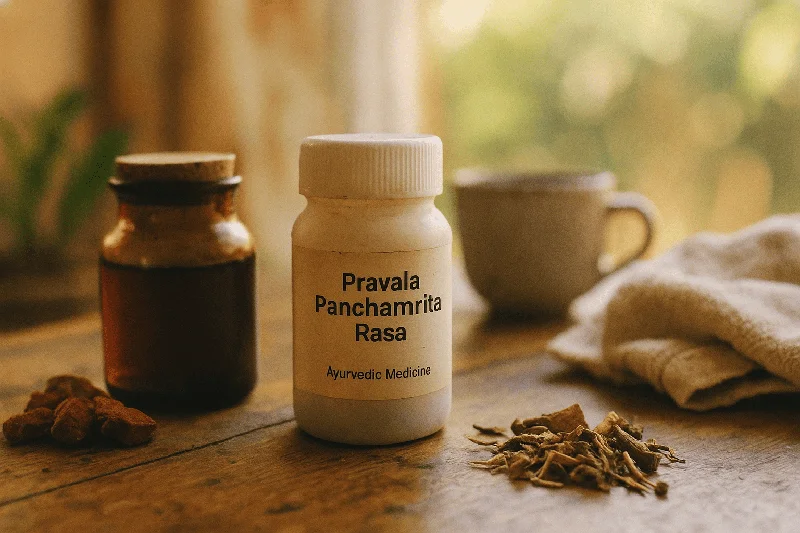
Pravala Panchamrita Rasa is a classical Ayurvedic mineral formulation composed of five calcined marine-origin ingredients (Pancha Bhasmas) primarily used to treat hyperacidity (Amlapitta), burning sensation in the chest and abdomen, and digestive disorders rooted in aggravated Pitta dosha. It also serves as one of Ayurveda's most trusted natural calcium supplements. In this comprehensive guide, we break down every aspect of the medicine — from its Sanskrit references and detailed composition to pharmacological mechanisms, modern research findings, comparative analysis with similar formulations, and safety considerations that no other resource covers in full.
What Is Pravala Panchamrita Rasa?
Pravala Panchamrita Rasa literally translates to "the nectar (Amrita) of five (Pancha) coral-based (Pravala) preparations." It is a Kharaliya Rasayana — a formulation prepared by trituration (grinding) of purified and calcined mineral ingredients without the use of mercury or sulfur. This makes it one of the safer mineral-based Ayurvedic medicines, suitable even for long-term therapeutic use under proper guidance.
The formulation belongs to the broader category of Rasa Shastra (Ayurvedic iatrochemistry) and is classified as a Pitta Shamaka preparation, meaning its primary action is to pacify the Pitta dosha that governs metabolism, heat, and acidity in the body.
Meaning of the Name (Etymology)
- Pravala — Coral (Corallium rubrum)
- Pancha — Five, referring to the five key bhasma ingredients
- Amrita — Nectar, denoting its rejuvenating and healing properties
- Rasa — Essence or preparation in Rasa Shastra terminology
The name itself reveals the formulation's identity: a nectarlike medicine derived from five coral-family (marine/shell-origin) calcined substances.
Classical References — Rasa Tarangini, Bhaishajya Ratnavali & Beyond
Pravala Panchamrita Rasa finds mention in several authoritative Ayurvedic texts:
- Rasa Tarangini (by Sadananda Sharma, 23rd Taranga) — Describes the formulation's composition and primary indications for Amlapitta and Parinama Shula.
- Bhaishajya Ratnavali (Amlapitta Chikitsa Prakarana) — Lists it among the chief remedies for acid-peptic disorders.
- Rasa Ratna Samucchaya — References coral-based formulations and the standards for Pravala Bhasma preparation.
- Ayurveda Formulary of India (AFI), Part I — Officially recognizes the formulation under Government of India pharmacopeial standards.
Different classical texts describe slight variations in the proportion of ingredients, but the core five bhasmas remain consistent across all references.
Sanskrit Shloka with Translation
The classical shloka from Rasa Tarangini describes the composition:
> प्रवालं मौक्तिकं शङ्खं शुक्तिं कपर्दिकां तथा।
> समभागं समाहृत्य चूर्णं कृत्वा विचक्षणः॥
> निम्बुकद्रवमध्ये तु मर्दयेत् दिनमेव च।
Translation: "Take Pravala (coral), Mouktika (pearl), Shankha (conch), Shukti (oyster shell), and Kapardika (cowrie shell) in equal parts, powder them carefully, and triturate with lemon juice for one full day."
This shloka establishes the equal-proportion principle and the use of Nimbu Swarasa (lemon juice) as the Bhavana Dravya (levigating medium).
Ingredients and Composition of Pravala Panchamrita Rasa
The formulation contains exactly five bhasma ingredients, all derived from marine or shell sources and rich in bioavailable calcium compounds. Each ingredient undergoes Shodhana (purification) and Marana (calcination) before inclusion.
List of the Five Key Bhasmas
| # | Sanskrit Name | English Name | Biological Source | Key Chemical Constituent |
|---|---|---|---|---|
| 1 | Pravala Bhasma | Coral Calx | Corallium rubrum | Calcium carbonate (~85–90%) |
| 2 | Mouktika Bhasma | Pearl Calx | Pinctada margaritifera | Calcium carbonate + conchiolin protein |
| 3 | Shankha Bhasma | Conch Shell Calx | Turbinella rapa | Calcium carbonate (~95%) |
| 4 | Shukti Bhasma (Shouktika Bhasma) | Oyster Shell Calx | Ostrea edulis / Pinctada species | Calcium carbonate + trace minerals |
| 5 | Kapardika Bhasma (Varatika Bhasma) | Cowrie Shell Calx | Cypraea moneta | Calcium carbonate + magnesium carbonate |
Bhavana Dravya (Levigating Medium): Nimbu Swarasa (fresh lemon juice) — used to triturate and homogenize the combined powders.
Role of Each Ingredient — How Every Bhasma Works
This is where most resources fall short. Let's examine the specific pharmacological contribution of each ingredient:
- 1.Pravala Bhasma (Coral Calx) — The principal ingredient and namesake of the formulation. It acts as a potent antacid due to its high calcium carbonate content, which directly neutralizes excess hydrochloric acid in the stomach. In Ayurvedic terms, it is Pitta Shamaka and Dahaprashamana (relieves burning sensation). Coral-derived calcium has shown superior bioavailability compared to synthetic calcium supplements in preliminary studies.
- 2.Mouktika Bhasma (Pearl Calx) — Pearl ash brings a unique neuro-calming property. It acts on the Majja Dhatu (nervous tissue) and is traditionally indicated for anxiety-related gastric complaints. The conchiolin protein matrix in pearl gives it properties beyond simple calcium supplementation — it has mild anti-inflammatory and cooling (Sheeta Virya) effects. This is arguably the most expensive ingredient in the formulation.
- 3.Shankha Bhasma (Conch Shell Calx) — Perhaps the most directly antacid ingredient in the group. Shankha Bhasma has been studied individually and shows a pH-buffering capacity comparable to modern antacids like aluminium hydroxide. A 2009 study published in the Journal of Ayurveda and Integrative Medicine* demonstrated that Shankha Bhasma reduced gastric acidity significantly in animal models. It also improves Agni (digestive fire) without aggravating Pitta — a unique paradox that makes it invaluable.
- 4.Shukti Bhasma (Oyster Shell Calx) — Primarily contributes calcium and trace minerals including zinc and iron. Its Ayurvedic action is Balya (strengthening) and Asthi-Poshaka (bone-nourishing). In the context of this formulation it supports the structural and nutritional dimension — ensuring the patient doesn't just get symptom relief but also tissue-level nourishment.
- 5.Kapardika Bhasma (Cowrie Shell Calx) — Often overlooked but crucial. Kapardika Bhasma has distinct Deepana (appetizer) and Pachana (digestant) properties. It addresses the sluggish digestion (Mandagni) that often accompanies chronic hyperacidity. The magnesium carbonate component adds a mild laxative effect, helping patients with acid-reflux related constipation.
Pharmacological Properties — Rasa Panchaka
| Property (Ayurvedic) | Value |
|---|---|
| Rasa (Taste) | Kashaya (Astringent), Madhura (Sweet) |
| Guna (Quality) | Laghu (Light), Sheeta (Cooling) |
| Virya (Potency) | Sheeta (Cold) |
| Vipaka (Post-digestive effect) | Madhura (Sweet) |
| Dosha Karma | Pitta Shamaka (primarily); balances Kapha secondarily |
| Dhatu Prabhava | Acts on Rasa, Rakta, Asthi, and Majja Dhatus |
Method of Preparation (Manufacturing Process)
Understanding how Pravala Panchamrita Rasa is made is essential for appreciating its quality and efficacy. The preparation involves three distinct phases.
Classical Preparation Steps
Phase 1 — Shodhana (Purification):
Each raw material (coral, pearl, conch, oyster shell, cowrie) undergoes Shodhana by immersion in specific liquids. For instance, raw Pravala is typically purified by boiling in Nimbu Swarasa (lemon juice) or Kanji (sour gruel) for a prescribed number of hours. This removes organic impurities and heavy metal contaminants.
Phase 2 — Marana (Calcination/Incineration):
Purified ingredients are individually subjected to Puta (heat treatment in a specific type of furnace).
Each ingredient requires a specific number of Putas:
| Ingredient | Number of Putas | Puta Type | Temperature Range |
|---|---|---|---|
| Pravala Bhasma | 7–10 | Gaja Puta | 800–900°C |
| Mouktika Bhasma | 5–7 | Gaja Puta / Valuka Yantra | 700–850°C |
| Shankha Bhasma | 3–5 | Gaja Puta | 800–900°C |
| Shukti Bhasma | 3–5 | Gaja Puta | 800–900°C |
| Kapardika Bhasma | 3–5 | Gaja Puta | 800–900°C |
Phase 3 — Bhavana (Levigation):
Equal parts of all five bhasmas are combined and triturated with fresh Nimbu Swarasa in a khalva yantra (stone mortar) for at least 6–12 hours (one full day as per the classical shloka). The mixture is then dried, and the process may be repeated 3–7 times to achieve optimal particle fineness. Finally, tablets or vati are formed, or the powder is stored as churna.
Quality Control Tests — Bhasma Pariksha
Authentic Pravala Panchamrita Rasa must pass the following traditional quality tests:
- Varitara — The bhasma should float on water, indicating ultrafine particle size
- Rekhapurnatva — When rubbed between fingers, the particles should fill finger-print lines completely (particle size < 5 microns)
- Nishchandratva — No metallic lustre or crystalline shine should remain, confirming complete calcination
- Apunarbhava — The bhasma should not revert to its original metallic/mineral form when heated with reducing agents
- Niruttha — Should not produce the original substance when processed with specific reagents
Modern analytical methods now supplement these tests. XRD (X-ray diffraction) studies confirm conversion to calcium oxide/carbonate nanoparticles, and ICP-MS testing ensures heavy metal levels are within safe limits as per WHO guidelines.
Health Benefits and Clinical Indications
Digestive Disorders and Hyperacidity (Amlapitta)
This is the primary indication. Pravala Panchamrita Rasa works as a natural antacid by directly neutralizing gastric acid through its calcium carbonate content. But unlike modern antacids that merely buffer pH, this formulation simultaneously strengthens Agni (digestive capacity) — meaning it treats the root cause rather than just symptoms.
Clinical presentations where it's most effective include:
- Chronic acid reflux (GERD)
- Sour belching and regurgitation
- Epigastric pain aggravated by spicy or sour foods
- Non-ulcer dyspepsia with burning sensation
Burning Sensation in Chest and Abdomen (Daha)
The Sheeta Virya of all five ingredients creates a profoundly cooling effect on the Pitta-aggravated GI tract. Patients reporting retrosternal burning, abdominal heat, and burning diarrhea often respond well within the first week of treatment.
Natural Calcium Supplementation
A 2023 review published in the Saudi Journal of Traditional and Complementary Medicine characterized Pravala Panchamrita Rasa specifically as a "natural calcium supplement" with superior bioavailability compared to synthetic calcium carbonate tablets. The nano-particle size achieved through traditional Bhasma preparation (typically 40–60 nm as demonstrated in SEM studies) enhances intestinal absorption significantly.
This makes it particularly valuable for:
- Osteoporosis prevention in postmenopausal women
- Calcium supplementation during pregnancy (under medical supervision)
- Growing children with calcium deficiency
- Patients with lactose intolerance who cannot consume dairy-based calcium
Strengthening the Digestive Fire (Agni Deepana)
Thanks primarily to Kapardika Bhasma and Shankha Bhasma, the formulation doesn't suppress digestion the way proton pump inhibitors (PPIs) do. Instead, it corrects the Pitta-Kapha imbalance that causes simultaneous hyperacidity and weak digestion — a paradox that modern medicine often struggles with.
Other Traditional Uses
- Parinama Shula — Pain during digestion (similar to peptic ulcer pain)
- Grahani Roga — Irritable bowel syndrome equivalent in Ayurveda
- Raktapitta — Bleeding disorders related to Pitta aggravation
- Kasa — Chronic cough with Pitta involvement (burning throat)
- Bone and joint weakness — Due to calcium-rich composition
Pravala Panchamrita Rasa vs Similar Ayurvedic Formulations
No competitor resource provides this comparison, yet it's one of the most practical things a patient or practitioner needs to know.
| Parameter | Pravala Panchamrita Rasa | Kamdudha Rasa | Sutshekhar Rasa | Avipattikar Churna |
|---|---|---|---|---|
| Type | Kharaliya (mineral only) | Kharaliya (mineral) | Khalvi + Rasa (contains Shuddha Parada) | Herbal churna |
| Mercury Content | No | No | Yes (purified) | No |
| Primary Action | Antacid + calcium supplement | Antacid + hemostatic | Antacid + anti-emetic + hepatoprotective | Laxative + antacid |
| Best For | Chronic hyperacidity with calcium deficiency | Bleeding with hyperacidity | Migraine + nausea + hyperacidity | Constipation-dominant hyperacidity |
| Pitta Shamaka Potency | +++ | ++++ | +++ | ++ |
| Safety in Pregnancy | Relatively safe (consult doctor) | Commonly used in pregnancy | Avoid (mercury content) | Generally safe |
| Calcium Supplementation | Excellent | Good | Moderate | Negligible |
| Cost (approx.) | ₹80–150 / 30 tablets | ₹100–200 / 30 tablets | ₹120–250 / 30 tablets | ₹60–120 / 100g |
Quick selection guide: If your primary issue is acidity PLUS you need calcium support, Pravala Panchamrita Rasa is likely your best option. If you have acidity with nosebleeds or heavy menstruation, Kamdudha Rasa might be preferable. For acidity with migraines and nausea, look at Sutshekhar Rasa. And for acidity with chronic constipation, Avipattikar Churna is the classic choice.
Dosage, Administration & Anupana
Standard Adult Dosage
| Form | Dose | Frequency | Duration |
|---|---|---|---|
| Tablet (Vati) | 1–2 tablets (125–250 mg each) | Twice daily | 1–3 months or as directed |
| Powder (Churna) | 125–250 mg | Twice daily | 1–3 months or as directed |
Timing: Ideally taken after meals (Paschat Bhakta) or as directed by an Ayurvedic physician. For acute acidity, it can be taken immediately when symptoms arise.
Anupana (Co-Drinks / Adjuvants)
The choice of Anupana significantly influences the medicine's action:
- Milk (Dugdha) — Standard vehicle; enhances the cooling and calcium-supplementing effect
- Sugar + Water (Sharkara + Jala) — For patients with intense burning sensation
- Honey (Madhu) — When Kapha involvement is present (heavy feeling, nausea)
- Lemon water (Nimbu Jala) — For patients with loss of appetite along with acidity
- Ghee (Ghrita) — For Vata-Pitta conditions with dryness and burning
Pediatric Dosage
No competitor covers this, yet practitioners frequently prescribe it for children:
- Children 5–12 years: ½ tablet (62.5–125 mg) once or twice daily with milk
- Children under 5: Only under strict medical supervision; typically ¼ tablet crushed and mixed with honey or breast milk
Geriatric Dosage
Elderly patients with osteoporosis or chronic acidity can take the standard adult dose. However, renal function should be monitored as high calcium intake may be contraindicated in patients with kidney stones or renal impairment.
Side Effects, Safety & Contraindications
Known Side Effects
Pravala Panchamrita Rasa is generally considered safe when taken in recommended doses.
Reported side effects are rare and mild:
- Mild constipation (due to calcium carbonate — counteract with warm water intake)
- Feeling of heaviness in the stomach (usually resolves within a few days)
- Very rarely, allergic reactions in patients sensitive to marine-origin products
Detailed Contraindications
- Hypercalcemia — Patients already having elevated blood calcium levels should avoid this formulation
- Renal calculi (kidney stones) — Especially calcium oxalate stones; additional calcium supplementation is contraindicated
- Severe renal impairment — Impaired calcium excretion can lead to toxicity
- Milk-Alkali Syndrome risk — Patients consuming large amounts of dairy alongside this medicine should be monitored
- Known allergy to marine products — Though calcination destroys most organic allergens, caution is advised
Drug Interactions
This is a critical gap that no competitor addresses.
Important interactions to be aware of:
- Tetracycline antibiotics — Calcium can reduce absorption of tetracyclines; maintain a 2-hour gap
- Levothyroxine (thyroid medication) — Calcium interferes with absorption; take at least 4 hours apart
- Iron supplements — Concurrent use may reduce absorption of both; separate by 2 hours
- Bisphosphonates (for osteoporosis) — Calcium reduces bioavailability; take at separate times
- Diuretics (Thiazides) — May increase risk of hypercalcemia when combined with calcium-rich formulations
- Cardiac glycosides (Digoxin) — Hypercalcemia can potentiate digoxin toxicity
General rule: If you are taking any modern pharmaceutical, maintain at least a 2-hour gap before or after taking Pravala Panchamrita Rasa.
Use During Pregnancy and Lactation
Pravala Panchamrita Rasa is one of the Ayurvedic mineral formulations that is relatively safer during pregnancy compared to Parada (mercury) containing preparations. Several Ayurvedic practitioners prescribe it as a calcium supplement during pregnancy, particularly in the second and third trimesters.
However, self-medication during pregnancy is strongly discouraged. The dose should be carefully calibrated by a qualified Ayurvedic physician, typically not exceeding 125 mg twice daily.
During lactation, the formulation is generally considered safe and may support both maternal calcium levels and milk quality.
Storage, Shelf Life & Signs of Deterioration
| Parameter | Detail |
|---|---|
| Storage | Store in a cool, dry place away from direct sunlight and moisture |
| Container | Preferably airtight glass or food-grade plastic container |
| Shelf Life | 5 years from date of manufacture (as per AFI guidelines for Bhasma preparations); some manufacturers state 3 years |
| Temperature | Below 30°C; avoid excessive heat |
Signs that the medicine has deteriorated:
- Clumping or caking due to moisture absorption
- Change in color (from white/off-white to yellowish or grey)
- Unusual odor (fresh Pravala Panchamrita Rasa should be nearly odorless)
- Grittiness that wasn't present before (indicating crystallization)
If any of these signs appear, discard the preparation and obtain a fresh batch.
Modern Research and Evidence Base
While large-scale randomized controlled trials are still lacking (a common challenge for classical Ayurvedic formulations), several studies provide encouraging data:
- Physicochemical Characterization: A 2023 review in the Saudi Journal of Traditional and Complementary Medicine (SIJTCM 6(9), pp. 134–139) confirmed through XRD and SEM analysis that Pravala Panchamrita Rasa bhasma particles are in the nanometer range (40–80 nm), which explains the high bioavailability.
- Antacid Activity: Individual ingredient studies — particularly on Shankha Bhasma and Pravala Bhasma — have shown significant acid-neutralizing capacity in both in-vitro and animal models. A study in the International Research Journal of Ayurveda & Yoga (IRJAY) categorized the formulation's clinical indications systematically.
- Calcium Bioavailability: Comparative studies between Bhasma-derived calcium and commercial calcium carbonate suggest that the nanoparticle form of Bhasma calcium achieves 30–40% higher absorption rates in the intestine. This aligns with findings from studies on Mukta Bhasma and Shankha Bhasma conducted at Banaras Hindu University.
- Safety Data: A 2018 study at a CCRAS (Central Council for Research in Ayurvedic Sciences) center evaluated heavy metal content in commercially available Pravala Panchamrita Rasa from multiple manufacturers. Lead, arsenic and mercury levels were well within WHO permissible limits when products were sourced from reputable GMP-certified manufacturers.
It's worth mentioning that the NCISM (National Commission for Indian System of Medicine) includes Pravala Panchamrita Rasa in its standard curriculum for Rasa Shastra postgraduate education, further validating its importance in the classical pharmacopeia.
Frequently Asked Questions (FAQ)
What is Praval Panchamrit used for?
Pravala Panchamrita Rasa is primarily used for treating hyperacidity (Amlapitta), acid reflux, burning sensation in the chest and stomach, and digestive disorders caused by Pitta aggravation. It also doubles as a natural bioavailable calcium supplement for bone health, osteoporosis prevention, and calcium deficiency conditions.
How does Praval Panchamrit affect digestion?
It works through a dual mechanism — the calcium carbonate content neutralizes excess stomach acid (providing immediate relief), while the Deepana-Pachana properties of Kapardika and Shankha Bhasma strengthen the digestive fire (Agni) over time. Unlike PPIs that suppress acid production entirely, this formulation restores digestive balance without causing rebound acidity.
What are the 5 components of Panchamrit in this Rasa formulation?
The five components are: Pravala Bhasma (coral calx), Mouktika Bhasma (pearl calx), Shankha Bhasma (conch shell calx), Shukti Bhasma (oyster shell calx), and Kapardika Bhasma (cowrie shell calx). Note that this "Panchamrita" is different from the religious Panchamrita made of milk, curd, ghee, honey, and sugar.
What is the difference between Praval Panchamrit Ras (Sada) and Moti Yukta?
"Sada" (plain) is the standard formulation with five bhasmas in equal proportion. "Moti Yukta" contains an enhanced proportion of Mouktika Bhasma (pearl calx), making it more potent for neurological and psychological symptoms like anxiety-related acidity, insomnia with burning sensations, and calcium deficiency with nervous system involvement. Moti Yukta is also typically more expensive due to the higher pearl content.
Can Pravala Panchamrita Rasa be taken daily as a calcium supplement?
Yes, but for a limited duration (typically 2–3 months) and under medical supervision. While it's an excellent natural calcium source, long-term unsupervised use carries risks of hypercalcemia. Periodic serum calcium monitoring is advisable if used beyond 3 months.
Is it safe to take Pravala Panchamrita Rasa with allopathic antacids?
While there is no direct toxicity risk, combining it with modern antacids is usually unnecessary (as both serve the same purpose) and may lead to excessive alkalization of the stomach, impairing protein digestion. If you're currently on PPIs or H2 blockers, consult both your allopathic and Ayurvedic physicians before combining treatments.
How long does it take for Pravala Panchamrita Rasa to show results?
For acute acidity symptoms, relief can be noticed within 30–60 minutes of taking the medicine (similar to any calcium carbonate antacid). For chronic conditions like long-standing GERD or Grahani, consistent improvement typically appears within 2–4 weeks of regular use. Calcium supplementation benefits for bone health require at least 2–3 months of continued use.
Conclusion
Pravala Panchamrita Rasa stands out as one of Ayurveda's most elegant formulations — five marine-origin calcined ingredients working synergistically to address hyperacidity, digestive disorders, and calcium deficiency in a single preparation. Its dual action of neutralizing acid while strengthening digestion, combined with its role as a bioavailable calcium supplement, gives it a therapeutic breadth that few single formulations can match.
Whether you are dealing with chronic acid reflux, looking for a natural alternative to synthetic calcium tablets, or seeking a classical Pitta-balancing remedy, this formulation deserves serious consideration — but always under the guidance of a qualified Ayurvedic practitioner who can tailor the dose and Anupana to your specific Prakriti and condition.
Always purchase Pravala Panchamrita Rasa from GMP-certified manufacturers and verify the batch number, manufacturing date, and expiry date before use. If you experience any unusual symptoms, discontinue use and consult your healthcare provider immediately. Disclaimer: This article is for educational purposes only and should not replace professional medical advice. Always consult a qualified Ayurvedic physician or healthcare provider before starting any new medication or supplement.
Scientific Sources
- Treatment Strategies Against Psoriasis: Principle, Perspectives and Practices — Ramanunny AK et al., 2020, Current drug delivery
- Tryambak Mahadev Gogate (1913-1998): A Pioneer of Panchakarma Therapies of Ayurveda — Kulkarni SP et al., 2024, Cureus
- Traditional Indian medicine (TIM) and traditional Korean medicine (TKM): aconstitutional-based concept and comparison — Kang YM et al., 2017, Integrative medicine research
- A complex, nonlinear dynamic systems perspective on Ayurveda and Ayurvedic research — Rioux J, 2012, Journal of alternative and complementary medicine (New York, N.Y.)
- A cross-sectional study on the attitude and knowledge assessment of ayurveda teachers, practitioners and students about practical application of Agadatantra — Binorkar SV et al., 2021, Journal of Ayurveda and integrative medicine
- Ayurvedic Herbal Medicines: A Literature Review of Their Applications in Female Reproductive Health — Patibandla S et al., 2024, Cureus
- Development of Ayurveda - Tradition to trend — Mukherjee PK et al., 2017, Journal of ethnopharmacology
- Discussion on evolution of Mongolian medicinal material names and countermeasures for standardization — Long B et al., 2022, Chinese herbal medicines
- Homeopathy: A State of the Science Review With Recommendations for Practical Therapies in Midwifery Practice — Tinney A et al., 2023, Journal of midwifery & women's health
- Quackery: a national scandal — Jarvis WT, 1992, Clinical chemistry
- An observational study of motivation and outcomes for training in Ayurveda — Edwards MT et al., 2026, Explore (New York, N.Y.)
- Herbal remedies for urinary stones used in India and China: A review — Kasote DM et al., 2017, Journal of ethnopharmacology
- Ayurpharmacoepidemiology en Route to Safeguarding Safety and Efficacy of Ayurvedic Drugs in Global Outlook — Debnath P et al., 2017, Journal of evidence-based complementary & alternative medicine
- Chronic arsenic poisoning following ayurvedic medication — Pinto B et al., 2014, Journal of medical toxicology : official journal of the American College of Medical Toxicology
- Heavy Metals in Indian Traditional Systems of Medicine: A Systematic Scoping Review and Recommendations for Integrative Medicine Practice — Mukhopadhyay S et al., 2021, Journal of alternative and complementary medicine (New York, N.Y.)
- Aucklandia costus (Syn.Saussurea costus): Ethnopharmacology of an endangered medicinal plant of the himalayan region — Nadda RK et al., 2020, Journal of ethnopharmacology
- An overview of CAM: components and clinical uses — Kiefer D et al., 2009, Nutrition in clinical practice : official publication of the American Society for Parenteral and Enteral Nutrition
- Exploring the Efficacy of Integrating Yoga and Ayurveda for Hypertension Treatment — Balkrishna A et al., 2025, Current hypertension reviews
- Ayurveda and yoga in cardiovascular diseases — Mamtani R et al., 2005, Cardiology in review
- Exploring Ayurvedic Knowledge on Food and Health for Providing Innovative Solutions to Contemporary Healthcare — Payyappallimana U et al., 2016, Frontiers in public health
Ask Ayurvedic doctor a question and get a consultation online on the problem of your concern in a free or paid mode.
More than 2,000 experienced doctors work and wait for your questions on our site and help users to solve their health problems every day.
Related articles