Deepika Taila: Boost Digestion and Metabolism Naturally
Deepika Taila is a classical Ayurvedic medicated oil (Sneha Kalpana) primarily formulated for the management of Karnashoola (ear pain) and Karna Srava (ear discharge). Originally described by Acharya Sharangadhara in the Sharangadhara Samhita, this unique preparation uses Devadaru (Cedrus deodara) as its principal ingredient and employs a distinctive ignition-based extraction method that sets it apart from most other Taila preparations. Despite being a lesser-known formulation in mainstream wellness circles, Deepika Taila carries significant therapeutic value — both from a classical Ayurvedic perspective and through emerging modern scientific validation.
In this comprehensive guide, we'll cover everything from its full composition and original Sanskrit references to its preparation methods, clinical applications, dosage guidelines, and how it compares to other ear oils in Ayurveda.
What Is Deepika Taila? Definition and Ayurvedic Classification
Meaning of the Name "Deepika Taila"
The word "Deepika" is derived from the Sanskrit root "Dīp" meaning "to illuminate" or "to ignite." This name is not merely symbolic — it directly refers to the unique preparation method involving Jwalana Karma (ignition/combustion) of Devadaru wood. The oil is literally born from fire, capturing the volatile medicinal compounds released during controlled burning of the herb-coated wood pieces. "Taila" simply means oil, specifically a medicated oil prepared through classical pharmaceutical processes.
Classification in Ayurvedic Pharmacology (Sneha Kalpana)
Deepika Taila belongs to the Sneha Kalpana category of Ayurvedic pharmaceutics — the science of preparing medicated fats and oils.
Within this category, it occupies a unique position because:
- It is a Karna Taila — an oil specifically indicated for auricular (ear) application
- It uses a specialized extraction technique (Jwalana Karma) rather than the standard Taila Paka Vidhi (oil cooking method)
- It falls under Bahya Prayoga (external use), primarily administered as ear drops (Karna Purana)
| Classification Parameter | Details |
|---|---|
| Kalpana (Category) | Sneha Kalpana (Medicated Oil) |
| Primary Indication | Karnashoola (Otalgia/Ear Pain) |
| Route of Administration | Karna Purana (Ear Instillation) |
| Classical Reference | Sharangadhara Samhita |
| Key Ingredient | Devadaru (Cedrus deodara) |
| Base Oil | Tila Taila (Sesame Oil) |
Historical Roots and Classical Textual References
Sharangadhara Samhita — The Primary Source
The original reference for Deepika Taila comes from Acharya Sharangadhara's magnum opus, the Sharangadhara Samhita, a foundational Ayurvedic text composed approximately in the 13th century CE. Sharangadhara is celebrated for systematizing Ayurvedic pharmaceutical processes, and the Deepika Taila formulation appears in the Sneha Kalpana section dealing with medicated oils for specific therapeutic applications.
The text describes the formulation under the context of Karna Roga Chikitsa (treatment of ear diseases), positioning it as a targeted intervention rather than a general-purpose oil.
Original Shloka (Sanskrit Verse) With Translation
The classical reference verse from Sharangadhara Samhita can be transliterated as follows:
> Devadaru khanda lepayetvastra khandena cha
> Jwalayitvā tu tad tailam grihṇīyāt pātrayogataḥ
> Karnashoole prayoktavyam Deepika Taila namāmritam
Translation: "Coat pieces of Devadaru wood with cloth (Reshma Vastra), ignite them, and collect the oil that drips into a vessel placed below. This oil, called Deepika Taila, is to be employed in Karnashoola (ear pain) — it is like nectar (amritam)." Note: Different manuscript traditions may present slight variations in the shloka. The above represents the commonly cited version found in published commentaries.
References in Other Samhitas
While the Sharangadhara Samhita remains the primary source, references to similar Devadaru-based ear oil preparations appear in:
| Text | Context | Notes |
|---|---|---|
| Sharangadhara Samhita | Primary description with Jwalana Karma method | Original and most detailed reference |
| Bhavaprakasha Nighantu | Devadaru properties for Karna Roga | Mentions Devadaru's ear-specific actions, though doesn't name Deepika Taila directly |
| Yoga Ratnakara | Karna Roga Chikitsa section | Lists similar formulations for otalgia; cross-reference with Deepika methodology |
| Chakradatta | Karna Shoola Adhikara | Describes analogous preparations using Devadaru |
The fact that Devadaru appears across multiple texts for ear complaints validates the rational basis of the Deepika Taila formulation.
Complete Ingredients of Deepika Taila (Yogam With Proportions)
One of the most frequently asked questions about this formulation is: what are the ingredients in Deepika Taila? Unlike complex polyherbal oils, Deepika Taila is remarkably simple in its composition — which is actually a hallmark of its elegance.
Devadaru (Cedrus deodara) — The Principal Drug
Devadaru (Cedrus deodara, family Pinaceae) is the heartwood of the Himalayan Cedar, and it is the singular active ingredient of Deepika Taila. This is significant because the entire therapeutic potency of the oil depends on the quality and proper processing of this one herb. Pharmacological Properties of Devadaru (Dravyaguna Profile):
| Property (Sanskrit) | Value | English Equivalent |
|---|---|---|
| Rasa (Taste) | Tikta (Bitter), Katu (Pungent) | Bitter & Pungent |
| Guna (Quality) | Laghu (Light), Snigdha (Unctuous) | Light & Oily |
| Virya (Potency) | Ushna (Hot) | Thermogenic |
| Vipaka (Post-digestive effect) | Katu (Pungent) | Pungent metabolic end-effect |
| Karma (Action) | Vedanasthapana, Shothahara, Krimighna | Analgesic, Anti-inflammatory, Antimicrobial |
| Doshaghnata (Dosha action) | Kapha-Vata Shamaka | Pacifies Kapha and Vata |
The Ushna Virya (hot potency) of Devadaru is particularly relevant for Karnashoola, which is predominantly a Vata-Kapha disorder. The warming nature of the oil helps counteract the cold, obstructive qualities of vitiated Vata and Kapha in the ear canal.
Tila Taila (Sesame Oil) — The Base
Tila Taila (Sesamum indicum) serves as the base oil (Sneha Dravya). In classical Ayurveda, sesame oil is considered the best among all oils for medicinal preparations because of its:
- Sukshma Guna — subtle, penetrating quality that allows it to carry medicinal compounds deep into tissues
- Yogavahi property — ability to assimilate the qualities of whatever it is processed with, without losing its own inherent properties
- Vata Shamaka action — inherent Vata-pacifying effect
Reshma Vastra (Silk Cloth)
- This is not an ingredient per se, but an essential processing material. The silk cloth is used to coat the Devadaru wood pieces before ignition.
- It serves a dual purpose: it acts as a wick to sustain controlled combustion and helps regulate the temperature of burning, ensuring optimal release of the volatile medicinal oils from Devadaru.
Complete Formulation Proportion
Based on the classical method described in Sharangadhara Samhita:
| Component | Quantity | Role |
|---|---|---|
| Devadaru Khanda (Heartwood pieces) | Sufficient quantity (approx. 1 Pala / ~48g per batch) | Principal Drug (Pratiath Dravya) |
| Reshma Vastra (Silk cloth) | Sufficient to wrap Devadaru pieces | Processing material |
| Tila Taila (Sesame oil) | Equal quantity to collected Devadaru extract (1:1 or as per Sneha Paka Vidhi) | Base Oil (Sneha Dravya) |
| Jala (Water) | 4 parts (for standard Sneha Paka, if Method 2 is used) | Processing liquid (Drava Dravya) |
How Deepika Taila Is Prepared (Nirmana Vidhi) — Two Methods
This is where Deepika Taila truly stands apart from most Ayurvedic oils. There are two documented methods of preparation, and understanding both is essential for practitioners and scholars.
Method 1: Jwalana Karma (Ignition/Distillation Method)
This is the original and distinctive method described in the classical texts. It's essentially a form of destructive distillation.
Stage 1: Reshma Vastra Lepita Devadaru Khanda Nirmana (Preparation of Cloth-Coated Wood Pieces)
- Select high-quality Devadaru heartwood — it should be resinous, aromatic, and free from insect damage
- Cut the heartwood into uniform pieces (Khandas) of approximately 6-8 inches length
- Wrap each piece thoroughly with Reshma Vastra (silk cloth), ensuring complete coverage
- Secure the wrapping so it doesn't come loose during burning
Stage 2: Devadaru Khanda Jwalana Karma (Controlled Ignition and Oil Collection)
- Arrange a collection vessel below an inclined or suspended setup
- Ignite the cloth-wrapped Devadaru pieces from one end
- As the wood burns, the heat causes the volatile oils and resinous compounds of Devadaru to melt, liquefy, and drip downward
- Collect the dripping oil-resin mixture in the vessel below
- The collected liquid IS Deepika Taila in its crude form
This method is remarkable because it extracts compounds that wouldn't be available through standard decoction or oil-cooking methods — specifically the volatile terpenoids (like himachalol, atlantone, and deodarone) that require heat-based extraction.
Method 2: Samanya Taila Nirmana Vidhi (Standard Oil Cooking Method)
Some scholars and manufacturers prepare Deepika Taila using the general method of medicated oil preparation as described in Sneha Kalpana:
- Prepare a Kwatha (decoction) of Devadaru — 1 part Devadaru coarse powder boiled in 16 parts water, reduced to ¼
- Take Tila Taila (sesame oil) as the base
- Optionally prepare a Kalka (paste) of Devadaru
- Combine in the classical ratio: 1 part Kalka : 4 parts Taila : 16 parts Drava (decoction/water)
- Cook on mild heat (Mridu Agni) until Sneha Siddhi Lakshanas (signs of readiness) appear:
- Varti Vat Kalka — the paste can be rolled into a wick-like shape without sticking
- No crackling sound when a drop of water is added
- Characteristic aroma development
Comparative Physicochemical Profile (Method 1 vs Method 2)
- A 2016 study published in the World Journal of Pharmaceutical Research (WJPR) conducted a comparative analytical evaluation of Deepika Taila prepared by both methods.
- The results are quite revealing:
| Parameter | Method 1 (Jwalana Karma) | Method 2 (Samanya Vidhi) | Significance |
|---|---|---|---|
| pH | 4.5–5.2 | 5.8–6.2 | Method 1 is more acidic (antimicrobial advantage) |
| Specific Gravity | 0.918–0.925 | 0.912–0.920 | Slightly denser in Method 1 |
| Refractive Index | 1.468–1.472 | 1.465–1.468 | Higher in Method 1 (more dissolved compounds) |
| Acid Value | 3.2–4.1 | 1.8–2.5 | Higher in Method 1 |
| Iodine Value | 98–105 | 108–115 | Lower in Method 1 (more saturated compounds) |
| Saponification Value | 185–192 | 188–196 | Comparable |
| Peroxide Value | 2.1–3.0 | 1.5–2.2 | Slightly higher in Method 1 |
| Total Fat Content | 92–95% | 96–98% | Method 2 has higher fat content |
| Free Fatty Acids | 1.6–2.1% | 0.9–1.3% | Higher in Method 1 |
| Viscosity | Higher | Lower | Method 1 is thicker |
These data suggest that Method 1 yields a pharmacologically distinct product — richer in non-lipid active compounds (terpenoids, sesquiterpenes) extracted through pyrolysis, while Method 2 produces a more standardized oil-based preparation.
What Is Deepika Taila Used For? Therapeutic Applications
Primary Indication: Karnashoola (Ear Pain/Otalgia)
The foremost use of Deepika Taila is in managing Karnashoola — a condition encompassing various types of ear pain. According to Ayurveda, Karnashoola is predominantly caused by vitiation of Vata dosha, often in combination with Kapha.
The pathogenesis (Samprapti) involves:
- Vata Prakopa (aggravation) → enters Karna Srotas (ear channels)
- Kapha Samsarga (association with Kapha) → creates Avarodha (obstruction)
- Shoola Utpatti (pain generation) → Vata gets trapped, causing intense, throbbing or shooting pain
Mechanism of Action (Samprapti Vighatana): Deepika Taila interrupts this pathogenesis through multiple pathways:
- Ushna Virya of Devadaru counteracts the Sheeta (cold) quality of Vata
- Snigdha Guna (unctuous quality) from Tila Taila addresses the Ruksha (dry) nature of Vata
- Tikta-Katu Rasa helps in Kapha Vilayana (liquefaction and drainage of Kapha)
- Sukshma property of sesame oil enables deep penetration into the Karna Srotas
- Vedanasthapana (analgesic) action of Devadaru provides direct pain relief
Secondary Indication: Karna Srava (Ear Discharge)
Beyond pain, Deepika Taila is also indicated for Karna Srava — pathological discharge from the ear. The antimicrobial and drying (due to Tikta Rasa) properties of Devadaru help manage infected or mucoid ear discharge, particularly when associated with Kapha predominance.
Dosha-Specific Action
| Dosha | Action | Mechanism |
|---|---|---|
| Vata | Primarily pacifies | Ushna Virya, Snigdha Guna of base oil |
| Kapha | Secondarily pacifies | Tikta-Katu Rasa, Laghu Guna, Ushna Virya |
| Pitta | Neutral to mildly aggravating | Ushna Virya may increase Pitta in excess use |
Expanded Applications
While Karnashoola remains the classical indication, some contemporary practitioners and sources (including Ask-Ayurveda and other clinical platforms) have explored additional uses:
- Abhyanga (therapeutic massage) for localized Vata-Kapha disorders
- Supportive role in Tinnitus (Karna Nada) management
- Adjunct in sinusitis-related ear congestion where Eustachian tube dysfunction causes referred ear pain
How to Apply Deepika Taila for Best Results: Dosage and Administration
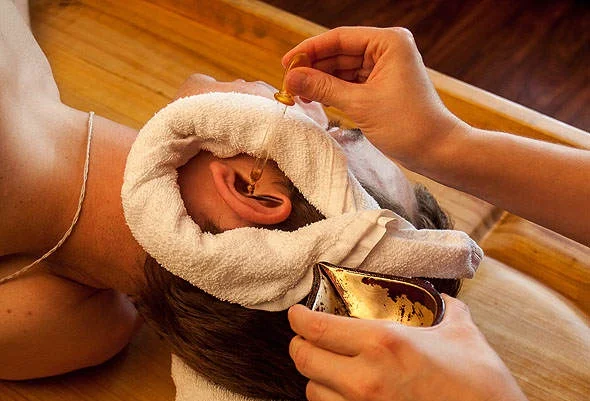
For Karna Purana (Ear Instillation)
This is the primary method of application.
Here's a step-by-step guide:
- Warm the oil to lukewarm temperature (approximately 37-40°C / body temperature).
- Test on the inside of your wrist — it should feel comfortably warm, not hot
- Patient positioning: Lie down on the opposite side (left side down for right ear treatment)
- Instill 4-8 drops of warm Deepika Taila into the affected ear using a clean dropper
- Gently pull the pinna (outer ear) upward and backward to straighten the ear canal
- Remain in position for 10-15 minutes to allow the oil to penetrate deeply
- Optional: Place a small cotton plug loosely in the ear after instillation
- Repeat for the other ear if bilateral treatment is needed
Dosage by Age and Condition
| Patient Category | Drops Per Ear | Frequency | Duration |
|---|---|---|---|
| Adults (acute Karnashoola) | 6-8 drops | 2 times daily | 5-7 days |
| Adults (chronic/mild) | 4-6 drops | Once daily | 7-14 days |
| Children (5-12 years) | 2-4 drops | Once daily | 3-5 days |
| Elderly | 4-6 drops | Once daily | 7-10 days |
| Preventive/maintenance | 2-3 drops | Weekly once | Ongoing |
Important: These are general guidelines based on classical Ayurvedic dosage principles. Individualized dosing should be determined by a qualified Ayurvedic practitioner.
For Abhyanga (External Massage)
When used for localized massage (around the ears, mastoid region, or temples):
- Take 5-10 ml of warm oil
- Apply with gentle circular motions around the auricular region
- Massage for 10-15 minutes
- Leave on for at least 30 minutes before washing
Precautions, Contraindications and Side Effects
Ayurvedic Contraindications
Deepika Taila should NOT be used in the following conditions:
- Karna Paka (suppurative otitis with active pus formation) — oil instillation can worsen infection
- Tympanic membrane perforation — oil entering the middle ear space through a perforated drum can cause serious complications
- Karna Vidradhi (ear abscess) in the acute inflammatory stage
- Known allergy to sesame oil or cedar wood products
- Fresh ear surgery — avoid until complete healing is confirmed by the surgeon
Modern Safety Precautions
- Always perform a patch test — apply a small amount on the inside of the forearm and wait 24 hours before ear use
- Pregnant and lactating women should consult an Ayurvedic physician before use
- Never use hot oil — only lukewarm. Hot oil can cause burns to the delicate ear canal skin
- Do not use if ear discharge is bloody or foul-smelling (may indicate serious pathology requiring ENT evaluation)
- Discontinue use if irritation, burning, or increased pain occurs after application
Potential Side Effects
Deepika Taila is generally well-tolerated.
However, rare side effects may include:
- Mild warmth or tingling sensation (usually normal, due to Ushna Virya)
- Temporary feeling of fullness in the ear
- Allergic contact dermatitis (rare, primarily in sesame-sensitive individuals)
Shelf Life, Storage and Where to Purchase Authentic Deepika Taila
Shelf Life
According to the general Ayurvedic pharmaceutical principle stated in Sharangadhara Samhita:
> "Tailam varsha shata pujyam" — Medicated oils improve with age and can remain potent for extended periods.
Practically speaking, properly prepared Deepika Taila has a shelf life of 16 months to 2 years when stored correctly, though many practitioners believe aged Taila (Purana Taila) has enhanced therapeutic value.
Storage Conditions
- Store in a cool, dark, dry place away from direct sunlight
- Use amber glass bottles or traditional ceramic containers. Avoid plastic
- Keep the container tightly sealed to prevent oxidation
- Ideal storage temperature: 15-25°C
- Avoid contamination — always use a clean dropper, never pour oil back into the main bottle
Purchasing Authentic Deepika Taila
Due to its relatively niche application, Deepika Taila is not as widely commercially available as popular oils like Anu Taila or Ksheerabala Taila.
Authentic sources include:
- Ayurvedic pharmacies affiliated with teaching hospitals (e.g., AVP, Kottakkal Arya Vaidya Sala)
- Licensed Ayurvedic medicine manufacturers with GMP certification
- Direct preparation by qualified Ayurvedic practitioners or Rasashalas (Ayurvedic pharmacies)
- Prices typically range from ₹150-450 for 50-100 ml depending on the manufacturer and method of preparation
Comparison With Other Karna Taila (Ear Oils in Ayurveda)
How does Deepika Taila stack up against other classical ear oils? This comparison helps practitioners make differential therapeutic choices.
| Parameter | Deepika Taila | Bilva Taila | Nirgundi Taila | Sarshapa Taila |
|---|---|---|---|---|
| Key Ingredient | Devadaru | Bilva (Aegle marmelos) | Nirgundi (Vitex negundo) | Sarshapa (Mustard) |
| Primary Dosha Action | Vata-Kapha Shamaka | Vata Shamaka | Vata-Kapha Shamaka | Kapha-Vata Shamaka |
| Best For | Acute Karnashoola | Karna Srava with Vata predominance | Karnashoola with inflammation | Karna Srava with Kapha predominance |
| Virya | Ushna | Ushna | Ushna | Ushna |
| Unique Feature | Jwalana Karma extraction | Antimicrobial leaf extracts | Strong anti-inflammatory | Intensely heating |
| Availability | Limited | Moderate | Widely available | Common household oil |
When to choose Deepika Taila specifically: It is the best choice when Karnashoola is predominantly due to Vata-Kapha Samsarga with cold-type pain (worse in mornings, cold weather, after exposure to wind), and when the ear canal feels blocked or congested without active infection.
Modern Scientific Validation of Key Ingredients
While large-scale clinical trials specifically on Deepika Taila formulation are still needed, the scientific literature on its principal ingredient is encouraging:
Cedrus deodara (Devadaru) — Research Evidence
- Anti-inflammatory activity: A 2012 study in the Journal of Ethnopharmacology demonstrated that himachalol (a major sesquiterpene from C. deodara) showed significant anti-inflammatory activity comparable to indomethacin in carrageenan-induced paw edema models
- Analgesic activity: Research published in Phytotherapy Research (2009) confirmed dose-dependent analgesic effects of Devadaru wood extract in both chemical and thermal pain models
- Antimicrobial properties: A 2015 study in Indian Journal of Pharmaceutical Sciences reported that Devadaru essential oil exhibited notable activity against Staphylococcus aureus, Pseudomonas aeruginosa, and Candida albicans — organisms commonly implicated in otitis externa
- Antioxidant capacity: Multiple studies have confirmed the free radical scavenging activity of Cedrus deodara extracts, with IC50 values ranging from 45-85 μg/ml in DPPH assays
Sesamum indicum (Tila Taila) — Research Evidence
- Sesame oil has been shown to possess inherent antibacterial properties against common ear pathogens (a 2005 Journal of Medicinal Food study)
- The lignan compounds (sesamin, sesamolin) provide anti-inflammatory and analgesic benefits
- Sesame oil's penetration-enhancing property has been documented in transdermal drug delivery research, validating the classical concept of Yogavahi quality
Frequently Asked Questions (FAQ)
Is Deepika Taila suitable for all skin types?
- When used externally (for Abhyanga or auricular application), Deepika Taila is generally suitable for all skin types. However, individuals with extremely sensitive skin, Pitta-predominant constitution, or known sesame allergy should exercise caution.
- The Ushna Virya may cause mild warmth — this is expected and not a sign of adverse reaction.
How often should I use Deepika Taila for optimal benefits?
For active Karnashoola, twice daily application (morning and before bedtime) is recommended for 5-7 days. For preventive ear care, once weekly Karna Purana with 2-3 drops is sufficient. Do not exceed the recommended duration without professional guidance.
Can Deepika Taila help with specific skin conditions?
Deepika Taila is primarily formulated for ear conditions, not skin diseases. While the anti-inflammatory properties of Devadaru may theoretically benefit certain localized skin issues, there are far more appropriate Ayurvedic oils for dermatological conditions (such as Kumkumadi Taila for facial skin or Mahamarichyadi Taila for fungal infections).
What is the difference between Deepika Taila and regular Devadaru oil?
Regular Devadaru essential oil is obtained through steam distillation of the wood and is primarily used in aromatherapy. Deepika Taila is a specific Ayurvedic pharmaceutical preparation involving either Jwalana Karma or classical Sneha Paka with sesame oil base, specifically designed for therapeutic ear application. They are quite different products with distinct compositions and clinical uses.
Can I prepare Deepika Taila at home?
While theoretically possible, home preparation is not recommended — especially for the Jwalana Karma method, which involves controlled burning and requires experience to ensure proper temperature management and complete collection of the medicinal extract. The Samanya Taila method is comparatively safer but still requires knowledge of Sneha Siddhi Lakshanas. Always source from qualified manufacturers or practitioners.
What is the connection between Deepika Taila and digestion/metabolism?
Some contemporary sources associate Deepika Taila with digestive benefits. This likely stems from Devadaru's inherent Deepana (appetizing) and Pachana (digestive) properties as documented in Dravyaguna texts. However, these actions are relevant when Devadaru is taken internally — not through ear application. Internal use of Deepika Taila is not its primary classical indication and should only be considered under strict medical supervision.
Conclusion: Why Deepika Taila Deserves a Place in Ayurvedic ENT Practice
Deepika Taila represents a brilliant example of classical Ayurvedic pharmaceutical ingenuity — a simple yet potent formulation that leverages the power of fire to extract healing compounds from Devadaru wood. Its specificity for Karnashoola, backed by a sound Samprapti Vighatana rationale and increasingly supported by modern pharmacological research on its ingredients, makes it an invaluable tool in the Ayurvedic management of ear disorders.
Whether you're an Ayurvedic practitioner looking to expand your therapeutic armamentarium for Karna Roga, a student researching classical formulations, or a patient seeking natural solutions for recurrent ear pain — understanding Deepika Taila in its full depth empowers better decisions.
Always consult a qualified Ayurvedic physician (BAMS/MD Ayurveda) before starting any Ayurvedic medication. Ear pain can sometimes indicate serious underlying conditions that require proper diagnosis before treatment. Have more questions about Deepika Taila or other Ayurvedic ear remedies? Consult with our verified Ayurvedic doctors for personalized guidance tailored to your specific health needs.
Scientific Sources
- Rosemary and neem: an insight into their combined anti-dandruff and anti-hair loss efficacy — Hashem MM et al., 2024, Scientific reports
- Bangladeshi medicinal plant dataset — Borkatulla B et al., 2023, Data in brief
- Phytotherapy in periodontics as an effective and sustainable supplemental treatment: a narrative review — Gawish AS et al., 2024, Journal of periodontal & implant science
- Formulation and Evaluation of Turmeric- and Neem-Based Topical Nanoemulgel against Microbial Infection — Giri S et al., 2024, Gels (Basel, Switzerland)
- Traditional Oral Hygiene Practices and Their Effectiveness: A Systematic Review of the Evidence — Shahzad M et al., 2026, Oral health & preventive dentistry
- Ulcerative colitis: molecular insights and intervention therapy — Liang Y et al., 2024, Molecular biomedicine
- Turmeric and Curcumin: From Traditional to Modern Medicine — Akaberi M et al., 2021, Advances in experimental medicine and biology
- Curcumin (Turmeric) and cancer — Unlu A et al., 2016, Journal of B.U.ON. : official journal of the Balkan Union of Oncology
- The Essential Medicinal Chemistry of Curcumin — Nelson KM et al., 2017, Journal of medicinal chemistry
- Neuroprotective Herbs for the Management of Alzheimer's Disease — Gregory J et al., 2021, Biomolecules
- Aromatherapy and Essential Oils: Holistic Strategies in Complementary and Alternative Medicine for Integral Wellbeing — Caballero-Gallardo K et al., 2025, Plants (Basel, Switzerland)
- Traditional Tibetan medicine: therapeutic potential in lung diseases — Li C et al., 2024, Frontiers in pharmacology
- Santalum Genus: phytochemical constituents, biological activities and health promoting-effects — Sharifi-Rad J et al., 2023, Zeitschrift fur Naturforschung. C, Journal of biosciences
- Progress in biosynthesis of santalene and santalol(https://pubmed.ncbi.nlm.nih.gov/29943532/) — Wang Y et al., 2018, Sheng wu gong cheng xue bao = Chinese journal of biotechnology
- East Indian Sandalwood and alpha-santalol odor increase physiological and self-rated arousal in humans — Heuberger E et al., 2006, Planta medica
- Properties of macerated herbal oil — Kantawong F et al., 2017, BioImpacts : BI
- Kampo herbal ointments for skin wound healing — Paul-Traversaz M et al., 2023, Frontiers in pharmacology
- Daily intranasal sesame oil instillation to improve nasal barrier function and mucosal immunity for respiratory health: A pilot randomized trial in healthy adults — Chaturvedi S et al., 2025, Complementary therapies in medicine
- Role of natural products in alleviation of rheumatoid arthritis-A review — Sharma D et al., 2021, Journal of food biochemistry
- Oil pulling for maintaining oral hygiene - A review — Shanbhag VK, 2017, Journal of traditional and complementary medicine
Ask Ayurvedic doctor a question and get a consultation online on the problem of your concern in a free or paid mode.
More than 2,000 experienced doctors work and wait for your questions on our site and help users to solve their health problems every day.
Related articles