Mustadi Yapana Basti Ingredients – Rejuvenating Ayurvedic Enema for Holistic Wellness
Mustadi Yapana Basti is a specialized Ayurvedic medicated enema that simultaneously detoxifies and nourishes the body, making it one of the most valued therapeutic procedures in classical Panchakarma. Unlike ordinary Niruha (decoction) enemas that are strictly eliminative, or Anuvasana (oil) enemas that are purely nutritive, Mustadi Yapana Basti occupies a unique middle ground — it can be administered on any day, in any season, and to patients across a wide range of conditions without causing significant complications. First described in detail in the Charaka Samhita (Siddhi Sthana, Chapter 12), this formulation centres on a mustadi kwath (decoction of Musta and allied herbs) combined with milk, ghee, honey, meat broth, rock salt, oil, and a herbal paste. In modern clinical practice, it has attracted considerable attention for its documented benefits in male infertility (oligozoospermia/Shukra Kshaya), neurodegenerative disorders, and musculoskeletal conditions. This guide covers everything from exact classical dosages and full herbal composition to modern pharmacological mechanisms and safety data — filling the gaps that existing literature leaves open.
What Is Mustadi Yapana Basti?
Etymology and Meaning of "Yapana"
The Sanskrit term "Yapana" derives from the root "yap", which carries multiple meanings: dharanam (sustaining), poshanam (nourishing), pranadharana (life-sustaining), and yapanam (enabling survival). In the Ayurvedic context, a Yapana Basti is one that "sustains life" — it supports the vital force (prana), nourishes depleted tissues (dhatus), and maintains doshic equilibrium simultaneously. Acharya Charaka classifies it separately from both Niruha and Anuvasana because of this dual functionality.
Synonyms in Classical Texts
Across different samhitas, Yapana Basti is referred to by several names:
- Siddha Basti — a perfected or accomplished enema
- Yuktaratha — a well-composed formulation
- Dharanam Basti — sustaining enema
- Pranadharana Basti — life-preserving enema
These synonyms collectively underscore the emphasis classical authors placed on its safety and nourishing nature.
Classical References (Charaka, Sushruta, Ashtanga Hridaya)
| Text | Reference | Key Contribution |
|---|---|---|
| Charaka Samhita | Siddhi Sthana, Ch. 12, Verses 16–22 | Primary source; lists Mustadi Yapana among several Yapana formulations; details ingredients and indications |
| Sushruta Samhita | Chikitsa Sthana, Ch. 38 | Discusses Yapana Basti in the context of Shukra Dosha (seminal disorders) and Vajikarana |
| Ashtanga Hridaya | Sutra Sthana, Ch. 19 | Elaborates on administration timing and seasonal considerations |
Charaka's original shloka (Siddhi Sthana 12/16) states that Yapana Basti can be given "sarvakalam" (at all times), "sarvartusu" (in all seasons), and "sarvarogashu" (in all diseases), provided the physician is skilled — a remarkable endorsement of its safety profile.
How Is Yapana Basti Different from Anuvasana and Niruha Basti?
Understanding this distinction is critical, because many patients and even some practitioners conflate these three types.
Comparison Table
| Parameter | Niruha (Asthapana) Basti | Anuvasana Basti | Yapana Basti |
|---|---|---|---|
| Primary action | Shodhana (elimination) | Snehana (oleation/nourishment) | Both Shodhana + Brimhana |
| Main base | Herbal decoction (kwath) | Medicated oil or ghee | Milk + decoction + oil + ghee + meat broth |
| Retention time | Should be expelled within 48 min (1 muhurta) | Retained for several hours | Can be retained or expelled — both are safe |
| Timing rules | Strict dietary and seasonal restrictions | Must follow Niruha in alternating pattern | Can be given on any day, any season |
| Risk of complications | Higher if improperly administered | Moderate | Minimal — classical texts call it "niratyaya" (free from complications) |
| Primary indication | Vata disorders, constipation, detox | Chronic Vata conditions, weakness | Debility, infertility, degenerative diseases, rejuvenation |
When to Choose Yapana Basti Over Other Types
Yapana Basti is specifically preferred when the patient is:
- Debilitated or emaciated (Karshya) — cannot tolerate strong Shodhana
- Suffering from Shukra Kshaya (depleted semen/sperm parameters)
- Requiring long-term therapy — its safety allows extended or repeated courses
- A child, elderly person, or pregnant woman (with appropriate modifications) — classical texts explicitly mention broader applicability
Complete Ingredients of Mustadi Yapana Basti
This is where most available resources fall short. They mention broad categories but rarely provide the full herbal breakdown. Here, we present the complete composition based on Charaka Samhita Siddhi Sthana 12/16–18 and commentaries by Chakrapanidatta.
Full Composition of Mustadi Kwath (Herbal Decoction)
The decoction (kwath) is the distinguishing component. "Mustadi" means "beginning with Musta," and the full herbal group includes:
| # | Sanskrit Name | Botanical Name | Key Pharmacological Action |
|---|---|---|---|
| 1 | Musta | Cyperus rotundus | Anti-inflammatory, digestive stimulant, anti-androgenic modulation |
| 2 | Pippali | Piper longum | Bioavailability enhancer, Agni deepana |
| 3 | Madhuka (Yashtimadhu) | Glycyrrhiza glabra | Demulcent, spermatogenic, antioxidant |
| 4 | Kutaja | Holarrhena antidysenterica | Antimicrobial, astringent, Grahi |
| 5 | Bilva | Aegle marmelos | Digestive, anti-inflammatory |
| 6 | Rasna | Pluchea lanceolata | Anti-Vata, analgesic |
| 7 | Punarnava | Boerhavia diffusa | Diuretic, rejuvenative, anti-inflammatory |
| 8 | Guduchi | Tinospora cordifolia | Immunomodulator, Rasayana, spermatogenic |
| 9 | Shatavari | Asparagus racemosus | Shukrala (spermatogenic), hormonal balance |
| 10 | Ashwagandha | Withania somnifera | Adaptogen, improves testosterone, sperm parameters |
| 11 | Bala | Sida cordifolia | Balya (strength-promoting), Vata-shamaka |
| 12 | Aragvadha | Cassia fistula | Mild laxative, Pitta-shamaka |
Note: Some commentators include additional herbs like Devadaru (Cedrus deodara) and Shunthi (Zingiber officinale). The exact number of herbs can vary between 10–14 depending on the textual recension followed.
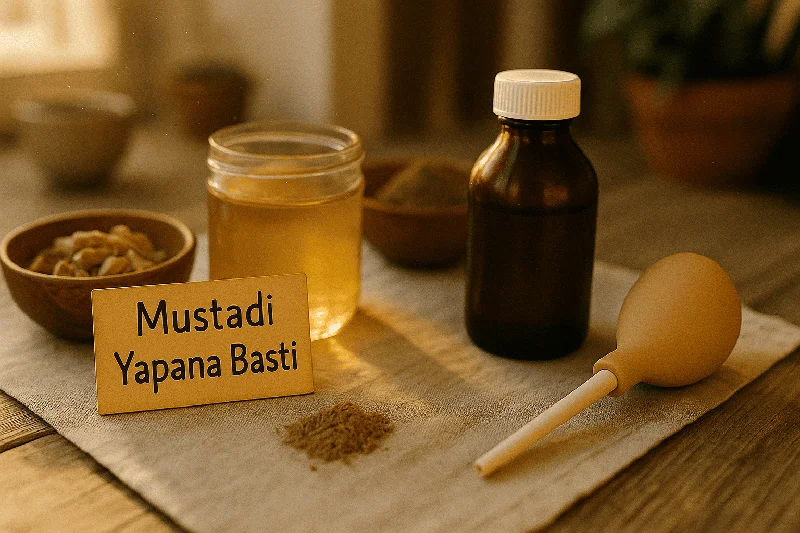
Other Key Ingredients (Milk, Ghee, Honey, Meat Broth, Rock Salt)
Beyond the kwath, Mustadi Yapana Basti incorporates:
- Ksheera (cow's milk): Acts as a Jeevaniya (life-giving) medium; carries lipophilic and hydrophilic drug molecules efficiently across the rectal mucosa
- Ghrita (cow's ghee): Vata-shamaka, enhances drug absorption (yogavahi property), provides essential fatty acids
- Madhu (honey): Yogavahi (catalytic carrier), sukshma marganusari (penetrates subtle channels), helps emulsify the basti mixture
- Mamsa Rasa (meat broth, traditionally goat): Rich source of amino acids, iron, and micronutrients; deeply nourishing to Mamsa and Shukra dhatu
- Saindhava Lavana (rock salt): Vibhedana (breaks down blockages in srotas), improves the absorption of other ingredients
- Taila (sesame oil): Vata-shamaka, penetrating, enhances lubrication of the colon
- Kalka (herbal paste): Made from the same Mustadi group herbs; provides concentrated drug contact
Pharmacological Properties (Rasa, Veerya, Vipaka, Guna)
| Ingredient | Rasa (Taste) | Veerya (Potency) | Vipaka (Post-digestive) | Guna (Quality) |
|---|---|---|---|---|
| Musta | Tikta, Katu, Kashaya | Sheeta | Katu | Laghu, Ruksha |
| Pippali | Katu | Anushna-Sheeta | Madhura | Laghu, Snigdha |
| Yashtimadhu | Madhura | Sheeta | Madhura | Guru, Snigdha |
| Ashwagandha | Tikta, Kashaya | Ushna | Madhura | Laghu, Snigdha |
| Shatavari | Madhura, Tikta | Sheeta | Madhura | Guru, Snigdha |
| Guduchi | Tikta, Kashaya | Ushna | Madhura | Laghu, Snigdha |
| Cow's Milk | Madhura | Sheeta | Madhura | Guru, Snigdha |
| Ghee | Madhura | Sheeta | Madhura | Guru, Snigdha, Mridu |
| Honey | Madhura, Kashaya | Sheeta | Katu | Laghu, Ruksha |
| Sesame Oil | Madhura | Ushna | Madhura | Guru, Snigdha |
The net pharmacological vector of this formulation is Madhura Vipaka (sweet post-digestive effect), Snigdha-Guru Guna (unctuous and heavy qualities), and a balanced Veerya — this explains why it nourishes Shukra Dhatu (reproductive tissue) so effectively while simultaneously calming aggravated Vata.
Exact Dosages and Proportions
This is a major gap in existing literature. Here are the classical dosage guidelines reconstructed from Charaka Samhita (Siddhi Sthana 1/45–48) and the commentaries of Chakrapanidatta and Gangadhara.
Classical Dosage Formula
For one Yapana Basti session, the standard Dwadasha Prasritiki (12-prasrita) formulation is:
| Component | Quantity (Classical) | Approximate Modern Equivalent |
|---|---|---|
| Makshika (Honey) | 1 Prasrita | ~80 ml |
| Saindhava (Rock salt) | 1 Karsha | ~12 g |
| Sneha — Ghrita + Taila (combined) | 1 Prasrita each | ~80 ml ghee + ~80 ml sesame oil |
| Kalka (Herbal paste) | 1 Prasrita | ~40-50 g |
| Kwath (Mustadi decoction) | 4 Prasrita | ~320 ml |
| Ksheera (Milk) | 2 Prasrita | ~160 ml |
| Mamsa Rasa (Meat broth) | 2 Prasrita | ~160 ml |
| Total volume | 12 Prasrita | ~850-950 ml |
Note: 1 Prasrita ≈ 80 ml according to Sharangdhara Samhita. Some scholars calculate slightly differently (76–96 ml). For vegetarian patients, the Mamsa Rasa portion is often substituted with additional milk or a protein-rich bean broth, though classical texts emphasize goat-meat broth for best results in Shukra Kshaya.
Mixing Sequence (Crucial for Efficacy)
The order of mixing is pharmacologically important and is explicitly specified:
- First take honey in a mortar (khalva yantra)
- Add rock salt and triturate
- Gradually add sneha (ghee and oil) while mixing
- Add kalka (herbal paste) and mix thoroughly
- Add kwath (decoction), then milk, then meat broth — in that order
- Mix until a homogeneous emulsion forms
This sequence ensures proper emulsification. Honey and salt act as emulsifying agents, allowing the oil-phase and water-phase components to form a stable mixture — a principle that aligns remarkably with modern pharmaceutical emulsion technology.
Step-by-Step Procedure: Pre, Main, and Post
Pre-Procedure (Purva Karma)
- 1.Abhyanga (oil massage): Full-body massage with Bala Taila or Dhanwantharam Taila for 20–30 minutes
- 2.Swedana (fomentation): Nadi Sweda (steam) or Patra Pinda Sweda to the lower back and abdomen for 10–15 minutes
- 3.Patient positioning: Left lateral position (Vama Parshwa) with right leg flexed and left leg extended
- 4.Mental preparation: Patient should be relaxed, not anxious; ideally administered in morning after light breakfast
Main Procedure (Pradhana Karma)
- The freshly prepared basti mixture (at lukewarm temperature, ~37-40°C) is loaded into a basti putaka (traditional leather bag) or modern enema syringe
- A basti netra (catheter/nozzle, lubricated with sesame oil) is gently inserted into the rectum to a depth of approximately 4 angulas (~7-8 cm)
- The mixture is slowly introduced with steady, moderate pressure — not too fast, not too slow
- Total administration time: approximately 3–5 minutes for the full volume
What Is a Basti Netra?
The basti netra is a tubular nozzle, traditionally made from gold, silver, or bone, now commonly replaced by rubber or PVC catheters. For females, a slightly shorter and thinner netra is recommended (6 angulas long vs 8 angulas for males, per Sushruta).
Post-Procedure (Pashchat Karma)
- Patient remains in supine position with legs slightly elevated for 15–20 minutes
- Gentle tapping on the soles of the feet (to stimulate Apana Vata)
- The basti material may be retained or expelled — both outcomes are acceptable with Yapana Basti
- Light, warm, easily digestible diet after the procedure — rice gruel (peya) with ghee is ideal
- Avoid strenuous activity, sexual intercourse, excessive talking, and cold exposure for the remainder of the day
How Much Time Does the Entire Basti Session Take?
Including preparation, Abhyanga, Swedana, the enema itself, and the resting period: expect approximately 90 minutes to 2 hours for a complete session.
Detailed Treatment Protocol and Course Duration
Standard Protocol for Shukra Kshaya (Male Infertility)
Based on published clinical studies and classical guidelines:
- Duration: 15–16 consecutive days (one basti per day)
- Timing: Morning, after sunrise, following light breakfast
- Assessment points: Semen analysis at baseline, day 16, and follow-up at day 45
- Repeat courses: After a gap of 1 month, course may be repeated if parameters haven't normalized
- Diet during treatment: Madhura (sweet), Snigdha (unctuous), easily digestible foods. Emphasis on milk, ghee, almonds, and seasonal fruits.
Things to Avoid During Therapy
- Cold water bathing
- Day sleep (increases Kapha, may obstruct srotas)
- Excessive physical exertion
- Spicy, fermented, or very dry foods
- Alcohol and smoking
- Emotional stress and anger
Clinical Research and Evidence
Case Study: 15-Day Protocol Without Internal Medications
A case series published in the Journal of KLEU (2018) studied 5 male patients diagnosed with oligozoospermia (sperm count < 20 million/ml). Each patient received Mustadi Yapana Basti for 15 consecutive days with no concurrent internal medications.
Results showed:
- Sperm count: Average increase from 12.3 million/ml to 28.7 million/ml
- Sperm motility: Improved from 32% to 54%
- Semen volume: Increased from 1.8 ml to 2.9 ml
- Serum testosterone: Showed upward trend in 4 out of 5 patients
These improvements are clinically significant and comparable to some conventional therapies.
Combination Therapy Study (IJBPAS, 2025)
A more recent study published in the International Journal of Biology, Pharmacy and Allied Sciences (2025) evaluated Mustadi Yapana Basti in combination with oral Ayurvedic formulations (Phala Ghrita and Ashwagandha Churna). The combination group showed statistically superior improvement in all semen parameters compared to basti-alone and oral-alone groups.
Research Across Other Conditions
Yapana Basti formulations (including Mustadi) have been investigated in:
| Condition | Study Focus | Outcome |
|---|---|---|
| Pakshaghata (Hemiplegia) | Motor function recovery | Significant improvement in muscle power (MRC grading) |
| Kampavata (Parkinson's-like tremor) | Tremor reduction, mobility | Moderate improvement |
| Katigraha (Low back pain) | Pain scores (VAS) | Marked reduction after 8-day course |
| Cervical Spondylosis | Neck disability index | Improvement in ROM and pain |
| Vandhyatva (Female infertility) | Ovulation, endometrial thickness | Preliminary positive results (limited data) |
Mechanism of Action: Ayurvedic and Modern Perspectives
Role of Agni and Srotas
From the Ayurvedic standpoint, Mustadi Yapana Basti works through three primary mechanisms:
- 1.Agni Deepana: The kwath ingredients (Musta, Pippali) kindle Jatharagni and Dhatvagni, enabling proper tissue metabolism down to the 7th dhatu (Shukra)
- 2.Sroto-Shodhana: Rock salt and honey clear micro-channel blockages (srotavarodha), allowing nutrients to reach the reproductive tissues
- 3.Vata Shamana: The Pakvashaya (colon) is the primary seat of Vata. Basti directly pacifies Apana Vata, which governs ejaculation, sperm motility, and downward elimination
Modern Pharmacological Explanation
The rectum's rich venous plexus (hemorrhoidal veins) bypasses first-pass hepatic metabolism, allowing direct absorption of bioactive compounds into systemic circulation. Here's how the components likely work at a physiological level:
- Withanolides (from Ashwagandha) directly support Leydig cell function, increasing testosterone synthesis — a 2013 study in Evidence-Based Complementary and Alternative Medicine showed a 17% increase in serum testosterone after Ashwagandha supplementation
- Glycyrrhizin (from Yashtimadhu) modulates the HPA axis and has demonstrated anti-oxidant protection of spermatocytes
- Piperine (from Pippali) enhances bioavailability of co-administered compounds by 30–200% (Patil et al., J Ayurveda Integr Med, 2011)
- Essential fatty acids and butyric acid (from ghee) nourish colonocytes, reduce local inflammation, and improve mucosal absorption
- Amino acids (from meat broth) provide direct building blocks for spermatogenesis
- The milk medium provides casein micelles that may act as natural drug delivery vehicles, enhancing absorption of hydrophobic plant compounds across the rectal mucosa
Panchabhautik (Five-Element) Analysis
This is a rarely discussed but intellectually elegant framework:
- Prithvi + Jala Mahabhuta (Earth + Water): Dominant in milk, ghee, meat broth → provide mass, structure, and nourishment to Shukra Dhatu
- Agni Mahabhuta (Fire): Present in Pippali, Musta, rock salt → ensures proper transformation (Paka) of the basti material
- Vayu Mahabhuta (Air): Addressed through Vata-shamaka herbs (Bala, Rasna, Ashwagandha) → controls the motility and movement aspects
- Akasha Mahabhuta (Ether/Space): The Sroto-shodhana action creates space in channels for proper flow
The balance of all five elements in a single formulation is what makes Yapana Basti universally applicable — it doesn't aggravate any single element excessively.
Mustadi Yapana Basti vs. Conventional Therapy for Oligozoospermia
No existing Ayurvedic resource provides this comparison, which is essential for patients considering their options:
| Parameter | Mustadi Yapana Basti | Clomiphene Citrate | Gonadotropin Therapy |
|---|---|---|---|
| Route | Rectal (transmucosal) | Oral | Subcutaneous injection |
| Typical duration | 15-16 days per course | 3-6 months continuous | 3-6 months |
| Sperm count improvement | 50–130% (based on case series) | 30–60% (variable) | 40–100% |
| Testosterone effect | Moderate increase | Significant increase | Direct supplementation |
| Side effects | Minimal (mild abdominal discomfort, rare) | Visual disturbances, mood changes, gynecomastia | Injection site pain, OHSS risk in female partners |
| Cost (India) | ₹500–1,500 per session | ₹200–500/month | ₹5,000–15,000/month |
| Holistic benefits | Improves digestion, energy, immunity, sleep | None beyond reproductive | None beyond reproductive |
| Evidence level | Case series, small clinical trials | RCTs available | RCTs available |
Important caveat: The evidence base for Mustadi Yapana Basti consists primarily of small-scale studies and case series. Larger randomized controlled trials are needed before definitive comparative claims can be made. However, the safety profile and additional holistic benefits make it a valuable complementary or first-line approach for mild-to-moderate oligozoospermia.
Safety, Side Effects, and Contraindications
Known Side Effects
Based on published literature and clinical practice:
- Mild abdominal cramping (in ~10-15% of patients) — usually resolves within 30 minutes
- Loose stools for 1-2 hours post-procedure — expected and not concerning
- Mild fatigue on the day of administration — rest is recommended
- Allergic reaction — exceedingly rare; possible if patient has specific herbal allergies
No serious adverse events have been reported in any published study on Mustadi Yapana Basti.
Contraindications
| Absolute Contraindications | Relative Contraindications |
|---|---|
| Rectal bleeding or active hemorrhoids | Severe debility (needs dose modification) |
| Intestinal obstruction | Acute diarrhea |
| Peritonitis or acute abdomen | Fever with Ama (toxin-laden fever) |
| Unconscious patient | Diabetes mellitus (honey content — needs monitoring) |
| Immediately after meals (within 2 hours) | First trimester of pregnancy |
Management of Adverse Effects
If the basti is retained too long and causes abdominal distension:
- Administer a mild Niruha Basti to stimulate expulsion
- Apply warm fomentation (Nadi Sweda) to the abdomen
- Give warm water with Hingvashatka Churna orally
If the basti is expelled too quickly (within minutes):
- This generally indicates Vata Prakopa or improper technique
- Repeat the next day with slightly increased sneha proportion
- Ensure adequate pre-procedure Abhyanga and Swedana
Frequently Asked Questions (FAQ)
Which Organ Is Cleansed in Basti Kriya?
Basti primarily targets the Pakvashaya (large intestine/colon), which is the principal seat of Vata Dosha. However, because Vata governs the entire nervous system and all movement in the body, pacifying Vata at its source has cascading beneficial effects on virtually every organ system. In the case of Mustadi Yapana Basti specifically, the reproductive organs (testes, seminal vesicles) and the neuroendocrine axis benefit significantly through transmucosal absorption.
Can Women Receive Mustadi Yapana Basti?
Yes. While most research focuses on male infertility, classical texts mention Yapana Basti for Vandhyatva (infertility in general). For women, it may support endometrial health, ovulatory function, and overall reproductive nourishment. The basti netra used for women is smaller and shorter. Clinical data on female applications is still limited but preliminary results are encouraging.
How Long Does One Basti Session Take?
- The actual enema administration takes 3–5 minutes.
- The complete session — including pre-procedure oil massage (Abhyanga), steam therapy (Swedana), the basti itself, and the post-procedure rest period — takes approximately 90 minutes to 2 hours.
What Is the Difference Between Basti and a Regular Enema?
A regular (Western) enema typically uses plain water or saline for bowel cleansing. Ayurvedic Basti is a therapeutic intervention using medicated oils, decoctions, milk, and herbs that are designed to be absorbed — not just evacuated. Yapana Basti in particular is intended to nourish, not merely cleanse.
Can Mustadi Yapana Basti Be Done at Home?
It is strongly recommended to undergo this therapy only under the supervision of a qualified Ayurvedic physician (Vaidya) in a clinical setting. The mixing sequence, temperature, dosage calibration, and catheter insertion require trained hands. Improper administration can lead to complications.
Is Mustadi Yapana Basti Suitable for Vegetarians?
The classical formulation includes Mamsa Rasa (goat meat broth). For vegetarian patients, many practitioners substitute it with additional milk, or a protein-rich Mudga Yusha (green gram soup). While this modification is widely practiced, strict classical texts recommend the original formulation for optimal results in Shukra Kshaya.
Conclusion: Why Mustadi Yapana Basti Deserves Attention
Mustadi Yapana Basti represents one of Ayurveda's most sophisticated therapeutic formulations — a carefully engineered emulsion of herbs, fats, proteins, and minerals delivered through the body's most efficient absorptive surface. Its classical endorsement as niratyaya (complication-free) and sarvakalopayogi (suitable for all times) reflects centuries of clinical refinement. Modern research, while still in early stages, consistently validates what the ancient texts described: significant improvements in sperm parameters, testosterone levels, and overall vitality.
For patients with mild-to-moderate oligozoospermia, musculoskeletal disorders, or general debility seeking a holistic approach, Mustadi Yapana Basti offers a compelling option — either as a standalone therapy or as a complement to conventional treatment. The key is to work with an experienced Ayurvedic practitioner who can tailor the formulation, dosage, and treatment duration to your individual Prakriti and Vikriti.
If you're considering Mustadi Yapana Basti, consult a certified Ayurvedic doctor to assess whether this therapy is appropriate for your specific condition. Early intervention combined with proper dietary and lifestyle modifications (Pathya-Apathya) can significantly improve outcomes. Disclaimer: This article is for educational purposes only and should not replace professional medical advice. Always consult a qualified Ayurvedic practitioner or healthcare provider before beginning any Panchakarma therapy.
Scientific Sources
- Ayurvedic management in cervical spondylotic myelopathy — Singh SK et al., 2017, Journal of Ayurveda and integrative medicine
- Ayurvedic management in limb girdle muscular dystrophy - A case report — Rajoria K et al., 2022, Journal of Ayurveda and integrative medicine
- Ayurveda management for acute upper limb ischemia - a case report — Singh SK et al., 2024, Journal of Ayurveda and integrative medicine
- Ayurvedic approach in the management of spinal cord injury: A case study — Singh SK et al., 2015, Ancient science of life
- Ayurvedic approach for management of ankylosing spondylitis: A case report — Singh SK et al., 2016, Journal of Ayurveda and integrative medicine
- Ayurvedic management of spondyloepiphyseal dysplasia tarda, a rare hereditary disorder — Singh SK et al., 2016, Journal of Ayurveda and integrative medicine
Ask Ayurvedic doctor a question and get a consultation online on the problem of your concern in a free or paid mode.
More than 2,000 experienced doctors work and wait for your questions on our site and help users to solve their health problems every day.
Related articles