Ask Ayurvedic doctor a question and get a consultation online on the problem of your concern in a free or paid mode. More than 2,000 experienced doctors work and wait for your questions on our site and help users to solve their health problems every day.
FREE! Ask Ayurvedic Doctors 24/7

 Fast responses
 1000+ verified doctors
Body DetoxEar, Nose, and Throat DisordersGeriatrics & RejuvenationImmunodeficiencyInfertility TreatmentNutritionOrthopedic DisordersPediatricsRespiratory DisordersSexually Transmitted Diseases (STDs)Surgery RecoveryUrological DisordersVascular DisordersDental DisordersEndocrinological DisordersGastrointestinal DisordersYoga TherapyGeneral MedicineAllergic DisordersCardio DisordersGynecology and ObstetricsCosmetologySkin and Hair DisordersEye DisordersInfectious DiseasesMental DisordersNeurological DisordersOncologyPanchakarmaSexual Health & DisordersSports Medicine
Published on 12/11/24
(Updated on 07/04/26)
3,462
Ashtamurti Rasayan: The Ayurvedic Elixir for Holistic Wellness
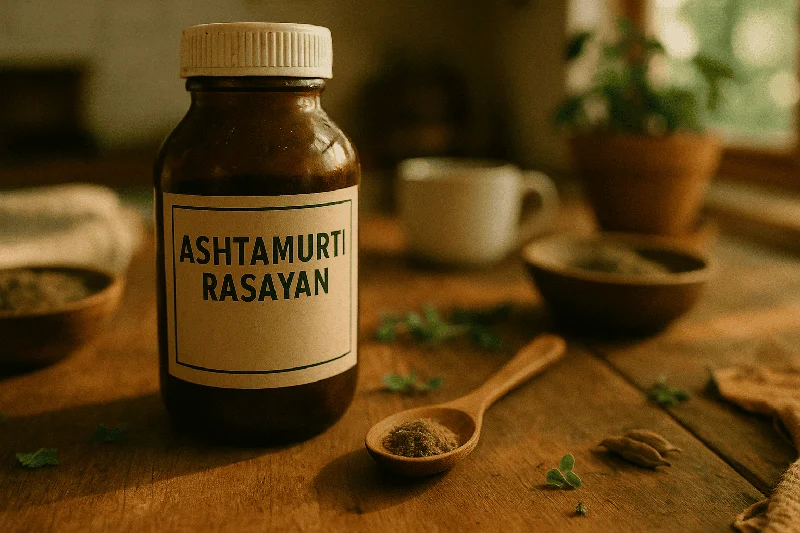
- Ashtamurti Rasayan is a classical Ayurvedic mineral-based formulation (Kupipakva Rasayana) described in the text Rasatantra Sara and Siddha Prayoga Sangraha.
- It contains eight core ingredients — hence the name "Ashtamurti," meaning "eight forms" — and is traditionally used for Vata-Pitta disorders, neurodegenerative conditions, chronic fevers, and general debility.
- This guide covers everything you need to know: the authentic classical composition, the controversial safety profile of its mineral ingredients, step-by-step preparation method, evidence-based analysis, dosage protocols, and how it compares to similar Kupipakva formulations like Makardhwaj Ras and Suvarna Malini Vasant.
What Is Ashtamurti Rasayan?
Ashtamurti Rasayan belongs to a specialized category of Ayurvedic medicines called Kupipakva Rasayana — formulations prepared by heating mercury, sulfur, and other minerals in a glass bottle (kupi) using a sand bath apparatus (Valuka Yantra). The final product is a sublimate or residue collected from the neck of the bottle after a controlled 30-hour heating process.
Unlike simple herbal churnas or kashayams, Kupipakva preparations undergo intense alchemical processing that Ayurvedic texts claim transforms toxic raw materials into therapeutically active, bioavailable compounds. Whether modern toxicology fully supports that claim is a question we'll address directly in this article.
Historical Origins & Classical References
The primary textual source for Ashtamurti Rasayan is Rasatantra Sara and Siddha Prayoga Sangraha, a well-known compendium of Rasa Shastra (Ayurvedic alchemy and iatrochemistry). This text catalogs hundreds of mineral and metallic preparations with their indications, dosages, and methods of preparation.
Unlike some widely referenced formulations that appear across multiple classical texts (Charaka Samhita, Bhaishajya Ratnavali, Rasa Ratna Samucchaya), Ashtamurti Rasayan's primary citation remains this single source. No alternative shloka references from other major Rasa Shastra texts have been widely documented, which makes it a relatively niche but respected formulation within the Kupipakva category.
Meaning of the Name: "Eight-Form Rejuvenator"
The Sanskrit name breaks down simply:
- Ashta = Eight
- Murti = Form / embodiment
- Rasayan = Rejuvenator / that which nourishes the rasa dhatu (primary tissue)
The "eight forms" refer to the eight principal ingredients in the classical recipe, each representing a distinct mineral or metal that contributes to the formulation's multi-system therapeutic action.
Classification as Kupipakva Rasayana
- Kupipakva Rasayanas are a distinct pharmaceutical category in Rasa Shastra.
- Key defining characteristics include:
- Preparation inside a glass bottle (kupi) sealed with multiple layers of mud-smeared cloth
- Heating on a Valuka Yantra (sand bath) at graded temperatures
- The final product is collected as a sublimate from the bottle's neck or as a residue at its base
- These are considered among the most potent Ayurvedic preparations
Other well-known Kupipakva Rasayanas include Rasa Sindhura, Makardhwaj, and Suvarna Malini Vasant Ras.
Classical Ingredients of Ashtamurti Rasayan
This is where things get important — and where existing online sources create significant confusion. Some websites list a purely herbal composition (ashwagandha, shilajit, amalaki, guduchi), while the classical text describes a mineral-metallic formulation. These are fundamentally different products.
Mineral and Metal Components (Classical Formula)
The authentic classical recipe from Rasatantra Sara includes the following eight ingredients:
| # | Sanskrit Name | English/Common Name | Role in Formula |
|---|---|---|---|
| 1 | Parada | Mercury (purified) | Primary catalytic agent in Rasa Shastra |
| 2 | Gandhaka | Sulfur (purified) | Binds with mercury to form Kajjali base |
| 3 | Swarna Bhasma | Gold calx | Immuno-modulator, cardiac and neural tonic |
| 4 | Rajata Bhasma | Silver calx | Nervine tonic, cooling |
| 5 | Hingula | Cinnabar (mercuric sulfide, purified) | Source of processed mercury-sulfur compound |
| 6 | Shilajatu | Shilajit (mineral pitch) | Yogavahi — enhances bioavailability of other ingredients |
| 7 | Somala | Arsenic (purified/Shodhita) | Used in minute quantities for specific disorders |
| 8 | Murdasang | Lead oxide (litharge, purified) | Traditionally used for chronic conditions |
> Critical note: The presence of mercury, arsenic, and lead oxide makes this formulation inherently high-risk if not prepared according to strict classical protocols. This is not a supplement to self-prescribe.
The Role of Shodhana (Purification) in Safety
- Every toxic mineral ingredient in Ashtamurti Rasayan must undergo Shodhana (purification/detoxification) before incorporation into the formula.
- Shodhana is not mere washing — it involves repeated processing with specific herbal media that Ayurvedic pharmacology claims alters the chemical form and reduces toxicity.
For example:
- Parada Shodhana — Mercury is triturated with specific plant juices (like kumari swarasa, nimbu swarasa) through 18 prescribed steps to remove its "pancha dosha" (five defects)
- Gandhaka Shodhana — Sulfur is melted and poured into cow's milk repeatedly
- Somala Shodhana — Arsenic undergoes repeated levigation with lime juice and heating cycles
A 2012 study published in the Journal of Ayurveda and Integrative Medicine analyzed traditionally prepared Ayurvedic Bhasmas and found that properly processed formulations contained metals in nanoparticle form with significantly different bioavailability and toxicity profiles compared to raw metals. However, the study also cautioned that quality control remains inconsistent across manufacturers.
This is the core safety issue that no competitor website adequately addresses. Without verified Shodhana and rigorous quality testing, these formulations carry real risk.
Modern Herbal Interpretations vs. Classical Formula
Some modern manufacturers market products labeled "Ashtamurti Rasayan" that contain herbal ingredients like ashwagandha (Withania somnifera), shatavari (Asparagus racemosus), amalaki (Emblica officinalis), and guduchi (Tinospora cordifolia) — with no mineral content whatsoever.
These are not the same medicine. The classical Ashtamurti Rasayan is a Kupipakva mineral preparation. The herbal versions may be proprietary reformulations designed to evoke the rasayana concept without using controversial mineral ingredients. Both may have therapeutic value, but they should not be conflated.
When purchasing, always check whether the product is classified under:
- Ras & Sindoor category (mineral-based, classical)
- Rasayana / herbal supplement category (plant-based, modern interpretation)
Method of Preparation (Kupipakva Method)
The preparation of Ashtamurti Rasayan follows the classical Kupipakva method, which is one of the most technically demanding pharmaceutical processes in Ayurveda.
Equipment: Valuka Yantra (Sand Bath Apparatus)
The Valuka Yantra consists of:
- A large earthen pot filled with sand
- A glass bottle (kupi) partially buried in the sand
- A graduated heat source (traditionally coal furnace, now sometimes electric)
- The bottle neck is left open initially to allow gases to escape, then partially covered to control sublimation
Step-by-Step Preparation Process
- 1.Kajjali preparation: Purified Parada and Gandhaka are triturated together until they form a fine, lusterless black powder (Kajjali). This is the base.
- 2.Addition of other Shodhita ingredients: Purified Hingula, Somala, Murdasang, Swarna Bhasma, Rajata Bhasma, and Shilajatu are added sequentially and triturated with the Kajjali.
- 3.Loading the Kupi: The mixture is placed inside a glass bottle. The bottle's mouth is covered with layers of mud-smeared cloth (kapadmitti) leaving a small opening.
- 4.Graded heating (approximately 30 hours):
- Mridu Agni (mild heat) — first 8-10 hours: moisture and volatile impurities escape
- Madhyama Agni (moderate heat) — next 10-12 hours: sulfur fumes (indicated by a burning matchstick test at the bottle mouth producing a blue flame)
- Tivra Agni (intense heat) — final 8-10 hours: sublimation occurs, the product deposits in the neck of the bottle
- 5.Cooling and collection: The apparatus is allowed to cool naturally. The kupi is carefully broken, and the sublimate or residue is collected from the bottle's neck.
Quality Indicators of the Final Product
A properly prepared Ashtamurti Rasayan should exhibit:
- Characteristic luster and color (varies by specific sublimate)
- Smooth texture when rubbed between fingers
- Specific gravity and particle size within classical parameters
- No raw sulfur smell (indicates complete reaction)
Key Benefits & Therapeutic Indications
Vata Disorders & Neurodegenerative Conditions
Classical texts indicate Ashtamurti Rasayan primarily for Vata-dominant conditions affecting the nervous system:
- Neurological weakness and degenerative nerve conditions
- Tremors and involuntary movements
- Chronic pain in bones, joints, tendons, and ligaments
- Muscle wasting and progressive weakness
The combination of Swarna Bhasma and Rajata Bhasma in the formula is particularly relevant here. A 2016 review in Ancient Science of Life noted that Swarna Bhasma demonstrated neuroprotective activity in animal models, potentially through antioxidant and anti-inflammatory mechanisms. Rajata Bhasma has traditionally been classified as a Medhya (intellect-promoting) and nervine tonic.
Fever Types & Immune Disorders
The formulation is indicated for:
- Jirna Jwara — chronic fevers unresponsive to standard treatment
- Vishama Jwara — intermittent fevers
- Immunodeficiency states and recurrent infections
Shilajit, one of the eight ingredients, has the most robust modern research backing among the formula's components. A 2019 clinical study published in the Journal of Ethnopharmacology demonstrated that purified Shilajit enhanced mitochondrial function and showed adaptogenic properties in human subjects.
Mental Health & Psychological Disorders
Ashtamurti Rasayan is traditionally prescribed for:
- Unmada — psychotic conditions
- Apasmara — epilepsy and convulsive disorders
- Anxiety, restlessness, and sleep disturbances
- Cognitive decline
Action on Dhatus (Tissues) — Ayurvedic Pharmacology
From an Ayurvedic pharmacological perspective, the formulation acts on multiple dhatus:
| Parameter | Description |
|---|---|
| Rasa (Taste) | Predominantly Tikta (bitter), Kashaya (astringent) |
| Guna (Quality) | Laghu (light), Snigdha (unctuous) |
| Virya (Potency) | Ushna (hot) |
| Vipaka (Post-digestive effect) | Madhura (sweet) |
| Prabhava (Special action) | Tridosha-shamaka with emphasis on Vata-Pitta |
| Dhatu affinity | Rasa, Rakta, Mamsa, Asthi, Majja, Shukra |
This multi-dhatu action explains why classical texts describe it as a broad-spectrum rasayana rather than a single-condition remedy.
Dosage, Course Duration & Administration
Standard Dosage
| Patient Category | Dosage | Anupana (Vehicle) |
|---|---|---|
| Adults (general) | 125 mg to 250 mg | Honey, or as directed by physician |
| Specific conditions (physician-guided) | Up to 250 mg, twice daily | Condition-specific: ghee, milk, or herbal decoctions |
| Children | Not recommended without specialized Ayurvedic pediatric consultation | — |
| Elderly | Lower end of range (125 mg) | Warm milk or honey |
Course Duration and Cycling
- This is a gap that every competitor ignores.
- Based on classical Rasa Shastra principles:
- Typical course: 30 to 90 days depending on the condition
- Cycling: Most Kupipakva Rasayanas are prescribed in cycles — for example, 30 days on, 15 days off — to prevent accumulation of mineral constituents
- Evaluation points: Clinical reassessment should occur every 30 days to evaluate efficacy and screen for any adverse effects
- Maximum continuous use: Generally should not exceed 90 days without blood work and clinical review
> Important: These are general guidelines from classical practice. Your Ayurvedic physician should determine the exact protocol based on your Prakriti (constitution), Vikriti (current imbalance), Agni (digestive capacity), and Bala (strength).
Don't wait or self medicate. Start chat with Doctor NOW
Side Effects, Contraindications & Safety Profile
Known Side Effects
When properly prepared and administered under medical supervision at classical doses:
- Gastrointestinal discomfort (rare, usually dose-related)
- Mild heat sensation (due to Ushna Virya)
- Metallic taste in mouth (transient)
Specific Contraindications
No competitor lists concrete contraindications. Here they are based on Rasa Shastra principles and modern safety considerations:
- Pregnancy and lactation — strictly contraindicated due to mineral content
- Hepatic insufficiency — the liver metabolizes mineral compounds; impaired function increases toxicity risk
- Renal impairment — kidneys excrete processed minerals; compromised filtration is dangerous
- Children under 12 — unless prescribed by a qualified Rasa Shastra specialist with pediatric experience
- Known allergy/sensitivity to sulfur compounds
- Concurrent use of hepatotoxic or nephrotoxic medications
- Active gastrointestinal ulceration or bleeding
Toxicology: The Elephant in the Room
Let's be direct. Ashtamurti Rasayan contains mercury, arsenic, and lead oxide. These are recognized toxic substances by the WHO and every modern toxicology reference.
- The Ayurvedic position is that Shodhana and the Kupipakva process transform these substances into biologically different compounds — essentially arguing that Parada Bhasma is not the same as elemental mercury.
- There is some supporting evidence:
- A 2011 study in the International Journal of Ayurveda Research found that properly prepared Rasa Sindoor (another mercury-sulfur Kupipakva preparation) contained mercury primarily as HgS (mercuric sulfide), which has dramatically lower bioavailability than elemental mercury or methylmercury
- A 2017 investigation published in Journal of Trace Elements in Medicine and Biology confirmed that classical Bhasma preparations contained metals in nanoparticle form with different absorption kinetics
However, the evidence is far from conclusive. Several case reports in Western toxicology literature have documented heavy metal poisoning from improperly prepared or adulterated Ayurvedic mineral formulations.
The bottom line: Only use Ashtamurti Rasayan from GMP-certified manufacturers with verifiable quality testing, and only under the supervision of a qualified Rasa Shastra physician who can monitor your response.
Drug Interactions
| Concurrent Medication | Interaction Risk | Recommendation |
|---|---|---|
| Allopathic medicines | Possible interaction; altered absorption | Maintain 30-minute gap minimum |
| Homeopathic medicines | Generally compatible | Can be taken concurrently |
| Other Ayurvedic medicines | Compatible in most cases | Physician should review total mineral load |
| Dietary supplements (zinc, iron, calcium) | Potential competition for absorption | Stagger timing by 2 hours |
Ashtamurti Rasayan vs. Similar Kupipakva Rasayanas
No existing resource offers this comparison, so here's a practical reference:
| Parameter | Ashtamurti Rasayan | Makardhwaj Ras | Suvarna Malini Vasant |
|---|---|---|---|
| Key metals | Mercury, gold, silver, arsenic, lead oxide | Mercury, gold, sulfur | Mercury, gold, tin, sulfur |
| Primary indication | Vata-Pitta disorders, neuro-degeneration, chronic fever | General debility, sexual disorders, cardiac weakness | Diabetes, respiratory disorders, wasting diseases |
| Potency category | High | Very high | High |
| Classical source | Rasatantra Sara | Rasa Ratna Samucchaya, others | Siddha Yoga Sangraha |
| Risk level | High (arsenic, lead content) | Moderate-High | Moderate-High |
| Common dose | 125–250 mg | 125 mg | 125–250 mg |
| Availability | Limited (niche manufacturers) | Widely available | Widely available |
The presence of Somala (arsenic) and Murdasang (lead oxide) makes Ashtamurti Rasayan's safety profile more complex than either Makardhwaj or Suvarna Malini Vasant. This is likely why it remains a less commonly prescribed formulation — it requires a practitioner with specific expertise.
Price, Availability & Regulatory Status
Current Market Pricing
| Manufacturer | Pack Size | Approximate Price (INR) | Availability |
|---|---|---|---|
| Vyas Pharmaceuticals (Indore) | 5 gm | ₹185–₹190 | Available through select Ayurvedic pharmacies |
| Krishna Gopal Ayurved Bhavan | 2 gm | ₹120–₹150 | Limited availability |
Shelf life is typically 3 years from date of manufacture when stored properly (cool, dry place away from direct sunlight).
Regulatory and Certification Considerations
- The formulation falls under Schedule E-1 of the Drugs and Cosmetics Act in India, meaning it contains potent ingredients requiring specific labeling and cautionary warnings
- Look for GMP certification (Good Manufacturing Practices as per AYUSH Ministry guidelines)
- Licensed manufacturers should display their Ayurvedic drug manufacturing license number
- The product should ideally carry heavy metal testing results from an accredited laboratory
Storage Precautions
- Store away from direct sunlight and moisture
- Keep out of reach of children — this is not a mild herbal supplement
- Do not transfer to unlabeled containers
- Maintain original packaging for reference to batch number and expiry
Integrating Ashtamurti Rasayan Into a Holistic Wellness Plan
- Ashtamurti Rasayan works best as part of a comprehensive Ayurvedic approach, not as a standalone magic pill.
- Consider these complementary practices:
- Diet (Ahara): Follow a Vata-pacifying diet if prescribed for neurological conditions — warm, cooked, easily digestible foods with healthy fats
- Lifestyle (Vihara): Regular sleep schedule, Abhyanga (oil massage), and avoidance of excessive physical strain
- Yoga & Pranayama: Gentle practices like Nadi Shodhana (alternate nostril breathing) and restorative yoga postures support nervous system recovery
- Meditation: Daily practice supports the mental health benefits of the formulation
- Regular monitoring: Blood tests for liver function, kidney function, and heavy metal levels every 60–90 days during treatment
Frequently Asked Questions (FAQ)
What is the Ashtamurti Rasayan price?
The classical mineral-based Ashtamurti Rasayan from manufacturers like Vyas Pharmaceuticals (Indore) is priced approximately ₹185–₹190 for a 5 gm pack. Due to its niche status, it may not be available in all pharmacies and is often purchased through specialized Ayurvedic stores or online platforms.
Is Ashtamurti Rasayan safe during pregnancy?
No. Ashtamurti Rasayan is strictly contraindicated during pregnancy and lactation due to its mineral content, including mercury and arsenic compounds. Even in purified form, these substances pose unacceptable risk to fetal development.
Can children take Ashtamurti Rasayan?
This is generally not recommended for children under 12 years of age. In exceptional cases, a qualified Rasa Shastra physician with pediatric expertise may prescribe it at highly reduced doses for specific conditions, but this requires close monitoring including regular blood work.
Where can I find the Ashtamurti Rasa shloka (classical verse)?
The primary reference is from Rasatantra Sara and Siddha Prayoga Sangraha. This text is available in Sanskrit with Hindi commentary from several Ayurvedic publishers. The full original shloka details the eight ingredients, their proportions, the method of preparation, and primary indications. Digital versions can be difficult to source, but physical copies are available through specialized Ayurvedic bookstores and some university libraries.
What is the reference book for this formulation (Rastantrasaar Siddha Prayog)?
The Rasatantra Sara and Siddha Prayoga Sangraha is the authoritative text. It is a comprehensive compilation of Rasa Shastra formulations and serves as a standard reference in Ayurvedic pharmaceutical education. If you're a practitioner, the Hindi-Sanskrit editions by Krishnadas Academy or Chaukhambha publishers are the most widely used scholarly editions.
How is Ashtamurti Rasayan different from Vyadhiharan Rasayan?
Both are classical Ayurvedic mineral formulations, but they differ in composition, indications, and preparation method. Vyadhiharan Rasayan has its own distinct ingredient profile and therapeutic focus. Ashtamurti Rasayan's unique eight-ingredient mineral formula with emphasis on Vata-Pitta disorders distinguishes it. Always consult with a qualified practitioner to determine which formulation is appropriate for your specific condition.
Is Ashtamurti Rasayan the same as herbal Rasayana supplements available online?
No. Some modern products marketed under similar names contain purely herbal ingredients (ashwagandha, guduchi, amalaki, etc.) and bear no relation to the classical mineral-based Kupipakva formulation. Both categories may offer health benefits, but they are entirely different medicines with different safety profiles, dosages, and indications.
Conclusion: A Powerful Tool That Demands Respect
Ashtamurti Rasayan represents the pinnacle of Ayurvedic mineral pharmacology — a sophisticated formulation born from centuries of alchemical tradition. Its potential benefits for neurodegenerative conditions, chronic fevers, immune dysfunction, and systemic rejuvenation are well-documented in classical literature.
- But it is not a casual supplement.
- The presence of mercury, arsenic, and lead compounds — even in purified form — demands that this medicine be used exclusively under qualified medical supervision, sourced from GMP-certified manufacturers, and monitored with appropriate laboratory testing.
If you're considering Ashtamurti Rasayan, consult a qualified Ayurvedic physician with specific training in Rasa Shastra. Bring your complete medical history, current medications list, and recent blood work. The right practitioner will determine whether this potent rasayana is appropriate for your unique constitution and condition — or whether a safer alternative can achieve similar results.
This article is for educational purposes only and does not constitute medical advice. Always consult a qualified healthcare practitioner before starting any Ayurvedic mineral formulation.
Scientific Sources
- Bacopa monniera, a reputed nootropic plant: an overview — Russo A et al., 2005, Phytomedicine : international journal of phytotherapy and phytopharmacology
- Complete resolution of lumbar disc sequestration with Ayurveda management: A case report — Wasedar V et al., 2023, Journal of Ayurveda and integrative medicine
- Yoga perspective on personal excellence and well-being — Chaudhry N et al., 2023, Journal of Ayurveda and integrative medicine
- Integrative medicine for musculoskeletal pains - A proposed model based on clinical experience — Shete K et al., 2024, Journal of Ayurveda and integrative medicine
- Radioprotection by plant products: present status and future prospects — Arora R et al., 2005, Phytotherapy research : PTR
- Ayurgenomics-based frameworks in precision and integrative medicine: Translational opportunities — Mukerji M, 2023, Cambridge prisms. Precision medicine
- Maternal health, supraja (eugenics) and ayurveda — Nanal VV et al., 2008, Ancient science of life
- Recent advances in teaching-learning methodologies of the Ayurveda education system — Jibkate B et al., 2024, Journal of education and health promotion
- Ayurvedic Therapies to Target the Microbiome: Evidence and Possibilities — Vijayanna ST et al., 2024, Alternative therapies in health and medicine
- Therapeutic Potential of Skin Stem Cells and Cells of Skin Origin: Effects of Botanical Drugs Derived from Traditional Medicine — Ratnayake P et al., 2022, Stem cell reviews and reports
- Management of Sannipata Jwara w.s.r to COVID-19 - Case report — Akhila VG, 2022, Journal of Ayurveda and integrative medicine
- Scientific validation of the antidiabetic effects of Syzygium jambolanum DC (black plum), a traditional medicinal plant of India — Baliga MS et al., 2013, Journal of alternative and complementary medicine (New York, N.Y.)
- Teaching Evidence-Based Medicine and Non-conventional (Alternative) Therapies in Portuguese Veterinary Schools-A Curricular Assessment — Magalhães-Sant'Ana M et al., 2024, Journal of veterinary medical education
- Ayurveda and traditional Chinese medicine: a comparative overview — Patwardhan B et al., 2005, Evidence-based complementary and alternative medicine: eCAM
- Harnessing Ayurveda in Acute Management of Type 1 Trigeminal Neuralgia: Insights from a Single-Case Report — Waskar RA et al., 2024, Journal of pharmacy & bioallied sciences
- The guggul for chronic diseases: ancient medicine, modern targets — Shishodia S et al., 2008, Anticancer research
- Immunomodulatory Effects of a Herbo-Mineral Ayurvedic Formulation in Experimental Models — Prakash VB et al., 2024, Cureus
- Nootropic potential of Ashwagandha leaves: Beyond traditional root extracts — Wadhwa R et al., 2016, Neurochemistry international
- Principles of Rajayakshma management for COVID-19 — Kumar Singh S et al., 2022, Journal of Ayurveda and integrative medicine
- Procedures of complementary medicine in rheumatology(https://pubmed.ncbi.nlm.nih.gov/38935116/) — Keyßer G et al., 2024, Zeitschrift fur Rheumatologie
Questions from users
What interactions should I be aware of when taking Ashtamurti Rasayan with other herbs?
Rowan
8 days ago
When taking Ashtamurti Rasayan with other herbs, it's important to be cautious because it contains strong substances like mercury and arsenic. These could interact with other herbs, potentially affecting digestive fire (agni) or aggravating doshas. Best to consult an Ayurvedic doctor to see how it fits with your own constitution and imbalances.
What is Vyadhiharan Rasayan and how does it differ from Ashtamurti Rasayan?
Nevaah
18 days ago
Vyadhiharan Rasayan is a compilation of formulations, focusing on treating various diseases using Rasa Shastra principles, often involveing minerals and metals. Ashtamurti Rasayan, in its classical form, is specifically a Kupipakva mineral prep, but modern herbal versions might differ. So they're not quite the same in their purpose or make-up!
Is it safe to use herbal versions of Ashtamurti Rasayan that don’t contain heavy metals?
Mason
27 days ago
If you're looking at herbal versions without heavy metals, they might be safer, but you still want to be cautious. Always check the manufacturer for quality control and look for products that are well-tested. Consulting with an Ayurvedic practitioner can also ensure it's a good fit for your dosha and any health issues. Safety first!
What are the mineral components in classical Ashtamurti Rasayan and their effects?
Ruby
36 days ago
In the classical Ashtamurti Rasayan, minerals like mercury, arsenic, and lead oxide are key components. They are traditionally processed (samskar) to form a potent iatrochemical medicine intended to invigorate and rejuvenate body tissues. For specific effects, its wise to consult with a qualified Ayurvedic practitioner, as these minerals can carry risks if not properly used.
What is the role of Ashtamurti Rasayan in supporting long-term health?
John
48 days ago
Ashtamurti Rasayan helps support long-term health by promoting longevity, boosting immunity, and enhancing mental clarity. It's like a holistic tonic; nourishes your tissues, improves cellular regeneration, and keeps organ functions optimal. Plus, it helps with stress and sharpens memory. Try including it as a regular part of your routine!
Is it safe to take Ashtamurti Rasayan during pregnancy?
Brooklyn
58 days ago
Hmm, Ashtamurti Rasayan is generally a powerful tonic, but during pregnancy, it's best to be super cautious. Always, better to talk with your doctor or an Ayurvedic practitioner before taking any herbs or supplements. Pregnancy can be a bit tricky with such things and professional guidance will be the safest way.
Is Ashtamurti Rasayan suitable for children or adolescents?
Aubrey
68 days ago
Ashtamurti Rasayan isn't typically recommended for children or adolescents due to its potent ingredients, usually more suited for adults. But, Ayurveda stresses personalized care, so talkin' with an Ayurvedic practitioner might help make a decision focused on a kid's unique constitution.
Can Ashtamurti Rasayan help improve overall vitality and energy levels?
Sofia
77 days ago
Yes, Ashtamurti Rasayan can definitely help with improving overall vitality and energy levels! It's a great herbal tonic for boosting immunity and tackling stress, which can both impact energy. Just remember, though, results can vary based on your individual prakriti and lifestyle habits. Be sure to balance it with a good diet and some mild exercise for best results!
Can I take Ashtamurti Rasayan if I have a chronic health condition?
Quinn
87 days ago
It kinda depends on the specific health condition you have. Important to first consult with an Ayurvedic practitioner who can assess your dosha balance and health needs. Ashtamurti Rasayan might interact with some conditions or medications. It's about finding a balance that supports your unique body! 😊
Is Ashtamurti Rasayan effective for improving mental fatigue and emotional balance?
Leo
96 days ago
Yes, Ashtamurti Rasayan is effective for mental fatigue and emotional balance. It's known for revitalizing mental and emotional energies, thanks to its blend of herbs and minerals that help balance the doshas. So if you're feeling particularly tired mentally or a bit emotionally off-balanced, it could be helpful to try. But always a good idea to consult an ayurvedic practicioner for personal advise!
Related articles
Mental Disorders
Psychological Illnesses
Mental illness is a condition that affects an individual’s thinking, feelings, mood, and behavior. They can be occasional or long-term (chronic).
2,999

Mental Disorders
Ayurvedic Medicine for OCD – Holistic Approach for Mental Clarity and Emotional Balance
Discover Ayurvedic medicine for OCD, a holistic approach that uses natural herbal formulations, detoxification therapies, and lifestyle modifications to promote mental clarity, balance, and emotional well-being.
3,892

Mental Disorders
Brahmi Drakshadi Kashayam: Improve Mental Clarity with Brahmi Drakshadi Kashayam
Explore Brahmi Drakshadi Kashayam, its benefits, proper dosage, uses, and the scientific evidence supporting this Ayurvedic remedy for cognitive health, stress relief, and overall well-being.
2,966
Mental Disorders
Narayan Kalp Vati – Ayurvedic Tonic for Comprehensive Health & Rejuvenation
Discover the benefits and uses of Narayan Kalp Vati, a traditional Ayurvedic tonic known for its rejuvenating properties, immune support, and overall health enhancement.
5,184

Mental Disorders
Kalyanaka Ghrita for Sleep: Ayurvedic Insights for Restful Nights
Explore how Kalyanaka Ghrita aids sleep, backed by research and Ayurvedic wisdom. Learn evidence-based tips, usage, and safety considerations.
4,723

Mental Disorders
Rilanx Capsules: Uses, Benefits, and Scientific Insights
Discover the science behind Rilanx Capsules, their benefits, potential risks, and research-backed insights to make informed healthcare decisions.
4,323

Mental Disorders
Achieve Body & Mind Balance through Ayurveda
Body and mind balance plays an important role in one’s life. It helps a person to achieve their utmost potential and lead life in an efficient manner.
2,769

Mental Disorders
Manasamitra Vatakam Benefits, Dosage, Ingredients and Side Effects
Exploration of Manasamitra Vatakam Benefits, Dosage, Ingredients and Side Effects
8,308
Mental Disorders
Brahmi Lehyam: Benefits, Dosage & Ayurvedic Insights
Explore the benefits, proper dosage, uses, and Ayurvedic foundations of Brahmi Lehyam, a traditional herbal tonic for cognitive enhancement and overall wellness.
4,206

Mental Disorders
Depression and Ayurveda: A Natural Path
Ayurveda views depression as an imbalance in the body's natural energies, influenced by the doshas, rather than just a mental health issue.
2,419
Related consultations on the topic
Legal
Additional Documents
© 2024 Ask Ayurveda. All rights reserved.