FREE! Ask Ayurvedic Doctors 24/7

 Fast responses
 1000+ verified doctors
Charngeryadi Gulika: Benefits, Dosage & Uses Explained Meta
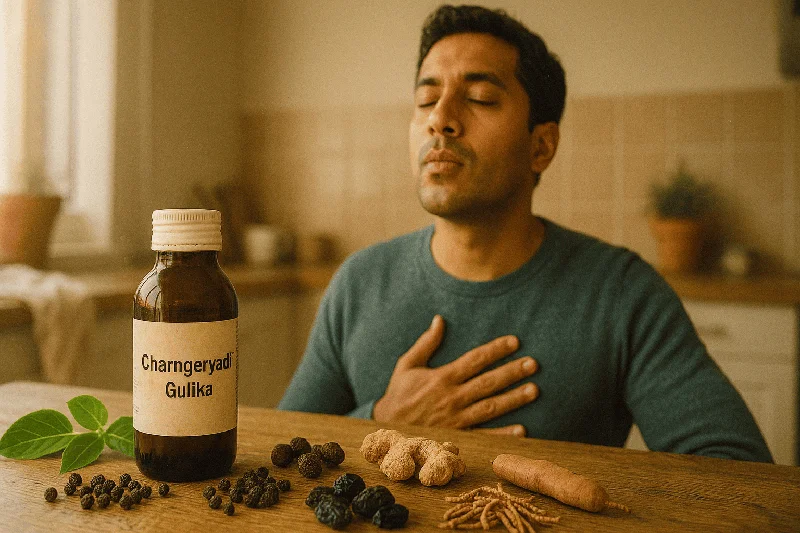
Charngeryadi Gulika is a classical Ayurvedic tablet formulation primarily used to treat cough, sore throat, bronchitis, nasal congestion, and a wide range of respiratory disorders. Derived from the ancient text Sahasrayogam, this herbal pill combines the mucolytic power of Changeri (Oxalis corniculata) with warming spices and soothing herbs to break down mucus, reduce inflammation, and restore healthy breathing. If you have been searching for a natural, time-tested remedy for persistent respiratory problems, this guide covers everything you need to know — from the complete ingredient list and classical pharmacology to exact dosages, side effects, and how it compares to similar formulations.
What Is Charngeryadi Gulika?
Charngeryadi Gulika is a polyherbal tablet (Gulika literally means "pill" or "tablet" in Sanskrit) that belongs to the Kasa-Svasa Chikitsa (cough and asthma treatment) category of Ayurvedic medicine. It has been prescribed by Vaidyas across Kerala and South India for centuries, and today it is manufactured by reputed pharmacies like Kottakkal Arya Vaidya Sala, Rajah Ayurveda, and SNA Oushadhasala.
Unlike many modern cough suppressants that simply mask symptoms, Charngeryadi Gulika addresses the root cause by balancing aggravated Kapha dosha — the primary driver of excessive mucus production — while simultaneously pacifying Vata dosha, which governs the upward movement of air in the chest and throat.
Etymology: Breaking Down the Name
The name itself reveals the formulation's identity:
- Changeri — refers to Oxalis corniculata (Indian sorrel), the principal herb in the formula
- Adi — a Sanskrit suffix meaning "and others" or "beginning with," indicating that Changeri leads a group of herbs
- Gulika — means tablet or pill
So "Charngeryadi Gulika" essentially translates to "the tablet beginning with Changeri." Surprisingly, none of the top-ranking pages currently explain this etymology — or even mention Changeri as an ingredient. This is a significant oversight, because Oxalis corniculata is foundational to the formulation's therapeutic action.
Classical Textual Reference
The formula is documented in the Sahasrayogam, one of the most important compilations of Ayurvedic formulations from the Kerala tradition. Some scholars also reference similar formulations in commentaries on the Ashtanga Hridayam by Vagbhata. The Sahasrayogam lists Charngeryadi Gulika under the Gulika Prakarana (chapter on pills), specifying exact ingredients and proportions for preparation.
Ayurvedic Pharmacological Profile (Dravyaguna)
| Property | Detail |
|---|---|
| Rasa (Taste) | Katu (Pungent), Amla (Sour), Madhura (Sweet) |
| Guna (Quality) | Laghu (Light), Tikshna (Penetrating) |
| Virya (Potency) | Ushna (Hot) |
| Vipaka (Post-digestive effect) | Katu (Pungent) |
| Doshaghnata (Dosha action) | Primarily Kapha-Vata Shamaka (pacifies Kapha and Vata) |
| Srotas (Channel affinity) | Pranavaha Srotas (respiratory channels), Annavaha Srotas (digestive channels) |
The combination of pungent and sour tastes with hot potency makes this formulation especially effective at liquefying and expelling thick, sticky Kapha accumulations from the respiratory tract.
Complete Ingredients of Charngeryadi Gulika
One of the biggest gaps in existing online content is the incomplete listing of ingredients. Most sources mention only 4 herbs. The classical formulation, however, contains a broader set of components. Below is the comprehensive ingredient profile based on the Sahasrayogam reference and the formulations used by major manufacturers.
Changeri (Oxalis corniculata) — The Key Herb
Changeri, or Indian sorrel, is the prdhana dravya (principal drug) of this formulation. It is a small creeping herb with a distinctly sour taste, rich in oxalic acid, vitamin C, and flavonoids.
In Ayurveda, Changeri is classified as having:
- Amla rasa (sour taste) that stimulates Agni (digestive fire) and helps break down Ama (toxins)
- Deepana-Pachana properties that improve digestion of Kapha
- Demonstrated anti-inflammatory activity — a 2017 study published in the Journal of Ethnopharmacology confirmed that Oxalis corniculata extracts showed significant anti-inflammatory and analgesic effects in animal models
It is genuinely surprising that this herb is absent from competing articles, given that it literally gives the formulation its name.
Trikatu — The Triple Pungent Combination
Trikatu is a classical Ayurvedic trio that forms the warming backbone of the formula:
Shunti (Zingiber officinale — Dry Ginger)
Shunti is one of the most well-researched Ayurvedic herbs. A 2013 systematic review in the International Journal of Preventive Medicine highlighted gingerols and shogaols as potent anti-inflammatory and antioxidant compounds. In this formulation, Shunti acts as a powerful Kapha-liquefier and bioenhancer.
Maricha (Piper nigrum — Black Pepper)
Maricha contains piperine, which has been shown to enhance the bioavailability of other herbal compounds by up to 2,000% (Shoba et al., 1998, Planta Medica). Beyond bioenhancement, it has direct expectorant and decongestant properties.
Pippali (Piper longum — Long Pepper)
Pippali is perhaps the most important respiratory herb in Ayurveda. It is specifically indicated for Kasa (cough) and Svasa (dyspnea). A 2016 study in Phytotherapy Research demonstrated that Piper longum extracts had significant bronchodilatory activity comparable to standard drugs.
Lavanga (Syzygium aromaticum — Clove)
Lavanga provides both its characteristic aromatic flavor and potent antimicrobial action. Eugenol, the primary bioactive compound in cloves, has been extensively studied for its antibacterial, antifungal, and local anesthetic properties. In Charngeryadi Gulika, Lavanga serves as a Kanthya (throat-soothing) agent that provides quick relief from sore throat and pharyngeal irritation.
Yashtimadhu (Glycyrrhiza glabra — Licorice)
- Yashtimadhu is the Madhura (sweet) component that balances the predominantly pungent nature of the formula.
- Glycyrrhizin, its primary active compound:
- Exerts a demulcent action on inflamed mucous membranes
- Has proven anti-tussive (cough-suppressing) effects
- Shows anti-viral properties — a 2003 study in The Lancet demonstrated its in-vitro activity against SARS-associated coronavirus
Other Ingredients and Excipients
Depending on the manufacturer, additional classical ingredients may include:
| Ingredient | Sanskrit/Common Name | Primary Role |
|---|---|---|
| Karpoora | Camphor | Decongestant, mild analgesic |
| Jatiphala | Nutmeg (Myristica fragrans) | Carminative, anti-spasmodic |
| Ela | Cardamom (Elettaria cardamomum) | Aromatic, anti-Kapha |
| Twak | Cinnamon (Cinnamomum zeylanicum) | Warming, antimicrobial |
| Madhu / Guda | Honey or Jaggery (as binding agent) | Yogavahi (carrier), Kaphahara |
> Note: Proportions can vary slightly between manufacturers. Kottakkal Arya Vaidya Sala and SNA Oushadhasala generally adhere most closely to the classical Sahasrayogam ratios, while some smaller manufacturers may modify the formula. Always check the label.
How Does Charngeryadi Gulika Work?
The mechanism of action is multi-layered, working through several pharmacological pathways simultaneously. This is one of the reasons Ayurvedic polyherbal formulations often outperform single-ingredient remedies for complex conditions like chronic respiratory disease.
Expectorant and Mucolytic Action
The Trikatu combination (Shunti + Maricha + Pippali) generates Ushna Virya (thermal potency) that literally heats up stagnant Kapha in the respiratory tract. This transforms thick, adhesive mucus into a thinner, more fluid secretion that can be easily expectorated. Changeri's sour nature further aids this process by stimulating the secretory glands of the respiratory mucosa.
Anti-inflammatory and Soothing Properties
Yashtimadhu and Lavanga provide a protective, soothing layer over irritated and inflamed respiratory epithelia. This is particularly important in conditions like pharyngitis and laryngitis, where the primary symptom is pain and rawness rather than congestion. The anti-inflammatory effects reduce swelling of the bronchial walls, improving airflow in conditions like bronchitis and asthma.
Immunomodulatory Effects
Several ingredients — notably Pippali and Yashtimadhu — have well-documented immunomodulatory properties. Pippali has been shown to enhance macrophage activity and stimulate both innate and adaptive immune responses. This makes Charngeryadi Gulika not just a symptomatic treatment but a formulation that strengthens the body's own defense against recurrent infections.
Action on Kapha and Vata Dosha
From a classical Ayurvedic perspective, most respiratory disorders arise from two doshic imbalances:
- 1.Kapha vitiation — manifests as excess mucus, heaviness in chest, productive cough
- 2.Vata vitiation — manifests as dry cough, breathlessness, irregular breathing patterns
Charngeryadi Gulika's Ushna Virya and Katu Rasa dominance directly antagonizes Kapha, while its Snigdha (slightly unctuous) qualities from Yashtimadhu and the binding medium prevent excessive Vata aggravation. This dual action is what makes the formulation suitable for both productive and dry cough variants.
Key Health Benefits of Charngeryadi Gulika
Chronic and Acute Cough (Kasa)
This is the primary indication. Whether it's a lingering cough after a cold or a chronic cough lasting weeks, Charngeryadi Gulika works effectively on multiple types of Kasa described in Ayurveda — Vataja Kasa (dry, spasmodic cough), Kaphaja Kasa (wet, productive cough), and Vatakaphaja Kasa (mixed type).
Clinical tip: For acute cough, results are often seen within 3-5 days. Chronic cough may require 2-4 weeks of consistent use.
Bronchitis and Asthma (Svasa)
The bronchodilatory properties of Pippali combined with the mucolytic action of the entire formula make it a valuable adjunct therapy in bronchitis and mild-to-moderate bronchial asthma. It helps reduce the frequency of wheezing episodes and improve overall lung function. However, it should not be used as a replacement for emergency inhalers in acute asthma attacks.
Sore Throat and Pharyngitis
Lavanga's local anesthetic properties and Yashtimadhu's demulcent action provide rapid relief from throat pain and scratchiness. Many practitioners recommend slowly dissolving the tablet in the mouth rather than swallowing it whole for maximum throat contact.
Nasal Congestion and Sinusitis
The warming herbs in the formulation — particularly Maricha and Shunti — act as natural decongestants. They promote vasodilation in the nasal mucosa, thinning accumulated secretions and facilitating drainage from blocked sinuses. For chronic sinusitis, Charngeryadi Gulika is often combined with Nasya (nasal administration) therapies for enhanced results.
Allergic Rhinitis
While not traditionally listed as a primary indication, practitioners have reported good results in allergic rhinitis, especially the Kapha-dominant type characterised by watery nasal discharge, sneezing, and nasal obstruction. The immunomodulatory action helps reduce hypersensitivity over time.
Boosting Respiratory Immunity
Regular use during seasonal transitions (especially the monsoon and winter — the Kapha-aggravating seasons) can help build resistance against common respiratory infections. This preventive application is increasingly popular among Ayurvedic practitioners in Kerala.
Dosage and Administration
Getting the dosage right is critical. Too little won't be effective; too much of the warming herbs can cause gastric irritation.
Standard Dosage Guidelines
| Age Group | Dosage | Frequency | Anupana (Vehicle) |
|---|---|---|---|
| Adults | 1-2 tablets (125-250 mg each) | 2-3 times daily | Warm water or honey |
| Children (5-12 years) | ½-1 tablet | 2 times daily | Honey |
| Children (below 5) | Only under physician guidance | — | — |
| Elderly | 1 tablet | 2 times daily | Warm water |
Best Time to Take
- Before meals (on an empty or semi-empty stomach) for maximum absorption
- After meals if you have a sensitive stomach or a history of gastritis
How Long Does It Take for Charngeryadi Gulika to Show Results?
For acute conditions like fresh cough or sore throat, noticeable improvement is typically seen within 2-3 days. For chronic conditions like long-standing bronchitis or recurrent sinusitis, a course of 2-6 weeks is usually recommended. Your Ayurvedic physician will adjust duration based on response.
Can I Take Charngeryadi Gulika Daily?
Yes, it is generally safe for daily use during the prescribed course duration. However, continuous long-term use (beyond 2-3 months) without a physician's supervision is not advisable, as the Ushna Virya herbs may gradually cause Pitta aggravation in susceptible individuals.
The Honey Trick
- Traditional practitioners often recommend taking Charngeryadi Gulika with honey (Madhu) as the Anupana (vehicle).
- This is not just tradition for the sake of it — honey itself is classified as Kaphahara (Kapha-reducing) in Ayurveda and acts as a Yogavahi (bioenhancer) that carries the medicinal compounds deeper into tissues. Simply crush the tablet, mix with a teaspoon of raw honey, and take it. This method is especially effective for children who resist swallowing tablets.
Side Effects and Precautions
Charngeryadi Gulika is generally well-tolerated when taken in recommended doses. That said, awareness of potential side effects is important.
Possible Side Effects
- Gastric irritation or acidity — due to the pungent and hot nature of Trikatu; more common if taken on empty stomach in Pitta-predominant individuals
- Mild burning sensation in the throat or stomach (usually transient)
- Loose stools in rare cases, particularly at higher doses
Contraindications
- Hyperacidity and peptic ulcers — the Ushna Virya can worsen these conditions
- Pregnancy and lactation — safety not established; avoid unless prescribed by a qualified Vaidya
- Diabetic patients — exercise caution if taking the formulation with honey or if the tablet contains jaggery as a binding agent; monitor blood sugar levels
- Known allergy to any ingredient — particularly clove (eugenol sensitivity) or black pepper
Can Charngeryadi Gulika Be Taken with Other Medications?
There are no well-documented severe drug interactions. However, because Piperine (from Maricha) enhances bioavailability of many drugs, there is a theoretical risk of increased absorption of concurrently taken allopathic medications. If you are on blood thinners, antihypertensives, or anti-diabetic drugs, consult your doctor before starting this formulation.
Charngeryadi Gulika vs. Similar Ayurvedic Formulations
One question practitioners frequently hear is: "How is this different from other cough tablets?" Here's a practical comparison.
| Feature | Charngeryadi Gulika | Vyoshadi Vatakam | Khadiradi Gulika | Lavangadi Vati |
|---|---|---|---|---|
| Primary ingredient | Changeri (Oxalis corniculata) | Vyoshadi (Trikatu-based) | Khadira (Acacia catechu) | Lavanga (Clove) |
| Best for | Productive cough, bronchitis, congestion | Dry cough, throat irritation | Mouth ulcers, throat infections, oral health | Cough with nausea, vomiting tendency |
| Dosha action | Kapha-Vata Shamaka | Kapha Shamaka | Kapha-Pitta Shamaka | Kapha-Vata Shamaka |
| Potency | Ushna (Hot) | Ushna (Hot) | Sheeta (Cool) | Ushna (Hot) |
| Unique strength | Strong mucolytic + anti-inflammatory | Broad-spectrum throat soother | Astringent, antimicrobial | Anti-emetic, aromatic |
When to choose Charngeryadi Gulika over the others: When the primary complaint is chest congestion with thick mucus, especially accompanied by nasal blockage and a feeling of heaviness. Its combination of sour (Changeri) and pungent (Trikatu) tastes gives it a uniquely powerful Kapha-liquefying action that the other formulations lack.
Differences Between Manufacturers
- Not all Charngeryadi Gulika tablets are identical.
- Here's what you should know:
| Manufacturer | Tablet Weight | Pack Size / Price (approx.) | Notes |
|---|---|---|---|
| Kottakkal Arya Vaidya Sala | ~125 mg | 100 tablets / ₹120-150 | Closest to classical Sahasrayogam formula; most widely recommended by practitioners |
| Rajah Ayurveda | ~125 mg | 120 tablets / ₹449 | Slightly premium pricing; GMP certified |
| SNA Oushadhasala | ~125 mg | 100 tablets / ₹100-130 | Kerala-based; uses traditionally sourced herbs |
| Vaidyaratnam | ~125 mg | 100 tablets / ₹110-140 | Another reputed Kerala pharmacy |
> Pro tip: If your Ayurvedic doctor doesn't specify a brand, Kottakkal Arya Vaidya Sala and SNA are generally considered the gold standard for classical Kerala formulations.
Storage and Shelf Life
- Store in a cool, dry place away from direct sunlight
- Keep the container tightly closed to prevent moisture absorption
- Typical shelf life: 3-5 years from date of manufacture (check the label)
- If tablets become soft, discolored, or develop an unusual smell, discard them
How Is Charngeryadi Gulika Prepared? (Classical Method)
For practitioners and students of Ayurveda, understanding the preparation method (Bhavana) adds depth to understanding the formulation's potency:
- 1.Individual herb processing: Each ingredient is cleaned, dried, and powdered (Churna) separately
- 2.Mixing in correct proportions: The powders are combined according to the Sahasrayogam ratios
- 3.Bhavana (wet grinding): The mixed powder is triturated with specific liquid media — typically Changeri Swarasa (fresh juice of Oxalis corniculata) — in a stone mortar. This is repeated multiple times (often 3-7 cycles) to enhance potency through a process Ayurveda calls Bhavana Samskara
- 4.Pill formation: The wet mass is rolled into uniform pills of standard weight
- 5.Drying: Tablets are shade-dried (not sun-dried or heat-dried) to preserve the volatile compounds in clove and ginger
The Bhavana step with Changeri juice is what truly differentiates this Gulika from a simple mixture of the same powders. It is believed to enhance the synergistic interaction between ingredients at a molecular level.
Frequently Asked Questions (FAQ)
What Is Charngeryadi Gulika Used For?
Charngeryadi Gulika is primarily used for respiratory conditions including cough (both dry and productive), bronchitis, asthma, sore throat, pharyngitis, nasal congestion, and sinusitis. It also supports respiratory immunity during seasonal changes.
Is Charngeryadi Gulika Safe for Children?
Yes, it is generally safe for children above 5 years of age at reduced doses (½ to 1 tablet, twice daily with honey). For children below 5, always consult a qualified Ayurvedic physician. Never self-prescribe for infants.
Where Can I Buy Charngeryadi Gulika?
You can purchase it from:
- Online: Ayurkart.com, Amazon India, 1mg.com, AyurvedaBay.com, AyushBuy.com
- Offline: Authorized Ayurvedic pharmacies, Kottakkal Arya Vaidya Sala outlets, Rajah Ayurveda stores
- Prices typically range from ₹100 to ₹449 depending on brand and pack size
What Is the Benefit of Gulika Tablets in General?
In Ayurveda, Gulika (tablet) formulations offer precise dosing, ease of administration, longer shelf life, and better patient compliance compared to liquid or powder forms. The Bhavana processing also concentrates the medicinal properties.
Can Charngeryadi Gulika Cure Asthma Completely?
Ayurveda views asthma (Tamaka Svasa) as a chronic condition that can be effectively managed rather than "cured" in the allopathic sense. Charngeryadi Gulika can significantly reduce the frequency and severity of episodes, improve breathing capacity, and reduce dependence on bronchodilators — but it works best as part of a comprehensive Ayurvedic treatment plan that includes diet, lifestyle modifications, and Panchakarma therapies.
What Are the Uses of Charngeryadi Ghrutham?
Charngeryadi Ghrutham is a related formulation using the same herb base but prepared in a ghee (Ghrita) medium instead of tablet form. It is preferred for Pitta-associated respiratory conditions, children, and patients with gastric sensitivity, as the ghee base is cooling and soothing. It is also used for peptic conditions where the Gulika form might be too heating.
Conclusion
Charngeryadi Gulika stands out as one of the most effective classical Ayurvedic formulations for respiratory health. Its unique combination of Changeri's sour, mucus-dissolving action with the warming penetration of Trikatu and the soothing protection of Yashtimadhu and Lavanga creates a synergy that addresses cough, congestion, and throat disorders from multiple angles simultaneously.
Whether you're dealing with a stubborn seasonal cough or managing chronic bronchitis, this time-tested formulation deserves serious consideration — ideally under the guidance of a qualified Ayurvedic practitioner who can tailor the dosage and duration to your specific constitution and condition.
Ready to explore Ayurvedic solutions for your respiratory health? Consult with a certified Ayurvedic doctor to determine if Charngeryadi Gulika is right for your individual needs, and always choose reputed manufacturers to ensure you receive an authentic, classically prepared product. Disclaimer: This article is for informational purposes only and does not substitute professional medical advice. Always consult a qualified Ayurvedic physician or healthcare provider before starting any new medication or supplement.
Scientific Sources
- Nyctanthes arbor-tristis Linn.: comprehensive insights into its medicinal, phytochemical and safety profiles — Tipugade O et al., 2026, Natural product research
- Ethnopharmacological approaches to wound healing--exploring medicinal plants of India — Kumar B et al., 2007, Journal of ethnopharmacology
- Screening of anti-cancerous potential of classical Raudra rasa and modified Raudra rasa modified with hiraka bhasma (nanodiamond) through FTIR & LC-MS analysis — Dash MK et al., 2022, Journal of complementary & integrative medicine
- Burning Mouth Syndrome in Association With Angular Cheilitis: A Case Report — Bhaiyya PS et al., 2024, Cureus
- Biochemical analysis of methanolic extract from Evolvulus alsinoides — Nithya K et al., 2023, Bioinformation
- Development of Lepidium sativum Extracts/PVA Electrospun Nanofibers as Wound Healing Dressing — Amer AA et al., 2022, ACS omega
- In-silico evaluation of Oroxylum indicum vent compounds in the plausible treatment and prevention of nasopharyngeal cancer — Thrigulla SR et al., 2024, Journal of Ayurveda and integrative medicine
- Evaluation of wound healing potential of Bhallatakadi Ghrita - cow ghee based polyherbal formulation: in-vivo excision and incision wound model — Wayal SR et al., 2021, Journal of complementary & integrative medicine
- An integrative approach for management of post-traumatic dorsal foot wounds - A case report — Sherkhane R et al., 2024, Journal of Ayurveda and integrative medicine
- Reverse pharmacology approach to validate the diabetic wound-healing activity of Jatyadi thailam formulations in vitro on diabetic mimic environment — Swathi K et al., 2024, Archives of physiology and biochemistry
- Ayurveda--the science of healing — Gokani T, 2014, Headache
- Hypnotizability and the use of traditional dhami-jhankri healing in Nepal — Biswas A et al., 2000, The International journal of clinical and experimental hypnosis
- The genus Anogeissus: A review on ethnopharmacology, phytochemistry and pharmacology — Singh D et al., 2016, Journal of ethnopharmacology
- Assessment of anticancer properties of cumin seed (Cuminum cyminum) against bone cancer — Chandrasekaran R et al., 2023, Frontiers in oncology
- A brief review on chemoprofling and pharmacological potential of Desmodium gangeticum (L.) DC — Das M et al., 2026, Natural product research
- The Role of Medicinal Plants in the Diabetic Wound Healing Process — Chaudhary R, 2023, Current diabetes reviews
- QbD Optimized Nanoemulsion Based Topical Formulation of Jatyadi Taila: Unveiling its In Vitro and In Vivo Efficacy for Enhanced Wound Healing — Chavan SV et al., 2025, Pharmaceutical research
- Modulating prime molecular expressions and in vitro wound healing rate in keratinocyte (HaCaT) population under characteristic honey dilutions — Chaudhary A et al., 2015, Journal of ethnopharmacology
- Sinigrin and Its Therapeutic Benefits — Mazumder A et al., 2016, Molecules (Basel, Switzerland)
- The practitioner's perspective: introduction to Ayurvedic herbalism — Khalsa KP, 2007, Journal of herbal pharmacotherapy
Ask Ayurvedic doctor a question and get a consultation online on the problem of your concern in a free or paid mode.
More than 2,000 experienced doctors work and wait for your questions on our site and help users to solve their health problems every day.
Related articles