Ask Ayurvedic doctor a question and get a consultation online on the problem of your concern in a free or paid mode. More than 2,000 experienced doctors work and wait for your questions on our site and help users to solve their health problems every day.


Body DetoxEar, Nose, and Throat DisordersGeriatrics & RejuvenationImmunodeficiencyInfertility TreatmentNutritionOrthopedic DisordersPediatricsRespiratory DisordersSexually Transmitted Diseases (STDs)Surgery RecoveryUrological DisordersVascular DisordersDental DisordersEndocrinological DisordersGastrointestinal DisordersYoga TherapyGeneral MedicineAllergic DisordersCardio DisordersGynecology and ObstetricsCosmetologySkin and Hair DisordersEye DisordersInfectious DiseasesMental DisordersNeurological DisordersOncologyPanchakarmaSexual Health & DisordersSports Medicine
Published on 01/02/25
(Updated on 08/10/26)
star_border 5
6,521
Guggulu Tiktaka Ghrita: Uses, Benefits, and How to Use It Effectively
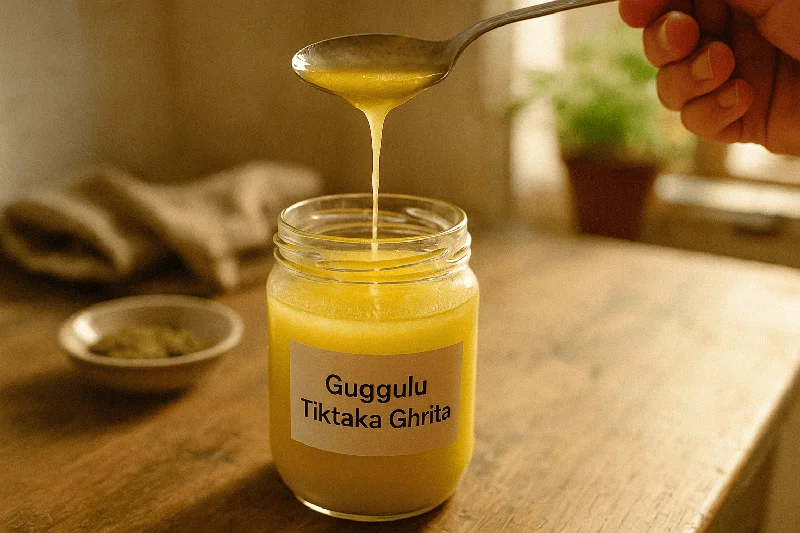
Guggulu Tiktaka Ghrita (also known as Guggulutiktakam Ghritam or Gulguluthikthaka Ghritham) is a classical Ayurvedic medicated ghee formulation used primarily for managing chronic joint disorders, inflammatory skin conditions, and deep-seated bone diseases. Referenced in the ancient text Ashtanga Hridayam (Chikitsa Sthana, Chapter 21) and listed in the Ayurvedic Formulary of India (AFI), this preparation combines the powerful resin of Guggulu (Commiphora mukul) with a group of bitter herbs (Tikta Dravyas) processed in clarified butter. The result is a lipid-soluble medicine that penetrates deep tissues — bones, joints, marrow, and skin — delivering anti-inflammatory, detoxifying, and regenerative compounds where they're needed most.
If you've been searching for a comprehensive guide that goes beyond surface-level information, this article covers everything: the full 20+ ingredient formula with exact proportions, classical preparation method, Panchakarma applications, comparison with similar ghritams, drug interactions, pediatric use, and the latest research evidence. Let's get into it.
What Is Guggulu Tiktaka Ghrita and Why Is It Important in Ayurveda?
Guggulu Tiktaka Ghrita belongs to the Sneha Kalpana (medicated fat preparations) category of Ayurvedic pharmacy.
The name itself tells you what's inside:
- Guggulu — the oleo-gum resin of Commiphora mukul, renowned for its anti-inflammatory guggulsterone compounds
- Tiktaka — meaning "bitter," referring to the group of bitter-tasting herbs that form the core herbal base
- Ghrita — clarified butter (ghee), which serves as the lipid carrier and enhances bioavailability of fat-soluble phytochemicals
In Ayurvedic theory, this formulation primarily pacifies Vata and Pitta doshas while also addressing aggravated Kapha in certain contexts. The classical reference is found in Ashtanga Hridayam by Vagbhata, where it is prescribed under Vatarakta Chikitsa (management of gouty arthritis) and Asthi-Majja Gata Vata (diseases affecting bones and marrow).
The Ayurvedic Principle Behind Its Action
The formulation works through two key Ayurvedic therapeutic strategies:
- Samana (pacification) — The bitter herbs and Guggulu directly pacify inflammatory Pitta and stagnant Kapha in joints and skin
- Shamana (disease alleviation) — Ghee as a carrier performs Yogavahi action, meaning it carries the medicinal properties deep into the Dhatus (tissues) without increasing its own Kapha-aggravating quality
This dual mechanism explains why a ghee-based preparation — which you might expect to be "heavy" — actually works effectively against inflammatory and metabolic disorders.
Classical Reference: The Original Shloka
The original Sanskrit verse from Ashtanga Hridayam, Chikitsa Sthana 21 describes the formulation context within Vatarakta management. Vagbhata lists it alongside other Tikta Ghrita formulations, emphasizing its use when Vata lodges in bones and blood, creating pain, swelling, and skin discoloration. The text specifically notes this ghrita's suitability for both internal consumption (Abhyantara Pana) and as a pre-procedure preparation for Panchakarma.
Alternative Names You May Encounter
Depending on the regional tradition and manufacturer, you'll see this formulation marketed under different names:
| Alternative Name | Region/Tradition |
|---|---|
| Guggulutiktakam Ghritam | Kerala Ayurveda tradition |
| Gulguluthikthaka Ghritham | South Indian transliteration |
| Panchatikta Guggulu Ghrita | North Indian variant (slightly different formula) |
| Guggulu Tikta Ghrtam | Simplified transliteration |
It's important to note that Panchatikta Guggulu Ghrita is sometimes used interchangeably, but there can be minor compositional differences depending on the text followed. We'll clarify this in the comparison section below.
Complete Ingredients of Guggulu Tiktaka Ghrita with Exact Proportions
One of the biggest gaps in existing resources online is the lack of a complete ingredient list. Most websites mention 3–5 herbs and stop there. The actual classical formulation contains over 20 herbal components. Here is the full formula based on Ashtanga Hridayam and the Ayurvedic Formulary of India:
Kashaya Dravyas (Decoction Herbs)
| Sanskrit Name | Botanical Name | Part Used | Proportion |
|---|---|---|---|
| Patola | Trichosanthes dioica | Leaf | 1 part |
| Nimba | Azadirachta indica | Stem bark | 1 part |
| Vasa | Adhatoda vasica | Leaf | 1 part |
| Guduchi (Amrutha) | Tinospora cordifolia | Stem | 1 part |
| Katukarohini (Katuka) | Picrorhiza kurroa | Rhizome | 1 part |
| Bhunimba (Kiratatikta) | Andrographis paniculata | Whole plant | 1 part |
| Sunthi | Zingiber officinale | Rhizome | 1 part |
| Maricha | Piper nigrum | Fruit | 1 part |
| Pippali | Piper longum | Fruit | 1 part |
| Musta | Cyperus rotundus | Tuber | 1 part |
| Haridra | Curcuma longa | Rhizome | 1 part |
| Daruharidra | Berberis aristata | Stem | 1 part |
| Rasna | Pluchea lanceolata | Root | 1 part |
| Manjistha | Rubia cordifolia | Root | 1 part |
| Chitraka | Plumbago zeylanica | Root | 1 part |
| Bhallataka | Semecarpus anacardium | Fruit (purified) | 1 part |
| Triphala (Haritaki, Bibhitaki, Amalaki) | Three fruits | Fruit | 1 part each |
| Guggulu | Commiphora mukul | Purified resin | 1 part |
Base and Processing Liquids
| Component | Quantity (per classical ratio) |
|---|---|
| Ghrita (Cow's ghee) | 1 part (e.g., 768 ml) |
| Kashaya (herbal decoction) | 4 parts (e.g., 3072 ml) |
| Kalka (herbal paste) | ¼ of ghee (e.g., 192 g) |
The kalka (fine paste) is made from the same group of herbs listed above. The kashaya is a water decoction of these herbs, reduced to one-quarter volume.
Pharmacological Profile of Key Ingredients
Understanding why each herb is included requires knowing its Ayurvedic pharmacological properties:
| Herb | Rasa (Taste) | Guna (Quality) | Virya (Potency) | Vipaka (Post-digestive) | Key Action |
|---|---|---|---|---|---|
| Guggulu | Tikta, Kashaya | Laghu, Ruksha | Ushna | Katu | Anti-inflammatory, lipid-regulating |
| Nimba | Tikta, Kashaya | Laghu, Ruksha | Sheeta | Katu | Blood purifier, antimicrobial |
| Guduchi | Tikta, Kashaya | Guru, Snigdha | Ushna | Madhura | Immunomodulator, anti-inflammatory |
| Manjistha | Tikta, Kashaya | Guru, Ruksha | Ushna | Katu | Blood cleanser, skin healing |
| Chitraka | Katu | Laghu, Ruksha | Ushna | Katu | Digestive stimulant, metabolic enhancer |
| Bhallataka | Tikta, Kashaya, Madhura | Laghu, Snigdha | Ushna | Madhura | Potent anti-arthritic, neuro-protective |
The predominance of Tikta Rasa (bitter taste) is deliberate — bitter taste in Ayurveda directly pacifies Pitta and Kapha, reduces inflammation, and purifies blood and skin tissues.
How to Prepare Guggulu Tiktaka Ghrita: Classical Sneha Paka Vidhi
No competitor has detailed the actual preparation method. Here's the step-by-step classical process following Sneha Paka Vidhi (medicated fat processing) from Sharangadhara Samhita:
Step 1: Prepare the Kashaya (Decoction)
Take the coarsely powdered kashaya dravyas (listed above). Add 16 parts water to 1 part herb. Boil and reduce to ¼ volume. Filter through clean cloth. This concentrated decoction is your liquid medium.
Step 2: Prepare the Kalka (Herbal Paste)
Take the same group of herbs in fine powder form. Add small amount of water and grind into a smooth, thick paste. The quantity of kalka should be ¼ the weight of ghee used.
Step 3: The Sneha Paka Process
- Place cow's ghee in a wide, heavy-bottomed vessel over moderate flame (Madhyama Agni)
- Add the kalka to melted ghee and stir continuously for a few minutes
- Slowly pour in the prepared kashaya
- Maintain cooking on moderate heat, stirring periodically
- The process continues until all water content evaporates
Step 4: Identify Siddhi Lakshanas (Signs of Completion)
This is the critical quality checkpoint that determines whether the ghrita is properly prepared:
- Varti Vat — The kalka, when rolled between fingers, forms a wick-like shape without sticking
- Shabda Abhava — No crackling or hissing sound when a drop of water is added (all moisture evaporated)
- Characteristic aroma — The ghrita develops a distinct herbal fragrance
- Color change — Ghee turns from pale yellow to a deeper brownish-green hue
- No froth — Surface is calm with no foam
Step 5: Filtration and Storage
Filter the finished ghrita through clean muslin cloth while still warm. Discard the residual kalka. Store in a clean, dry, airtight glass or food-grade container away from direct sunlight.
Typical preparation time: 6–12 hours depending on the quantity and heat control. Shelf life: Properly prepared medicated ghee improves with age — classically, it can last 16 months or longer when stored correctly. Some traditions hold that ghrita aged over one year (Purana Ghrita) has enhanced medicinal properties.
What Are the Primary Uses and Benefits of Guggulu Tiktaka Ghrita?
Joint Diseases and Rheumatic Conditions
This is the primary indication.
Guggulu Tiktaka Ghrita is classically prescribed for:
- Vatarakta (gouty arthritis) — the hallmark indication from Ashtanga Hridayam
- Sandhivata (osteoarthritis) — degenerative joint conditions
- Amavata (rheumatoid arthritis) — autoimmune inflammatory joint disease
- Asthi-Kshaya (bone tissue depletion/osteoporosis)
- Asthi-Majja Gata Vata — when Vata lodges in bones and marrow, causing deep pain
The mechanism involves guggulsterones inhibiting the NF-κB inflammatory pathway, which reduces production of pro-inflammatory cytokines like TNF-α and IL-6. The ghee base allows these compounds to penetrate Asthi Dhatu (bone tissue) and Majja Dhatu (marrow) effectively.
Chronic Skin Diseases
The bitter herbs in this formulation make it exceptionally effective for:
- Psoriasis (Kitibha Kushtha) — chronic, scaly, inflammatory skin lesions
- Eczema (Vicharchika) — itchy, weeping dermatitis
- Chronic non-healing ulcers/wounds — where tissue regeneration is impaired
- Dermatitis — contact and atopic varieties
How Does It Work for Skin Issues?
The Tikta Rasa herbs purify Rakta Dhatu (blood tissue), while Guggulu's anti-inflammatory action reduces the underlying inflammatory cascade. Ghee itself is a renowned skin-nourishing base that supports healthy cell membranes. Nimba and Manjistha specifically target blood-borne skin toxins.
Can Guggulu Tiktaka Ghrita Help with Weight Management?
Yes, though it's not the primary indication. The formulation supports weight management through several pathways:
- Guggulsterones enhance thyroid function by stimulating thyroid peroxidase activity, increasing T3 and T4 levels
- Chitraka and Trikatu (Sunthi, Maricha, Pippali) boost Agni (metabolic fire) and accelerate lipid metabolism
- A 2022 study published in the Journal of Ayurveda and Integrative Medicine (PMC9250015) demonstrated that Guggulu Tiktaka Ghrita significantly reduced total cholesterol, LDL, triglycerides, and blood glucose levels in Wistar rats fed a high-fat diet
Cardiovascular and Metabolic Support
The same 2022 study on Wistar rats showed some remarkable findings:
- Reduced VCAM-1 levels — Vascular Cell Adhesion Molecule-1 is a key marker in atherosclerosis development. Lower VCAM-1 means reduced adhesion of inflammatory cells to blood vessel walls
- Decreased foam cell formation — Foam cells are lipid-laden macrophages that form the core of arterial plaques
- Improved liver histopathology — Reduced fatty deposition in liver tissue
- Improved cardiac histopathology — Less inflammation in heart tissue
These findings are significant because they provide preliminary scientific evidence for what Ayurvedic practitioners have observed clinically for centuries — that this formulation benefits the entire cardiovascular-metabolic axis, not just joints and skin.
Detoxification and Liver Support
The bitter herbs, particularly Katuka, Nimba, and Bhunimba, are known hepatoprotectives. They enhance Phase I and Phase II liver detoxification enzymes, supporting the body's natural elimination of metabolic toxins (Ama in Ayurvedic terminology).
How to Take Guggulu Tiktaka Ghrita: Dosage and Administration
Standard Dosage Guidelines
| Form | Adult Dose | Frequency | Anupana (Vehicle) |
|---|---|---|---|
| Classical Ghrita (semi-solid ghee) | 5–10 grams (approx. 1–2 teaspoons) | 1–2 times daily | Warm water or warm milk |
| Capsule form (soft gel) | 1–2 capsules (typically 500 mg each) | 2–3 times daily | Warm water |
Best time to take: Early morning on empty stomach (before food) for maximum absorption. A second dose, if prescribed, can be taken before dinner.
How to Use Gulguluthikthakam Ghrutham in Practice
- Measure the prescribed quantity of ghrita
- If the ghee has solidified, place the container in warm water to soften (do not microwave)
- Take with warm water or warm milk — the warmth aids absorption and enhances the Vata-pacifying effect
- Wait at least 30 minutes before eating
- Follow the dietary guidelines your practitioner specifies
Dosage for Children (Pediatric Use)
Pediatric dosing is rarely discussed online, yet this formulation can be used in children under medical supervision:
| Age Group | Dose |
|---|---|
| 5–12 years | 1–3 grams (¼ to ½ teaspoon), once daily |
| 12–16 years | 3–5 grams (½ to 1 teaspoon), once daily |
| Below 5 years | Generally not recommended without specialist guidance |
Important: Always consult a qualified Ayurvedic physician before giving medicated ghee to children. The dose depends on the child's Agni (digestive capacity) and Koshtha (bowel habit).
Capsule Form vs. Traditional Ghee Format
Modern manufacturers like AVP (Arya Vaidya Pharmacy) and Kottakkal Arya Vaidya Sala offer Guggulu Tiktaka Ghrita in soft-gel capsule form. Some products like AVP's version undergo a 7-fold enrichment process (Saptavarti — seven times processing), which is said to increase potency.
Capsule advantages:
- Convenient for travel and office use
- No bitter taste
- Pre-measured dosage
- Longer shelf life
Traditional ghee advantages:
- Can be used for both internal and external application
- Better suited for Snehapana (therapeutic oleation in Panchakarma)
- Direct absorption through oral mucosa begins immediately
- Allows flexible dosage adjustment
Don't wait or self medicate. Start chat with Doctor NOW
Guggulu Tiktaka Ghrita in Panchakarma Therapy
This is a significant clinical application that competitors have completely missed. Guggulu Tiktaka Ghrita is extensively used as a Purvakarma (preparatory procedure) medicine for Panchakarma, specifically for Snehapana (internal oleation) before Virechana (therapeutic purgation).
The Snehapana Protocol
During Snehapana, the ghrita is administered in escalating doses over 3–7 days to saturate body tissues with medicated ghee:
| Day | Approximate Dose | Observation |
|---|---|---|
| Day 1 | 30 ml | Assess digestion time |
| Day 2 | 60 ml | Monitor appetite return |
| Day 3 | 90 ml | Check for oleation signs |
| Day 4 | 120 ml | Snigdha Lakshanas appearing |
| Day 5 | 150 ml | Often sufficient for many patients |
| Day 6–7 | 180–210 ml | Only if Samyak Snigdha signs not yet achieved |
Signs of adequate oleation (Samyak Snigdha Lakshanas):
- Soft, oily stools
- Aversion to ghee
- Feeling of lightness in the body
- Smooth, soft skin
After achieving adequate oleation, the patient undergoes Abhyanga (oil massage) and Swedana (steam therapy), followed by Virechana on the designated day. This complete protocol is especially effective for chronic psoriasis, gouty arthritis, and deep-seated Vata-Rakta conditions.
Diet During Panchakarma (Pathya-Apathya)
Recommended Foods (Pathya):
- Light rice gruel (Peya), thin rice soup (Manda)
- Warm water throughout the day
- Light, easily digestible meals after Snehapana digests
- Green gram (Mudga) soup
Foods to Avoid (Apathya):
- Cold food and beverages
- Heavy, fried, or oily foods (paradoxically, you avoid external oils while doing internal oleation)
- Sour, fermented foods
- Vigorous exercise, daytime sleep, cold exposure
Guggulu Tiktaka Ghrita vs. Other Tikta Ghrita Formulations
This comparison has never been properly done by any competitor.
Here's a clear breakdown:
| Parameter | Guggulu Tiktaka Ghrita | Mahatiktaka Ghrita | Tiktaka Ghrita | Panchatikta Ghrita Guggulu |
|---|---|---|---|---|
| Classical Source | Ashtanga Hridayam | Ashtanga Hridayam | Ashtanga Hridayam | Bhaishajya Ratnavali |
| Key Differentiator | Contains Guggulu + Trikatu | Largest formula (40+ herbs), contains Draksha | Simplest Tikta Ghrita, no Guggulu | Contains 5 bitter herbs + Guggulu |
| No. of Ingredients | 20+ | 40+ | 10–15 | ~10 |
| Primary Focus | Joints + Skin + Bones | Skin diseases (especially Kushtha) | General Pitta-Kapha disorders | Joints and bones primarily |
| Panchakarma Use | Snehapana for Vatarakta | Snehapana for Kushtha | Snehapana for Pitta conditions | Oral supplement (rarely for Snehapana) |
| Available Forms | Ghee, Capsule | Ghee | Ghee | Ghee, Tablets |
| Best For | Gouty arthritis, psoriasis, bone diseases | Chronic skin diseases, non-healing wounds | Pitta-type inflammatory conditions | Osteoarthritis, fracture healing |
Key takeaway: If your concern is primarily joint-related with a skin component, Guggulu Tiktaka Ghrita is likely the best choice. For purely dermatological conditions, Mahatiktaka Ghrita might be more appropriate. Panchatikta Ghrita Guggulu is the simpler, more accessible option often available in tablet form.
Side Effects, Contraindications, and Drug Interactions
Known Side Effects
Guggulu Tiktaka Ghrita is generally well-tolerated when taken at prescribed doses.
However, possible side effects include:
- Mild nausea or loss of appetite (especially initially, due to bitter taste)
- Loose stools in people with sensitive digestion
- Heaviness in abdomen if Agni (digestive fire) is weak
- Rare: allergic reactions in individuals sensitive to Guggulu or Bhallataka
Contraindications
- Pregnancy — Guggulu is considered potentially uterotonic; avoid without expert guidance
- Lactation — Safety not established; use only under medical supervision
- Severe hypercholesterolemia on statins — Potential interaction (see below)
- Ama condition (heavy coating on tongue, low appetite, sluggish digestion) — Ghee preparations can worsen Ama; treat Ama first
- Kapha Prakriti with active congestion — Ghee may increase congestion in some individuals
Interactions with Allopathic Medications
This is a critical gap that no competitor has addressed:
| Medication Class | Potential Interaction | Recommendation |
|---|---|---|
| Statins (Atorvastatin, Rosuvastatin) | Guggulsterones may have additive lipid-lowering effects; risk of excessive LDL reduction | Monitor lipid levels; inform both doctors |
| NSAIDs (Ibuprofen, Diclofenac) | Additive anti-inflammatory effects; possible increased GI sensitivity | Can often reduce NSAID dose gradually under supervision |
| Antidiabetic drugs (Metformin, Glimepiride) | GTG showed hypoglycemic activity in animal studies; risk of additive blood sugar reduction | Monitor blood glucose more frequently |
| Thyroid medications (Levothyroxine) | Guggulsterones may stimulate thyroid function | Monitor TSH levels; dose adjustment may be needed |
| Anticoagulants (Warfarin) | Some ingredients may have mild antiplatelet activity | Use with caution; monitor INR |
Important note: These interactions are based on pharmacological reasoning and animal study data. No large-scale human interaction studies exist. Always disclose all medications to both your Ayurvedic and allopathic practitioners.
Quality Standards, Certification, and Storage
How to Identify Quality GTG
When purchasing, look for:
- Compliance with API/AFI standards — Ayurvedic Pharmacopoeia of India provides quality specifications
- GMP certification — Mandatory for licensed Ayurvedic manufacturers in India
- Batch testing parameters: Acid value, saponification value, refractive index, heavy metal limits (lead, mercury, arsenic should be within permissible limits)
Storage Guidelines
- Store in a cool, dry place away from direct sunlight
- Airtight glass containers are ideal — avoid plastic for long-term storage
- Shelf life is typically 2–3 years from manufacture (check label), though classically ghrita improves with age
- If the ghrita develops an unusual rancid smell or visible mold, discard it
Frequently Asked Questions
Is Guggulu Tiktaka Ghrita safe for long-term use?
- Yes, when taken under the guidance of a qualified Ayurvedic physician, this formulation can be used for extended periods (3–6 months or longer) for chronic conditions. However, periodic assessment of liver function and lipid profiles is advisable, especially if you're on concurrent allopathic medication.
- Classical Ayurveda recommends "Kala Parimanam" — time-bound courses with breaks.
What is the classical textual reference for this formulation?
The primary reference is Ashtanga Hridayam, Chikitsa Sthana, Chapter 21 (Vatarakta Chikitsa) by Acharya Vagbhata. It's also referenced in Sahasrayogam, a compilation text popular in Kerala Ayurveda tradition. The formulation is listed in the Ayurvedic Formulary of India (AFI), Part I.
Can I take this if I have diabetes or high cholesterol alongside joint pain?
This is actually a scenario where GTG may be particularly beneficial, given its demonstrated anti-hyperglycemic and anti-hyperlipidemic effects in the 2022 Wistar rat study. However, you must coordinate with both your Ayurvedic and allopathic doctors to adjust dosages of conventional medications as needed. Self-medication is not recommended.
Are there any human clinical trials on Guggulu Tiktaka Ghrita?
As of 2025, published clinical trials on humans specifically for Guggulu Tiktaka Ghrita are limited. The most robust preclinical evidence comes from the 2022 study (PMC9250015) using Wistar rats on a high-fat diet. Several small observational studies and case reports exist in Indian Ayurvedic journals, but large-scale randomized controlled trials are still needed. This is a recognized research gap in the field.
What is nanoencapsulation of GTG and why does it matter?
Recent research (published through NISCPR) has explored nanoencapsulation of Guggulu Tiktaka Ghrita — a technique where the medicated ghee is packaged into nano-sized particles to enhance bioavailability and targeted delivery. This represents a fascinating bridge between traditional Ayurveda and modern pharmaceutical technology, though it remains in the experimental stage.
Can it be used externally?
Yes. In clinical practice, Guggulu Tiktaka Ghrita is sometimes applied externally over inflamed joints or chronic skin lesions, either alone or as part of a Panchakarma protocol. For external use, warm the ghrita slightly and apply a thin layer over the affected area. However, the primary route of administration remains internal.
Conclusion: Making the Most of Guggulu Tiktaka Ghrita
Guggulu Tiktaka Ghrita stands as one of the most versatile and powerful medicated ghee formulations in the Ayurvedic pharmacopoeia. Its unique combination of Guggulu resin, bitter herbs, and ghee creates a synergistic medicine that addresses the root causes of joint degeneration, skin inflammation, metabolic imbalance, and cardiovascular risk — not just the symptoms.
Whether you're considering it for chronic arthritis, stubborn psoriasis, or as part of a comprehensive Panchakarma protocol, the key is working with a qualified Ayurvedic practitioner who can assess your Prakriti, Vikriti, and Agni status before prescribing the right dose and duration.
Your next step: Consult a certified Ayurvedic doctor to determine whether Guggulu Tiktaka Ghrita is appropriate for your specific condition, and to get a personalized dosage plan tailored to your constitution and health goals.
Scientific Sources
- A review of whole-medical systems and holistic care approach for type 2 diabetes and associated metabolic syndrome — Makoni L et al., 2024, Journal of integrative medicine
- Mapping the Mind-Body Connections: A Two-decade Bibliometric Exploration of Yoga and Psychoneuroimmunology — Dhanasekar H et al., 2026, Annals of neurosciences
- Integrative approach combining Ayurveda, counselling, Yoga and meditation with conventional management of Ankylosing Spondylitis - A case report — Sushma NS et al., 2022, Journal of Ayurveda and integrative medicine
- Intermittent Fasting and Vitamin E Supplementation Attenuates Hypothyroidism-Associated Ophthalmopathy — Kumar N et al., 2024, Molecular nutrition & food research
- Comparative analysis of traditional and modern epigenetic therapies for diabetes associated cognitive decline — Meher R et al., 2026, Computational biology and chemistry
- A century of 'The science of yoga' (1921-2021): Revival, renewal and renaissance — Vaidya ADB et al., 2023, Journal of Ayurveda and integrative medicine
- Emblica officinalis (Amla): A review for its phytochemistry, ethnomedicinal uses and medicinal potentials with respect to molecular mechanisms — Variya BC et al., 2016, Pharmacological research
- Perspectives and dietary management of excess weight in polycystic ovary syndrome: A focus group study with clinicians of traditional Indian medicine — Rao VS et al., 2025, Integrative medicine research
- Benefits of antioxidant supplements for knee osteoarthritis: rationale and reality — Grover AK et al., 2016, Nutrition journal
- Green jackfruit flour ameliorates MASH and development of HCC via the AMPK and MAPK signaling pathways in experimental model systems — Suresh D et al., 2025, Scientific reports
- Use of Ayurveda in the Treatment of Type 2 Diabetes Mellitus — Gordon A et al., 2019, Global advances in health and medicine
- Indigenous drugs and atherosclerosis — Udupa SL, 2001, Drugs of today (Barcelona, Spain : 1998)
- Ayurveda — Fleischman PR, 1976, The International journal of social psychiatry
- A comprehensive yoga programme for weight reduction in children & adolescents with obesity: A randomized controlled trial — Jain V et al., 2022, The Indian journal of medical research
- Knowledge, attitude and practices of ayurvedic medicine practitioners in Kerala towards millets and millet-based diet: a prospective cross-sectional online survey study — Chettiyam Kandy S et al., 2024, BMJ nutrition, prevention & health
- Effect of dietary, social, and lifestyle determinants of accelerated aging and its common clinical presentation: A survey study — Samarakoon SM et al., 2011, Ayu
- Integrative therapeutics for ocular surface disorders — Kourosh A et al., 2024, Current opinion in allergy and clinical immunology
- Some excerpts from Charaka Samhita - An ancient treatise on Ayurveda & healthy living — Katiyar CK et al., 2017, Journal of ethnopharmacology
- Ayurvedic management of female infertility due to tubal blockage — Otta SP et al., 2021, Journal of complementary & integrative medicine
- Ayurvedic medicine. Core concept, therapeutic principles, and current relevance — Chopra A et al., 2002, The Medical clinics of North America
Questions from users
What conditions can Guggulu Tiktaka Ghrita treat effectively?
Client_044adf
2 days ago
Guggulu Tiktaka Ghrita is traditionally used in treating gouty arthritis, psoriasis, and various bone diseases. It's primarily aimed at conditions that involve joint issues with a skin component. This Ayurvedic preparation is usually consumed in the form of ghee or tablets. Though traditional use suggests benefits for these conditions, empirical evidence is limited. Generally, you should expect several weeks to see effects and watch for any digestive concerns. Consult a healthcare provider for persistent or severe cases, especially if combining with other treatments.
What are the key herbal ingredients in Guggulu Tiktaka Ghrita?
Client_b60400
7 days ago
Guggulu Tiktaka Ghrita is a traditional Ayurvedic formulation mentioned in "Ashtanga Hridayam," primarily used to support joint health and manage inflammatory conditions. Its key herbal ingredients typically include guggulu (Commiphora mukul), tikta dravyas like neem (Azadirachta indica), and other herbs such as guduchi (Tinospora cordifolia) and katuki (Picrorhiza kurroa). This medicated ghee is grounded in an extensive classical Ayurvedic preparation process involving the careful blending of these herbs. It is important to consult a healthcare provider before using this formulation, especially if you are taking other medications, to monitor any potential effects on liver function and lipid levels.
How long does it take to see results from Guggulu Tiktaka Ghrita?
Client_114a00
12 days ago
The time it takes to see results from Guggulu Tiktaka Ghrita can vary based on the individual and the condition being treated. Typically, people might start noticing changes within a few weeks to a few months, depending on the consistency of use and the particular health issue. It's primarily used for dermatological and detoxification purposes, enhancing liver function. If you're combining it with conventional medications, consult both Ayurvedic and allopathic healthcare providers to ensure safety and proper adjustments. If no improvements are seen after a reasonable period, or if adverse effects occur, it's important to consult a doctor.
Can Guggulu Tiktaka Ghrita support weight loss efforts?
Client_57f764
17 days ago
Guggulu Tiktaka Ghrita is traditionally used in Ayurveda to support joint health and metabolic issues, rather than directly for weight loss. While some ingredients may have properties that support metabolism, there is no robust scientific evidence linking Guggulu Tiktaka Ghrita specifically to weight loss. To support weight loss efforts effectively, a combination of a balanced diet, regular physical activity, and medical guidance is recommended. Before starting any supplement, especially if you have diabetes or high cholesterol, consult a healthcare provider to avoid potential interactions with medications or health conditions.
How does Guggulu Tiktaka Ghrita help with joint health?
Client_40a5bb
27 days ago
Guggulu Tiktaka Ghrita is an Ayurvedic formulation used to support joint health by targeting inflammation and detoxifying tissues. It combines the anti-inflammatory properties of Guggulu (Commiphora mukul) with bitter herbs, processed in ghee, believed to help balance Vata imbalances often associated with joint pain. Nanoencapsulation technology is enhancing its effectiveness by improving absorption and targeting delivery to affected areas. For noticeable effects, it might require consistent use over several weeks, alongside dietary and lifestyle modifications. Consult a healthcare provider before starting any new supplement, especially if you have existing medical conditions or are taking other medications.
What are the potential side effects of Guggulu Tiktaka Ghrita?
Client_ab800c
37 days ago
Guggulu Tiktaka Ghrita, an Ayurvedic formulation, can potentially cause side effects such as digestive issues, especially if consumed in excessive amounts. It is crucial to monitor liver function and lipid profiles during its use, particularly if taking it alongside allopathic medicines. Due to its lipid content, diarrhea or gastrointestinal discomfort may occur in some individuals. If new symptoms arise or existing ones worsen, discontinue use and consult a healthcare professional. Always seek medical advice to tailor treatments to your health needs.
How does nanoencapsulation improve the effectiveness of Guggulu Tiktaka Ghrita?
Client_f82e60
47 days ago
Nanoencapsulation improves the effectiveness of Guggulu Tiktaka Ghrita by enhancing its bioavailability and enabling targeted delivery. By packaging the medicated ghee into nano-sized particles, the body can absorb it more efficiently, potentially increasing the therapeutic benefits. This technique can help ensure that the active compounds reach specific sites more effectively, possibly leading to better outcomes in managing inflammation and pain. However, the use of nanoencapsulation in GTG is still experimental, and more research is needed to verify its efficacy and safety. If you are considering using Guggulu Tiktaka Ghrita, especially for medical purposes, consult a healthcare professional for advice tailored to your situation.
What are the traditional uses of Guggulu Tiktaka Ghrita in Ayurveda?
Client_de3d6a
56 days ago
Guggulu Tiktaka Ghrita is traditionally used in Ayurveda to manage chronic joint disorders, inflammatory skin conditions, and deep-seated bone diseases. This medicated ghee formulation is valued for its potential to balance Vata when it affects bones and blood, leading to symptoms like pain, swelling, and skin discoloration. While it is used in practice, large-scale human clinical trials specifically for this formulation are limited. If symptoms persist or worsen, it is vital to consult a healthcare professional for proper diagnosis and treatment. Avoid self-medication and seek guidance from a qualified Ayurvedic practitioner.
Can Guggulu Tiktaka Ghrita be used for treating skin allergies or irritations?
Client_1593d5
66 days ago
Yep, Guggulu Tiktaka Ghrita can be used for skin issues like allergies or irritations! It works because of its blood-purifying properties from herbs like Nimba and Manjistha—great for detoxing skin issues. While it's traditionally for Vata-related issues, it can help soothe skin discomfort. Always consult a practitioner to consider your dosha and skin type, though!
What is the process for making Guggulu Tiktaka Ghrita at home?
Client_1c9545
75 days ago
Making Guggulu Tiktaka Ghrita at home involves two main steps. In step 1, prepare a decoction by boiling those coarsely powdered herbs, then reducing it to a quarter of its original volume. In step 2, make kalka by taking the same herbs, but in a fine powder form, adding water. Gradually mix these with ghee and gently cook till it's ready. It's quite a process but manageable with care! Just ensure you maintain the right proportions and temperatures.
Related articles
Gastrointestinal Disorders
Mandur Powder: An Ayurvedic Remedy for Overall Health and Wellness
Mandur Powder is a calcined form of iron oxide that undergoes a meticulous purification process as per Ayurvedic methods. It is combined with herbal ingredients to enhance its therapeutic properties.
2,784
Gastrointestinal Disorders
Gandharva Haritaki Tablet Uses: An Ayurvedic Remedy for Holistic Health
Gandharva Haritaki is an herbal preparation widely used in Ayurveda to support digestive health, detoxification, and vitality.
4,745

Gastrointestinal Disorders
Is Papaya Good for Loose Motion? Ayurvedic View and Practical Advice
Exploration of Papaya: A Gentle Remedy for Managing Loose Motion
17,253

Gastrointestinal Disorders
Does Cold Milk Reduce Acidity? Ayurvedic Explanation and Uses
Explore if cold milk reduces acidity, its benefits at night, how and when to drink it. Learn if cold milk is good for acidity relief according to Ayurveda
14,641

Gastrointestinal Disorders
Madiphala Rasayanam – Uses, Dose, Ingredients, Side Effects
Exploration of Madiphala Rasayanam – Uses, Dose, Ingredients, Side Effects
4,246

Gastrointestinal Disorders
Punarnavashtak Kwath Churna: Benefits, Dosage & Scientific Insights
Explore the benefits, proper dosage, uses, and scientific research behind Punarnavashtak Kwath Churna, a potent Ayurvedic herbal formulation.
5,487

Gastrointestinal Disorders
Amritarishta – Uses, Ingredients, Dose and Side Effects
Exploration of Amritarishta – Uses, Ingredients, Dose and Side Effects
4,040

Gastrointestinal Disorders
Effective Ayurvedic Treatment for BPH: Natural Remedies and Solutions
Discover effective ayurvedic treatment for BPH methods, natural remedies, and holistic approaches to manage benign prostatic hyperplasia using ancient wisdom.
4,103
Gastrointestinal Disorders
Laghu Sutshekhar Ras Uses: A Comprehensive Guide
Discover the practical, research-backed uses of Laghu Sutshekhar Ras in digestive health, acidity management, and more. Learn key benefits and safety tips here.
5,629

Gastrointestinal Disorders
How to Heal a Fistula Without Surgery: Ayurvedic Methods and Recovery
Learn how to heal a fistula without surgery using Ayurvedic remedies, herbal treatments, and lifestyle changes. Discover safe and natural ways to support recovery
6,672
Related consultations on the topic
Legal
Additional Documents
© 2024 Ask Ayurveda. All rights reserved.