Bilwadi Taila: Traditional Uses and Benefits for Digestive Health
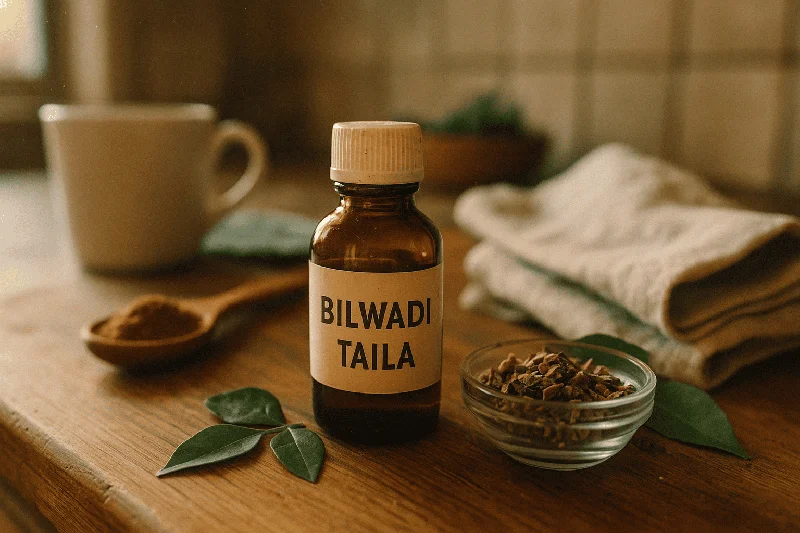
Bilwadi Taila is a classical Ayurvedic medicated oil formulated primarily for ear disorders — including deafness (Badhirya), tinnitus (Karnanada), and suppurative ear conditions (Putikarna). Prepared using Aegle marmelos (Bilva) as the principal herb along with sesame oil, goat milk, cow urine, and water through the traditional Taila Paka Vidhi process, this formulation has been referenced in ancient Ayurvedic texts like the Bhaishajya Ratnavali. Unlike many modern ear drops, Bilwadi Taila works through a holistic mechanism — balancing Vata and Kapha doshas in the ear canal while providing anti-inflammatory, antimicrobial, and nourishing effects to the delicate structures of the ear.
If you've been searching for a reliable natural remedy for chronic ear problems or want to understand this formulation in depth before using it, this guide covers everything — from the classical Sanskrit references and detailed ingredient pharmacology to the step-by-step preparation method, proper Karna Purana technique, and scientific evidence supporting its use.
What Is Bilwadi Taila and What Is It Used For?
Bilwadi Taila (also spelled Bilwadi Tail or Bilvadi Taila) is a medicated oil preparation classified under "Taila Kalpana" in Ayurvedic pharmacy. The word "Bilwadi" derives from "Bilwa" (Aegle marmelos, commonly known as Bael) and "Adi" meaning "and others," indicating that Bilva is the chief ingredient among several components.
This formulation is primarily indicated for Karna Roga (ear diseases) in Ayurvedic practice.
Its main therapeutic uses include:
- Badhirya — Hearing loss or deafness
- Karnanada — Tinnitus or ringing in the ears
- Putikarna — Suppurative otitis or discharging ear
- Karnashula — Ear pain
- Karna Kandu — Itching in the ear canal
The oil is administered through Karna Purana — the Ayurvedic procedure of instilling warm medicated oil into the ear canal — or simply used as ear drops.
Bilwadi Taila vs Bilva Taila: Clearing the Confusion
One common source of confusion online is the interchange between "Bilwadi Taila" and "Bilva Taila." These are not the same formulation, though they share overlapping ingredients.
Bilva Taila typically refers to any oil preparation where Bilva is the sole or dominant herb, often used for broader purposes including scalp application and general Vata disorders. Bilwadi Taila, on the other hand, is a specific classical compound formulation with multiple ingredients (Bilva, sesame oil, goat milk, cow urine, water) prepared in fixed ratios as described in classical texts. The "adi" suffix signals a multi-ingredient formula with Bilva as the lead component.
When purchasing, always check the full ingredient list and the classical reference cited on the label to ensure you're getting the correct formulation.
Composition and Ingredients of Bilwadi Taila
The formulation of Bilwadi Taila follows precise proportions as described in Ayurvedic classical literature.
Below is the detailed composition:
| Ingredient | Sanskrit/Hindi Name | Latin Name | Proportion |
|---|---|---|---|
| Sesame Oil | Tila Taila | Sesamum indicum | 100% (base oil) |
| Bael Leaves/Root | Bilva | Aegle marmelos | 25% |
| Cow Urine | Gomutra | — | 25% |
| Goat Milk | Aja Ksheera | — | 400% |
| Water | Jala | — | 400% |
Note: Proportions are relative to the base oil quantity. For example, if 100 ml of sesame oil is used, 25 ml of Bilva paste, 25 ml of cow urine, 400 ml of goat milk, and 400 ml of water are required.
Detailed Pharmacology of Each Ingredient
Understanding the individual pharmacological profiles of each ingredient reveals why this specific combination is so effective for ear disorders.
Aegle Marmelos (Bilva)
Bilva is the star ingredient.
In Ayurvedic pharmacology:
- Rasa (Taste): Kashaya (Astringent), Tikta (Bitter)
- Guna (Properties): Laghu (Light), Ruksha (Dry)
- Veerya (Potency): Ushna (Hot)
- Vipaka (Post-digestive effect): Katu (Pungent)
- Karma (Action): Vata-Kapha Shamaka (pacifies Vata and Kapha), Shothahara (anti-inflammatory), Vedanasthapana (analgesic), Krimighna (antimicrobial)
A 2016 study published in the Journal of Ethnopharmacology confirmed that Aegle marmelos leaf extracts exhibit significant antimicrobial activity against common ear pathogens including Staphylococcus aureus and Pseudomonas aeruginosa — the two bacteria most frequently responsible for otitis externa and chronic suppurative otitis media (Rana et al., 2016).
Sesamum Indicum (Tila Taila — Sesame Oil)
Sesame oil serves as the base (Sneha Dravya) and is considered the best oil for Vata disorders in Ayurveda.
- Rasa: Madhura (Sweet), Tikta (Bitter), Kashaya (Astringent)
- Guna: Guru (Heavy), Snigdha (Unctuous), Sukshma (Subtle/Penetrating)
- Veerya: Ushna (Hot)
- Vipaka: Madhura (Sweet)
The Sukshma (subtle, penetrating) quality of sesame oil is particularly important — it allows the medicated oil to penetrate deep into the narrow ear canal and reach the Tympanic membrane. Research published in the Journal of Clinical and Diagnostic Research (2015) demonstrated that sesame oil possesses inherent anti-inflammatory properties due to its sesamol and sesamin content, which inhibit NF-κB inflammatory pathways.
Goat Milk (Aja Ksheera)
- Goat milk is considered Laghu (light) and easy to assimilate in Ayurvedic texts. When used in Taila preparation, it acts as a liquid medium (Drava Dravya) that helps extract water-soluble active compounds from Bilva.
- It also imparts a cooling, soothing quality to the final oil — important for conditions involving inflammation or burning sensations in the ear.
Cow Urine (Gomutra)
Though it may seem unconventional, Gomutra has been used in Ayurvedic pharmacy for centuries as a bio-enhancer and antimicrobial agent. A 2017 study in the Asian Journal of Pharmaceutical and Clinical Research found that cow urine distillate enhances the bioavailability of active compounds and exhibits antibacterial properties. In this formulation, it serves as both a Shodhana (purifying) agent and a medium for extracting alkaloid compounds from Bilva.
Classical Reference and Shloka (Sanskrit Verse)
Bilwadi Taila finds its primary reference in the Bhaishajya Ratnavali, one of the most important Ayurvedic formularies compiled by Govinda Dasji in the 18th century. The formulation is described under the Karnaroga Chikitsa (Treatment of Ear Diseases) chapter.
The original Sanskrit shloka reads:
> बिल्वादि तैलं कर्णरोगहरं |
> बिल्वस्य मूलं तिलतैलयुक्तं ||
> गोमूत्रम् अजक्षीरं च जलेन सह |
> पक्त्वा विधानेन कर्णे प्रयोज्यम् ||
(Approximate transliteration: Bilwadi Tailam Karnarogaharam | Bilvasya Moolam Tilataila Yuktam || Gomutram Ajakshiram Cha Jalena Saha | Paktva Vidhanena Karne Prayojyam ||) Translation: "Bilwadi Taila, which destroys ear diseases, is prepared by cooking the root of Bilva with sesame oil, cow urine, goat milk, and water according to the prescribed method, and is to be applied in the ear."
Mentions Across Different Classical Texts
While the Bhaishajya Ratnavali provides the most commonly referenced version, variations of Bilva-based ear oil formulations also appear in:
- Chakradatta — Mentions Bilva-based oils for Karna Shula (ear pain)
- Sharangdhara Samhita — Describes the general Taila Paka Vidhi (oil preparation methodology) used for formulations like Bilwadi Taila
- Sushruta Samhita — Discusses Karna Purana therapy extensively and mentions Bilva among herbs suitable for ear treatments in Uttara Tantra
The slight variations across texts mainly concern the proportions or the inclusion of additional herbs, but the core principle — Bilva medicated in sesame oil with milk and Gomutra processing — remains consistent.
How Bilwadi Taila Is Prepared: The Complete Taila Paka Vidhi
This is something no other resource online covers in detail, yet it's critical for practitioners and serious students of Ayurveda. The preparation follows the classical Taila Paka Vidhi (oil cooking method) as described in Sharangdhara Samhita.
Step 1: Preparation of Kalka (Herbal Paste)
Fresh or dried Bilva root bark is taken and ground into a fine paste (Kalka) using a stone mortar and pestle. The quantity of Kalka should be 1/4th of the base oil (for 100 ml oil, 25 grams of Kalka).
Step 2: Preparation of Drava Dravya (Liquid Media)
The liquid components are measured:
- Goat milk — 4 times the oil quantity (400 ml per 100 ml oil)
- Water — 4 times the oil quantity (400 ml per 100 ml oil)
- Cow urine — 1/4th of the oil quantity (25 ml per 100 ml oil)
These are mixed together to form the combined liquid medium.
Step 3: Murchhana of Taila (Pre-processing of Base Oil)
Before cooking, the sesame oil undergoes Murchhana — a pre-treatment process where the oil is heated with small amounts of acidic and aromatic substances (like Haridra, Musta, Manjishtha) to remove raw odor, improve shelf life, and enhance the oil's capacity to absorb herbal constituents. This step is often skipped in commercial preparations, but it makes a significant difference in the final product's efficacy.
Step 4: Paka (Cooking Process)
The actual cooking follows these stages:
- 1.Manda Agni (Low heat): Sesame oil is placed in a wide-mouthed stainless steel or iron vessel and heated gently
- 2.Kalka Addition: The Bilva paste is added to the warm oil and stirred continuously
- 3.Drava Dravya Addition: The combined liquid medium (goat milk + water + cow urine) is added slowly
- 4.Continuous Stirring: The mixture is cooked on low to medium heat with constant stirring to prevent sticking and burning
- 5.Sneha Siddhi Lakshana (Signs of completion): The oil is ready when:
- The Kalka becomes wick-like and can be rolled between fingers without sticking
- No crackling sound is heard when a drop of water is sprinkled on the oil
- The characteristic aroma of cooked herbal oil develops
- All moisture has completely evaporated
Step 5: Filtration and Storage
The finished oil is filtered through a clean muslin cloth while still warm. It is stored in amber glass bottles away from direct sunlight. When prepared and stored properly, Bilwadi Taila has a shelf life of approximately 18–24 months.
How to Use Bilwadi Taila: Dosage and Karna Purana Technique
Standard Dosage
- The generally recommended dosage is 5 to 10 drops instilled into the affected ear, once or twice daily, or as directed by a qualified Ayurvedic practitioner.
- The oil should always be used lukewarm — never cold or excessively hot.
Complete Karna Purana Procedure (Step-by-Step)
- Karna Purana is the classical Ayurvedic procedure for administering medicated oil into the ears.
- Here's how to perform it properly at home:
Preparation
- Warm the Bilwadi Taila by placing the bottle in a bowl of hot water for 3–5 minutes.
- Test the temperature on your inner wrist — it should feel comfortably warm, approximately body temperature (37°C/98.6°F)
- Have a clean dropper, cotton balls, and a small towel ready
- Choose a quiet, warm room free from drafts
Application Process
- Lie down on your side with the affected ear facing upward
- Gently pull the ear pinna (outer ear) slightly upward and backward to straighten the ear canal
- Using a clean dropper, instill 5–10 drops of warm Bilwadi Taila into the ear canal
- Gently press the tragus (the small pointed eminence in front of the ear opening) several times to help the oil move deeper into the canal
- Remain lying on your side for 10 to 15 minutes to allow the oil to stay in contact with the ear canal tissues
- Place a cotton ball loosely at the ear opening to prevent oil from dripping out when you sit up
- Repeat on the other ear if needed
Recommended Course Duration
For chronic conditions like tinnitus or gradual hearing loss, a typical course is 14 to 21 days of daily application. Many Ayurvedic practitioners recommend repeating the course after a gap of one week for sustained results. For acute ear pain, shorter courses of 5–7 days are usually sufficient.
Benefits of Bilwadi Taila: What Does the Evidence Say?
Ear Health Benefits
The primary benefits of Bilwadi Taila center around ear health:
- Hearing Improvement: By nourishing the auditory nerve and reducing Vata aggravation in the ear canal, regular Karna Purana with Bilwadi Taila may help improve hearing capacity in cases of sensorineural hearing loss caused by Vata imbalance
- Tinnitus Relief: The Ushna (hot) potency and Snigdha (unctuous) quality of the oil help pacify Vata dosha, which Ayurveda considers the primary cause of Karnanada (tinnitus)
- Anti-infective Action: The combined antimicrobial properties of Bilva and Gomutra make this oil useful in Putikarna (suppurative ear conditions)
- Pain Relief: Sesame oil's inherent analgesic properties, enhanced by Bilva's Vedanasthapana action, provide relief from ear pain
- Earwax Management: Regular use helps soften and facilitate natural removal of impacted cerumen (earwax)
Ayurvedic Principle of Action
From the Ayurvedic perspective, most ear disorders are caused by vitiation of Vata Dosha, which governs all movement and sensory perception in the body. The ear is considered a primary site of Vata.
Bilwadi Taila works through these pharmacological principles:
| Ayurvedic Property | Effect on Ear |
|---|---|
| Ushna Veerya (Hot potency) | Counteracts cold, stagnant Vata in the ear canal |
| Snigdha Guna (Unctuousness) | Lubricates and nourishes dry ear tissues |
| Sukshma Guna (Subtle quality) | Penetrates deep into ear canal micro-channels |
| Vata-Kapha Shamaka | Balances the two doshas most commonly involved in ear diseases |
| Shothahara (Anti-inflammatory) | Reduces swelling and inflammation in the ear canal |
| Krimighna (Antimicrobial) | Addresses infectious causes of ear discharge |
Supporting Scientific Evidence
While large-scale clinical trials specifically on Bilwadi Taila are limited, several studies support its mechanism:
- A 2019 clinical study published in the Journal of Ayurveda and Integrative Medicine demonstrated that Karna Purana with medicated sesame oil–based preparations significantly improved symptoms in patients with chronic sensorineural hearing loss compared to the control group (n=60, p<0.05)
- Research on Aegle marmelos published in Phytomedicine (2018) confirmed its potent anti-inflammatory activity through inhibition of COX-2 and LOX enzymes
- A randomized controlled trial (2020) in the International Journal of Ayurveda Research showed that Taila-based Karna Purana reduced tinnitus severity scores by 42% over a 21-day treatment period
Comparison: Bilwadi Taila vs. Other Ayurvedic Ear Oils
If you're wondering how Bilwadi Taila stacks up against other Ayurvedic ear oil options, here's a practical comparison:
| Feature | Bilwadi Taila | Nirgundi Taila | Kshara Taila | Sarshapa Taila |
|---|---|---|---|---|
| Primary Indication | Deafness, Tinnitus, Suppurative ear | Joint pain, Ear pain | Chronic suppurative otitis | Ear pain, Wax removal |
| Base Oil | Sesame | Sesame | Sesame | Mustard |
| Key Herb | Bilva (Bael) | Nirgundi (Vitex negundo) | Apamarga Kshara | Sarshapa (Mustard) |
| Dosha Action | Vata-Kapha Shamaka | Vata-Kapha Shamaka | Kapha Shamaka | Vata-Kapha Shamaka |
| Best For | Chronic hearing issues, Tinnitus | Acute ear pain with inflammation | Chronic ear discharge, Fungal infections | Earwax removal, Mild ear pain |
| Potency | Moderate-Strong | Moderate | Strong | Mild-Moderate |
| Classical Reference | Bhaishajya Ratnavali | Sharangdhara Samhita | Sushruta Samhita | Various texts |
Bilwadi Taila is generally considered the go-to choice when the primary complaints are hearing loss and tinnitus, while other oils may be preferred for specific conditions like acute pain or heavy ear discharge.
Safety, Side Effects, and Contraindications
Known Side Effects
- Bilwadi Taila is generally well-tolerated when used as directed.
- Reported side effects are rare but may include:
Mild warming or tingling sensation in the ear canal (usually temporary and normal)
Occasional temporary dizziness if the oil is instilled too cold
Rare allergic reactions in individuals sensitive to sesame oil
Contraindications (When NOT to Use)
This is critical safety information that most resources fail to mention:
- Tympanic Membrane Perforation: Do NOT use Bilwadi Taila or any oil ear drops if you have a perforated eardrum. Oil entering the middle ear through a perforation can cause serious complications including worsening infection
- Acute Suppurative Otitis Media with Active Discharge: During the acute phase with heavy pus discharge, oil instillation is generally contraindicated. Wait until the acute phase subsides
- Post-Ear Surgery: Avoid use after any ear surgery until your ENT specialist clears you
- Known Allergy to Sesame: Individuals with documented sesame allergy should avoid this formulation entirely
- Foreign Body in Ear: If there's a suspected foreign body, do not instill oil — seek medical attention
Use During Pregnancy and Lactation
Bilwadi Taila is applied externally (topically in the ear canal), so systemic absorption is minimal. However, as a precautionary measure, pregnant and lactating women should use this oil only under the supervision of a qualified Ayurvedic practitioner. There are no specific classical contraindications for external ear use during pregnancy, but individual assessment is always recommended.
Drug Interactions
No significant drug interactions have been reported with topical ear application of Bilwadi Taila. However, if you are using prescription ear drops (antibiotic or steroid-based), maintain a gap of at least 30 minutes between applications. Inform your healthcare provider about all Ayurvedic products you are using alongside conventional medicines.
Storage, Shelf Life, and Quality Check
Optimal Storage Conditions
- Store in amber or dark-colored glass bottles
- Keep away from direct sunlight and heat sources
- Ideal storage temperature: 15–30°C (59–86°F)
- Keep the bottle tightly closed after each use
- Store out of reach of children
Shelf Life
When properly prepared and stored, Bilwadi Taila has a shelf life of 18 to 24 months from the date of manufacturing. Some brands mention a 3-year shelf life for well-preserved commercial preparations. Always check the expiry date on the label.
How to Identify Spoiled Oil
Discard your Bilwadi Taila if you notice:
- A rancid or unusually foul smell (fresh oil has a mild, earthy, herbal aroma)
- Change in color to unusually dark or cloudy appearance
- Visible mold or floating particulate matter
- Sticky or gummy texture instead of smooth, flowing oil
Available Sizes and Pricing
- Bilwadi Taila is manufactured by several reputable Ayurvedic companies.
- Common available sizes include:
| Size | Approximate Price Range (INR) |
|---|---|
| 10 ml | ₹50 – ₹90 |
| 25 ml | ₹80 – ₹150 |
| 50 ml | ₹120 – ₹220 |
| 100 ml | ₹200 – ₹400 |
| 500 ml | ₹800 – ₹1,500 |
| 1000 ml (Bulk) | ₹1,500 – ₹2,800 |
Prices vary based on the manufacturer, raw material quality, and whether the oil undergoes traditional Murchhana processing. Always purchase from licensed Ayurvedic pharmacies or verified sellers.
Frequently Asked Questions (FAQ)
What is the use of Bilwadi oil?
- Bilwadi Taila (Bilwadi oil) is primarily used for ear disorders including hearing loss (deafness), tinnitus (ringing in ears), ear pain, itching in the ear, and suppurative ear conditions.
- It is administered as ear drops — typically 5–10 drops of warm oil instilled into the ear canal once or twice daily. Some practitioners also use it in the Karna Purana Panchakarma procedure.
What is the composition of Bilwadi Taila?
Bilwadi Taila is composed of five main ingredients: Sesame oil (Tila Taila) as the base, Bael or Bilva (Aegle marmelos) as the primary herb, Goat milk (Aja Ksheera), Cow urine (Gomutra), and Water (Jala). These are processed together through the classical Taila Paka method in specific ratios as described in Bhaishajya Ratnavali.
What are the benefits of Bilva in this formulation?
- Bilva (Aegle marmelos) contributes powerful anti-inflammatory, antimicrobial, and analgesic properties to the oil.
- Its Ushna Veerya (hot potency) helps pacify Vata dosha — the primary cause of most ear disorders according to Ayurveda. Studies have shown that Bilva extracts are effective against common ear-infecting bacteria like Staphylococcus aureus and Pseudomonas aeruginosa.
Can Bilwadi Taila be used for children?
Yes, Bilwadi Taila can be used for children, but with a reduced dosage of 2–3 drops per ear and only under the guidance of a qualified Ayurvedic doctor. Children's ear canals are narrower and more sensitive, so extra care should be taken with oil temperature and quantity. Never use in infants without professional supervision.
How long does it take for Bilwadi Taila to show results?
- Results vary depending on the condition being treated. For ear pain, relief may begin within 2–3 applications. For tinnitus and hearing improvement, a minimum course of 14–21 days is usually needed to notice meaningful improvement. Chronic conditions may require multiple courses with gaps in between.
- Consistency is key — sporadic use typically yields poor outcomes.
Where can I find the classical reference (Shloka) for Bilwadi Taila?
The primary classical reference for Bilwadi Taila is found in the Bhaishajya Ratnavali, under the Karnaroga Chikitsa (Ear Disease Treatment) chapter. Variations of Bilva-based ear oil formulations are also mentioned in Chakradatta and referenced in the broader Taila preparation principles of Sharangdhara Samhita.
Is Bilwadi Taila the same as Bilwadi ear drops?
Yes. "Bilwadi Taila" and "Bilwadi ear drops" refer to the same product. Some commercial manufacturers label it as "ear drops" for consumer convenience, but the classical name is Bilwadi Taila. Always verify the ingredient list matches the classical formulation regardless of how it's marketed.
Can I use Bilwadi Taila along with allopathic ear drops?
You can, but maintain a gap of at least 30 minutes between Bilwadi Taila and any prescription ear drops. Apply the allopathic drops first, wait 30 minutes, then apply Bilwadi Taila — or vice versa. Always inform both your Ayurvedic practitioner and your ENT specialist about all products you're using.
Conclusion
Bilwadi Taila is a time-tested Ayurvedic formulation with genuine therapeutic value for ear disorders, particularly hearing loss and tinnitus. Its effectiveness stems from a carefully designed combination of Bilva's antimicrobial and anti-inflammatory properties, sesame oil's deep-penetrating Vata-pacifying action, and the bio-enhancing roles of goat milk and cow urine.
However, like any therapeutic intervention, it must be used correctly — with proper temperature, dosage, technique, and awareness of contraindications. A perforated eardrum, for instance, is an absolute contraindication that can't be overlooked.
- If you're dealing with persistent ear problems and considering Bilwadi Taila, consult a qualified Ayurvedic practitioner who can assess your Prakriti (constitution), the specific nature of your ear condition, and recommend an appropriate treatment protocol.
- Ayurveda works best when treatments are personalized — not one-size-fits-all.
This article is for informational purposes only and does not replace professional medical advice. Always consult a qualified healthcare provider before starting any new treatment.
Scientific Sources
- Triphala incorporated collagen sponge--a smart biomaterial for infected dermal wound healing — Kumar MS et al., 2010, The Journal of surgical research
- Bergenin, a bioactive flavonoid: advancements in the prospects of anticancer mechanism, pharmacokinetics and nanoformulations — Pandey P et al., 2024, Frontiers in pharmacology
- Unproven methods in cancer: a worldwide problem — Schraub S, 2000, Supportive care in cancer : official journal of the Multinational Association of Supportive Care in Cancer
- Curiosity and Creative Experimentation Among Psychiatrists in India — Lang C et al., 2024, Culture, medicine and psychiatry
- Conserving traditional wisdom in a commodified landscape: Unpacking brand Ayurveda — Viale M et al., 2023, Journal of Ayurveda and integrative medicine
- Wound healing activity of honey: A pilot study — Vijaya KK et al., 2012, Ayu
- Effective management of Colles fracture using Murivenna and Abha Guggulu - A case report — Alias Benny G et al., 2023, Journal of Ayurveda and integrative medicine
- Arjunolic acid: a novel phytomedicine with multifunctional therapeutic applications — Hemalatha T et al., 2010, Indian journal of experimental biology
- The healing potential of Draksha-guduchyadi kavala in radiotherapy induced oral mucositis in non-metastatic squamous cell carcinoma of head and neck: A comparative case study — C K S et al., 2022, Journal of Ayurveda and integrative medicine
- Translation and purification: Ayurvedic psychiatry, allopathic psychiatry, spirits and occult violence in Kerala, South India — Lang C, 2018, Anthropology & medicine
- Use of Ayurveda and Sri Lankan traditional medicine for healing shaft of humerus fracture following nonunion — Attanayake AMHS et al., 2018, Journal of Ayurveda and integrative medicine
- Systematic review of antimicrobial treatments for diabetic foot ulcers — Nelson EA et al., 2006, Diabetic medicine : a journal of the British Diabetic Association
- Ayurveda-modern medicine interface: A critical appraisal of studies of Ayurvedic medicines to treat osteoarthritis and rheumatoid arthritis — Chopra A et al., 2010, Journal of Ayurveda and integrative medicine
- Integrating ayurvedic medicine into cancer research programs part 1: Ayurveda background and applications — Arnold JT, 2023, Journal of Ayurveda and integrative medicine
- Psychosocial Effects of a Holistic Ayurvedic Approach to Well-being in Health and Wellness Courses — Patel S et al., 2019, Global advances in health and medicine
- Wound healing and antimicrobial activity of two classical formulations of Laghupanchamula in rats — Ghildiyal S et al., 2015, Journal of Ayurveda and integrative medicine
- Experimental and histopathological observation scoring methods for evaluation of wound healing properties of Jatyadi Ghrita — Jamadagni PS et al., 2016, Ayu
- The uses and properties of almond oil — Ahmad Z, 2010, Complementary therapies in clinical practice
- Diversity, pharmacology and synthesis of bergenin and its derivatives: potential materials for therapeutic usages — Bajracharya GB, 2015, Fitoterapia
- Unraveling the Mechanisms of Diabetic Wounds: Insights into Pathogenesis and Advanced Treatment Strategies — Mondal NS et al., 2026, Current diabetes reviews
Ask Ayurvedic doctor a question and get a consultation online on the problem of your concern in a free or paid mode.
More than 2,000 experienced doctors work and wait for your questions on our site and help users to solve their health problems every day.
Related articles