Ask Ayurvedic doctor a question and get a consultation online on the problem of your concern in a free or paid mode. More than 2,000 experienced doctors work and wait for your questions on our site and help users to solve their health problems every day.
FREE! Ask Ayurvedic Doctors 24/7

 Fast responses
 1000+ verified doctors
Body DetoxEar, Nose, and Throat DisordersGeriatrics & RejuvenationImmunodeficiencyInfertility TreatmentNutritionOrthopedic DisordersPediatricsRespiratory DisordersSexually Transmitted Diseases (STDs)Surgery RecoveryUrological DisordersVascular DisordersDental DisordersEndocrinological DisordersGastrointestinal DisordersYoga TherapyGeneral MedicineAllergic DisordersCardio DisordersGynecology and ObstetricsCosmetologySkin and Hair DisordersEye DisordersInfectious DiseasesMental DisordersNeurological DisordersOncologyPanchakarmaSexual Health & DisordersSports Medicine
Published on 03/05/25
(Updated on 07/07/26)
3,254
Panchavalkala Kashaya – Traditional Ayurvedic Herbal Decoction for Wound Healing & Skin Health
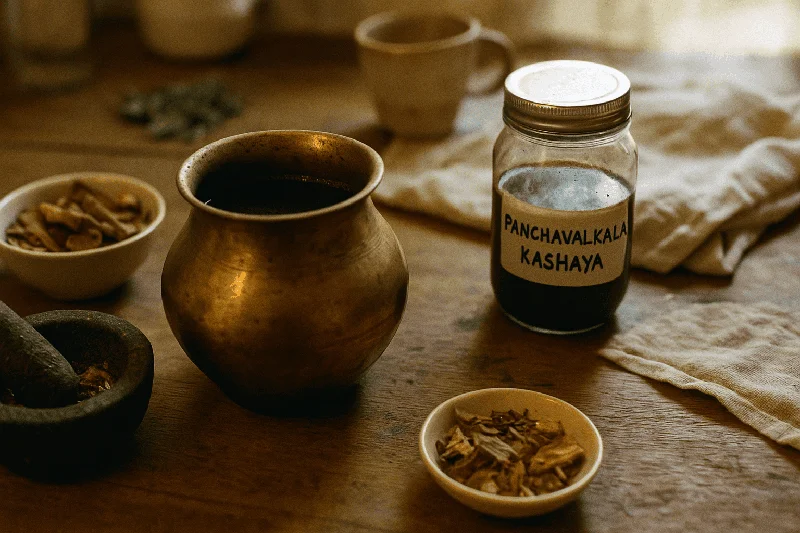
Panchavalkala Kashaya is a classical Ayurvedic decoction (kwath) prepared from the bark of five sacred fig-family trees — Vata, Ashwatha, Udumbara, Plaksha, and Parisha. Referenced extensively in the Sushruta Samhita and Charaka Samhita, this formulation is primarily used for wound healing (Vrana Shodhana and Vrana Ropana), skin disorders, gynecological conditions, and oral health. Whether you need it for external wound washing (dhawana), vaginal douching (yoni prakshalana), or internal detoxification, this guide covers everything: ingredients, pharmacological profiles, step-by-step home preparation, clinical evidence, dosage, contraindications, and how it compares to other Ayurvedic wound-healing formulations.
What Is Panchavalkala Kashaya?
- Panchavalkala Kashaya is a traditional polyherbal decoction that has been part of Ayurvedic clinical practice for over 2,500 years.
- The name itself reveals the formulation's identity: Pancha (five) + Valkala (bark) + Kashaya (decoction/astringent preparation). It falls under the category of kashaya kalpana, one of the five fundamental methods of Ayurvedic drug preparation.
Meaning and Etymology
In Sanskrit, "kashaya" carries a dual meaning — it refers both to the astringent taste (kashaya rasa) and the pharmaceutical form of a decoction. This is fitting, because all five barks in the formulation are predominantly astringent in taste, which directly contributes to their wound-drying and tissue-contracting properties. The word "valkala" specifically denotes the inner bark (phloem region) of trees, not the outer rough bark, which is an important distinction when collecting raw materials.
Historical References in Classical Ayurvedic Texts
The formulation finds its earliest detailed mention in the Sushruta Samhita (Sutra Sthana, Chapter 38), where it is categorized under the Nyagrodhadi Varga — a group of drugs predominantly composed of Ficus species. Sushruta describes it as essential for managing Dushta Vrana (chronic, non-healing, infected wounds).
Charaka Samhita references Panchavalkala in the context of Shodhana (purification) and Ropana (healing) therapies. The Ashtanga Hridaya by Vagbhata further elaborates on its external applications, particularly for inflammatory skin conditions and gynecological disorders.
Significance in Nyagrodhadi Varga
The Nyagrodhadi Varga is a pharmacological group that contains trees with shared properties — primarily kashaya rasa (astringent taste), sheeta virya (cooling potency), and Pitta-Kapha shamaka action (pacifying Pitta and Kapha doshas). All five trees in Panchavalkala belong to or are closely related to this group, which is why the formulation is considered particularly effective for conditions involving excessive discharge, inflammation, and microbial infection — all hallmarks of aggravated Pitta and Kapha.
The Five Herbal Ingredients of Panchavalkala (Key Drugs)
What makes Panchavalkala uniquely effective is the synergistic combination of five barks, four of which belong to the Ficus genus. Each component brings a distinct pharmacological profile to the formulation.
Vata (Ficus benghalensis) — Banyan Tree Bark
| Property | Detail |
|---|---|
| Sanskrit Name | Vata / Nyagrodha |
| Rasa (Taste) | Kashaya (Astringent), Madhura (Sweet) |
| Guna (Quality) | Guru (Heavy), Ruksha (Dry) |
| Virya (Potency) | Sheeta (Cooling) |
| Vipaka (Post-digestive effect) | Katu (Pungent) |
| Karma (Action) | Vrana Ropana, Stambhana, Kapha-Pitta Shamaka |
Banyan bark is rich in tannins, flavonoids, and beta-sitosterol. It serves as the primary astringent and antimicrobial agent in the formulation. Modern phytochemical analysis has identified significant quantities of leucocyanidin and leucopelargonidin, both of which exhibit strong anti-inflammatory activity.
Ashwatha (Ficus religiosa) — Peepal Tree Bark
Ashwatha bark contains bergapten, lanosterol, and stigmasterol. Its primary role in the formulation is anti-inflammatory and analgesic. In Ayurvedic terms, its Kashaya-Madhura rasa and Sheeta virya make it particularly effective at pacifying Pitta — the dosha most responsible for burning sensations, redness, and purulent discharge in wounds.
Udumbara (Ficus racemosa) — Cluster Fig Bark
- Udumbara is described as Vrana Shodhana (wound cleansing) in classical texts. Its bark is notably rich in racemosic acid, ceryl behenate, and lupeol acetate.
- A key distinction: Udumbara bark has demonstrated significant hemostatic activity — a property uniquely valuable for bleeding wounds. It has Kashaya-Madhura rasa, Sheeta virya, and Madhura vipaka, making it the gentlest component in the formulation.
Plaksha (Ficus lacor) — White Fig Bark
Plaksha contributes primarily to the formulation's anti-exudative properties. Its bark helps reduce excessive wound discharge (srava) and edema (shotha). Phytochemically, it contains ficusin, bergapten, and psoralen. Its Kashaya rasa and Sheeta virya align with the overall cooling, tissue-contracting theme of the formulation.
Parisha (Thespesia populnea) — Indian Tulip Tree Bark
This is the only non-Ficus member of the group. Parisha bark contains gossypol, herbacetin, and populneol. It adds notable antifungal and anti-dermatophyte properties that the four Ficus species don't strongly provide. In Ayurvedic pharmacology, it is described as Kushtaghna (anti-dermatosis) and Krimighna (anti-microbial), making it the formulation's specialist against skin infections.
Pharmacological Profile Summary Table
| Component | Primary Rasa | Virya | Key Phytochemicals | Primary Karma |
|---|---|---|---|---|
| Vata (Banyan) | Kashaya, Madhura | Sheeta | Tannins, flavonoids, beta-sitosterol | Vrana Ropana, Stambhana |
| Ashwatha (Peepal) | Kashaya, Madhura | Sheeta | Bergapten, stigmasterol | Shothahara, Vedanahara |
| Udumbara (Cluster Fig) | Kashaya, Madhura | Sheeta | Lupeol, racemosic acid | Vrana Shodhana, Raktastambhana |
| Plaksha (White Fig) | Kashaya | Sheeta | Ficusin, psoralen | Sravahara, Shothahara |
| Parisha (Indian Tulip) | Kashaya, Tikta | Sheeta | Gossypol, herbacetin | Kushtaghna, Krimighna |
All five ingredients share Kashaya rasa and Sheeta virya, creating a powerfully synergistic astringent and cooling formulation that pacifies both Pitta and Kapha doshas — the two doshas most implicated in wound pathology and skin diseases.
How to Prepare Panchavalkala Kashaya at Home (Step-by-Step)
None of the existing resources online provide a complete, practical recipe. Here's the traditional method based on classical kashaya kalpana principles from Sharangadhara Samhita.
Collecting and Storing the Bark (Dravya Sangraha Kala)
- The optimal time for bark collection is during Sharad Ritu (autumn, roughly September–November) or Vasanta Ritu (spring, roughly March–May), when the phloem is most active and phytochemical concentration peaks. Collect the inner bark (not the outermost dead bark layer) using a clean, sharp tool.
- Dry the bark pieces in shade — never in direct sunlight, as UV exposure degrades tannins and flavonoids.
Storage: Dried bark can be stored in airtight cloth bags or glass jars for up to 12 months. Powdered bark (churna) should be used within 6 months for optimal potency.
Traditional Kashaya Preparation Method
Ingredients:
- Coarsely powdered Panchavalkala Churna — 48 grams (1 pala, equal parts of all five barks)
- Water — 768 ml (16 times the drug quantity)
Process:
- Soak the coarse powder in 768 ml of water for 2–4 hours (overnight soaking yields better extraction)
- Heat on a low flame, bringing to a gentle boil
- Reduce the liquid to 1/4th of the original volume — approximately 192 ml. This reduction ratio (Chaturthaamsha) is the standard for kashaya preparation as per Sharangadhara Samhita
- Filter through a clean muslin cloth while still warm
- Use immediately — freshly prepared kashaya is most potent
The entire boiling process typically takes 45–60 minutes on low flame. Do not use a pressure cooker, as it alters the extraction profile of volatile compounds.
Ghanasatwa (Concentrated Solid Extract) Method
For clinical and commercial use, the kashaya can be further concentrated into Ghanasatwa:
- Prepare the kashaya as above
- Continue heating on very low flame until all water evaporates
- The remaining solid residue is the Ghanasatwa
- Dry completely, powder, and store in airtight containers
This concentrate is used to formulate creams, ointments (lepam), and tablets. A 2016 study published in the journal AYU described a Panchavalkala cream formulated from Ghanasatwa that showed significant wound-healing activity in clinical trials.
Uses of Panchavalkala Kashaya: Internal vs. External Applications
One critical distinction that most resources fail to make is the difference between internal and external applications. Panchavalkala Kashaya serves different therapeutic purposes depending on the route of administration.
External Application — Wound Washing (Dhawana)
This is the most well-documented use. The lukewarm kashaya is used to irrigate and wash chronic, infected, or non-healing wounds. The process is called Vrana Dhawana in Ayurvedic surgery (Shalya Tantra).
Protocol: Wash the wound with freshly prepared, lukewarm kashaya twice daily. Allow the liquid to flow over the wound for 5–10 minutes. Pat dry with a sterile cloth. This can be followed by application of Jatyadi Taila or Panchavalkala cream.
Internal Administration (Oral Decoction)
When taken orally, Panchavalkala Kashaya acts as a systemic detoxifier — eliminating ama (metabolic toxins) and pacifying Pitta-Kapha.
It's prescribed internally for:
- Chronic skin diseases with internal etiology
- Excessive vaginal or urethral discharge
- Bleeding disorders (Raktapitta) due to its hemostatic properties
- As an adjunct to Panchakarma therapies
Oral dosage: 40–80 ml, twice daily, before meals. Always under practitioner supervision.
Gynecological Applications (Yoni Prakshalana)
This is perhaps the most underreported use of Panchavalkala Kashaya. In Stri Roga (Ayurvedic gynecology), the kashaya is widely used for:
- Yoni Prakshalana (vaginal douching) in cases of leucorrhea (shweta pradara)
- Vaginal infections with discharge, itching, and inflammation
- Post-partum wound healing
- Cervical erosion
The lukewarm kashaya is used for gentle irrigation of the vaginal canal. This practice is described in Kashyapa Samhita and is routinely performed in Ayurvedic hospitals across Kerala and Karnataka.
Oral Health Applications (Kavala and Gandusha)
Panchavalkala Kashaya makes an excellent therapeutic mouth rinse:
- Kavala (gargling): Hold kashaya in the mouth, swish for 2–3 minutes, spit out. Effective for gingivitis, bleeding gums, and mouth ulcers
- Gandusha (oil-pulling variant): Fill the mouth completely with kashaya, hold without moving for 3–5 minutes. Used for periodontitis, tooth mobility, and receding gums
The high tannin content provides strong astringent action on gingival tissues, reducing bleeding and inflammation. This application is particularly useful for Pitta-type dental conditions with bleeding and inflammation.
How Does Panchavalkala Kashaya Promote Wound Healing? (Scientific Evidence)
The wound-healing mechanism of Panchavalkala operates through multiple pharmacological pathways, and several modern studies have validated these traditional claims.
Antimicrobial Action
A clinical study published in AYU (2016) involving 50 patients with chronic non-healing wounds demonstrated that Panchavalkala cream (formulated from kashaya Ghanasatwa) significantly reduced the microbial load in wound tissue. The study used tissue biopsy for quantitative microbial assessment — a methodologically rigorous approach. Bacterial counts decreased substantially in the treatment group compared to controls, with particular efficacy against common wound pathogens.
Anti-Inflammatory and Analgesic Effects
The formulation reduces all five cardinal signs of inflammation — redness (Raga), swelling (Shotha), heat (Ushna), pain (Vedana), and discharge (Srava). In Ayurvedic pharmacology, this corresponds to its Sheeta virya (cooling potency) and Pitta shamaka action. In vitro studies have confirmed the presence of anti-inflammatory compounds including flavonoids, tannins, and triterpenes across all five bark ingredients.
Hemostatic (Blood-Stopping) Activity
A study published in ResearchGate evaluated the hemostatic activity of Panchavalkala Kashaya using Wistar rat models. The results showed a statistically significant reduction in bleeding time compared to control groups. This property makes it especially valuable for wounds with active or recurrent bleeding — a scenario where many other herbal formulations fall short.
Tissue Regeneration (Vrana Ropana)
- Beyond cleaning and disinfecting, Panchavalkala actively promotes granulation tissue formation and epithelialization. The tannins form a protective layer over the wound (like a biological dressing), while the flavonoids stimulate fibroblast proliferation.
- This dual action — protecting and rebuilding — is what classical Ayurveda calls Vrana Ropana.
Don't wait or self medicate. Start chat with Doctor NOW
Is Panchavalkala Kashaya Effective for All Types of Skin Conditions?
While Panchavalkala is primarily a wound-healing formulation, its applications extend to several dermatological conditions — though it's not a universal skin remedy.
Conditions Where It Works Best
- Chronic non-healing wounds (Dushta Vrana) — primary indication with strong clinical evidence
- Burns — the cooling and tissue-regenerating properties are well-suited
- Eczema with oozing/wet lesions — the astringent action dries excessive exudate
- Fungal skin infections — particularly due to Parisha's anti-dermatophyte action
- Diabetic foot ulcers — emerging clinical interest in this application
- Post-surgical wound care — accelerates healing when used as an adjunct
Conditions Where Other Formulations May Be Better
For dry skin conditions (like psoriasis without oozing) or purely cosmetic concerns, Panchavalkala may be too drying. In such cases, oil-based preparations like Jatyadi Taila or Eladi Coconut Oil are more appropriate.
Panchavalkala Kashaya vs. Other Ayurvedic Wound-Healing Formulations
| Parameter | Panchavalkala Kashaya | Triphala Kashaya | Jatyadi Taila | Manjishtadi Kashaya |
|---|---|---|---|---|
| Form | Water decoction | Water decoction | Medicated oil | Water decoction |
| Primary Action | Wound cleansing + healing | Wound cleansing | Wound healing + regeneration | Blood purification |
| Best For | Infected, discharging wounds | Mild wounds, eye wash | Clean wounds needing tissue growth | Skin diseases with blood impurity |
| Rasa | Kashaya (Astringent) | Kashaya + Amla + Madhura | Complex (multiple herbs) | Tikta (Bitter) + Kashaya |
| Route | External + Internal | External + Internal | External only | Primarily internal |
| Hemostatic | Yes | Mild | No | No |
| Antimicrobial Strength | Strong | Moderate | Mild | Mild |
- Key takeaway: Panchavalkala Kashaya is the formulation of choice for infected, discharging, non-healing wounds where microbial load reduction and exudate control are priorities. For clean wounds needing tissue regeneration, Jatyadi Taila is preferred.
- In practice, these formulations are often used sequentially — Panchavalkala first for cleansing, then Jatyadi for healing.
Can Panchavalkala Kashaya Be Used Alongside Other Ayurvedic Therapies?
Absolutely. In fact, Panchavalkala Kashaya is rarely used in isolation in clinical Ayurvedic practice.
Integration with Panchakarma
- Abhyanga (oil massage) followed by Swedana (steam therapy) can precede wound washing with Panchavalkala Kashaya to improve local circulation and enhance penetration of active compounds
- During Vamana or Virechana procedures, oral Panchavalkala may be used as an adjunct for patients with concurrent skin conditions
- Post-Panchakarma, Panchavalkala wound washing accelerates healing at any procedural sites
Complementary Formulations
- Triphala Guggulu (internal) + Panchavalkala Kashaya (external) — powerful combination for chronic wounds with systemic inflammation
- Gandhaka Rasayana (internal) + Panchavalkala wash — for infected wounds with suspected resistant organisms
- Yashtimadhu Ghrita (local application after Panchavalkala wash) — for burn wounds
Dosage, Contraindications & Safety Considerations
Standard Dosage Guidelines
| Application | Dosage | Frequency | Duration |
|---|---|---|---|
| Oral decoction | 40–80 ml | Twice daily, before meals | 2–6 weeks |
| Wound washing (Dhawana) | As needed to irrigate | Twice daily | Until wound is clean |
| Yoni Prakshalana | 200–400 ml lukewarm | Once daily | 7–14 days |
| Kavala/Gandusha (mouth rinse) | 50–100 ml | Twice daily | 2–4 weeks |
How Long Does It Take to Notice Improvements?
For external wound application, most patients notice reduced discharge and pain within 3–5 days. Significant wound size reduction typically becomes apparent by 2–3 weeks. Chronic non-healing wounds may require 6–8 weeks of consistent application. Oral intake for skin conditions generally shows results within 4–6 weeks.
Contraindications
- Very dry wounds without discharge — the astringent action can over-dry tissues and impede healing
- Pregnancy — oral intake is generally avoided; external use should be under medical supervision
- Severe dehydration — the drying (Ruksha) quality of the formulation can aggravate Vata
- Known allergy to any Ficus species — rare but possible; discontinue if rash or irritation worsens
Interactions with Modern Medicines
While no major drug interactions have been documented in clinical literature, the high tannin content of Panchavalkala can potentially:
- Reduce absorption of iron supplements and certain antibiotics (tetracyclines, fluoroquinolones) if taken orally within 2 hours
- Enhance the effect of topical antiseptics when used together for wound washing
- Theoretically potentiate anticoagulant effects when combined with blood-thinning medications (due to its own hemostatic mechanism working through a different pathway)
Always inform your physician about Panchavalkala use if you're on prescription medications.
Shelf Life and Storage of Prepared Kashaya
- Freshly prepared kashaya: Use within 6–8 hours. Do not refrigerate and reheat, as this degrades active compounds
- Panchavalkala Churna (powder): 6 months in airtight container, away from moisture
- Ghanasatwa (solid extract): 12–18 months if stored properly
- Commercial Kwatha bottles: Follow manufacturer's expiry date; typically 2–3 years
Where Can You Obtain Authentic Panchavalkala Kashaya?
Panchavalkala is available in multiple commercial forms:
- Churna (powder): For preparing kashaya at home. Available from brands on Amazon India in the range of ₹228–274 per 100 grams
- Ready-made Kwatha (liquid decoction): Available from Ayurvedic pharmacies like AyurCentral, typically in 100 ml or 200 ml bottles
- Panchavalkala Cream/Ointment: Formulated from Ghanasatwa, available at specialized Ayurvedic hospitals
- Lepam (paste): Sometimes prepared fresh at Ayurvedic clinics for direct wound application
When purchasing, verify that the product lists all five barks. Some cheaper products substitute Parisha (Thespesia populnea) with other barks — this significantly alters the formulation's therapeutic profile.
What Dietary Practices Support Effectiveness of Panchavalkala Kashaya?
Ayurveda emphasizes Pathya (supportive diet) during any treatment.
For wound healing with Panchavalkala:
- Favor: Light, easily digestible foods — green gram (moong dal), rice gruel, bitter gourd, pointed gourd, warm water
- Avoid: Heavy, fried, and fermented foods; excess sugar; sour foods (which aggravate Pitta); curd at night
- Include: Turmeric in cooking (synergistic anti-inflammatory), ghee in moderate amounts (supports tissue regeneration), and amla (vitamin C for collagen synthesis)
- Lifestyle: Avoid exposing wounds to dust, contaminated water, or excessive physical strain
Frequently Asked Questions
What is the use of Panchavalkala?
Panchavalkala is used primarily for wound cleansing, wound healing, and managing skin diseases. Its applications include external wound washing (dhawana), vaginal douching for leucorrhea, mouth rinsing for gum diseases, and oral intake for systemic detoxification and balancing Pitta-Kapha doshas.
What are the ingredients in Panchavalkala Kashaya?
The five ingredients are: Vata (Ficus benghalensis — Banyan bark), Ashwatha (Ficus religiosa — Peepal bark), Udumbara (Ficus racemosa — Cluster Fig bark), Plaksha (Ficus lacor — White Fig bark), and Parisha (Thespesia populnea — Indian Tulip bark). All five barks are used in equal proportions.
What is Panchavalkala Kashaya reference in classical texts?
The primary reference is Sushruta Samhita (Sutra Sthana, Chapter 38) under Nyagrodhadi Varga. Additional references are found in Charaka Samhita, Ashtanga Hridaya, Sharangadhara Samhita, and Kashyapa Samhita. Bhavaprakasha Nighantu also describes the individual drug profiles.
What is the difference between Panchavalkala Kashaya, Churna, and Lepam?
Kashaya is the liquid decoction, Churna is the dry powder form (used to prepare kashaya or for direct application), and Lepam is a paste made by mixing the churna or ghanasatwa with a liquid medium for topical application on wounds or skin lesions. The underlying drug combination remains the same across all forms.
Can Panchavalkala Kashaya replace antibiotics for wound infections?
No. While Panchavalkala demonstrates significant antimicrobial activity and can reduce microbial load, it should not be used as a sole replacement for antibiotics in severe or systemic infections. It works best as a complementary therapy alongside conventional wound care, or as a primary therapy for mild to moderate wounds under qualified Ayurvedic supervision.
Conclusion
Panchavalkala Kashaya stands as one of Ayurveda's most well-validated wound-healing formulations, backed by both millennia of clinical tradition and growing modern scientific evidence. Its five-bark composition creates a synergistic blend of astringent, antimicrobial, anti-inflammatory, and hemostatic properties that few single herbs can match.
Whether you're dealing with a chronic non-healing wound, recurring skin infections, gynecological concerns, or oral health issues — this versatile formulation deserves consideration as part of your treatment protocol. However, always consult a qualified Ayurvedic practitioner (BAMS or MD Ayurveda) before starting any new herbal regimen, especially for internal use or if you are concurrently taking modern medications.
The key to getting results with Panchavalkala Kashaya lies in three things: authentic ingredients, proper preparation, and consistent application under professional guidance. Get these right, and you're working with one of the most time-tested healing formulations in the entire Ayurvedic pharmacopoeia.
Scientific Sources
- Ayurveda Management of Allergic Rhinitis: Protocol for a Randomized Controlled Trial — Mata S et al., 2024, JMIR research protocols
- Anatomy in ancient India: a focus on the Susruta Samhita — Loukas M et al., 2010, Journal of anatomy
- The Ayurvedic Pharmacopoeia of India, development and perspectives — Joshi VK et al., 2017, Journal of ethnopharmacology
- Editorial: Special issue on Ayurveda — Mukherjee PK et al., 2017, Journal of ethnopharmacology
- A case for testing and modifying theory in Ayurveda: Author's response — Patwardhan K, 2023, Indian journal of medical ethics
- Exploring scientific validation of Triphala Rasayana in ayurveda as a source of rejuvenation for contemporary healthcare: An update — Ahmed S et al., 2021, Journal of ethnopharmacology
- Rational use of Ashwagandha in Ayurveda (Traditional Indian Medicine) for health and healing — Joshi VK et al., 2021, Journal of ethnopharmacology
- The use of "tortured phrases" in science communication — Samal J, 2025, Indian journal of medical ethics
- Nano-ayurvedic medicine and its potential in cancer treatment — Lopus M, 2023, Journal of integrative medicine
- Effects of Ashwagandha (roots of Withania somnifera) on neurodegenerative diseases — Kuboyama T et al., 2014, Biological & pharmaceutical bulletin
- The landscape of Ayurveda education in India: Current status and prospects — Kumar S et al., 2025, The National medical journal of India
- Ayurveda for diabetes mellitus: a review of the biomedical literature — Elder C, 2004, Alternative therapies in health and medicine
- Efficacy and safety of ayurvedic intervention (Sarpgandha Mishran) vs amlodipine for Stage-I primary hypertension- study protocol for a prospective Double-Dummy, Double-Blind, placebo-controlled Randomized Clinical Trial — Yadav B et al., 2025, BMC complementary medicine and therapies
- Evaluating Ayurveda — Bodeker G, 2001, Journal of alternative and complementary medicine (New York, N.Y.)
- Historical and cross-cultural perspectives on Parkinson's disease — Blonder LX, 2018, Journal of complementary & integrative medicine
- A qualia-centric approach to Ayurveda and Hindu knowledge systems can address modern science's blind spot — Venkatraman A, 2025, Indian journal of medical ethics
- Ayurvedic and Chinese Herbs against Coronaviruses — Gasmi A et al., 2024, Current pharmaceutical design
- Traditional Formulations for Managing COVID-19: A Systematic Review — Bhandari RB et al., 2024, Journal of integrative and complementary medicine
- Hot and Cold Theory: Evidence in Physiology — Namiranian P et al., 2021, Advances in experimental medicine and biology
- Molecular approach to ayurveda — Tripathi YB, 2000, Indian journal of experimental biology
Questions from users
How can Panchavalkala Kashaya be used for faster wound healing?
Lila
6 days ago
Panchavalkala Kashaya can aid faster wound healing by serving as an effective initial cleansing agent. It's traditionally used to clean and prepare wounds by removing debris and non-viable tissue, which optimizes the site for further therapeutic measures. After cleansing with Panchavalkala, applying Jatyadi Taila supports tissue regeneration. Typical use may require 6–8 weeks for chronic wounds, but duration varies by wound severity. Watch for signs of infection like increased redness or pus. Consult a healthcare professional for non-healing wounds or signs of infection.
Can I use Panchavalkala Kashaya for treating gum issues or oral health problems?
Zoey
15 days ago
Yes, Panchavalkala Kashaya can be used for gum issues, like periodontitis and receding gums. Its astringent action helps reduce bleeding and inflammation. It's especially good if there's excess Pitta, which can cause burning and swelling. Just make sure to use it as directed and keep an eye on how your body reacts!
Is it safe to use Panchavalkala Kashaya for sensitive skin types?
William
27 days ago
Using Panchavalkala Kashaya on sensitive skin can be safe, but it kinda depends on individual reactions due to its astringent nature. It's a good idea to do a patch test first or chat with an Ayurvedic practitioner to get junk on any specific dosha imbalances or skin concerns you might have. They can give personalized advice, based on your unique body constitution.
What is the best way to prepare Panchavalkala Kashaya for maximum benefits?
Jack
36 days ago
To prepare Panchavalkala Kashaya, take equal parts of the bark from Vata, Udumbara, Ashwatha, Plaksha, and Parisha. Boil them in water until the volume reduces by half. Make sure to use clean and fresh herbs, and drink it warm. It's tailored for pitta and kapha imbalances, so sip slowly, listening to how your body responds.
What is the traditional preparation method for Panchavalkala Kashaya?
Michael
45 days ago
To prepare Panchavalkala Kashaya, traditionally you'd take equal parts of the barks from five trees mentioned in the texts. Boil these barks in water until it's reduced to about one-fourth of the original volume. That process helps concentrate the healing qualities. Strain it before use. If possible, consult an Ayurvedic practitioner to ensure it's right for your needs!
Can I use Panchavalkala Kashaya for internal detoxification as well?
Zoey
55 days ago
Yes, Panchavalkala Kashaya can be used for internal detoxification! It's known for stimulating digestion and helping eliminate ama (toxins) from your body. Just remember to get it from a reputable source and maybe chat with an Ayurvedic practitioner to make sure it fits with your overall health needs.
What is the role of detoxification in Ayurvedic skin healing practices?
Mckenzie
64 days ago
Detoxification is actually key in Ayurvedic skin healing. It helps balance the doshas and clear toxins (ama) from the body, which can cause skin issues. This is done through practices like panchakarma, using herbs, and a proper diet. It boosts the agni (digestive fire), cleansing the body, and promoting overall skin health.
What are the side effects of using Panchavalkala Kashaya on the skin?
Paisley
74 days ago
Panchavalkala Kashaya is mostly safe for the skin, thanks to its natural ingredients. But like anything, it might cause some irritation or allergic reaction for some people, especially if you have sensitive skin. Just to be safe, try doing a patch test on a small area. If there's any redness or itching, it might be best to stop using it or talk with a health pro.
Can I use Panchavalkala Kashaya for acne treatment?
Jack
84 days ago
Yes, Panchavalkala kashaya might help with acne. It's known for its anti-inflammatory and antimicrobial properties, which can help reduce redness and bacteria associated with acne. Just make sure to check in with an Ayurvedic pro to see if it suits your unique dosha and balance. They might have personalized advice for your skin type too!
Is Panchavalkala Kashaya effective for preventing skin infections?
Bella
93 days ago
Yes, Panchavalkala Kashaya can be effective for preventing skin infections! It's astringent, it helps tighten skin tissues & reduces moisture, cutting infection risk. Balances Pitta and Kapha doshas, promoting skin's natural resilience. Just note, it's more supportive than a cure for severe infections, so consult a healthcare practitioner too!
Related articles

Skin and Hair Disorders
Ayurvedic Treatment for Ichthyosis Vulgaris: Skin Healing Guide
Explore Ayurvedic approaches for ichthyosis vulgaris. Discover natural remedies, herbal treatments, and lifestyle tips to manage dry, scaly skin and promote healthy complexion.
3,993

Skin and Hair Disorders
Is Coconut Oil Good for Hair? Ayurvedic Benefits, Growth & Usage Tips
Is coconut oil good for hair? Discover its benefits for hair growth, fall, low porosity, and how to apply or mix pure coconut oil for best Ayurvedic results
6,022

Skin and Hair Disorders
What Is Manjistha? Ayurvedic Herb for Skin, Blood, and Detox
Learn the meaning, uses, and benefits of manjistha powder and oil in Ayurveda. Discover how manjistha supports skin, blood purification, and wellness
7,575

Skin and Hair Disorders
Ayurveda's Approach to Skin Tags
Skin tags are harmless but can be bothersome; understanding them is crucial for effective treatment.
9,166
Skin and Hair Disorders
Valiya Madhusnuhi Rasayanam – Traditional Ayurvedic Rejuvenation Therapy for Enhanced Vitality
Discover Valiya Madhusnuhi Rasayanam, a classical Ayurvedic rejuvenation therapy. Learn about its ingredients, benefits, usage, and how it promotes holistic health and longevity naturally.
2,768
Skin and Hair Disorders
Lakshadi Kera Thailam: Ayurvedic Hair Nourishment
Discover the benefits, proper dosage, side effects, and scientific research behind Lakshadi Kera Thailam, a potent Ayurvedic herbal oil for hair and scalp health.
3,408

Skin and Hair Disorders
What Is Kushta Roga in Ayurveda? Meaning, Symptoms, and Healing
What is Kushta Roga in Ayurveda? Learn about its meaning, types, symptoms, and Ayurvedic treatments for skin disorders traditionally known as Kushta diseases
7,890
Skin and Hair Disorders
Bhallataka Vati – Potent Ayurvedic Remedy for Rejuvenation & Therapeutic Support
Discover the bhallataka vati benefits, a powerful Ayurvedic formulation used for rejuvenation, pain management, and chronic condition support. Learn about its traditional preparation, therapeutic uses, dosage, and necessary precautions.
2,517

Skin and Hair Disorders
Sindooradi Lepam – An Ayurvedic Remedy for Skin Health and Radiance
Learn about Sindooradi Lepam, a powerful Ayurvedic paste that promotes healthy, radiant skin by treating blemishes, acne, pigmentation, and signs of aging.
3,301
Related consultations on the topic
Legal
Additional Documents
© 2024 Ask Ayurveda. All rights reserved.