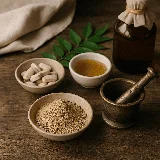
Nagaradi Choornam: Ayurvedic Uses, Benefits & Dosage Guide

Nagaradi Choornam (also known as Nagaradi Lepa Choornam or Manikkuntirikkadi Choornam) is a classical Ayurvedic herbal powder formulated specifically for external application as a therapeutic paste (lepa) to treat traumatic inflammatory swelling, sprains, ligament injuries, and musculoskeletal pain. Referenced in the ancient text Sahasrayogam under the Lepa Prakarana section, this time-tested formulation combines seven potent herbal and mineral ingredients — led by Nagara (dry ginger) — that work synergistically to reduce edema, relieve pain, and accelerate tissue repair.
If you're dealing with a swollen ankle after a sprain, post-injury inflammation, or joint pain that just won't quit, this guide covers everything you need to know: the complete ingredient breakdown, step-by-step application instructions, safety precautions, how it compares to similar formulations, and when you should skip the home remedy and see a doctor instead.
What Is Nagaradi Choornam?
- Nagaradi Choornam is a polyherbal powder (choornam) designed exclusively for external use as a medicated paste.
- The word "Nagaradi" derives from its primary ingredient — Nagara (Zingiber officinale, dry ginger) — followed by the suffix "adi," meaning "and others" in Sanskrit. Unlike many Ayurvedic choornams that are consumed orally, Nagaradi Choornam belongs to the Lepa category — topical applications mixed with a liquid medium and applied directly to the affected area.
- This is not an internal medicine. It's important to clarify this upfront because some online sources incorrectly suggest digestive or respiratory uses.
- The classical reference is unambiguous: Nagaradi Choornam is a lepa formulation.
Classical Reference: Sahasrayogam
The formulation originates from Sahasrayogam, one of the most comprehensive compilations of Ayurvedic formulations, widely followed in the Kerala school of Ayurveda. It appears in the Lepa Yoga Prakarana (chapter on topical paste formulations).
The original Sanskrit shloka describes the ingredients and their proportions:
> "Nagaram kumari vacha cha laksha srivasakam tatha | Tankanam madhukam chaiva lepoyam shopha nashanah"
This translates roughly to: "Nagara, Kumari, Vacha, Laksha, Srivasa, Tankana, and Madhuka — this lepa destroys swelling."
The verse explicitly states its purpose — shopha nashana (destruction of swelling) — leaving little room for misinterpretation about its intended use.
Alternative Names
Depending on the regional tradition and manufacturer, you may find this formulation listed under different names:
- Nagaradi Lepa Choornam — emphasizing its lepa (paste) application
- Manikkuntirikkadi Choornam — a Malayalam-origin name used in some Kerala Ayurvedic texts
- Nagaradi Churna — Hindi transliteration
All three refer to the same classical formulation with identical ingredients.
Ayurvedic Properties & Dosha Significance
Understanding the Ayurvedic pharmacological properties of Nagaradi Choornam helps explain why it works — not just that it works.
Dosha Karma: Tridoshahara Action
Nagaradi Choornam is classified as Tridoshahara, meaning it has the capacity to pacify all three doshas — Vata, Pitta, and Kapha. However, its primary action targets Kapha and Vata imbalances, which are the root causes of most inflammatory swelling and pain conditions according to Ayurvedic pathology.
- Kapha involvement: Stagnation, fluid accumulation, and swelling (shopha) are quintessential Kapha disorders. The heating (ushna) and drying (ruksha) properties of ingredients like Nagara and Vacha counteract excess Kapha directly.
- Vata involvement: Pain (shoola) is primarily a Vata symptom. Ingredients like Laksha and Madhuka help stabilize Vata, reducing pain signaling in the affected tissues.
Roga Karma: Therapeutic Actions
| Karma (Action) | Sanskrit Term | Clinical Meaning |
|---|---|---|
| Anti-inflammatory | Shophahara | Reduces traumatic and inflammatory swelling |
| Analgesic | Shoolahara | Relieves localized pain |
| Tissue-healing | Sandhana | Promotes repair of ligaments, tendons, and soft tissue |
| Anti-edema | Shothhara | Reduces fluid accumulation in tissues |
How It Balances Kapha and Vata
When trauma occurs — say a twisted ankle or a muscle strain — Ayurveda explains the pathology through a dual-dosha lens. Vata gets aggravated at the site of injury (causing pain, throbbing, and restricted movement), while Kapha accumulates (causing swelling, heaviness, and stiffness). Nagaradi Choornam addresses both simultaneously through its combination of ushna (hot), tikshna (penetrating), and laghu (light) properties. This dual action is what makes it particularly effective for acute traumatic conditions rather than chronic degenerative ones.
Complete Ingredients List with Individual Benefits
The formulation contains seven ingredients, each contributing a specific pharmacological action. Let me break down what each one actually does in this formula — something most sources simply skip over.
Nagara — Zingiber officinale (Dry Ginger)
The lead ingredient and namesake of the formulation. Dry ginger contains gingerols and shogaols, compounds extensively studied for their anti-inflammatory effects. A 2009 study published in the Journal of Medicinal Food demonstrated that ginger extract inhibits COX-2 and 5-LOX enzymes — the same inflammatory pathways targeted by conventional NSAIDs. When applied topically, these compounds penetrate the skin to reduce local inflammation and provide analgesic warmth.
Role in formula: Primary anti-inflammatory and analgesic agent; improves local blood circulation.
Kumari / Kanyasara — Aloe vera
Aloe vera might seem like an unusual addition to a heating anti-inflammatory formula, but it serves a crucial balancing function. Its cooling (sheeta) and moisturizing (snigdha) properties prevent the formula from being excessively irritating to the skin. Aloe vera also contains acemannan, a polysaccharide that accelerates wound healing and reduces oxidative stress at the tissue level.
Role in formula: Cooling counterbalance; skin protectant; enhances tissue hydration and repair.
Vacha — Acorus calamus (Sweet Flag)
Vacha is renowned in Ayurveda for its penetrating (tikshna) quality, which helps carry other ingredients deeper into tissues. The essential oil of Acorus calamus has demonstrated significant analgesic and anti-inflammatory activity in animal models (Rajput et al., 2014, Journal of Ethnopharmacology). Its strong aromatic compounds also contribute mild counter-irritant effects similar to menthol.
Role in formula: Deep tissue penetration enhancer; analgesic; anti-edema action.
Laksha — Laccifer lacca (Lac/Shellac)
This is perhaps the most specialized ingredient in the formula. Laksha has been used in Ayurveda specifically for Asthi-Sandhaniya (bone and joint healing) properties for thousands of years. It contains flavonoids and terpenes that support osteoblast activity and connective tissue repair. In traditional practice, Laksha is a go-to ingredient in any formulation targeting fractures, dislocations, or ligament damage.
Role in formula: Promotes repair of bones, ligaments, tendons, and connective tissue.
Srivasakam — Pinus roxburghii (Chir Pine Resin)
- Pine resin contributes its natural anti-inflammatory oleoresins and provides a mild adhesive quality that helps the paste maintain contact with skin.
- The terpene compounds in pine resin — particularly α-pinene and β-pinene — have documented analgesic and anti-inflammatory properties. A 2017 study in Molecules journal confirmed that these terpenes modulate TNF-α and IL-6 inflammatory cytokines.
Role in formula: Anti-inflammatory resin; helps paste adhesion; provides warming counter-irritant effect.
Tankana — Borax (Sodium Borate)
- This is the only mineral ingredient in the formulation, and surprisingly, no competitor has explained its role adequately.
- Borax serves multiple functions: it acts as a natural preservative extending shelf life, provides mild antiseptic action to prevent secondary infection at injury sites, and — critically — it functions as a flux that enhances the absorption of herbal compounds through the skin barrier. In traditional Ayurvedic pharmacy, Tankana is always purified (shodhana) before use to remove impurities.
Role in formula: Absorption enhancer; antiseptic; preservative; anti-inflammatory mineral.
Madhuka — Glycyrrhiza glabra (Licorice)
Licorice root contains glycyrrhizin, a compound with well-documented anti-inflammatory properties comparable to hydrocortisone in some studies. A 2019 review in Frontiers in Pharmacology highlighted its ability to inhibit phospholipase A2, a key enzyme in the inflammatory cascade. In this formulation, Madhuka also provides a soothing (madhura rasa) quality that tempers the overall intensity of the paste.
Role in formula: Potent anti-inflammatory; skin-soothing; anti-allergic buffer.
Ingredient Summary Table
| Ingredient | Latin Name | Key Active Compound | Primary Action |
|---|---|---|---|
| Nagara | Zingiber officinale | Gingerols, Shogaols | Anti-inflammatory, analgesic |
| Kumari | Aloe vera | Acemannan | Cooling, tissue repair |
| Vacha | Acorus calamus | β-asarone | Penetration enhancer, analgesic |
| Laksha | Laccifer lacca | Flavonoids, terpenes | Bone & tissue repair |
| Srivasakam | Pinus roxburghii | α-pinene, β-pinene | Anti-inflammatory resin |
| Tankana | Borax (purified) | Sodium borate | Absorption enhancer, antiseptic |
| Madhuka | Glycyrrhiza glabra | Glycyrrhizin | Anti-inflammatory, soothing |
How to Use Nagaradi Choornam: Step-by-Step Application
One of the biggest gaps in existing guides is the lack of practical, detailed application instructions. Here's exactly how to prepare and apply the lepa.
Preparing the Paste
- 1.Measure the powder: Take 1-2 tablespoons of Nagaradi Choornam (approximately 10–20 grams), depending on the area to be covered.
- 2.Choose your liquid medium: Mix with lukewarm water or fresh coconut water. Some practitioners recommend using Dhanyamla (fermented grain water) for enhanced anti-inflammatory action. The ratio should be approximately 2 parts powder to 1 part liquid — you want a thick, spreadable consistency, not a runny paste.
- 3.Mix thoroughly: Stir until you achieve a smooth, lump-free paste similar to the consistency of a face pack. Let it sit for 2–3 minutes.
Applying the Lepa
- Clean the affected area with lukewarm water and pat dry.
- Apply a uniform layer of paste approximately 3–5 mm thick over the swollen or painful area.
- Extend slightly beyond the borders of the swelling — about 1 cm past the visible inflammation.
- Leave undisturbed for 30 to 45 minutes, or until the paste dries completely.
- Gently wash off with lukewarm water. Do not scrub.
- Pat dry and optionally apply a light coat of coconut oil to prevent skin dryness.
How Often Can I Apply It?
For acute conditions (fresh sprains, post-injury swelling):
- Apply 2–3 times daily for the first 3–5 days
- Reduce to once daily as swelling subsides
- Typical treatment duration: 7–14 days
For chronic inflammatory conditions:
- Apply once daily, preferably in the evening
- Treatment duration: 2–4 weeks under practitioner guidance
Can It Be Used for Sprains?
Yes — this is actually one of its primary indications. For fresh sprains specifically, wait at least 12–24 hours after the injury before applying (to allow initial acute bleeding to stop). Apply as described above. Many Ayurvedic practitioners combine Nagaradi Choornam lepa with internal anti-inflammatory medications like Yogaraja Guggulu for comprehensive sprain management.
Key Benefits of Nagaradi Choornam
Beyond the general "reduces swelling and pain" description, here are the specific therapeutic benefits supported by traditional usage and modern pharmacological understanding:
- 1.Rapid reduction of traumatic edema — The combination of Ushna (hot) and Tikshna (penetrating) herbs promotes lymphatic drainage from the injury site, visibly reducing swelling within 2–3 applications.
- 2.Non-systemic pain relief — Unlike oral painkillers that affect your entire body, this topical application delivers analgesic compounds directly to the pain site, minimizing systemic side effects.
- 3.Accelerated ligament and tendon repair — Laksha specifically supports connective tissue regeneration, making this formula superior to generic anti-inflammatory pastes for musculoskeletal injuries.
- 4.Prevention of post-traumatic stiffness — By resolving Kapha stagnation early in the injury cycle, the formula helps prevent the chronic stiffness that often follows inadequately treated sprains.
- 5.Safe for repeated use — As a topical herbal application, it avoids the gastrointestinal and renal side effects associated with prolonged NSAID use.
Nagaradi Choornam vs. Similar Ayurvedic Formulations
This comparison is something no other guide provides, and it's genuinely useful if you're trying to decide which lepa or choornam to use.
| Feature | Nagaradi Choornam | Kottamchukkadi Choornam | Rasnadi Choornam | Grihadhoomadi Lepa |
|---|---|---|---|---|
| Primary Use | Traumatic swelling, sprains | Arthritis, joint stiffness | Headache, sinusitis | Acute fracture swelling |
| Application Type | External lepa | External lepa or dhara | External lepa (forehead) | External lepa |
| Key Ingredient | Dry ginger | Kottam (Saussurea) | Rasna (Alpinia) | Grihadhoomam (Soot) |
| Dosha Target | Kapha-Vata | Vata-Kapha | Vata-Kapha | Kapha-Pitta |
| Best For | Fresh injuries, sprains | Chronic joint conditions | Head-region ailments | Fracture-associated swelling |
| Contains Minerals | Yes (Borax) | No | No | Yes (Soot/carbon) |
| Available From | Vaidyaratnam, Sitaram | Most manufacturers | Most manufacturers | Limited availability |
When to choose Nagaradi Choornam: Acute or sub-acute traumatic swelling and sprains — particularly of limbs. If your primary issue is an injury rather than a degenerative condition, Nagaradi is typically the better choice over Kottamchukkadi.
Side Effects, Precautions & Contraindications
Are There Any Side Effects?
Nagaradi Choornam is generally well-tolerated when used as directed for external application.
However, some individuals may experience:
- Mild skin redness or warmth — This is usually a normal response to the heating herbs (especially ginger) and subsides within 30 minutes after washing off. Not a reason to discontinue.
- Skin irritation or itching — Occurs in individuals with sensitive skin or those allergic to specific components. Discontinue and wash off immediately if this happens.
- Contact dermatitis — Rare, but possible, particularly in individuals sensitive to Borax (Tankana). Perform a patch test before first full application.
Detailed Contraindications
No other source provides a comprehensive contraindication list, so here it is:
- Open wounds or broken skin — Never apply lepa to cuts, abrasions, or open fractures. The borax and penetrating herbs can cause significant irritation to exposed tissue.
- Known allergy to any ingredient — Particularly borax or pine resin. Do a small patch test on the inner forearm 24 hours before first use.
- Pregnancy — Avoid without explicit practitioner approval. Some ingredients (particularly Vacha) have uterine stimulant properties that could theoretically be absorbed through skin.
- Lactation — Use with caution and only under medical supervision.
- Children under 5 years — The concentration of active compounds can be too intense for very young children's skin. For children aged 5–12, dilute the paste with extra Aloe vera gel.
- Severe skin conditions — Active eczema, psoriasis, or fungal infections at the application site.
Can Children Use It?
Children above 5 years can use Nagaradi Choornam with modifications. Reduce the concentration by mixing the standard paste with an equal quantity of fresh Aloe vera gel, and limit application time to 15–20 minutes maximum. Always supervise the application and watch for any adverse skin reactions.
Combining with Other Ayurvedic Treatments
One of the most practical but overlooked aspects of Nagaradi Choornam is how it fits into a comprehensive treatment protocol. It rarely works in isolation for significant injuries.
Compatible Internal Medications
| Internal Medicine | Purpose | Typical Combination |
|---|---|---|
| Yogaraja Guggulu | Anti-inflammatory, analgesic | Most common pairing for sprains |
| Kaisora Guggulu | Anti-inflammatory, blood purifier | For injuries with skin discoloration |
| Dhanwantharam Kashayam | Vata pacification | For pain-dominant presentations |
| Gandharvahastadi Kashayam | Muscle relaxant | For muscle strain injuries |
Compatible External Treatments
- Dhanwantharam Thailam — Apply the oil after removing the lepa and washing the area. The oil helps maintain the anti-inflammatory effect between lepa applications.
- Panchakarma procedures — Nagaradi Choornam lepa can be used as an adjunct to Pizhichil (oil bath) or Podikkizhi (herbal powder bolus) treatments for injuries.
- Bandaging (Bandhana) — For sprains, a light crepe bandage can be applied over the dried lepa for additional immobilization support, though this is practitioner-dependent.
When to See a Doctor Instead
Nagaradi Choornam is effective for mild to moderate traumatic swelling and sprains.
Seek medical attention if:
- Swelling does not reduce after 48–72 hours of regular application
- You suspect a fracture (deformity, inability to bear weight, crepitus)
- The area shows signs of infection (increasing redness, warmth, pus, fever)
- Pain intensity increases despite treatment
- Numbness or tingling develops below the injury site
- The injury involves the spine, head, or chest
Shelf Life, Storage & Manufacturers
Storage Guidelines
- Shelf life: 6 months from date of manufacture (shorter than many oral choornams because the volatile oils in ginger and vacha degrade over time)
- Store in a cool, dry place away from direct sunlight
- Keep in an airtight container — moisture causes clumping and reduces efficacy
- Do not refrigerate (condensation introduces moisture)
Manufacturer Comparison
| Manufacturer | Pack Size | Approx. Price (INR) | Notable Feature |
|---|---|---|---|
| Vaidyaratnam | 50 gm | ₹65–85 | Most established; strict traditional preparation |
| Sitaram Ayurveda | 50 gm | ₹70–90 | GMP certified; good consistency |
| Santhigiri | 50 gm | ₹60–80 | Kerala-based; traditional processing |
| AVP (Arya Vaidya Pharmacy) | 50 gm | ₹75–95 | Well-known brand; wide availability |
- All major manufacturers follow the same classical formulation, so differences are minimal. Vaidyaratnam and Sitaram Ayurveda are generally considered the most reliable options based on consistency and traditional preparation methods.
- If you're buying online, verify the manufacturing date — remember, you only have a 6-month window.
Frequently Asked Questions
What is Nagaradi Choornam exactly?
Nagaradi Choornam is a classical Ayurvedic herbal powder containing seven ingredients (dry ginger, aloe vera, sweet flag, lac, pine resin, purified borax, and licorice) used exclusively as an external paste (lepa) for treating traumatic swelling, sprains, and musculoskeletal pain. It is referenced in the Sahasrayogam text.
Is Nagaradi Choornam for internal use?
No. This is strictly an external application. It is classified under Lepa Yoga Prakarana in classical texts. Do not consume it orally. Any source suggesting internal use for digestive or respiratory conditions is incorrect and likely confusing it with another formulation.
How long does it take to show results?
- Most patients notice visible reduction in swelling within 2–3 applications (approximately 24–48 hours).
- Pain relief is often felt even sooner — within the first application itself. For complete resolution of a moderate sprain, expect 7–14 days of regular use.
What is the price of Nagaradi Choornam?
A standard 50 gm pack costs between ₹60–95 depending on the manufacturer. This typically lasts 5–10 applications for a limb injury. Available at Ayurvedic pharmacies and online platforms like Amazon India, 1mg, and manufacturer websites.
Where can I find the original shloka reference?
The original formulation shloka is found in Sahasrayogam, Lepa Prakarana section. The verse lists all seven ingredients and explicitly states "shopha nashana" (destroys swelling) as the primary indication.
Can I use it alongside modern painkillers?
Yes, topical application of Nagaradi Choornam does not interfere with oral analgesics like paracetamol or ibuprofen. However, avoid applying the lepa over areas where you've already applied a modern topical analgesic (like diclofenac gel) — wait at least 4 hours between different topical applications.
How is Nagaradi Choornam different from Nagarmotha-based formulations?
Despite the similar-sounding names, Nagaradi Choornam (based on Nagara/dry ginger) and formulations using Nagarmotha (Cyperus rotundus) are entirely different medicines with different ingredients, mechanisms, and uses. Don't confuse the two.
Final Thoughts
Nagaradi Choornam remains one of the most effective and underappreciated formulations in the Ayurvedic external medicine toolkit. For acute traumatic swelling and sprains, its combination of anti-inflammatory, analgesic, and tissue-repair ingredients offers a holistic approach that complements — and in mild cases, can replace — conventional anti-inflammatory treatments.
The key is proper application: right consistency, adequate thickness, appropriate duration, and correct frequency. And knowing when the lepa alone isn't enough.
- If you're dealing with a recent sprain or injury, consult a qualified Ayurvedic practitioner who can assess whether Nagaradi Choornam alone is sufficient or whether you need a combination protocol with internal medications and supportive therapies.
- The classical formula has stood the test of centuries — but only when used correctly and for the right conditions.
Scientific Sources
- Krimighna (anthelmintic) role of Neem Oil (medicated oil of Azadirachta indica Linn.) and adjuvant Ayurvedic therapies in the management of anal myiasis: A case report — Joshi FP, 2022, Journal of Ayurveda and integrative medicine
- A comprehensive review of the phytochemistry, pharmacology, pharmacokinetics, and green nanotechnological significance of Boerhavia diffusa Linn — Patel N et al., 2025, Fitoterapia
- A case series of second-degree burn patients managed with Patoladi vikeshika, an Ayurvedic contact layer dressing — Shetty AJ et al., 2021, Journal of Ayurveda and integrative medicine
- Gotu Kola (Centella asiatica): Nutritional Properties and Plausible Health Benefits — Chandrika UG et al., 2015, Advances in food and nutrition research
- The healing potential of Draksha-guduchyadi kavala in radiotherapy induced oral mucositis in non-metastatic squamous cell carcinoma of head and neck: A comparative case study — C K S et al., 2022, Journal of Ayurveda and integrative medicine
- Interaction of Indian Culture and Ayurveda with Modern Medicine — Chandalia HB, 2025, The Journal of the Association of Physicians of India
- Nyctanthes arbor-tristis Linn.: comprehensive insights into its medicinal, phytochemical and safety profiles — Tipugade O et al., 2026, Natural product research
- Pharmacological evaluation and chemical standardization of an ayurvedic formulation for wound healing activity — Gangopadhyay KS et al., 2014, The international journal of lower extremity wounds
- The genus Anogeissus: A review on ethnopharmacology, phytochemistry and pharmacology — Singh D et al., 2016, Journal of ethnopharmacology
- Patient agency revisited: "healing the hidden" in South India — Sieler R, 2014, Medical anthropology quarterly
- Making room for alternatives — Edelberg D, 1994, Second opinion (Park Ridge, Ill.)
- Amelioration of mild and moderate depression through Pranic Healing as adjuvant therapy: randomised double-blind controlled trial — Rajagopal R et al., 2018, Australasian psychiatry : bulletin of Royal Australian and New Zealand College of Psychiatrists
- Development and Validation of a Green Stability-Indicating HPTLC Method for Estimation of Curcumin, Gallic Acid, and Ursolic Acid From Polyherbal Formulation Jatyadi Taila — Patel MN et al., 2023, Journal of AOAC International
- Effectiveness of herbal drug Terminalia Arjuna in chronic venous insufficiency - A prospective observational study — Pratap Shankar KM et al., 2024, Journal of vascular nursing : official publication of the Society for Peripheral Vascular Nursing
- Integrating Ayurvedic philosophy with modern technologies for drug research and development: A critical need of mechanistic insights for wider acceptability — Sandeep C et al., 2024, Journal of Ayurveda and integrative medicine
- The medicinal properties and phytochemistry of plants of the genus Terminalia (Combretaceae) — Cock IE, 2015, Inflammopharmacology
- Modulation of bone turnover by Cissus quadrangularis after ovariectomy in rats — Guerra JM et al., 2019, Journal of bone and mineral metabolism
- Withaferin A: From Ancient Remedy to Potential Drug Candidate — Sultana T et al., 2021, Molecules (Basel, Switzerland)
- Relationships among classifications of ayurvedic medicine diagnostics for imbalances and western measures of psychological states: An exploratory study — Mills PJ et al., 2019, Journal of Ayurveda and integrative medicine
- Assessment of anticancer properties of cumin seed (Cuminum cyminum) against bone cancer — Chandrasekaran R et al., 2023, Frontiers in oncology
आयुर्वेदिक डॉक्टर से एक प्रश्न पूछें और मुफ़्त या सशुल्क मोड में अपनी चिंता की समस्या पर ऑनलाइन परामर्श प्राप्त करें।
2,000 से अधिक अनुभवी डॉक्टर हमारी साइट पर काम करते हैं और आपके प्रश्नों की प्रतीक्षा करते हैं और प्रतिदिन उपयोगकर्ताओं को उनकी स्वास्थ्य समस्याओं को हल करने में मदद करते हैं।
संबंधित आलेख