Suvarna Bindu Drops: Benefits, Dosage & Ayurvedic Insights
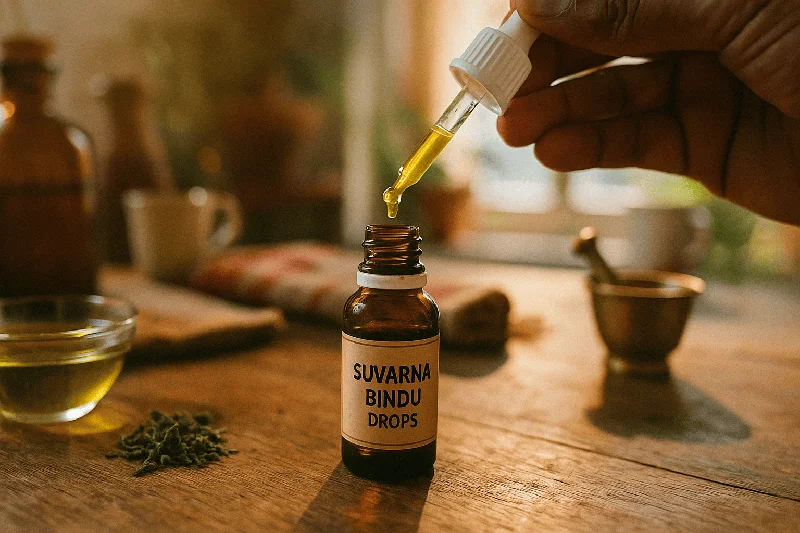
Suvarna Bindu Drops — also known as Swarna Bindu Prashana or Swarnaprashana — is an ancient Ayurvedic immunization practice for children that involves oral administration of purified gold (Swarna Bhasma) mixed with honey, cow's ghee, and potent herbs like Brahmi and Vacha. Rooted in the teachings of Acharya Kashyapa Samhita, this formulation is designed to boost non-specific immunity, enhance memory, improve intellect, and support overall physical and cognitive development in children from birth to 16 years. If you're a parent researching whether Suvarna Bindu Drops are right for your child — or how they compare to conventional vaccination — this guide covers everything you need to know.
What Are Suvarna Bindu Drops (Swarna Bindu Prashana)?
- Suvarna Bindu Drops is an Ayurvedic paediatric formulation that delivers microscopic gold particles (Swarna Bhasma) along with immunomodulatory herbs in a palatable liquid form.
- The term breaks down simply: Swarna means gold, Prashana means the act of ingesting or licking.
- Children receive measured drops orally — typically on an empty stomach — as a form of non-specific immunization.
Unlike modern vaccines that target specific pathogens, Suvarna Bindu Drops work by stimulating the body's overall immune competence. Think of it as training the entire immune army rather than preparing it for a single enemy.
Origin and History in Ayurveda
The practice dates back over 2,500 years. Acharya Kashyapa, one of the foremost authorities on Ayurvedic paediatrics (Kaumarbhritya), documented Swarnaprashana as one of the 16 essential Samskaras (rites) for children. In Kashyapa Samhita's Lehana Adhyaya, the text explicitly states that gold consumed with honey and ghee on Pushya Nakshatra day enhances medha (intellect), agni (digestive fire), bala (strength), and aayush (longevity).
Historically, royal families across ancient India administered gold preparations to their children — not merely as a luxury but as a calculated health investment. The practice declined during colonial rule but has seen a strong revival since the early 2000s, particularly across Karnataka, Kerala, Maharashtra, and Gujarat.
Alternative Names You'll Encounter
This single practice goes by a sometimes confusing array of names.
Here's a quick reference:
| Name | Region / Context |
|---|---|
| Suvarna Bindu Drops | Commercial product name (most common) |
| Swarna Bindu Prashana (SBP) | Clinical / standardized Ayurvedic term |
| Swarnaprashana | Shortened traditional term |
| Suvarnaprashan | Hindi/Marathi variant spelling |
| Swarnamritha Prashana | South Indian variant (Karnataka/Kerala) |
| Swarna Vacha Drops | Some formulations emphasizing Vacha herb |
All of these refer to essentially the same core practice — oral gold-based immunization for children. The differences lie mainly in regional naming conventions and minor variations in herbal composition.
Ingredients of Suvarna Bindu Drops
- The formulation follows a precise Ayurvedic rationale where each ingredient serves a specific pharmacological role.
- No single ingredient works in isolation — the synergy matters.
Swarna Bhasma (Gold Ash / Gold Nanoparticles)
The star ingredient. Swarna Bhasma is produced through a rigorous Ayurvedic process called Bhasmikaran — repeated cycles of calcination that convert pure gold into biocompatible nanoparticles typically ranging from 28–56 nm in size. Modern research published in the International Journal of Pharmaceutical Sciences and Research (2017) confirmed that these particles qualify as gold nanoparticles (AuNPs) by contemporary nanotechnology standards.
What makes this fascinating is the mechanism. A 2020 study in AYU Journal demonstrated that gold nanoparticles interact with dendritic cells — the "sentinel" cells of the immune system. When AuNPs contact dendritic cells, they promote dendritic cell maturation, which in turn activates T-cells and triggers a robust cytokine response. This explains the broad-spectrum immunomodulatory effect that Ayurvedic texts described thousands of years before anyone knew what a T-cell was.
The nanoparticle form also matters for bioavailability. Different shapes (spherical, rod-shaped) and surface charges of gold particles influence how they interact with biological membranes. The traditional Bhasmikaran process, interestingly, produces predominantly spherical particles with characteristics favorable for cellular uptake.
Honey (Madhu) and Cow's Ghee (Go-Ghrita)
These two serve as Anupana (vehicle) and are combined in unequal proportions — a deliberate Ayurvedic principle. Honey acts as a Yogavahi (bioenhancer), improving the absorption of gold and herb actives across mucosal membranes. Cow's ghee provides lipid-soluble transport, crosses the blood-brain barrier, and is considered Medhya (intellect-promoting) in its own right.
- Important note: Ayurveda strictly warns against mixing honey and ghee in equal proportions, considering it Viruddha Ahara (incompatible combination).
- In Suvarna Bindu Drops, the ratio is always unequal — typically more honey than ghee.
Key Herbal Ingredients
| Herb | Sanskrit Name | Primary Action |
|---|---|---|
| Bacopa monnieri | Brahmi | Memory enhancement, neuroprotection, anxiolytic |
| Acorus calamus | Vacha | Speech and cognitive development, digestive stimulant |
| Convolvulus pluricaulis | Shankhapushpi | Intellect promoter, calming effect on nervous system |
| Withania somnifera | Ashwagandha | Adaptogenic, strengthening, immune-boosting |
| Tinospora cordifolia extract | Guduchi Satva | Immunomodulatory, anti-inflammatory, hepatoprotective |
| Glycyrrhiza glabra | Yashtimadhu | Soothes respiratory tract, enhances voice, anti-allergic |
Each herb is classified as Medhya Rasayana (intellect-rejuvenating) in Ayurvedic pharmacology. Together, they create a formulation that simultaneously supports the immune, nervous, and digestive systems.
Benefits of Suvarna Bindu Drops (Suvarna Prashan Drops Benefits)
- The benefits span multiple organ systems, which is characteristic of Rasayana (rejuvenative) therapy in Ayurveda.
- Here's what the classical texts claim — and what modern research supports.
Immune System Enhancement
- This is the primary benefit.
- Suvarna Bindu Drops stimulate both arms of the immune system:
- Cellular immunity: Activation of T-lymphocytes, natural killer cells, and macrophages
- Humoral immunity: Enhanced antibody production (IgG, IgA levels)
A clinical study conducted at SDM College of Ayurveda, Hassan (2012), involving 100 children aged 0–16 years, found that children receiving Swarnaprashana showed statistically significant improvements in serum IgG levels compared to the control group after 6 months of administration (p < 0.05). Another observational study published in the Journal of Ayurveda and Integrative Medicine (2019) reported fewer episodes of upper respiratory tract infections in the Swarnaprashana group.
Memory, Intellect, and Cognitive Development
The Medhya herbs — particularly Brahmi and Shankhapushpi — have substantial clinical evidence for cognitive enhancement. A 2014 double-blind RCT published in Evidence-Based Complementary and Alternative Medicine showed that Bacopa monnieri improved attention, cognitive processing, and working memory in children aged 6–14 over 12 weeks.
When combined with the neuroprotective properties of gold nanoparticles (which can cross the blood-brain barrier via the ghee medium), the cognitive benefits are potentially amplified.
Support for Children with Developmental Challenges
Several Ayurvedic clinicians — including practitioners at AYUSH-approved hospitals across Karnataka — report improvements in children with:
- Autism spectrum disorder (ASD): Better eye contact, reduced repetitive behaviours
- ADHD: Improved attention span and reduced hyperactivity
- Delayed speech development: Earlier speech milestones when combined with Vacha-based formulations
- Delayed motor milestones: Improved muscle tone and coordination
- Dyslexia and learning difficulties: Better reading comprehension and focus
- It's critical to note: these are observational reports and clinical experience, not Level 1 evidence from large RCTs.
- Suvarna Bindu Drops should complement — not replace — conventional developmental therapies like occupational therapy, speech therapy, or behavioral interventions.
Physical Strength and Digestive Health
Ashwagandha and Guduchi Satva contribute to Bala (physical strength) while Vacha and honey support Agni (digestive fire). Parents frequently report that children on regular Swarnaprashana have better appetite, improved digestion, and stronger physical endurance.
Intergenerational Immunity (Kashyapa's Claim)
One remarkable — and scientifically provocative — claim from Kashyapa Samhita is that Swarnaprashana administered properly can build resistance that transfers to the next generation. While this sounds like epigenetic inheritance of immune traits, no modern study has directly confirmed this specific claim yet. However, the emerging field of transgenerational epigenetics suggests such mechanisms are at least biologically plausible.
Dosage of Suvarna Bindu Drops (Swarna Bindu Prashana Dosage)
Dosage depends primarily on the child's age. Here is the standard guideline followed by most AYUSH-registered practitioners:
Age-Wise Dosage Chart
| Age Group | Recommended Dose | Frequency |
|---|---|---|
| 0–6 months | 1–2 drops | Once daily or on Pushya Nakshatra day |
| 6 months – 1 year | 2–3 drops | Once daily or on Pushya Nakshatra day |
| 1–5 years | 3–4 drops | Once daily or on Pushya Nakshatra day |
| 5–12 years | 4–5 drops | Once daily or on Pushya Nakshatra day |
| 12–16 years | 5–6 drops | Once daily or on Pushya Nakshatra day |
Daily vs. Pushya Nakshatra Administration
There are two schools of thought:
Daily administration: A measured dose every morning on an empty stomach. Kashyapa Samhita recommends a 30-day course for immediate immune boosting, extendable to 6 months for long-term benefits. Pushya Nakshatra days only: Pushya Nakshatra is a specific lunar mansion (Nakshatra) that occurs approximately every 27 days. Ayurvedic tradition holds that gold's potency is maximized when consumed on this day. Many community health camps administer Swarnaprashana exclusively on Pushya Nakshatra dates.
For parents following the Pushya Nakshatra schedule — you'll find that the dates shift each month since the Hindu Panchang follows a lunar calendar.
Pushya Nakshatra Dates for 2025 (approximate):
| Month | Pushya Nakshatra Date |
|---|---|
| January | January 9 |
| February | February 5 |
| March | March 5 |
| April | April 1 & April 28 |
| May | May 26 |
| June | June 22 |
| July | July 19 |
| August | August 16 |
| September | September 12 |
| October | October 9 |
| November | November 6 |
| December | December 3 & December 30 |
Note: Exact timings vary by region. Consult a local Panchang or Ayurvedic centre for precise muhurta timings.
How to Administer Suvarna Bindu Drops: Step-by-Step Guide
Getting the administration right matters.
Here's a practical, parent-friendly guide:
Step 1 — Timing: Give drops in the early morning, ideally before sunrise or at least 30 minutes before the child's first feed or breakfast. Step 2 — Preparation: Shake the bottle gently. Do not heat the drops. Ensure your hands are clean. Step 3 — Positioning: For infants (0–12 months), hold the baby in a semi-reclined position at approximately 45 degrees. For older children, they can sit upright. Step 4 — Administration: Using the dropper provided, place the prescribed number of drops directly on the child's tongue. For very young infants, you can place drops on a clean finger and gently apply to the inner lip or tongue. Step 5 — Post-administration: Do not give food or water for at least 30 minutes after administration. This allows optimal mucosal absorption. Step 6 — Observation: Watch for any unusual reactions for 15–20 minutes. While adverse reactions are extremely rare, first-time users should stay alert.
Storage and Shelf Life Recommendations
This is an area no competitor covers adequately, so here are detailed guidelines:
- Temperature: Store between 15–25°C (room temperature). Avoid refrigeration unless the manufacturer specifies otherwise — cold temperatures can cause honey in the formulation to crystallize, altering consistency.
- Light protection: Keep in the original amber/dark glass bottle away from direct sunlight. UV exposure can degrade herbal actives.
- Shelf life (unopened): Typically 24–36 months from date of manufacture (check packaging).
- Shelf life (after opening): Use within 3–6 months of opening. Mark the opening date on the bottle.
- Hygiene: Never touch the dropper tip to any surface, including the child's mouth. This prevents microbial contamination.
- Travel: Carry in an insulated pouch if traveling in temperatures above 35°C.
Suvarna Bindu Drops vs Standard Vaccination: Understanding the Difference
This is perhaps the most searched — and most misunderstood — comparison among parents. Let's be clear and precise.
| Parameter | Suvarna Bindu Drops (Swarnaprashana) | Standard Vaccination |
|---|---|---|
| Type of immunity | Non-specific / general immunomodulation | Specific / pathogen-targeted |
| Mechanism | Stimulates overall immune competence (innate + adaptive) | Introduces antigens to create specific antibodies |
| Protects against | General susceptibility to infections, recurrent illness | Specific diseases (polio, measles, hepatitis B, etc.) |
| Evidence level | Traditional use + limited clinical studies | Extensive Phase I–IV clinical trials, WHO-validated |
| Administration period | Birth to 16 years, ongoing | Fixed schedule as per national immunization program |
| Regulatory status | AYUSH-approved Ayurvedic formulation | Approved by DCGI, WHO, national drug authorities |
| Side effects | Very rare (mild GI disturbance in some cases) | Mild fever, injection-site soreness (common and temporary) |
| Can they be combined? | Yes — they are complementary | Yes — they are complementary |
The critical point: Suvarna Bindu Drops are NOT a replacement for standard vaccinations. They are complementary. Your child should receive all vaccinations as per the Indian Academy of Pediatrics (IAP) schedule. Swarnaprashana adds an additional layer of non-specific immunity on top of the specific protection that vaccines provide.
Many integrated paediatric clinics in India — particularly in Karnataka and Kerala — now recommend both conventional vaccines and Swarnaprashana simultaneously.
Safety, Side Effects, and Contraindications
Is Suvarna Bindu Drops Safe for Babies?
When prepared by a qualified Ayurvedic pharmacy with properly processed Swarna Bhasma and administered in recommended doses, Suvarna Bindu Drops have an excellent safety profile. Kashyapa Samhita itself mentions that the formulation is safe from birth — provided the ingredients are authentic and dosage is age-appropriate.
A 2018 safety review published in the Journal of Ayurveda and Integrative Medicine assessed Swarna Bhasma toxicity and concluded that properly prepared gold Bhasma (meeting Ayurvedic Pharmacopoeia of India standards) showed no evidence of heavy metal toxicity, hepatotoxicity, or nephrotoxicity in animal models at therapeutic doses.
Known Side Effects
Side effects are rare but can include:
- Mild gastrointestinal disturbance (loose stools, nausea) — usually self-limiting
- Occasional mild skin rash in children with honey sensitivity
- Slight increase in salivation immediately after administration
When NOT to Give Suvarna Bindu Drops
| Contraindication | Reason |
|---|---|
| Active fever (Jwara) | Gold may aggravate Pitta during febrile states |
| Acute diarrhea or dysentery | Impaired absorption; may worsen GI symptoms |
| Active vomiting | Risk of aspiration; poor absorption |
| Known gold allergy | Rare but exists; perform patch test if uncertain |
| Indigestion / Ama state | When digestive fire is severely compromised, Bhasma won't be properly assimilated |
Drug Interactions
There is limited documented interaction data between Suvarna Bindu Drops and allopathic medications.
However, as a precautionary principle:
- Maintain a 2-hour gap between Suvarna Bindu Drops and any allopathic medication
- If your child is on immunosuppressant therapy (e.g., for autoimmune conditions or post-transplant), consult both your paediatrician and an Ayurvedic physician before starting
- If your child is taking anticoagulant or antiplatelet drugs, note that some herbal ingredients may have mild blood-thinning effects
- Always inform all treating physicians — both AYUSH and allopathic — about all medications your child receives
Comparing Commercial Suvarna Bindu Drops Products
Since no competitor provides this comparison, here's an objective overview to help parents make informed choices. (Note: This is for informational purposes; we do not endorse any specific brand.)
| Parameter | What to Look For |
|---|---|
| Swarna Bhasma concentration | Should be explicitly stated on the label (usually 0.0625–0.125 mg per drop) |
| Manufacturing license | Must have AYUSH/Drug Manufacturing License number |
| GMP certification | Look for WHO-GMP or GMP certification mark |
| FSSAI registration | Required if classified as health supplement |
| Ingredient transparency | Full ingredient list with botanical names and proportions |
| Batch testing | Ask if heavy metal testing reports are available (should test for lead, mercury, arsenic) |
| Price range | Typically ₹200–₹800 per bottle (10–30 ml); suspiciously cheap products may compromise on gold quality |
| Expiry and manufacturing date | Clearly printed; avoid products without these |
Red flags to watch for:
- No mention of Swarna Bhasma concentration
- Missing manufacturing license
- Claims of "100% cure" for specific diseases
- No listed ingredients or proprietary formula without any disclosure
- Unusually low price (authentic Swarna Bhasma is expensive; gold quality has a floor cost)
Scientific Mechanism: How Gold Nanoparticles Work in the Body
For the science-minded parent (or the medical professional reading this), here's a deeper look at what's happening at the cellular level.
Nanoparticle Interaction with Immune Cells
- Gold nanoparticles in Swarna Bhasma — typically 28–56 nm in diameter — are small enough to be internalized by antigen-presenting cells (APCs), particularly dendritic cells.
- Research published in ACS Nano (2015) demonstrated that:
- AuNPs are phagocytosed by immature dendritic cells
- This triggers dendritic cell maturation (upregulation of CD80, CD86, MHC-II surface markers)
- Mature dendritic cells then migrate to lymph nodes
- T-cell activation follows, producing both Th1 (cellular) and Th2 (humoral) responses
- Cytokine production (IL-2, IL-12, IFN-γ) increases, enhancing immune surveillance
This is not hypothetical — it's documented in peer-reviewed nanotechnology literature. The Ayurvedic process of Bhasmikaran essentially created biocompatible nanoparticles centuries before the term "nanotechnology" existed.
Green Synthesis Parallel
Modern scientists now pursue "green synthesis" of gold nanoparticles using plant extracts, proteins, and polysaccharides — precisely what Ayurvedic processing achieves with herbal juices during Bhasmikaran. A 2021 review in Nanomaterials journal noted that biologically synthesized AuNPs show superior biocompatibility compared to chemically synthesized ones — another vindication of the traditional approach.
COVID-19 and Future Pandemic Relevance
During the COVID-19 pandemic, the Ministry of AYUSH recommended Swarnaprashana as a supportive measure for children's immunity. While Suvarna Bindu Drops were not positioned as a treatment for COVID-19, the non-specific immune enhancement they provide — particularly the activation of innate immune pathways — is relevant to preparedness for novel pathogens where no specific vaccine yet exists.
A perspective article in Journal of Ayurveda and Integrative Medicine (2020) explicitly discussed Swarnaprashana's potential role in building population-level immune resilience against future viral pandemics.
Expert Opinions
Dr. Prasanna N. Rao, Former Principal, SDM College of Ayurveda, Hassan, Karnataka: "In over 15 years of administering Swarnaprashana to thousands of children, I have observed consistent improvements in immunity, appetite, and cognitive milestones. The practice is safe when done with properly manufactured formulations and I recommend it as a complement to the standard vaccination schedule." Dr. B. S. Prasad, Research Officer (Ayurveda), Central Council for Research in Ayurvedic Sciences (CCRAS): "Swarnaprashana represents one of the most promising areas of Ayurvedic paediatric research. We need larger multi-centre RCTs, but the preliminary clinical data and the immunological rationale are compelling." A note on evidence: While expert opinions and traditional textual authority carry weight in Ayurveda, parents should know that large-scale, double-blind, placebo-controlled trials specifically on commercial Suvarna Bindu Drops products remain limited. The strongest evidence exists for individual ingredients (Swarna Bhasma, Brahmi, Ashwagandha) rather than the specific combined formulation.
Frequently Asked Questions (FAQ)
Does Suvarnaprashan really work for babies?
- Yes, when administered correctly. Kashyapa Samhita recommends starting from birth. Clinical observations across multiple Ayurvedic institutions show that infants on Swarnaprashana tend to have fewer episodes of common colds, better weight gain, and timely developmental milestones.
- However, results vary — some children show noticeable improvements within 1–3 months, while others may take 6+ months of consistent use.
What is the age limit for Swarna Bindu Prashana?
The classical texts specify birth to 16 years. After 16, Ayurveda considers the individual's immune and cognitive faculties to be largely established. Some practitioners extend usage to adults in specific situations (low immunity, recovery from illness), but this is not standard protocol.
Can I give Suvarna Bindu Drops along with regular vaccinations?
Absolutely yes. They work through entirely different mechanisms and do not interfere with each other. Many paediatricians and Ayurvedic doctors in India now recommend both. Just maintain a gap of 24–48 hours between a vaccination day and Swarnaprashana to avoid confusing any mild reactions from either.
What should I do if my child misses a dose?
Simply continue with the next scheduled dose. Do not double the dose. If you're following the Pushya Nakshatra schedule, wait for the next Pushya Nakshatra date. If you're on a daily regimen, resume the next morning. Missing occasional doses does not undo the cumulative benefit.
How much do Swarna Bindu Drops cost?
Prices range from approximately ₹200 to ₹800 per bottle (10–30 ml), depending on brand, gold concentration, and where you purchase. Pushya Nakshatra community camps run by Ayurvedic colleges sometimes offer free or subsidized doses — check with local AYUSH hospitals.
Can Suvarna Bindu Drops help with autism or ADHD?
Anecdotal and observational evidence from Ayurvedic clinicians suggests improvements in attention, social interaction, and speech in some children with ASD and ADHD. However, these are not cures. Swarnaprashana should be part of a comprehensive management plan that includes behavioral therapy, speech therapy, and regular monitoring by qualified professionals.
Are there any long-term observational studies?
The longest published observational data comes from SDM College of Ayurveda, Hassan, where children have been followed over 5+ years. These observations report sustained immunity benefits, fewer hospitalizations for infectious diseases, and good academic performance. However, these are not controlled studies with a formal comparison group — a limitation that the Ayurvedic research community acknowledges and is working to address through CCRAS-funded multi-centre trials.
Conclusion: Making an Informed Decision for Your Child
Suvarna Bindu Drops represent one of Ayurveda's most sophisticated paediatric interventions — a practice that combines gold nanotechnology (centuries before that word existed), immunomodulatory herbs, and a carefully designed delivery system of honey and ghee. The evidence base, while still growing, is supported by traditional textual authority, modern immunological rationale, and accumulating clinical observations.
Here's what we recommend:
- Consult a qualified Ayurvedic physician (BAMS or MD Ayurveda) before starting — they'll assess your child's Prakriti (constitution) and current health status
- Choose products wisely — verify AYUSH manufacturing license, GMP certification, and transparent ingredient labeling
- Continue standard vaccinations — Swarnaprashana complements but never replaces them
- Be patient and consistent — immune building is a gradual process; expect meaningful results over 3–6 months of regular use
- Keep records — note your child's illness frequency, appetite, and developmental milestones before and during Swarnaprashana for your own assessment
If you have specific questions about Suvarna Bindu Drops for your child's unique health situation, consult a certified Ayurvedic doctor who can provide personalized guidance based on your child's age, weight, health history, and constitution.
Scientific Sources
- Ayurveda, malaria and the indigenous herbal tradition in Sri Lanka — Silva KT, 1991, Social science & medicine (1982)
- Utilization of Ayurveda in health care: an approach for prevention, health promotion, and treatment of disease.Part 1--Ayurveda, the science of life — Sharma H et al., 2007, Journal of alternative and complementary medicine (New York, N.Y.)
- Treatment of fibromyalgia at the Maharishi Ayurveda Health Centre in Norway II--a 24-month follow-up pilot study — Rasmussen LB et al., 2012, Clinical rheumatology
- Ayurveda in Early Life to Prevent Noncommunicable Diseases From Epigenetical Alterations — Kuldeep C et al., 2021, Alternative therapies in health and medicine
- Brain enhancing ingredients from Āyurvedic medicine: quintessential example of Bacopa monniera, a narrative review — Singh HK, 2013, Nutrients
- Ayurvedic genomics: establishing a genetic basis for mind-body typologies — Patwardhan B et al., 2008, Journal of alternative and complementary medicine (New York, N.Y.)
- Legal status of ayurveda in the healthcare system — Pashkov VМ et al., 2025, Polski merkuriusz lekarski : organ Polskiego Towarzystwa Lekarskiego
- Utilization of Ayurveda in health care: an approach for prevention, health promotion, and treatment of disease.Part 2--Ayurveda in primary health care — Sharma H et al., 2007, Journal of alternative and complementary medicine (New York, N.Y.)
- Bioethics and ayurveda — Valiathan MS, 2008, Indian journal of medical ethics
- Integrative Skin Care: Dermatology and Traditional and Complementary Medicine — Bodeker G et al., 2017, Journal of alternative and complementary medicine (New York, N.Y.)
- Uphill struggle — Owen A, 1996, Nursing times
- Lead poisoning outbreak from consumption of contaminated Ayurvedic medication — Ferson MJ et al., 2022, The Medical journal of Australia
- Network Pharmacology of Ayurveda Formulation Triphala with Special Reference to Anti-Cancer Property — Chandran U et al., 2015, Combinatorial chemistry & high throughput screening
- An overview of CAM: components and clinical uses — Kiefer D et al., 2009, Nutrition in clinical practice : official publication of the American Society for Parenteral and Enteral Nutrition
- The Microbiome in Health and Disease from the Perspective of Modern Medicine and Ayurveda — Wallace RK, 2020, Medicina (Kaunas, Lithuania)
- Market Analysis of Medicinal Plants in India — Ravi S et al., 2019, Current pharmaceutical biotechnology
- Therapeutic potential of Phyllanthus emblica (amla): the ayurvedic wonder — Krishnaveni M et al., 2010, Journal of basic and clinical physiology and pharmacology
- Combined Ayurveda and Yoga Practices for Newly Diagnosed Type 2 Diabetes Mellitus: A Controlled Trial — Datey P et al., 2018, Complementary medicine research
- The use and safety of non-allopathic Indian medicines — Gogtay NJ et al., 2002, Drug safety
- Twenty-eight days of repeated dose sub-acute toxicological evaluation of polyherbal Ayurvedic medicine BPGrit in Sprague-Dawley rats — Balkrishna A et al., 2024, Journal of applied toxicology : JAT
Ask Ayurvedic doctor a question and get a consultation online on the problem of your concern in a free or paid mode.
More than 2,000 experienced doctors work and wait for your questions on our site and help users to solve their health problems every day.
Related articles