Stress Management through Ayurveda
Stress is not just a modern buzzword — it is a silent epidemic. According to a 2021 Times of India survey, 82% of Indians report experiencing high levels of stress, and globally the numbers are equally alarming. If you have been looking for a way to manage stress that goes beyond popping pills, Ayurveda stress management offers a time-tested, holistic system that treats the root cause rather than masking symptoms. Ayurveda views stress (called Sahasa) as a force that depletes your vital immunity (Ojas), disrupts your mind-body balance, and eventually leads to chronic disease. Through personalized herbal remedies, therapeutic procedures, dietary routines, yoga, and meditation, Ayurveda provides a structured path back to equilibrium — one that modern science is increasingly validating.
This guide covers everything: from understanding your unique stress type based on your dosha, to a week-by-week action plan, specific herb dosages, scientific evidence, and even how Ayurvedic methods compare to Western approaches like CBT and pharmaceutical interventions.
What Is Stress in Ayurveda? Understanding Sahasa and Ojas Depletion
In Western medicine, stress is broadly defined as the body's response to any demand or threat. Hans Selye's classic General Adaptation Syndrome describes three stages: alarm, resistance, and exhaustion. Remarkably, Ayurveda identified a parallel framework thousands of years ago.
Ayurveda calls stress Sahasa — the act of exerting beyond one's capacity. When you push past your limits physically, emotionally, or mentally, you deplete Ojas, the subtle essence of all bodily tissues that governs immunity, vitality, and emotional resilience. This condition, known as Ojah Kshaya, is essentially what modern medicine would describe as adrenal fatigue combined with immunosuppression.
The Three Sources of Stress: Adhyatmik, Adhidaivik, and Adhibhautik
The ancient philosopher Gaudapada, in the Samkhya-Karika, classified all suffering into three categories — a framework that remains profoundly relevant:
- Adhyatmik (Internal/Self-generated): Stress originating from within — anxiety, negative thought patterns, unresolved emotions, and psychosomatic illness. This is the most common type in modern life.
- Adhidaivik (Supernatural/Environmental): Stress from forces beyond human control — natural disasters, pandemics, seasonal changes, and cosmic influences. Think of how your mood shifts during monsoon season or extreme heat.
- Adhibhautik (External/Interpersonal): Stress caused by other beings — toxic relationships, workplace conflict, financial pressure from societal expectations.
This classification is unique because Western psychology typically doesn't differentiate stress by origin in this structured way. Identifying which category your stress falls into is the first step toward selecting the right Ayurvedic intervention.
The Three Gunas and Selye's Stress Model
Ayurveda also connects stress response to the three mental qualities (gunas):
| Guna | Mental State | Selye's Parallel | Stress Response |
|---|---|---|---|
| Sattva | Clarity, balance | Healthy adaptation | Resilient coping, calm problem-solving |
| Rajas | Agitation, ambition | Alarm/Resistance phase | Anxiety, restlessness, over-reactivity |
| Tamas | Inertia, darkness | Exhaustion phase | Depression, withdrawal, hopelessness |
The goal of Ayurvedic stress management is to cultivate Sattva — a state of mental clarity and equilibrium — while reducing Rajas (agitation) and Tamas (lethargy).
How Do the Three Doshas Shape Your Stress Response?
Not everyone experiences stress the same way, and Ayurveda explains why. Your constitutional type (Prakriti), determined by the dominance of Vata, Pitta, or Kapha doshas, directly influences how stress manifests in your body and mind.
Vata-Type Stress
Dominant emotions: Fear, anxiety, overwhelm, racing thoughts Physical signs: Insomnia, dry skin, constipation, muscle twitching, irregular heartbeat Triggers: Change, uncertainty, travel, lack of routine, cold weather
Vata individuals are most susceptible to stress because Vata governs the nervous system. When aggravated, it literally scatters your mental energy.
Pitta-Type Stress
Dominant emotions: Irritability, anger, frustration, perfectionism Physical signs: Acid reflux, skin rashes, inflammation, burning eyes, headaches Triggers: Competition, injustice, heat, time pressure, feeling out of control
Pitta types don't just feel stressed — they combust. Their stress often manifests as anger directed outward or inward self-criticism.
Kapha-Type Stress
Dominant emotions: Sadness, attachment, emotional eating, withdrawal Physical signs: Weight gain, lethargy, excessive sleep, congestion, water retention Triggers: Loss, loneliness, stagnation, lack of stimulation
Kapha stress is the slowest to develop but often the hardest to shake. It can look a lot like clinical depression.
Quick Self-Assessment: What's Your Stress Dosha?
- Use this checklist to identify your dominant stress pattern.
- Check the statements that apply to you when you're stressed:
Vata (Nervous Stress)
- I can't stop worrying or overthinking
- My sleep is disrupted or light
- I feel spacey, scattered, or ungrounded
- I lose my appetite or forget to eat
Pitta (Fiery Stress)
- I snap at people more than usual
- I get headaches or stomach acidity
- I feel the need to control everything
- I become overly critical of myself or others
Kapha (Heavy Stress)
- I want to sleep all day or binge-eat comfort food
- I feel emotionally numb or stuck
- I avoid social situations and withdraw
- I gain weight easily during stressful periods
The category with the most checks reveals your primary stress dosha — and determines which herbs, therapies, and routines will work best for you.
Which Ayurvedic Medicines Reduce Stress? Herbs, Dosages, and How They Work
This is where most guides fail. They mention Ashwagandha and Brahmi but never tell you how much to take, in what form, or how these herbs actually work in your body. Let's fix that.
How Ayurvedic Adaptogens Interact with the HPA Axis
The hypothalamic-pituitary-adrenal (HPA) axis is your body's central stress response system. When you perceive a threat, the hypothalamus signals the pituitary gland, which tells the adrenals to pump out cortisol. Chronic stress keeps this axis locked in overdrive.
- Ayurvedic adaptogenic herbs work by modulating this axis.
- They don't simply suppress cortisol — they help the body recalibrate its stress response to an appropriate level. This is why adaptogens can help both anxious (high-cortisol) and exhausted (burned-out, low-cortisol) individuals.
Key Herbs with Dosages and Forms
| Herb | Primary Action | Best For | Recommended Dosage | Form | Duration |
|---|---|---|---|---|---|
| Ashwagandha (Withania somnifera) | Reduces cortisol, strengthens Ojas | Vata & Kapha stress, anxiety, insomnia | 300–600 mg standardized extract daily | Capsule or churna (powder) with warm milk | 8–12 weeks |
| Brahmi (Bacopa monnieri) | Enhances GABA, improves cognition | Mental fatigue, poor focus, Pitta stress | 300–450 mg standardized extract daily | Capsule, tablet, or fresh juice | 8–12 weeks |
| Jatamansi (Nardostachys jatamansi) | Calms nervous system, promotes sleep | Insomnia, emotional volatility, Vata stress | 250–500 mg powder twice daily | Churna or tablet | 4–8 weeks |
| Shankhpushpi (Convolvulus pluricaulis) | Anxiolytic, memory-enhancing | Anxiety, ADHD-like symptoms, exam stress | 3–6 g powder or 2 tsp syrup daily | Powder, syrup, or decoction | 4–12 weeks |
| Vacha (Acorus calamus) | Stimulates intellect, clears Tamas | Brain fog, depressive stress, speech issues | 125–500 mg powder twice daily | Churna with honey | 4–6 weeks |
Rasayana Formulations: Compound preparations like Chyawanprash (1–2 tsp daily), Manasamithra Vatakam, and Saraswatarishta (15–30 ml after meals) combine multiple herbs for synergistic stress relief. Ksheerabala Thailam is specifically used for nervous system rejuvenation in both oral and external application.
The Science Behind Ashwagandha and Cortisol
A landmark 2012 study published in the Indian Journal of Psychological Medicine found that participants taking 300 mg of Ashwagandha root extract twice daily for 60 days showed a 28% reduction in serum cortisol levels compared to placebo. They also reported significant improvements in perceived stress, anxiety, and overall well-being. The mechanism involves Ashwagandha's withanolides mimicking GABA activity and modulating serotonin signaling — essentially helping the brain switch from "alarm mode" to "rest-and-digest mode."
> Important: Always consult a qualified Ayurvedic practitioner (Vaidya) before starting any herbal regimen, especially if you are pregnant, breastfeeding, on antidepressants, or have cardiovascular conditions.
Ayurvedic Therapies and Procedures for Deep Stress Relief
While herbs work from the inside, Ayurvedic external therapies provide profound neuro-muscular relaxation that pills simply cannot replicate.
Abhyanga (Warm Oil Massage)
Daily self-massage with warm sesame oil (for Vata), coconut oil (for Pitta), or mustard oil (for Kapha) is perhaps the single most effective daily anti-stress practice in Ayurveda. A 2019 study demonstrated that regular Abhyanga significantly reduces subjective stress markers and improves sleep quality. The warm oil penetrates the skin, nourishes the nerve endings, and calms the nervous system within minutes.
How to do it at home: Warm the oil slightly. Massage your scalp, forehead, soles of feet, and entire body using long strokes on limbs and circular motions on joints. Leave on for 15–20 minutes, then shower with warm water.
Shirodhara (Continuous Oil Stream on Forehead)
This iconic Ayurvedic therapy involves gently pouring a continuous stream of warm medicated oil over the forehead (specifically the Ajna or third-eye area) for 30–45 minutes. The rhythmic flow induces a meditative state and has been shown to reduce noradrenaline levels. It's particularly effective for anxiety, insomnia, and Vata-type stress. This one needs to be done by a trained therapist, though.
Nasya (Nasal Oil Administration)
A lesser-known but highly effective technique: instilling 2–3 drops of medicated oil (like Anu Taila) into each nostril. The nasal passage has direct connections to the brain, making this a fast-acting route for calming the central nervous system. Best done in the morning after gentle facial steam.
Panchakarma for Chronic Stress
For deeply entrenched, chronic stress, Ayurveda recommends Panchakarma — a comprehensive five-fold detoxification program. A 2017 study found that Panchakarma significantly reduced anxiety and fatigue markers in participants undergoing the full treatment course. The five procedures (Vamana, Virechana, Basti, Nasya, and Raktamokshana) are selected based on individual constitution and performed over 7–21 days under medical supervision.
Contraindications for Ayurvedic Stress Therapies
- Not everyone is a candidate for every therapy.
- Avoid or modify treatments in these situations:
- Pregnancy: Most Panchakarma procedures are contraindicated; Abhyanga is generally safe with appropriate oils
- Active cardiovascular disease: Shirodhara and Abhyanga require medical clearance
- Substance dependency: Certain herbal formulations may interact with withdrawal management
- Acute fever or infection: Postpone all oil-based therapies until recovery
- Very young children or frail elderly: Lighter, modified protocols needed
Diet, Sleep, and Daily Routine: The Three Pillars of Stress Resilience
Ayurveda identifies Traya Upastambha — three foundational pillars of health — that must be balanced before any treatment can be fully effective: Ahara (food), Nidra (sleep), and Brahmacharya (balanced use of vital energy).
Stress-Reducing Diet by Dosha
For Vata stress: Favor warm, cooked, slightly oily foods. Soups, stews, ghee, warm milk with nutmeg. Avoid raw salads, cold drinks, caffeine, and dry snacks. For Pitta stress: Favor cooling, slightly sweet foods. Coconut water, cucumber, sweet fruits, milk, rice. Avoid spicy food, alcohol, fermented foods, and excessive sour/salty tastes. For Kapha stress: Favor light, warm, spiced foods. Ginger tea, steamed vegetables, millet, honey. Avoid heavy dairy, fried foods, excessive sweets, and overeating.
The 80/20 Rule in Ayurveda
- This is a practical Ayurvedic eating guideline: fill your stomach to only 80% capacity, leaving 20% empty for proper digestion.
- Overeating — especially under stress — aggravates Ama (digestive toxins), which clouds the mind and worsens anxiety. In a practical sense, this means stopping before you feel completely full.
The Critical Role of Sleep (Nidra) in Stress Recovery
- This is a topic most Ayurveda stress articles overlook, but it shouldn't be. Charaka Samhita states that happiness, nourishment, strength, knowledge, and life itself depend on proper sleep.
- Sleep is not passive rest — it's active repair time for the nervous system.
Ayurvedic sleep recommendations for stress:
- Sleep by 10 PM (before the Pitta period of 10 PM–2 AM, which can cause second-wind wakefulness)
- Wake before 6 AM (the Kapha period after 6 AM promotes heaviness and lethargy)
- Apply warm oil to the soles of feet and scalp before bed
- Drink warm milk with a pinch of nutmeg and turmeric
- Avoid screens for at least 45 minutes before sleep
- Jatamansi and Tagara are the herbs of choice for sleep-related stress issues
Dinacharya: Building a Stress-Proof Daily Routine
Dinacharya (daily routine) is arguably the most powerful — and most underestimated — tool in Ayurveda's anti-stress arsenal. A predictable routine grounds Vata, cools Pitta, and energizes Kapha. Core Dinacharya for stress management:
- Wake before sunrise
- Tongue scraping and oil pulling
- Warm water with lemon
- Self-Abhyanga (even 5 minutes helps)
- Yoga/pranayama (20–30 minutes)
- Warm, nourishing breakfast
- Structured work with breaks
- Lunch as the largest meal (noon–1 PM, when Pitta/Agni is strongest)
- Light dinner before sunset
- Evening walk, journaling, or meditation
- Sleep by 10 PM
Yoga, Pranayama, and Meditation: What Are the Best Ways to Manage Stress Naturally?
A 2018 study in the Journal of Clinical Psychology confirmed what Ayurveda has taught for millennia: regular yoga practice significantly reduces perceived stress, cortisol levels, and anxiety symptoms.
Yoga Asanas for Each Stress Type
Vata stress (grounding poses): Balasana (Child's Pose), Viparita Karani (Legs Up the Wall), Supta Baddha Konasana (Reclining Butterfly). Slow, gentle, restorative practice. Pitta stress (cooling poses): Forward bends like Paschimottanasana, Ardha Matsyendrasana (Seated Twist), Shavasana with extended duration. Avoid competitive or heating practices. Kapha stress (stimulating poses): Surya Namaskar (Sun Salutations), Ustrasana (Camel Pose), Bhujangasana (Cobra). Vigorous, energizing practice to break stagnation.
Pranayama Techniques
- Nadi Shodhana (Alternate Nostril Breathing): Balances both hemispheres of the brain. 5–10 minutes daily. Excellent for all doshas.
- Bhramari (Bee Breath): The humming vibration calms the vagus nerve. Highly effective for anxiety and insomnia.
- Sheetali (Cooling Breath): Inhale through a rolled tongue. Best for Pitta-type anger and frustration.
- Kapalabhati: Rapid exhalations energize and clear mental fog. Best for Kapha stress but should be avoided by Vata types.
Meditation and Mindfulness
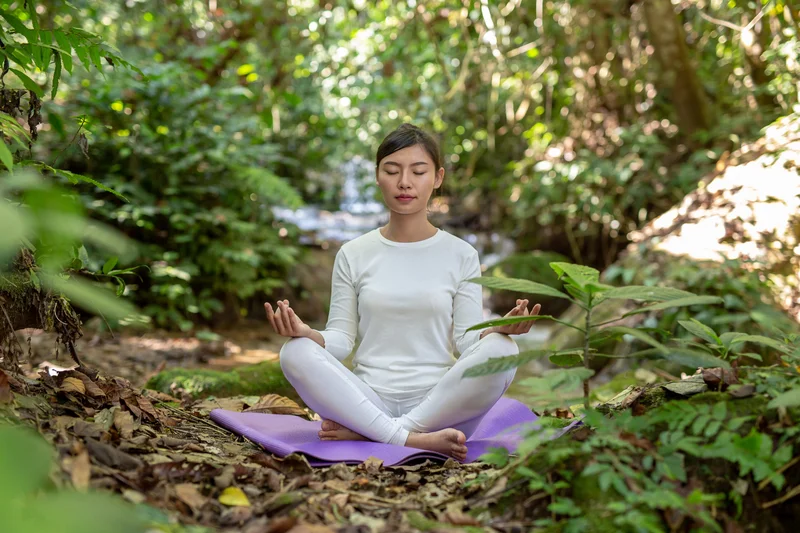
Even 10 minutes of daily meditation changes brain structure over time — increasing grey matter in the prefrontal cortex (executive function) and reducing amygdala reactivity (fear response). Ayurveda traditionally recommends Dhyana (meditation) during the Brahma Muhurta (approximately 4:30–6:00 AM), when Sattva guna is naturally highest.
- Simple practice: Sit comfortably, close your eyes. Focus on the mantra "So-Hum" (I am That).
- Inhale on "So", exhale on "Hum." When the mind wanders — and it will — gently return without judgement.
- Ayurveda vs Western Stress Management: An Honest Comparison
No other guide covers this, and it's something readers genuinely want to know: how does Ayurveda stack up against Western approaches?
| Parameter | Ayurveda | Western (CBT, MBSR, Pharmaceuticals) |
|---|---|---|
| Approach | Holistic — body, mind, spirit, environment | Often compartmentalized — mental OR physical |
| Personalization | Highly personalized by Prakriti (dosha type) | Some personalization (CBT), mostly standardized (drugs) |
| Speed of relief | Gradual (weeks to months) | Faster symptom relief (SSRIs within 2–4 weeks, benzos within minutes) |
| Side effects | Minimal when properly prescribed | Can be significant (dependency, withdrawal, weight gain) |
| Root cause focus | Central philosophy — treats Nidana (cause) | CBT addresses thought patterns; drugs address chemistry, not always the root cause |
| Scientific evidence | Growing but still moderate | Extensive, well-documented |
| Cost | Generally affordable (herbs, self-care practices) | Can be expensive (therapy sessions, medications) |
| Sustainability | High — builds self-reliance and lifestyle change | Variable — medication dependency possible |
- The honest verdict: They are not mutually exclusive.
- The best approach for severe stress is often integrative — using Ayurvedic lifestyle practices and herbs alongside evidence-based therapy like CBT when needed. Never discontinue prescribed psychiatric medication without medical supervision.
A 4-Week Ayurvedic Stress Management Plan for Beginners
- No other resource offers this structured, step-by-step approach.
- Here's your roadmap:
Week 1: Foundation (Ground and Stabilize)
- Establish a consistent wake-up and sleep time
- Begin daily warm water with lemon on waking
- Start 5-minute self-Abhyanga (feet and scalp only)
- Identify your stress dosha using the checklist above
- Remove one major dietary stressor (caffeine, alcohol, processed food)
Week 2: Nourish (Feed Body and Mind)
- Introduce dosha-appropriate dietary changes
- Begin Ashwagandha (300 mg at night with warm milk) or Brahmi (300 mg in the morning) — based on your dosha
- Add 10 minutes of pranayama (Nadi Shodhana recommended for all types)
- Start a simple journaling practice before bed
Week 3: Move and Breathe (Activate Healing)
- Add 20 minutes of dosha-appropriate yoga
- Increase pranayama to 15 minutes
- Begin 10-minute meditation practice
- Schedule one Abhyanga or Shirodhara session with a practitioner if possible
Week 4: Integrate and Sustain
- Full Dinacharya routine in place
- Evaluate herb effectiveness and adjust with practitioner guidance
- Add a Rasayana formula if needed (Chyawanprash, Saraswatarishta)
- Practice the 80/20 eating rule consistently
- Assess your stress levels — most people report noticeable improvement by now
Managing Stress at the Workplace: Micro-Practices
- You can't always escape to a meditation room during a hectic workday.
- Here are quick Ayurvedic interventions:
- 2-minute Bhramari breath at your desk between meetings
- Rose water eye compress to cool Pitta aggravation from screens
- Warm water sipping throughout the day (never ice-cold)
- Spiced lunch eaten mindfully away from your desk — even 15 minutes of conscious eating makes a difference
- Marma point press: Gently press the center of your palm or the point between your eyebrows for 30 seconds to release tension
- 5-minute walking break every 90 minutes to reset Vata
Frequently Asked Questions
What is a natural stress reliever according to Ayurveda?
The most effective natural stress reliever in Ayurveda is a combination of daily Abhyanga (warm oil self-massage), pranayama (breathing exercises), and adaptogenic herbs like Ashwagandha. A 2012 study showed Ashwagandha reduced cortisol by 28% over 60 days. However, Ayurveda emphasizes that no single remedy works in isolation — a consistent daily routine (Dinacharya) is the ultimate natural stress reliever.
What are 7 ways to manage stress with Ayurveda?
- Daily self-Abhyanga with warm herbal oil
- Pranayama (especially Nadi Shodhana and Bhramari)
- Adaptogenic herbs (Ashwagandha, Brahmi, Jatamansi)
- Dosha-appropriate diet following the 80/20 rule
- Consistent sleep schedule aligned with natural cycles
- Daily meditation or Dhyana practice
- Periodic Panchakarma detoxification for deep reset
Can Ayurvedic stress treatments interact with Western medications?
Yes, some herbs can interact with pharmaceuticals. Ashwagandha may potentiate the effects of sedatives and thyroid medications. Brahmi can interact with cholinergic drugs. Always inform both your Ayurvedic practitioner and allopathic doctor about all substances you are taking. Integration should be supervised, never self-directed.
How long does Ayurvedic stress management take to show results?
- Most people experience initial improvements in sleep and anxiety within 2–3 weeks of consistent practice.
- Deeper constitutional changes — like improved stress resilience and reduced reactivity — typically emerge over 8–12 weeks. Chronic stress that has been building for years may require 3–6 months of committed practice plus periodic Panchakarma.
Is Ayurvedic stress management safe for everyone?
While generally safe, there are contraindications. Pregnant women should avoid most Panchakarma procedures and certain herbs (Vacha, strong purgatives). Individuals with severe psychiatric conditions should use Ayurveda as a complement to — not replacement for — professional mental health care. Children and elderly patients need modified dosages and gentler therapies.
Conclusion: Start Your Ayurvedic Stress Relief Journey Today
- Stress isn't something that just goes away on its own. Left unchecked, it depletes your Ojas, disrupts your doshas, and sets the stage for chronic disease. The beauty of Ayurveda's approach is that it doesn't ask you to overhaul your life overnight.
- Start small — a warm oil foot massage before bed tonight, a cup of Ashwagandha milk, five minutes of conscious breathing.
The system works because it addresses why you're stressed (your unique constitution, your specific triggers) rather than just throwing generic solutions at the problem. With thousands of years of wisdom now increasingly backed by modern research, Ayurveda stress management isn't alternative medicine — it's original medicine.
Ready to take the next step? Consult with a certified Ayurvedic practitioner to identify your Prakriti, get personalized herb recommendations, and build a stress management plan tailored to your body, your mind, and your life.
Scientific Sources
- Ayurveda management of post TURP urethral stricture: A case report — Sushendra T et al., 2025, Journal of Ayurveda and integrative medicine
- Evidence-Based Traditional Medicine for Transforming Global Health and Well-Being — Patwardhan B et al., 2023, Journal of integrative and complementary medicine
- Ethnobotanical, phytochemical, toxicology and anti-diabetic potential of Senna occidentalis (L.) link; A review — Lum Nde A et al., 2022, Journal of ethnopharmacology
- Ayurvedic medicine for the treatment of chronic rhinosinusitis: a systematic review of randomized and non-randomized trials — Schmale IL et al., 2023, Journal of complementary & integrative medicine
- Natural Medicines for Psychotic Disorders: A Systematic Review — Hoenders HJR et al., 2018, The Journal of nervous and mental disease
- Evaluating Ayurveda — Bodeker G, 2001, Journal of alternative and complementary medicine (New York, N.Y.)
- Direct evidence for GABAergic activity of Withania somnifera on mammalian ionotropic GABAA and GABAρ receptors — Candelario M et al., 2015, Journal of ethnopharmacology
- Ayurveda and botanical drugs for epilepsy: Current evidence and future prospects — Sriranjini SJ et al., 2015, Epilepsy & behavior : E&B
- Berberine: A Multi-Target Natural PCSK9 Inhibitor with the Potential to Treat Diabetes, Alzheimer's, Cancer and Cardiovascular Disease — Coppinger C et al., 2024, Current reviews in clinical and experimental pharmacology
- People With Non-Communicable Diseases Using Ayurveda: A UK-Based Qualitative Study — Egwumba P et al., 2025, Health expectations : an international journal of public participation in health care and health policy
- Unconventional antidiabetic agents (https://pubmed.ncbi.nlm.nih.gov/17484443/) — Rustenbeck I, 2007, Medizinische Monatsschrift fur Pharmazeuten
- Diabetes mellitus and Alzheimer's disease: Understanding disease mechanisms, their correlation, and promising dual activity of selected herbs — Pramanik R et al., 2024, Journal of ethnopharmacology
- Ayurveda Management of Menorrhagia (Raktapradara): Protocol for a Randomized Controlled Trial — Rajput S et al., 2025, JMIR research protocols
- The use of curcumin as an effective adjuvant to cancer therapy: A short review — Bashang H et al., 2020, Biotechnology and applied biochemistry
- Universal significance of the principle of Samanya and Vishesha beyond Ayurveda — Pandey DN et al., 2018, Journal of Ayurveda and integrative medicine
- The Role of Ayurveda in Prostate Cancer Management — Jabbari P et al., 2025, Integrative cancer therapies
- Promoting evidence-base for Ayurveda — Patwardhan K, 2024, Journal of Ayurveda and integrative medicine
- Time for evidence-based Ayurveda: A clarion call for action — Patwardhan B, 2013, Journal of Ayurveda and integrative medicine
- Recommendations of the committee on complementary medicine and nutrition in ayurvedic medicine, homeopathy, nutrition and Mediterranean diet (https://pubmed.ncbi.nlm.nih.gov/37212842/) — Keyßer G et al., 2023, Zeitschrift fur Rheumatologie
- Ayurveda: (W)here is the evidence — Narayana DBA et al., 2021, Journal of Ayurveda and integrative medicine
आयुर्वेदिक डॉक्टर से एक प्रश्न पूछें और मुफ़्त या सशुल्क मोड में अपनी चिंता की समस्या पर ऑनलाइन परामर्श प्राप्त करें।
2,000 से अधिक अनुभवी डॉक्टर हमारी साइट पर काम करते हैं और आपके प्रश्नों की प्रतीक्षा करते हैं और प्रतिदिन उपयोगकर्ताओं को उनकी स्वास्थ्य समस्याओं को हल करने में मदद करते हैं।
संबंधित आलेख