Ask Ayurvedic doctor a question and get a consultation online on the problem of your concern in a free or paid mode. More than 2,000 experienced doctors work and wait for your questions on our site and help users to solve their health problems every day.


Body DetoxEar, Nose, and Throat DisordersGeriatrics & RejuvenationImmunodeficiencyInfertility TreatmentNutritionOrthopedic DisordersPediatricsRespiratory DisordersSexually Transmitted Diseases (STDs)Surgery RecoveryUrological DisordersVascular DisordersDental DisordersEndocrinological DisordersGastrointestinal DisordersYoga TherapyGeneral MedicineAllergic DisordersCardio DisordersGynecology and ObstetricsCosmetologySkin and Hair DisordersEye DisordersInfectious DiseasesMental DisordersNeurological DisordersOncologyPanchakarmaSexual Health & DisordersSports Medicine
Published on 12/16/24
(Updated on 08/15/26)
3,460
Akshi Tarpana Benefits: Nourish and Rejuvenate Your Eyes with Ayurveda

In an age where over 2.2 billion people globally suffer from some form of vision impairment — and India alone accounts for roughly 40 million blind or visually impaired individuals — the search for effective, gentle eye therapies has never been more urgent. Akshi Tarpana (also spelled Akshi Tarpanam) is a specialized Ayurvedic ophthalmic procedure in which warm medicated ghee is pooled over the open eyes within a dam made of black gram dough, nourishing ocular tissues, relieving dryness, and strengthening vision. Classified under Kriyakalpa (localized eye therapeutics) in Shalakya Tantra, it has been practiced for thousands of years and is now supported by emerging clinical evidence.
This guide covers everything — from classical references and step-by-step procedure to contraindications, types, duration protocols, medicinal ghee formulations, and post-care guidelines — filling the gaps that most resources leave open.
What Is Akshi Tarpana in Ayurveda?
The term comes from two Sanskrit roots: Akshi (eye) and Tarpana (nourishment or satiation). Acharya Vagbhata in Ashtanga Hridaya (Uttaratantra, Chapter 16) describes Tarpana as a Snigdha (unctuous) procedure primarily indicated when Vata and Pitta doshas vitiate the eye tissues. Sushruta, in Sushruta Samhita (Uttaratantra 18/17), classifies it among the five Kriyakalpas — the localized ophthalmic therapies that form the backbone of Ayurvedic ophthalmology.
The core idea is simple but elegant: by bathing the eyes in lipid-rich, herb-infused ghee at a controlled temperature, the therapy delivers fat-soluble phytonutrients directly to the cornea, conjunctiva, and surrounding tissues through transconjunctival absorption. Think of it as a prolonged, medicated "eye bath" that modern artificial tear drops can only partially replicate.
Akshi Tarpana as Part of Kriyakalpa
Kriyakalpa literally means "procedure protocol." According to Sharangadhara Samhita, the five Kriyakalpas are:
| Kriyakalpa | Method | Primary Action |
|---|---|---|
| Tarpana | Pooling medicated ghee over the eyes | Deep nourishment (Brumhana) |
| Putapaka | Freshly extracted herbal juice retained on eyes | Strengthening after Tarpana |
| Seka | Continuous pouring of medicated liquid over closed eyes | Cleansing, soothing |
| Aschyotana | Eye drops instilled from 2-inch height | Quick relief, first-line therapy |
| Anjana | Collyrium (medicated paste) applied to inner lid | Scraping, cleansing, stimulation |
| Bidalaka | Medicated paste applied on closed eyelids | Cooling, anti-inflammatory |
- When to choose Tarpana over other Kriyakalpas? Tarpana is the therapy of choice when dryness, degeneration, or Vata-dominant pathology is the primary concern. In contrast, Seka suits acute inflammatory conditions, Anjana works best for Kapha-dominant congestion, and Putapaka is used as a follow-up strengthening measure after a course of Tarpana.
- Understanding this hierarchy helps practitioners — and patients — pick the right intervention.
What Is Akshi Tarpana in English?
In English, Akshi Tarpana is commonly translated as "Ayurvedic eye nourishment therapy" or "medicated ghee eye bath." Some clinics market it as "Netra Tarpana" — Netra being another Sanskrit word for eye. Both names refer to the same procedure, though purists note that classical texts predominantly use the term Akshi Tarpana.
How Is the Akshi Tarpana Procedure Performed?
Let me walk you through the complete protocol — from preparation to post-care — as described in classical texts and refined by contemporary Ayurvedic practice.
Purva Karma (Pre-Procedure Preparation)
This is where most online resources fall short. A proper Akshi Tarpana doesn't begin on the treatment table; it begins days before.
- 1.Systemic Preparation (3–7 days prior): The patient may undergo mild Snehana (internal oleation with ghee) and Swedana (fomentation) to balance doshas systemically. This is especially important in chronic conditions like degenerative myopia or macular issues.
- 2.Shodhana Nasya: Acharya Vagbhata specifically recommends Nasya (nasal administration of medicated oils) as a Poorva-Karma before Tarpana. Since the nasal passage is anatomically connected to the orbital region via the nasolacrimal duct, Nasya helps clear Srotas (channels) and prepares the eye tissues for better absorption. In practice, Pratimarsha Nasya with Anu Taila for 3–5 days before the procedure is commonly used.
- 3.Dietary Advice: Light, easily digestible food is recommended the day before and on the day of the procedure. Heavy meals, alcohol, and late nights should be avoided.
- The patient should have complete bowel clearance — constipation is generally considered a relative contraindication as it indicates Ama (undigested toxins).
- 4.Gentle Facial Massage: On the day of the procedure, a light Abhyanga (oil massage) of the face and head with Bala Taila or sesame oil is done, followed by mild steam (Nadi Swedana) directed towards the face while protecting the eyes.
Pradhana Karma (Main Procedure)
Here's what happens during the actual therapy:
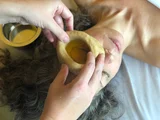
Step 1: The patient lies down comfortably in a supine position on a treatment table in a draft-free room. Step 2: The therapist prepares a ring (called Veshavara) from black gram flour (Masha) dough, about half an inch high and wide enough to encircle the entire orbital rim. This ring is carefully placed around each eye, ensuring no gaps where ghee could leak. Step 3: Warm medicated ghee — heated to a comfortable lukewarm temperature (approximately 37–39°C, close to body temperature) — is slowly poured into the dough cavity until it covers the closed eyelids completely. Step 4: The patient is asked to slowly open and close the eyes intermittently, allowing the medicated ghee to come into direct contact with the cornea and conjunctival surface. This controlled blinking facilitates transconjunctival absorption of the herbal actives. Step 5: The ghee is retained for a specific duration (discussed in the Dharana Kala section below). During this time, the patient remains still and relaxed. Step 6: After the prescribed time, the ghee is carefully drained, the dough ring is removed, and the eyes are gently cleaned with warm water or a mild herbal decoction.
Dharana Kala: How Long Should the Ghee Be Retained?
This is one of the most clinically relevant details — and almost never discussed online. Classical texts provide a precise duration graded by the dosha involved:
| Condition | Duration (in Matra Kala*) | Approximate Minutes |
|---|---|---|
| Vata Dosha disorders | 1000 Matra Kala | ~33 minutes |
| Pitta Dosha disorders | 800 Matra Kala | ~27 minutes |
| Kapha Dosha disorders | 600 Matra Kala | ~20 minutes |
| Swastha (healthy person, preventive) | 500 Matra Kala | ~17 minutes |
\One Matra Kala ≈ the time taken for one blink, roughly 2 seconds.*
This gradation exists because Vata conditions require the longest oleation for pacification, while Kapha conditions need shorter durations to avoid aggravating the already heavy, unctuous quality of Kapha. For preventive wellness, a moderate duration suffices.
Paschat Karma (Post-Procedure Care)
After the procedure:
- The eyes are gently cleaned. Mild Dhoomapana (herbal fumigation) may be administered to remove residual Kapha.
- Rest the eyes for at least 2–3 hours. Avoid bright light, screens, reading, and driving immediately after.
- Splash the eyes with cool or lukewarm water after a couple of hours.
- Avoid exposure to wind, dust, and harsh sunlight for the rest of the day. Wearing sunglasses outdoors is advisable.
- A light, warm, Vata-pacifying meal is recommended post-procedure.
Four Types of Akshi Tarpana and Their Applications
Not all Tarpana procedures are the same. Classical texts describe four distinct types based on their therapeutic intent:
Snehana Tarpana (Nourishing)
This is the most commonly performed type. It uses unctuous, heavy ghee formulations to deeply nourish and moisturize dry, depleted eye tissues. Best for Vata-dominant conditions like chronic dry eye, digital eye strain, and age-related degeneration.
Lekhana Tarpana (Scraping/Reducing)
- Uses ghee medicated with Ruksha (dry) and Tikshna (sharp) herbs.
- The goal is to reduce excess Kapha — such as in cases of early cataracts, corneal opacities, or excessive lacrimation. Triphala Ghrita is often used here for its mild scraping action.
Ropana Tarpana (Healing)
Focused on wound healing and tissue repair. Indicated in post-surgical recovery, corneal ulcers (in non-acute stages), and traumatic eye injuries. Ghee infused with Ropana herbs like Manjishtha, Sariva, and Chandana is employed.
Prasadana Tarpana (Clarifying)
Aims to improve visual clarity and complexion of the eyes. Used in conditions where vision is blurry but no significant structural damage exists. Often performed after a course of Snehana or Lekhana Tarpana as a finishing therapy.
Benefits of Akshi Tarpana
The therapeutic benefits are both broad and deep, addressing structural, functional, and cosmetic aspects of eye health.
How Akshi Tarpana Relieves Dry Eyes and Digital Eye Strain
- Computer Vision Syndrome (CVS) affects an estimated 60–90% of computer workers globally. The primary complaint? Dryness, burning, and fatigue.
- Akshi Tarpana directly addresses this by:
- Restoring the lipid layer of the tear film through the fatty acids in ghee (primarily butyric acid, oleic acid, and conjugated linoleic acid)
- Providing prolonged contact time — unlike eye drops that wash away in seconds, the 20–30 minute retention allows sustained absorption
- Pacifying Vata dosha, which governs dryness and movement in Ayurvedic physiology
A 2017 study published in the Journal of Ayurveda and Integrative Medicine demonstrated that Akshi Tarpana with Triphala Ghrita significantly improved Schirmer's test values (a measure of tear production) in patients with dry eye syndrome after a 7-day course.
Role in Managing Myopia (Timira)
In Ayurveda, simple myopia correlates with Timira — a condition described as progressive visual impairment linked to involvement of the first and second Patala (layers of the eye). When Doshas vitiate the first Patala, the patient sees hazy or distorted images; when the second Patala is involved, they perceive false colors or forms — clinically corresponding to refractive errors.
A randomized clinical trial published in PMC/International Journal of Ayurveda Research compared two groups: one receiving Akshi Tarpana with Jeevantyadi Ghrita and the other with plain Go Ghrita (cow's ghee). The Jeevantyadi Ghrita group showed a statistically significant improvement in visual acuity — with approximately 73% of patients experiencing measurable improvement in distant vision compared to 40% in the plain ghee group. This suggests that the herbal mediation of the ghee, not just the lipid base, plays a crucial role.
Additional Benefits
- Strengthens the optic nerve and retinal tissues through sustained delivery of fat-soluble vitamins (A, D, E, K) present in ghee
- Reduces periorbital dark circles by improving local microcirculation
- Slows progression of early-stage cataracts and glaucoma when used as adjunct therapy
- Alleviates Pitta-related eye conditions like burning sensation, redness, and photophobia
- Improves eye muscle tone — beneficial in early ptosis (drooping eyelid)
- Enhances the complexion and brightness of the eyes — the classic "sparkle" that texts describe as Netra Prasadana
Medicated Ghee Formulations (Ghrita) Used in Akshi Tarpana
- The choice of ghee formulation is not random — it's carefully matched to the patient's condition, dosha imbalance, and disease stage.
- Here are the most important ones:
| Ghrita Formulation | Key Ingredients | Primary Indications |
|---|---|---|
| Triphala Ghrita | Amalaki, Haritaki, Vibhitaki, cow ghee | Dry eyes, early cataract, general eye wellness |
| Mahatriphala Ghrita | Triphala + Bhringaraj, Shatavari, Guduchi, others | Degenerative conditions, chronic eye diseases |
| Jeevantyadi Ghrita | Jeevanti, Triphala, Draksha, Shatavari, cow ghee | Myopia (Timira), refractive errors |
| Patoladi Ghrita | Patola, Triphala, Bhunimba, Neem | Pitta-dominant conditions, burning eyes, redness |
| Yashtimadhu Ghrita | Yashtimadhu (Licorice), cow ghee | Inflammatory eye conditions, post-surgical healing |
| Plain Go Ghrita | Pure cow ghee (no herbal infusion) | Preventive care, mild dryness, general nourishment |
A note on quality: The ghee must be prepared according to Sneha Kalpana (Ayurvedic pharmaceutical methodology). Simply melting store-bought ghee and adding herbs is not the same. Properly prepared medicated ghee undergoes a specific cooking process — typically boiled with herbal paste (Kalka) and decoction (Kwatha) in a 1:4:16 ratio — ensuring optimal extraction of active phytochemicals into the lipid medium.
Don't wait or self medicate. Start chat with Doctor NOW
Contraindications and Side Effects of Akshi Tarpana
This is a critical section that most resources surprisingly ignore. While Akshi Tarpana is generally safe when performed by a trained practitioner, it is not suitable for everyone or every condition.
When Should You Avoid Akshi Tarpana?
- Acute conjunctivitis or any active eye infection — performing Tarpana over an infected eye can worsen inflammation and spread infection
- Fever (Jwara) — systemic Ama (toxins) during fever interfere with proper tissue absorption
- Extreme cloudy or rainy weather — classical texts specifically advise against performing Tarpana in Megha Achchanna (overcast) conditions due to increased Kapha provocation
- Immediately after weeping or emotional distress — the ocular surface is already irritated
- Indigestion or Ama conditions — the body cannot process oleation therapies effectively when digestion is compromised
- Acute glaucoma — increased pressure in the eye chamber may be aggravated by retained ghee; only chronic, stable cases under practitioner supervision
- Extremely hungry or extremely full — procedures should be done in a balanced metabolic state
- Post-cataract surgery (within first 4–6 weeks) — the eye needs to heal before any external application
Signs of Properly Conducted Tarpana (Samyak Tarpana Lakshana)
Classical texts provide clear indicators that the procedure has been done correctly:
- Clear, comfortable vision after the procedure
- A sensation of lightness and freshness in the eyes
- Ability to tolerate sunlight better than before
- Comfortable sleep the following night
Signs of Over-Treatment (Atiyoga Lakshana)
- Heaviness in the eyes
- Excessive watering
- Blurred vision that persists beyond a few hours
- Itching or mild swelling
Signs of Under-Treatment (Ayoga Lakshana)
- No subjective improvement in symptoms
- Persisting dryness or irritation
- A feeling that the eyes are still "hungry"
If over-treatment signs appear, the practitioner should reduce the duration and potency of ghee in subsequent sessions. If under-treatment signs appear, duration and number of sittings should be increased.
Full Course Protocol: Sessions, Seasons, and Scheduling
How Many Sessions Do You Need?
A standard therapeutic course consists of 7 consecutive days of Akshi Tarpana. For chronic conditions like degenerative myopia or macular degeneration, 2–3 courses with a gap of 15–30 days between them may be required.
For preventive wellness (Swastha Rakshanam), a course of 5–7 sessions once or twice a year is generally sufficient.
Best Season for Akshi Tarpana (Ritucharya)
According to Sushruta Samhita, Tarpana should ideally be performed in:
- Varsha Ritu (Monsoon) and Sharat Ritu (Autumn) — when Vata aggravation is at its peak
- Avoid during extreme summer (Grishma) — Pitta is already high, and the heat can cause discomfort during the procedure
- In practice, the therapy can be done year-round in climate-controlled settings, but seasonal guidelines improve outcomes
Best Time of Day
Classical recommendation is morning (Poorvahna), after completing morning routines and a light breakfast. The body's Agni (digestive fire) is active but not overwhelmed, and the patient has the rest of the day for post-procedure eye rest.
Akshi Tarpana for Specific Conditions: Detailed Protocols
Computer Vision Syndrome (CVS)
- Ghrita: Triphala Ghrita or plain Go Ghrita
- Duration: 500–600 Matra Kala (17–20 minutes)
- Course: 7 days, repeat after 1 month if needed
- Adjuncts: Netra Prakshalana (eye wash) with Triphala Kwatha daily, screen time reduction
Chronic Dry Eye (Shushkakshipaka)
- Ghrita: Yashtimadhu Ghrita or Mahatriphala Ghrita
- Duration: 800–1000 Matra Kala (27–33 minutes)
- Course: 7–14 days, with concurrent internal Snehapana
- Adjuncts: Nasya with Anu Taila, increased water intake, Omega-3 rich diet
Simple Myopia (Timira — 1st & 2nd Patala)
- Ghrita: Jeevantyadi Ghrita (clinically studied, as noted above)
- Duration: 1000 Matra Kala (33 minutes)
- Course: 7 days, followed by Putapaka for 3 days, repeat course after 21 days
- Adjuncts: Saptamrita Lauha internally, Trataka (candle-gazing exercise)
Early Cataract (Linganasha — early stage)
- Ghrita: Mahatriphala Ghrita or Patoladi Ghrita
- Duration: 600–800 Matra Kala
- Course: 14 days, with periodic review by an ophthalmologist
- Note: Only suitable for incipient cataracts; mature cataracts require surgical intervention
Modern Scientific Understanding: How Does It Actually Work?
Beyond the Ayurvedic framework, modern pharmacology offers plausible mechanisms for Akshi Tarpana's effects:
- Transconjunctival Drug Delivery: The conjunctiva is a semi-permeable membrane.
- Lipophilic substances — like the fat-soluble compounds in medicated ghee — can penetrate through it to reach deeper ocular tissues. This is the same principle behind modern lipid-based ophthalmic drug delivery systems.
Fatty Acid Profile of Ghee: Cow ghee contains butyric acid (a short-chain fatty acid with anti-inflammatory properties), conjugated linoleic acid (antioxidant), and fat-soluble vitamins A, D, E, and K. Vitamin A, in particular, is essential for rhodopsin synthesis in retinal photoreceptors — directly relevant to night vision and overall visual acuity. Thermal Effect: The warm ghee (37–39°C) increases local blood flow, relaxes the smooth muscles around the eye, and may improve meibomian gland function — which is critical for the lipid layer of the tear film. Herb-Specific Pharmacology: Herbs like Triphala (especially Amalaki) are rich in Vitamin C and gallic acid — potent antioxidants that combat oxidative stress in ocular tissues. Jeevanti contains glycosides with documented cytoprotective activity. These are not vague claims; multiple in-vitro and animal studies published in journals like Phytomedicine and Journal of Ethnopharmacology support these mechanisms.
- Comparison with Artificial Tears: Modern artificial tears provide temporary lubrication but don't nourish tissues or address underlying dosha imbalances.
- Akshi Tarpana offers a fundamentally different approach — sustained-release, nutrient-rich, whole-system therapy versus symptom-level temporary relief.
Pathya-Apathya: Diet and Lifestyle After Akshi Tarpana
For results to last, what you do after the course matters almost as much as the procedure itself.
Pathya (Favorable)
- Light, warm, freshly cooked foods — Khichdi, moong dal soup, steamed vegetables
- Ghee in daily diet (1–2 teaspoons)
- Green leafy vegetables rich in lutein and zeaxanthin (spinach, fenugreek leaves)
- Adequate sleep (7–8 hours, sleeping before 10 PM)
- Trataka practice (gentle candle-gazing for 5–10 minutes daily)
- Wearing sunglasses in bright sunlight, and taking regular screen breaks (20-20-20 rule)
Apathya (Unfavorable)
- Excessive screen time immediately after the course
- Staying up late at night
- Spicy, fried, sour, and fermented foods in excess (aggravate Pitta)
- Suppressing natural urges (tears, sneezing)
- Exposure to dust, smoke, and harsh chemicals
- Day sleeping (Divaswapna) — increases Kapha in the head region
Akshi Tarpana Cost in India
Pricing varies significantly depending on location, clinic reputation, and the type of medicated ghee used:
| Location/Setting | Cost Per Session (Approx.) | Course of 7 Sessions |
|---|---|---|
| Government Ayurveda Hospital | ₹200–₹500 | ₹1,400–₹3,500 |
| Private Ayurveda Clinic (Tier 2 city) | ₹600–₹1,000 | ₹4,200–₹7,000 |
| Premium Wellness Center (Metro city) | ₹1,200–₹2,500 | ₹8,400–₹17,500 |
| Kerala Panchakarma Resort | ₹1,500–₹3,000 | ₹10,500–₹21,000 |
Some clinics offer packaged rates. For example, a clinic in Ahmedabad lists ₹800 per session or ₹3,500 for 5 sessions. Always confirm whether the price includes the medicated ghee or charges it separately.
Frequently Asked Questions About Akshi Tarpana
Is Akshi Tarpana painful? Can I open my eyes during the procedure?
- No, it's not painful at all.
- Most patients describe it as deeply relaxing — almost meditative. Yes, you are asked to gently open and close your eyes periodically during the procedure so the medicated ghee directly contacts the cornea. There may be a slight blurriness immediately afterward, but it clears within 1–2 hours. There's no stinging or burning if the ghee is at the correct temperature and properly prepared.
How often should I repeat Akshi Tarpana?
- For therapeutic purposes, a 7-day course can be repeated every 1–3 months depending on the severity of the condition.
- For general eye wellness and prevention — especially if you work long hours on screens — once or twice a year is usually sufficient.
Can Akshi Tarpana cure myopia completely?
It's important to set realistic expectations. Clinical evidence (such as the Jeevantyadi Ghrita study) shows measurable improvement in visual acuity, but this doesn't mean you can throw away your glasses after one course. Best results are seen in early-stage myopia, especially in children and young adults where the refractive error is still evolving. For established high myopia, Tarpana works as an adjunct to slow progression and reduce eye strain.
Can I undergo Akshi Tarpana while taking allopathic eye drops?
Generally, yes — but with a gap. Do not use your allopathic eye drops for at least 2–3 hours before and after the Tarpana session. Inform both your ophthalmologist and Ayurvedic practitioner about all medications you're using. In most cases, Akshi Tarpana is used as complementary therapy alongside conventional treatment, not as a replacement.
Are there any side effects?
- When performed correctly by a qualified Ayurvedic practitioner, side effects are rare. Temporary mild blurriness and a slightly oily feeling around the eyes are normal and resolve within hours. Problems arise only when the procedure is done with improperly prepared ghee, at the wrong temperature, for an incorrect duration, or when contraindications are ignored.
- This is why you should always seek a trained Vaidya — never attempt this at home.
Is Akshi Tarpana suitable for children?
- Yes, it can be performed on children, typically from age 7 onwards, under careful supervision.
- Duration is reduced — usually 300–500 Matra Kala — and milder formulations like plain Go Ghrita or diluted Triphala Ghrita are used. It's particularly helpful for children developing myopia due to excessive screen exposure.
Final Thoughts: Is Akshi Tarpana Worth It?
In a world where we stare at screens for 8–12 hours a day and expect our eyes to just cope, Akshi Tarpana offers something genuinely different — not a quick fix, but a deep, systemic nourishment that addresses the root cause of eye problems at the tissue level.
Whether you're dealing with chronic dry eyes, progressive myopia, the early whispers of cataract, or simply the accumulated fatigue of years of screen work, this ancient therapy has shown — through both classical wisdom and modern research — that it deserves a place in your eye care strategy.
- The key is finding the right practitioner. Look for a BAMS-qualified Ayurvedic doctor with specific training in Shalakya Tantra (Ayurvedic ophthalmology and ENT). Ask about the type of medicated ghee they use and how it's prepared.
- A good practitioner will always do a thorough assessment — including your Prakriti (constitution), current dosha imbalance, and eye examination — before recommending the procedure.
Your eyes are irreplaceable. Nourish them wisely.
Scientific Sources
- A clinical study on the role of Akshi Tarpana with Jeevantyadi Ghrita in Timira (Myopia) — Poonam et al., 2011, Ayu
- Protocol of Comparative Efficacy of the Timirghnatraifalam Ghruta verses Triphaladi Ghruta Systemically Together with Padabhyanga in the Control of Non-Pathological Myopia — Chandankhede A et al., 2026, Journal of pharmacy & bioallied sciences
Questions from users
How is ghee prepared for Ayurvedic eye treatments?
Client_887fd4
22 days ago
Ghee used in Ayurvedic eye treatments like Akshi Tarpana is typically prepared by melting butter and simmering it until the milk solids separate and turn golden brown. This clarified butter is strained to remove the solids, resulting in a clear liquid. For its therapeutic use, especially in treatments like Akshi Tarpana for conditions such as myopia, the ghee is medicated with specific herbs like Triphala. This preparation is not done at home but rather by qualified practitioners. It is crucial to discuss any Ayurvedic eye treatment with both your ophthalmologist and Ayurvedic practitioner to ensure safety, especially regarding medication interactions and post-treatment care. If you experience prolonged blurriness or discomfort, consult your healthcare provider.
How long does an Akshi Tarpana treatment session typically last?
Client_76cea0
32 days ago
An Akshi Tarpana treatment session typically lasts about 30 to 45 minutes. During this time, a dough ring is positioned around the eyes and filled with medicated ghee. This time allows for the absorption of nutrients through the eye tissues. While some patients report improvement in visual acuity after multiple sessions, it's important to continue any prescribed treatments for eye conditions. Consult a healthcare provider for persistent eye issues or if you experience any discomfort during or after the treatment.
What are alternative treatments similar to Akshi Tarpana for eye care?
Client_7322b1
41 days ago
Alternative treatments similar to Akshi Tarpana focus on eye care without using ghee, such as homeopathic remedies, herbal eye drops, and compresses with chamomile or rose water. Techniques like palming, gently massaging the temples, and taking regular screen breaks help reduce eye strain. Dietary changes, such as increasing intake of omega-3 fatty acids and lutein, can support eye health over time. If eye issues persist, consult an ophthalmologist to rule out underlying conditions. While Ayurveda is popular, scientific evidence varies, so proceed with informed caution.
What herbs are commonly used in Akshi Tarpana therapy?
Client_4a8570
51 days ago
In Akshi Tarpana therapy, commonly used herbs include Jeevanti, Triphala, and other ingredients like Yashtimadhu and Ghruta (clarified butter or ghee). This Ayurvedic eye treatment aims to nourish and rejuvenate eye tissues. Typically, the ghee infused with these herbs is retained over the eyes for a specified duration, often 15-20 minutes. It's important to note that while herbs have their benefits, consulting with an Ayurvedic practitioner before starting any treatment is advisable, especially if you experience persistent or worsening eye conditions.
What precautions should I take after an Akshi Tarpana session?
Client_8dca00
60 days ago
After an Akshi Tarpana session, avoid straining your eyes with activities like reading, screen use, and exposure to bright lights for at least a few hours. Use protective eyewear if needed to shield your eyes from wind and dust. Stay away from swimming pools and avoid direct contact with water for a day. If you experience any discomfort, redness, or vision changes, consult a healthcare professional immediately. Although Ayurveda suggests specific seasons for optimal results, modern settings can accommodate treatments year-round, just be sure to follow any personalized recommendations provided by your practitioner.
What is the best time of year to start Akshi Tarpana treatments for eye health?
Client_b6f5e1
70 days ago
The best time for Akshi Tarpana is usually during cooler months, like fall or early spring. These seasons help balance any heat that might aggravate your eyes. But honestly, it can vary based on your personal constitution (prakriti) or specific dosha imbalances, so consulting an Ayurvedic practitioner would be super helpful!
What are the main benefits of using ghee infused with Ropana herbs for eye treatments?
Client_9ff0f8
79 days ago
The ghee with Ropana herbs like Manjishtha and Chandana helps improve visual clarity, nourish eye tissues, and can enhance the complexion of the eyes. It deeply moisturizes and might be particularly beneficial after Snehana treatments. It's a great way to address dryness and digital strain, making your eyes feel more refreshed and revitalized.
Is it safe to combine Akshi Tarpana with other natural eye treatments?
Client_aa1b96
88 days ago
Yes, Akshi Tarpana can be combined with other natural treatments, but be cautious. You want to make sure not to overwhelm the eyes. Pairing Akshi Tarpana with gentle practices like Nasya can actually compliment it well. Just avoid too many treatments at once, and give some time to each treatment to see how u respond.
Can Akshi Tarpana improve vision problems related to aging?
Client_abe75e
102 days ago
Akshi Tarpana can definitely help with vision problems due to aging by nourishing and rejuvenating the eyes. It keeps them hydrated and may improve issues like dryness or discomfort. But, if we're talking about serious age-related changes like macular degeneration, it might need combine with other treatments. Always best to consult with an Ayurvedic practitioner to get the right approach for your specific needs. Hope that helps!
Can I use Akshi Tarpana to help with eye fatigue after long reading sessions?
Client_7b6b49
111 days ago
Yes, Akshi Tarpana could be helpful for eye fatigue from long reading sessions! It works by nourishing and soothing the eyes with medicated oils, providing relief from dryness and discomfort. Just make sure it's done by a qualified practitioner to ensure it's suitable for you. Keep in mind, overall eye health benefits from balancing your dosha and maintaining a healthy lifestyle too. 😊
Related articles

Eye Disorders
The Secrets of Ayurvedic Medicine for Eye Nerves: Strengthen Vision Naturally!
Explore Ayurvedic solutions for eye nerves. Find out how natural treatments can strengthen vision, reduce strain, and improve overall eye health.
5,746

Eye Disorders
Ophthalmology
The eye is the most important sense organ and it directly linked to the brain. It is a very sensitive organ that is extremely close to the working of the human brain.
3,181

Eye Disorders
Netra Bindu: Benefits & Ayurvedic Eye Care
Discover the benefits, proper dosage, uses, and scientific research behind Netra Bindu, an effective Ayurvedic remedy for eye health and vision enhancement.
5,184
Eye Disorders
Akshi Tarpana in Ayurveda – Revitalizing Eye Health Therapy
Explore the benefits of Akshi Tarpana, a traditional Ayurvedic eye therapy that nourishes, rejuvenates, and revitalizes vision. Learn how this time-honored remedy improves eye health and alleviates common ocular issues.
4,037

Eye Disorders
Is Rose Water Good for Eyes: Benefits, Uses, and Precautions
Find out if rose water is good for eyes, its Ayurvedic benefits, how to use it safely, side effects, and tips for application to improve eye health naturally
12,477

Eye Disorders
Putapakam – Traditional Ayurvedic Remedy for Vitality
Explore Putapakam, an Ayurvedic formulation. Learn about its benefits, uses, dosage, precautions, and insights for holistic wellness and balance.
3,538

Eye Disorders
Itone Eye Drops
Exploration of Itone Eye Drops
6,931

Eye Disorders
Anjana Ayurveda – Ancient Eye Care from Ayurveda
Explore Anjana Ayurveda, a time-honored approach to eye health. Discover herbal remedies, traditional practices, and holistic techniques for nurturing vision naturally.
5,752

Eye Disorders
Ayurvedic Treatment for Retina: Protect & Revitalize Your Vision Naturally!
Discover Ayurvedic remedies to support retinal health, improve vision, and protect against age-related eye conditions with natural treatments.
5,252
Related consultations on the topic
Legal
Additional Documents
© 2024 Ask Ayurveda. All rights reserved.