आयुर्वेदिक डॉक्टर से प्रश्न पूछें और निःशुल्क या भुगतान मोड में अपनी चिंता की समस्या पर ऑनलाइन परामर्श प्राप्त करें। 2,000 से अधिक अनुभवी डॉक्टर हमारी साइट पर काम करते हैं और आपके प्रश्नों का इंतजार करते हैं और उपयोगकर्ताओं को उनकी स्वास्थ्य समस्याओं को हल करने में प्रतिदिन मदद करते हैं।
मुफ्त! आयुर्वेदिक डॉक्टरों से पूछें 24/7

 तेज़ प्रतिक्रियाएँ
 1000+ सत्यापित डॉक्टर
Body DetoxEar, Nose, and Throat DisordersGeriatrics & RejuvenationImmunodeficiencyInfertility TreatmentNutritionOrthopedic DisordersPediatricsRespiratory DisordersSexually Transmitted Diseases (STDs)Surgery RecoveryUrological DisordersVascular DisordersDental DisordersEndocrinological DisordersGastrointestinal DisordersYoga TherapyGeneral MedicineAllergic DisordersCardio DisordersGynecology and ObstetricsCosmetologySkin and Hair DisordersEye DisordersInfectious DiseasesMental DisordersNeurological DisordersOncologyPanchakarmaSexual Health & DisordersSports Medicine
पर प्रकाशित 01/03/25
(को अपडेट 06/23/26)
2,048
Doorvadi Thailam: Soothing Ayurvedic Oil for Muscle Pain & Stress
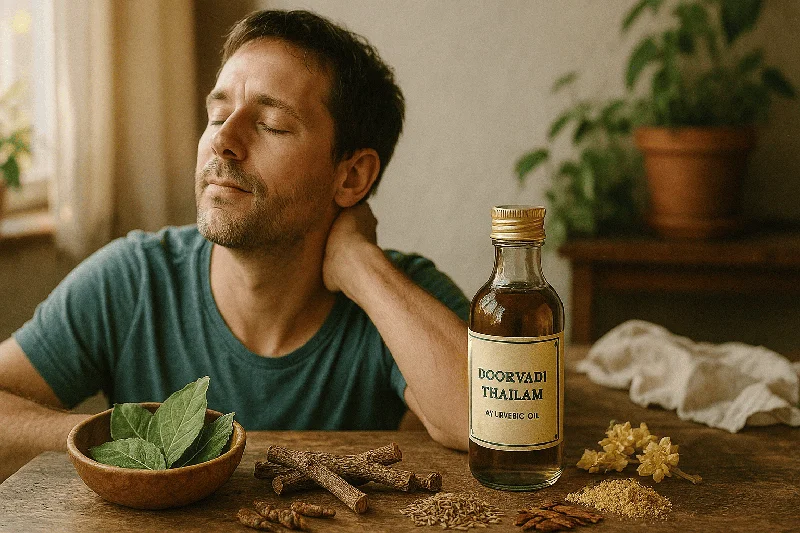
Doorvadi Thailam is a classical Ayurvedic medicated oil primarily used for treating skin diseases, non-healing wounds, ulcers, and scalp conditions like dandruff. Also spelled as Durvadi Thailam or Durvadi Kera Thailam, this formulation derives its name from its key ingredient — Durva (Cynodon dactylon), commonly known as Bermuda grass. Referenced in the ancient Ayurvedic compendium Sahasrayogam, this oil has been trusted by Ayurvedic practitioners across Kerala and South India for centuries to manage eczema, psoriasis, scabies, itching, and various types of skin inflammation.
- If you've been searching for a natural remedy for persistent skin issues or chronic wounds that just won't heal — this is one of the most time-tested options Ayurveda has to offer.
- Let's break down everything you need to know: from the complete ingredient list and how each component works, to detailed application protocols, realistic timelines for results, and how Doorvadi Thailam compares to similar Ayurvedic oils.
What Is Doorvadi Thailam?
Doorvadi Thailam (Durvadi Thailam) is a medicated oil (Thailam literally means "oil" in Malayalam and Tamil) prepared by processing select herbs in a base oil — traditionally coconut oil (in which case it's called Durvadi Kera Thailam) or sesame oil. It falls under the category of Taila Kalpana (medicated oil preparations) in Ayurvedic pharmacology.
The formulation is designed for external application only. Its primary action is on the skin and superficial tissues (Twak and Mamsa Dhatu in Ayurvedic terminology). It is classified as a Vrana Ropana (wound-healing) and Kushtaghna (anti-dermatosis) preparation.
Doorvadi vs Durvadi — Naming and Transliteration Explained
One of the most common confusions around this product is the spelling. You'll see it written as Doorvadi, Durvadi, Doorvadhi, and several other variations across different websites and product labels. Here's why.
The original Sanskrit name is दूर्वादि तैलम् (Dūrvādi Tailam). When transliterating Sanskrit to English, the long vowel "ū" can be rendered as "oo" or "u," and "v" is sometimes written as "v" or "w." This means Doorvadi Thailam and Durvadi Thailam are the exact same formulation — just different romanizations of the same Sanskrit word.
So whether a product label says "Durvadi Kera Thailam" or "Doorvadi Thailam," you're looking at the same classical recipe. When purchasing, focus on the ingredient list and the classical reference rather than the spelling variation.
Historical Origin and Classical References
Doorvadi Thailam finds its primary reference in the Sahasrayogam, a well-known Ayurvedic formulary from the Kerala tradition that compiles thousands of classical formulations. The oil is listed under the Taila Prakarana (section on medicated oils).
Some Ayurvedic scholars also cross-reference this formulation with descriptions in the Ashtangahridayam by Vagbhata, particularly in the context of Kushta Chikitsa (treatment of skin diseases) and Vrana Chikitsa (wound management). The original Sanskrit shlokas describe the oil as effective for Vrana (wounds), Kushta (skin diseases), Kandu (itching), and Dadru (ringworm-like conditions).
The formulation has been in continuous clinical use across Kerala's Ayurvedic hospitals (Vaidyashalas) for well over 300 years, making it one of the more battle-tested topical preparations in the entire Ayurvedic pharmacopoeia.
Key Ingredients and Their Roles
- Understanding what goes into Doorvadi Thailam helps you appreciate why it works.
- The formulation is not just a random mix of herbs — each ingredient serves a specific therapeutic purpose within the formula.
Durva (Cynodon dactylon) — The Core Herb
Durva, or Bermuda grass, is the star ingredient and the one that gives this oil its name ("Durvadi" literally means "starting with Durva").
In Ayurveda, Durva is classified as:
- Rasa (Taste): Kashaya (Astringent), Madhura (Sweet)
- Virya (Potency): Sheeta (Cooling)
- Vipaka (Post-digestive effect): Madhura (Sweet)
- Dosha action: Pacifies Pitta and Kapha
A 2017 review published in the Journal of Pharmacognosy and Phytochemistry documented that Cynodon dactylon possesses significant wound-healing, antimicrobial, and anti-inflammatory properties. The plant is rich in flavonoids, alkaloids, and glycosides that contribute to its skin-regenerative action. Its cooling potency makes it particularly effective for inflammatory skin conditions where there is redness, burning, and itching.
Coconut Oil Base vs Sesame Oil Base
This is a distinction that almost no one talks about — but it actually matters for your choice.
| Parameter | Coconut Oil Base (Kera Thailam) | Sesame Oil Base (Tila Thailam) |
|---|---|---|
| Sanskrit name | Durvadi Kera Thailam | Durvadi Thailam |
| Best for | Pitta-type skin conditions (burning, redness, inflammation) | Vata-type skin conditions (dryness, cracking, roughness) |
| Cooling/Heating | Cooling (Sheeta Virya) | Mildly warming (Ushna Virya) |
| Skin penetration | Moderate; stays on surface longer | Deeper penetration into tissues |
| Ideal climate | Hot, tropical climates | Cold or dry climates |
| Scalp application | Excellent for dandruff with itchy, inflamed scalp | Better for dry, flaky dandruff with hair fall |
| Shelf life | Shorter (coconut oil can go rancid faster) | Longer |
Practical tip: If you live in South India or any tropical region with a hot climate, the coconut oil base (Durvadi Kera Thailam) is generally the better choice. If you're in North India or dealing with dry, cracked skin during winter, the sesame oil base may serve you better.
Complete Ingredient Table
Below is the detailed composition based on the classical Sahasrayogam reference. Note that different manufacturers may have slight variations, but a genuine classical preparation should include these core ingredients:
| Ingredient (Sanskrit) | Botanical / Common Name | Role in the Formula |
|---|---|---|
| Durva | Cynodon dactylon (Bermuda Grass) | Primary herb; cooling, wound-healing, anti-inflammatory |
| Haridra | Curcuma longa (Turmeric) | Antiseptic, anti-inflammatory, skin complexion enhancer |
| Nimba | Azadirachta indica (Neem) | Potent antimicrobial, antifungal, anti-parasitic |
| Manjishtha | Rubia cordifolia (Indian Madder) | Blood purifier, improves skin tone, reduces pigmentation |
| Sariva | Hemidesmus indicus (Indian Sarsaparilla) | Blood purifier, cooling, anti-pruritic (anti-itch) |
| Karanja | Pongamia pinnata (Indian Beech) | Antifungal, anti-dermatosis, wound disinfectant |
| Chandana | Santalum album (Sandalwood) | Cooling, soothing, reduces burning sensation |
| Karpura | Camphor | Analgesic, anti-itch, improves local blood circulation |
| Daruharidra | Berberis aristata (Indian Barberry) | Anti-inflammatory, antimicrobial (contains berberine) |
| Narikela Taila / Tila Taila | Coconut Oil / Sesame Oil | Base oil; carrier for herb absorption into skin |
| Jala | Water | Medium for herbal decoction (evaporates during processing) |
Each of these ingredients has been individually studied for dermatological benefits. For instance, a 2016 study in Pharmacognosy Reviews confirmed that Azadirachta indica (Neem) extracts demonstrate broad-spectrum antibacterial and antifungal activity — which is exactly why it's included in a formulation targeting infected wounds and fungal skin conditions.
Benefits of Doorvadi Thailam
For Skin Diseases (Eczema, Psoriasis, Scabies)
This is the primary indication. Doorvadi Thailam is most frequently prescribed by Ayurvedic physicians for:
- Eczema (Vicharchika): Reduces itching, oozing, and inflammation. The cooling herbs help calm the Pitta aggravation that drives most eczematous flares.
- Psoriasis (Kitibha Kushta): Helps soften and reduce scaling. Works best as part of a comprehensive Ayurvedic protocol that includes internal medicines like Kaishore Guggulu or Mahatiktaka Kashayam.
- Scabies (Pama): The neem and karanja components provide anti-parasitic action against the scabies mite, while durva soothes the intense itching.
- Ringworm & Fungal Infections (Dadru): Antifungal herbs in the formula address the root cause while the oil base keeps the area moisturized.
For Wound Healing and Ulcers
Doorvadi Thailam is classically indicated for Vrana Ropana — the healing of wounds and ulcers.
This includes:
- Non-healing wounds, especially those that have become chronic
- Diabetic skin ulcers (as supportive therapy alongside medical management)
- Post-surgical wound care (after initial healing has begun)
- Minor burns and abrasions
The turmeric and neem in the formulation provide antiseptic coverage, while durva and manjishtha promote tissue regeneration. A 2019 animal study published in the International Journal of Green Pharmacy showed that Cynodon dactylon extract accelerated wound contraction by approximately 87% compared to control groups over a 16-day period.
For Dandruff and Scalp Health
While not the most commonly discussed application, Doorvadi Thailam — particularly the coconut oil base version — is quite effective for:
- Dandruff with itching and flaking
- Seborrheic dermatitis of the scalp
- Scalp psoriasis
- General scalp inflammation
- Apply the oil to the scalp 30-45 minutes before washing.
- The antifungal properties of neem target Malassezia — the yeast responsible for most dandruff cases — while the cooling herbs reduce scalp inflammation.
For Children's Skin Conditions
Doorvadi Thailam is generally considered safe for children's skin when used externally.
It's commonly recommended by Ayurvedic pediatricians for:
- Diaper rash
- Heat rash (prickly heat)
- Childhood eczema
- Minor cuts and scrapes
For children under 2 years, always do a patch test first and use a thin layer. If there's any redness or reaction, discontinue use and consult your physician.
Dosha Balancing — Pitta and Kapha
- From an Ayurvedic perspective, most skin diseases are primarily caused by vitiated Pitta (leading to inflammation, burning, redness) and Kapha (leading to oozing, itching, heaviness).
- Doorvadi Thailam specifically targets these two doshas:
- The cooling herbs (Durva, Chandana, Sariva) pacify Pitta
- The drying and astringent herbs (Nimba, Karanja, Haridra) address Kapha accumulation
- The base oil provides Vata balancing to prevent skin dryness and cracking
This tri-doshic approach is why the oil works across a wide range of skin conditions rather than being limited to just one type.
How to Use Doorvadi Thailam
Step-by-Step Application Guide
Here's a practical protocol based on traditional Ayurvedic practice:
- 1.Clean the affected area — Wash with lukewarm water and mild soap. Pat dry gently with a clean cloth. Do not rub.
- 2.Warm the oil slightly — Pour the required amount into a small bowl and warm it by placing the bowl in hot water for 2-3 minutes. The oil should be comfortably warm, not hot. Warming improves skin absorption.
- 3.Apply a thin layer — Using clean fingertips or a sterile cotton pad, apply the oil gently over the affected area. Do not massage vigorously on open wounds or active eczema patches.
- 4.Leave it on — For skin diseases, leave the oil on for at least 30-60 minutes before washing off. For wounds and ulcers, you may leave it on and cover with a light gauze bandage.
- 5.Frequency — Apply 2-3 times daily for most conditions. For mild dandruff, once daily application before bath is usually sufficient.
Dosage by Condition
| Condition | Amount Per Application | Frequency | Special Notes |
|---|---|---|---|
| Eczema (mild) | Thin layer on affected area | 2x daily | Avoid during active oozing; wait until oozing subsides |
| Eczema (moderate-severe) | Moderate layer | 2-3x daily | Combine with internal Ayurvedic medicines |
| Psoriasis | Moderate layer on plaques | 2x daily | Apply after warm compress for better penetration |
| Non-healing wounds | Thin layer around wound edges | 1-2x daily | Do NOT apply on deep or actively bleeding wounds |
| Dandruff | 5-10 ml on scalp | 1x daily (pre-bath) | Leave on 30-45 min, wash with mild shampoo |
| Scabies | Thin layer on affected area | 2-3x daily | Must combine with anti-scabies internal treatment |
| Diaper rash (children) | Very thin layer | After each diaper change | Discontinue if irritation occurs |
How Long Does It Take to See Results?
This is perhaps the most undertreated question across competitor articles, and it's one that every patient rightly wants answered.
Based on clinical experience reported in Ayurvedic practice:
- Minor wounds and abrasions: Visible improvement in 5-7 days
- Dandruff: Noticeable reduction in flaking within 1-2 weeks of regular use
- Mild eczema: Itching reduces within 3-5 days; visible skin improvement in 2-3 weeks
- Moderate-severe eczema/psoriasis: Requires 4-8 weeks of consistent use alongside internal medicines
- Chronic non-healing ulcers: May take 6-12 weeks; results depend heavily on underlying cause
Important: Doorvadi Thailam is not a quick fix. Like most Ayurvedic treatments, it works gradually by addressing the underlying imbalance rather than merely suppressing symptoms. If you don't see any improvement after 3-4 weeks of regular use, consult an Ayurvedic physician to reassess your treatment protocol.
Doorvadi Thailam vs Similar Ayurvedic Oils
One of the biggest confusions patients face is choosing between multiple Ayurvedic oils that all seem to be "for skin diseases." Here's a practical comparison to help you pick the right one.
Doorvadi Thailam vs Jathyadi Thailam
| Parameter | Doorvadi Thailam | Jathyadi Thailam |
|---|---|---|
| Primary indication | Skin diseases (eczema, psoriasis) | Wound healing and ulcers |
| Key herb | Durva (Bermuda grass) | Jati (Jasmine / Jasminum grandiflorum) |
| Best for | Inflammatory, itchy skin conditions | Non-healing wounds, fistula, sinuses |
| Cooling/Heating | Cooling | Cooling |
| Classical reference | Sahasrayogam | Ashtangahridayam |
| When to choose | When itching and skin eruption is the main concern | When wound healing and tissue regeneration is the priority |
Bottom line: If your primary issue is eczema, psoriasis, or itchy skin — go with Doorvadi. If you have a chronic wound, fistula, or post-surgical wound that isn't healing — Jathyadi Thailam is the better choice.
Doorvadi Thailam vs Pinda Thailam
| Parameter | Doorvadi Thailam | Pinda Thailam |
|---|---|---|
| Primary indication | Skin diseases | Inflammatory joint conditions and gout |
| Key herb | Durva | Multiple — Manjishtha, Sariva, Rakta Chandana |
| Best for | Eczema, psoriasis, wounds | Gout, arthritis, skin inflammation with burning |
| Dosha action | Pitta and Kapha | Primarily Pitta and Rakta (blood) |
| When to choose | Skin diseases without joint involvement | When skin inflammation co-exists with joint pain/gout |
Doorvadi Thailam vs Nalpamaradi Kera Thailam
| Parameter | Doorvadi Thailam | Nalpamaradi Kera Thailam |
|---|---|---|
| Primary indication | Skin diseases and wounds | Skin brightening and complexion improvement |
| Key herbs | Durva, Neem, Turmeric | Four types of fig tree bark (Nalpamara), Turmeric |
| Best for | Diseased skin — eczema, psoriasis, ulcers | Healthy skin — tan removal, uneven skin tone, dullness |
| Use case | Therapeutic / treatment | Cosmetic / maintenance |
| When to choose | Active skin disease | No active disease; want to improve skin tone and complexion |
स्वयं दवा न लें और प्रतीक्षा न करें। अभी डॉक्टर से चैट शुरू करें
Side Effects and Precautions
Known Side Effects
Doorvadi Thailam is generally well-tolerated when used as directed for external application.
However, some users may experience:
- Mild irritation or burning at the site of application, especially on broken skin — this usually subsides within minutes
- Allergic contact dermatitis — rare, but possible if you're sensitive to any of the herbal ingredients
- Temporary staining of clothes and bedsheets due to the turmeric content
No serious adverse effects have been documented in Ayurvedic literature or in clinical practice reports for external use.
Contraindications — When NOT to Use
- Deep, actively bleeding wounds — the oil can trap bacteria and impede clotting
- Severely infected wounds with pus — these need antimicrobial treatment first; oil application can worsen infection
- Known allergy to any ingredient — particularly neem or camphor, which are common allergens in some individuals
- Eyes and mucous membranes — strictly external use; avoid contact with eyes, nostrils, and mouth
- Immediately after chemical peels or laser treatments — the skin is too sensitized
Use During Pregnancy and Lactation
There is no classical contraindication for external use of Doorvadi Thailam during pregnancy or lactation. The oil is applied topically and systemic absorption is minimal.
However, as a precautionary measure:
- Avoid applying over the abdomen during pregnancy
- If breastfeeding, do not apply on or near the breast area
- Always inform your Ayurvedic physician about your pregnancy before starting any new treatment
Can Doorvadi Thailam Be Used with Allopathic Medicines?
Yes, in most cases. Since Doorvadi Thailam is for external use and modern dermatological treatments (corticosteroid creams, antifungals) are also topical, the main concern is timing of application.
Recommendation: Do not apply Doorvadi Thailam and a steroid cream simultaneously on the same area. Space them out by at least 3-4 hours. Many Ayurvedic physicians recommend using the allopathic cream during the day and Doorvadi Thailam at night, or vice versa.
If you're taking oral medications for skin conditions, there is generally no interaction with an externally applied oil. But always disclose all your treatments to both your Ayurvedic and allopathic doctors.
Storage, Shelf Life, and Buying Tips
How to Store Doorvadi Thailam
- Store in a cool, dry place away from direct sunlight
- Keep the bottle tightly closed after each use
- Do not refrigerate — cold temperatures can cause coconut oil-based versions to solidify
- Use a clean, dry spoon or pour directly; don't introduce moisture into the bottle
- Ideal storage temperature: 20-30°C (68-86°F)
Shelf Life
Most commercially available Doorvadi Thailam products have a shelf life of 3-5 years from the date of manufacture when stored properly.
However:
- The coconut oil base variety may develop an off-smell sooner than sesame oil base
- If the oil changes color significantly, develops a rancid smell, or shows visible mold — discard it immediately
- Once opened, try to use within 12-18 months for optimal potency
What to Look for When Buying
- Classical reference: The label should mention Sahasrayogam or another recognized Ayurvedic text
- GMP certification: Look for products manufactured in GMP-certified facilities
- AYUSH license number: Mandatory for all Ayurvedic products sold in India
- Reputable manufacturers: Kottakkal Arya Vaidya Sala, AVP (Arya Vaidya Pharmacy), Vaidyaratnam, SNA Oushadhasala, SKM Siddha and Ayurveda are well-regarded names
- Price range: Typically ₹120-₹250 for 200ml, depending on the manufacturer. Unusually cheap products may indicate compromised quality
Complementary Practices for Better Results
Doorvadi Thailam works best when combined with a holistic approach. Here are some evidence-informed practices that can amplify its benefits:
- Diet: Avoid excessive spicy, sour, and fermented foods which aggravate Pitta and worsen skin inflammation. Increase intake of bitter vegetables (bitter gourd, neem leaves) and cooling foods (cucumber, coconut water).
- Hydration: Drink 2-3 liters of water daily. Dehydrated skin heals slower.
- Yoga and Pranayama: Sheetali and Sheetkari Pranayama have a cooling effect that complements the Pitta-pacifying action of the oil. Even 10 minutes daily can make a difference.
- Internal medicines: For chronic conditions, Doorvadi Thailam alone may not be sufficient. Common complementary internal medicines include Manjishtadi Kashayam, Khadirarishta, and Arogyavardhini Vati — but these should only be taken under professional guidance.
- Panchakarma: For severe, chronic skin diseases, Virechana (therapeutic purgation) is considered the gold-standard Ayurvedic detox procedure. It's typically recommended before starting external oil therapy for maximum efficacy.
Frequently Asked Questions (FAQ)
What is Doorvadi Thailam used for?
Doorvadi Thailam is used primarily for skin diseases like eczema, psoriasis, scabies, and fungal infections. It is also used for non-healing wounds, ulcers, dandruff, and general scalp conditions. It is strictly for external application.
Is Durvadi Thailam good for hair growth?
Doorvadi Thailam is not a dedicated hair growth oil. However, by treating scalp conditions like dandruff, seborrheic dermatitis, and scalp inflammation — which are common causes of hair thinning — it can indirectly support healthier hair growth. For targeted hair growth treatment, oils like Neelibhringadi Kera Thailam or Kayyonni Thailam are more appropriate.
Can Doorvadi Thailam be used for respiratory health?
Some online sources attribute respiratory benefits (asthma, bronchitis, nasal congestion) to Doorvadi Thailam. This appears to be a case of confusing formulations. The classical Sahasrayogam reference for Durvadi Thailam focuses on skin and wound-related indications. If you need an Ayurvedic oil for respiratory conditions, consider Anu Thailam (nasal oil) or consult a qualified Ayurvedic practitioner.
Are there any side effects of using Doorvadi Thailam?
Side effects are rare with proper external use. Some individuals may experience mild skin irritation, temporary burning on broken skin, or allergic reactions to specific ingredients. Always perform a patch test before first use, especially for children or those with sensitive skin.
How long does it take to see results from Doorvadi Thailam?
Results vary by condition: minor wounds may improve in 5-7 days, dandruff in 1-2 weeks, mild eczema in 2-3 weeks, and chronic conditions like psoriasis may require 4-8 weeks of consistent use. It works best as part of a comprehensive Ayurvedic treatment plan.
What is the difference between Durvadi Thailam and Durvadi Kera Thailam?
Durvadi Kera Thailam specifically uses coconut oil (Kera means coconut) as the base. Plain "Durvadi Thailam" may use sesame oil as the base. The herbal ingredients are the same; the difference lies in the base oil, which affects the oil's cooling/warming properties and skin penetration depth.
Can I use Doorvadi Thailam alongside steroid creams?
Yes, but not simultaneously on the same area. Space the applications by at least 3-4 hours. Many practitioners recommend using one in the morning and the other at night. Always inform both your Ayurvedic and allopathic doctors about all treatments you're using.
Which ayurvedic medicine is best for varicose veins?
Doorvadi Thailam is not specifically indicated for varicose veins. For varicose veins, Ayurvedic physicians commonly recommend Sahacharadi Thailam for external application along with internal medicines like Chirabilwadi Kashayam. Consult a qualified practitioner for a personalized treatment plan.
Final Thoughts
Doorvadi Thailam is one of those quietly effective Ayurvedic formulations that doesn't get the marketing hype of trendier products — but delivers genuine results for skin diseases, wounds, and scalp conditions when used correctly and consistently. Its formulation, rooted in the Sahasrayogam, represents centuries of refined clinical observation.
The key to getting the most out of this oil is understanding what it's actually for (skin and wound healing, not respiratory conditions), choosing the right base oil for your constitution and climate, and combining it with appropriate dietary and lifestyle practices.
- If you're dealing with a stubborn skin condition or a wound that isn't responding well to conventional treatment, Doorvadi Thailam is well worth discussing with a qualified Ayurvedic physician.
- Don't self-prescribe for serious conditions — but do know that this classical formulation has a strong track record spanning several hundred years.
Consult a certified Ayurvedic doctor before starting any new treatment, especially if you are pregnant, nursing, or currently taking medication for any medical condition.
Scientific Sources
- Integrated management of diabetic foot ulcers (DFU) using a smartphone - A case report — Jadhav SS, 2024, International journal of surgery case reports
- Chemical Diversity and Medicinal Potential of Vitex negundo L.: From Traditional Knowledge to Modern Clinical Trials — Sharma D et al., 2023, Chemistry & biodiversity
- An ayurvedic approach in the management of Siragatavata complicated with Dusta Vrana — Singh SK et al., 2021, Journal of Ayurveda and integrative medicine
- Of odysseys and miracles: A narrative approach on therapeutic mobilities for ayurveda treatment — Kaspar H et al., 2023, Social science & medicine (1982)
- Diffuse systemic sclerosis managed with ayurvedic treatment modalities - A case report — Pandit RK, 2025, Journal of Ayurveda and integrative medicine
- Curiosity and Creative Experimentation Among Psychiatrists in India — Lang C et al., 2024, Culture, medicine and psychiatry
- Wound healing activity of topical herbal aerosol sprays on diabetic and Varicose Ulcers: A randomized, controlled, open labelled, multi-centric clinical trial — Tamoli S et al., 2022, Journal of Ayurveda and integrative medicine
- Traditional Indian spices and their health significance — Krishnaswamy K, 2008, Asia Pacific journal of clinical nutrition
- Dermal wound healing potency of single alkaloid (betaine) versus standardized crude alkaloid enriched-ointment of Evolvulus alsinoides — Mahibalan S et al., 2016, Pharmaceutical biology
- Traditional and ayurvedic herbalism, homeopathy--the alternative therapeutic methods in dentistry.Review(https://pubmed.ncbi.nlm.nih.gov/23421114/) — Wyganowska-Swiatkowska M et al., 2012, Przeglad lekarski
- Making room for alternatives — Edelberg D, 1994, Second opinion (Park Ridge, Ill.)
- The Role of Medicinal Plants in the Diabetic Wound Healing Process — Chaudhary R, 2023, Current diabetes reviews
- Preparation and standardization of Mathan Tailam: A classical Siddha formulation for diabetic ulcerative wound healing — Arunadevi R et al., 2020, Journal of Ayurveda and integrative medicine
- Phytochemical constituents, distributions and traditional usages of Arnebia euchroma: A review — Kumar A et al., 2021, Journal of ethnopharmacology
- From Maggots to Recovery: Exploring an Integrative Medicine Approach to Chronic Non-Healing Ulcer with Leech Therapy and Panchvalkal Ointment: A Case Study — Dagar M et al., 2025, Alternative therapies in health and medicine
- Therapeutic potential of curcumin in eye diseases — Radomska-Leśniewska DM et al., 2019, Central-European journal of immunology
- Use of Ayurveda and Sri Lankan traditional medicine for healing shaft of humerus fracture following nonunion — Attanayake AMHS et al., 2018, Journal of Ayurveda and integrative medicine
- Of relics, body parts and laser beams: the German Heilpraktiker and his Ayurvedic spa — Naraindas H, 2011, Anthropology & medicine
- Drimia indica: A Plant Used in Traditional Medicine and Its Potential for Clinical Uses — Aswal S et al., 2019, Medicina (Kaunas, Lithuania)
- Traditional wisdom through scientific evidence: a review of Marma manipulation in Amsa sandhimokśa (shoulder joint dislocation) with a special focus on the Milch method — Chenganakattil S et al., 2026, Frontiers in medicine
उपयोगकर्ताओं के प्रश्न
Can I apply Doorvadi Thailam on broken skin or open wounds?
Brooklyn
8 दिनों पहले
You shouldn't apply Doorvadi Thailam on broken skin or open wounds. It's really meant for unbroken skin, and using it on wounds might irritate or cause other problems. For open wounds, it's better to look for products designed to promote healing safely. Always good to consult with an Ayurvedic practitioner or doctor for guidance, too!
What is Doorvadi Thailam used for in treating skin diseases?
Emma
17 दिनों पहले
Doorvadi Thailam is great for treating skin issues like eczema, psoriasis, and scabies! It helps soothe the skin and is often used for non-healing wounds and ulcers too. Remember to warm it a bit before using for better absorption. Just don't rub it too hard on the skin! It's all about gentle care in Ayurveda :)
What are the main ingredients in Doorvadi Thailam and their role in respiratory health?
Zachary
28 दिनों पहले
Doorvadi Thailam's main ingredients vary but often contain herbs like Doorva grass and sesame oil as a base, each enhancing its soothing properties. Though the precise herbal mix can differ, they generally help by calming kapha and vata doshas, and supporting lubrication and energy flow in resp. system. It's best to consult an Ayurvedic expert for the full list and specific benefits!
What is the proper way to apply Doorvadi Thailam for respiratory benefits?
Brooklyn
37 दिनों पहले
To use Doorvadi Thailam for respiratory benefits, you can apply it gently on your chest and back, massaging it in a bit, especially before bedtime. Warming the oil slightly can help it penetrate better. Don't forget to breathe in deeply to really enjoy all the goodness. Just remember to check with your healthcare provider too!
Is it safe to use Doorvadi Thailam during pregnancy for respiratory relief?
Mason
47 दिनों पहले
Using Doorvadi Thailam during pregnancy should be approached cautiously. While it has properties that help with respiratory issues, it's always best to consult with an Ayurvedic doctor and your healthcare provider. They can assess your specific condition and any possible interactions or concerns regarding pregnancy. Stay safe!
Can Doorvadi Thailam help with seasonal allergies affecting my breathing?
Bella
57 दिनों पहले
Yes, Doorvadi Thailam can potentially help with seasonal allergies affecting breathing as it has bronchodilatory and anti-inflammatory properties. It's known to strengthen the respiratory system and relax bronchial muscles, so it might ease some symptoms. But, always check with a healthcare pro to make sure it suits your specific case. Stay safe!
Can I use Doorvadi Thailam to relieve sinus congestion?
Ruby
66 दिनों पहले
Yes, you can use doorvadi thailam to help with sinus congestion. It contains ingredients like eucalyptus and camphor that are great for respiratory relief. Just warm it a bit and apply it on the areas around your nose and forehead. Regular use can be helpful! Make sure you also check your overall diet and hydration, they matter a lot too.
Can Doorvadi Thailam be used alongside conventional asthma medications?
Addison
76 दिनों पहले
Doorvadi Thailam can generally be used alongside conventional asthma meds, but it's always a good idea to check with your healthcare provider. Every person's situation is unique, and they can help you figure out if there's any potential interactions or concerns. Plus an Ayurvedic practitioner can give specific advice based on your dosha and needs!
Can I use Doorvadi Thailam for children with respiratory issues?
Michael
86 दिनों पहले
Using Doorvadi Thailam for children can be beneficial, especially if done carefully. Just be cautious of their sensitive skin. Maybe start with a small patch test first to check for any reactions. It can help with respiratory issues by gently massaging it on their chest and back but consulting with an Ayurvedic doctor might be good idea!
What kinds of lifestyle changes can enhance the effects of Doorvadi Thailam for respiratory health?
Kendall
161 दिनों पहले
To boost Doorvadi Thailam's effects on your respiratory health, try incorporating yoga or pranayama (breathing exercises), staying hydrated, and avoiding allergens or irritants (like smoke). A balanced diet that supports your dosha, with warm, easily digestible foods, can also help. Don't forget to get enough rest to support your healing vibe!
संबंधित आलेख

Ear, Nose, and Throat Disorders
Sarivadi Vati for Vertigo – Natural Ayurvedic Remedy for Balance and Stability
Discover the benefits of Sarivadi Vati, an Ayurvedic formulation for treating vertigo, improving balance, and promoting overall ear and head health.
4,542
Ear, Nose, and Throat Disorders
Parnayavani – Ayurvedic Herb for Digestion, Detoxification, and Overall Health
Explore the benefits and uses of Parnayavani, a valuable Ayurvedic herb known for its role in improving digestion, detoxifying the body, and supporting overall health and vitality.
2,295
Ear, Nose, and Throat Disorders
Discover Gaytarin: Natural Ayurvedic Thyroid Support – Benefits, Dosage & Science-Backed Insights
Discover the benefits, proper dosage, and scientific insights behind Gaytarin, an Ayurvedic proprietary preparation for thyroid health by Arya Aushadi.
2,687
Ear, Nose, and Throat Disorders
Vasantha Kusumakaram: Benefits, Dosage & Scientific Insights
Explore the benefits, proper dosage, uses, and scientific research behind Vasantha Kusumakaram, a potent Ayurvedic herbal formulation for respiratory health.
3,423

Ear, Nose, and Throat Disorders
Shadbindu Tail Benefits How To Use Ingredients Side Effects
Exploration of Shadbindu Tail Benefits How To Use Ingredients Side Effects
5,028
Ear, Nose, and Throat Disorders
Alopecia Areata Ayurvedic Treatment – Natural Remedies for Hair Regrowth & Scalp Health
Explore holistic Ayurvedic treatment for alopecia areata. Discover natural remedies that detoxify, balance doshas, and nourish the scalp to promote hair regrowth and scalp health.
3,668

Ear, Nose, and Throat Disorders
Ayurvedic Medicine for Speech Delay: Natural Remedies for Child Development
Explore Ayurvedic medicine for speech delay, including Chitrakadi Kashayam, natural remedies, lifestyle changes, and scientific insights to enhance speech development.
5,183

Ear, Nose, and Throat Disorders
Vishwachi in Ayurveda – Traditional Herbal Remedy & Therapeutic Benefits
Discover the traditional uses and benefits of Vishwachi in Ayurveda. Learn about its rejuvenative properties, therapeutic applications, and how it supports holistic health and vitality.
2,451

Ear, Nose, and Throat Disorders
How Long Does a Sore Throat Last and How to Treat It Naturally
How long does a sore throat last? Find out typical duration for sore throats caused by colds, allergies, cold air, and when persistent symptoms need attention
2,421

Ear, Nose, and Throat Disorders
कान के दर्द से छुटकारा कैसे पाएं: असरदार घरेलू उपाय और प्राकृतिक इलाज
घर पर कान के दर्द से छुटकारा पाने के तरीके जानें। घर पर आयुर्वेदिक कान दर्द उपचार, प्राकृतिक इलाज और कान के दर्द को जल्दी से रोकने के उपायों के बारे में जानें।
5,632
विषय पर संबंधित प्रश्न
गले के इंफेक्शन के साथ सिरदर्द, बुखार और सर्दी के लक्षण होने पर घर पर क्या करें?
15 दिनों पहले
मेरे दाहिने कान में 6 महीने से टिनिटस है और एलोपैथिक दवा से कोई सुधार नहीं हुआ है, इसे कैसे ठीक करें?
15 दिनों पहले
आयुर्वेद पाटुलस यूस्टेशियन ट्यूब डिसफंक्शन के लक्षणों, जैसे अपनी आवाज़ ज़ोर से सुनाई देना, में कैसे मदद कर सकता है?
17 दिनों पहले
अतिरिक्त दस्तावेज़
© 2024 Ask Ayurveda. सर्वाधिकार सुरक्षित।