नींद के लिए कल्याणक घृत: आरामदायक रातों के लिए आयुर्वेदिक सुझाव
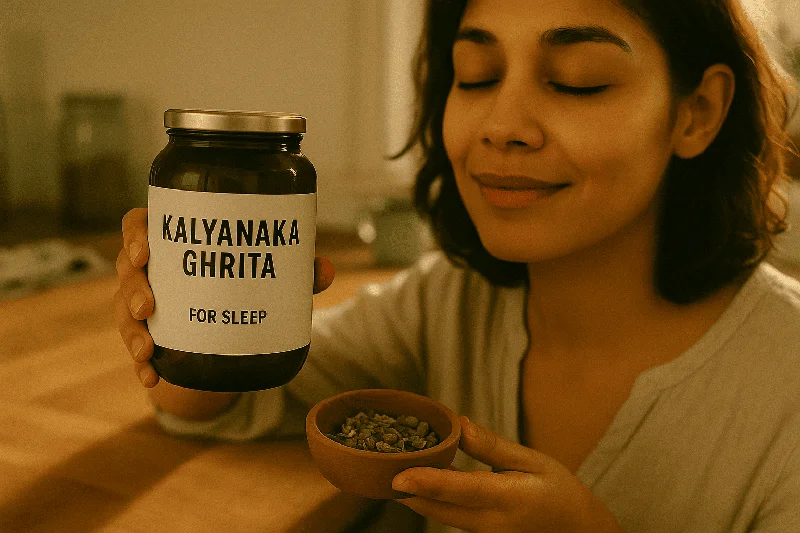
Kalyanaka Ghrita (also spelled Kalyanaka Ghritam) is a classical Ayurvedic medicated ghee formulation described in the Ashtanga Hridaya of Vagbhata, one of the most authoritative texts in Ayurvedic medicine. It contains approximately 28 polyherbal ingredients processed in cow's ghee through the traditional Sneha Kalpana method. Traditionally prescribed for psychiatric and neurological conditions—including epilepsy (Apasmara), psychosis (Unmada), anxiety, infertility, and anemia—it has gained renewed interest as a natural support for sleep, cognitive function, and mental clarity.
This guide covers everything you need to know: full ingredient list, proven and traditional benefits, exact dosage protocols, side effects, how it compares to other Ghrita formulations, and what modern research actually says. Whether you're a practitioner or a patient exploring Ayurvedic options, this is the most comprehensive resource you'll find on Kalyanaka Ghrita.
What Is Kalyanaka Ghrita?
Kalyanaka Ghrita is a Sneha Kalpana (lipid-based) preparation where cow's ghee acts as the base medium, infused with a carefully selected group of medicinal herbs. The word "Kalyanaka" derives from the Sanskrit root Kalyana, meaning "auspicious" or "beneficial"—a fitting name for a formulation designed to restore mental and physical wellbeing.
The primary classical reference appears in Ashtanga Hridaya, Uttarasthana, Chapter 6 (Unmada Chikitsa), where Vagbhata describes it as a remedy for various forms of insanity, epilepsy, and cognitive impairment. It is also referenced in the Ayurvedic Formulary of India (AFI), Part I, which standardizes its composition for modern manufacturing.
Historical Background & Classical References
The formulation has been in continuous use for over 1,500 years. Vagbhata composed the Ashtanga Hridaya around the 7th century CE, and Kalyanaka Ghrita has been one of its most frequently prescribed psychiatric formulations ever since.
The original Sanskrit shlokas describe it as effective for:
- Unmada (psychotic disorders, including what modern medicine classifies as schizophrenia)
- Apasmara (epilepsy and seizure disorders)
- Jwara (fever, particularly chronic and psychogenic fevers)
- Vandhyatva (infertility in both men and women)
- Pandu (anemia and related deficiency states)
- Vishama Jwara (intermittent fevers)
The classical text also states that Kalyanaka Ghrita "bestows progeny, lustre, voice, intelligence, and auspiciousness"—indicating its role as a Medhya Rasayana (intellect-promoting rejuvenative).
Kalyanaka Ghrita vs Mahakalyanaka Ghrita — Key Differences
This is one of the most common questions patients ask, and surprisingly, no other resource online answers it clearly.
Here's the distinction:
| Feature | Kalyanaka Ghrita | Mahakalyanaka Ghrita |
|---|---|---|
| Classical Source | Ashtanga Hridaya, Uttarasthana Ch. 6 | Sahasrayogam (Kerala text) |
| Number of Ingredients | ~28 herbs + ghee | ~30+ herbs + ghee (expanded formula) |
| Key Additions | — | Additional herbs like Jyotishmati (Celastrus paniculatus), Vacha (Acorus calamus) in some versions |
| Primary Focus | Broad psychiatric + general health | Stronger emphasis on neurological and seizure disorders |
| Availability | Widely manufactured (Kottakkal, AVP, etc.) | Less commonly available commercially |
| Dosage | Typically 5–10 g twice daily | Similar, but often used in higher doses under supervision |
When to choose which: If your practitioner recommends a general-purpose mental health and fertility Ghrita, Kalyanaka Ghrita is the standard choice. Mahakalyanaka Ghrita is typically reserved for more severe neuropsychiatric presentations, and is more commonly used within the Kerala Ayurvedic tradition.
Complete List of Ingredients (28 Herbs)
- Kalyanaka Ghrita's effectiveness comes from its synergistic polyherbal composition.
- Each ingredient contributes specific therapeutic properties—some are nervines, some are immunomodulators, and others enhance bioavailability.
Table of All Ingredients with Botanical Names & Proportions
| # | Sanskrit Name | Botanical Name | Part Used | Primary Action |
|---|---|---|---|---|
| 1 | Haritaki | Terminalia chebula | Fruit | Digestive, Rasayana |
| 2 | Vibhitaki | Terminalia bellirica | Fruit | Expectorant, Tridosha-balancing |
| 3 | Amalaki | Emblica officinalis | Fruit | Antioxidant, Pitta-pacifying |
| 4 | Haridra | Curcuma longa | Rhizome | Anti-inflammatory, neuroprotective |
| 5 | Daruharidra | Berberis aristata | Stem | Hepatoprotective, antimicrobial |
| 6 | Shweta Sariva | Hemidesmus indicus | Root | Blood purifier, cooling |
| 7 | Krishna Sariva | Cryptolepis buchanani | Root | Alterative, febrifuge |
| 8 | Kushta | Saussurea lappa | Root | Nervine, anti-spasmodic |
| 9 | Ela | Elettaria cardamomum | Seed | Carminative, Vata-pacifying |
| 10 | Tagara | Valeriana wallichii | Root | Sedative, anxiolytic |
| 11 | Agaru | Aquilaria agallocha | Heartwood | Calming, aromatic |
| 12 | Chandana | Santalum album | Heartwood | Cooling, Pitta-pacifying |
| 13 | Nagakesara | Mesua ferrea | Stamen | Hemostatic, digestive |
| 14 | Priyangu | Callicarpa macrophylla | Flower | Uterine tonic, cooling |
| 15 | Padmaka | Prunus cerasoides | Heartwood | Complexion-enhancing, cooling |
| 16 | Madhuka (Yashtimadhu) | Glycyrrhiza glabra | Root | Adaptogenic, demulcent |
| 17 | Mridvika (Draksha) | Vitis vinifera | Dried fruit | Nutritive, Pitta-pacifying |
| 18 | Nilotpala | Nymphaea stellata | Flower | Cooling, cardiac tonic |
| 19 | Kakoli | Roscoea procera | Tuber | Rasayana, Shukra-vardhaka |
| 20 | Kshirakakoli | Lilium polyphyllum | Tuber | Nutritive, fertility-enhancing |
| 21 | Manjistha | Rubia cordifolia | Root | Blood purifier, Pitta-pacifying |
| 22 | Shati | Hedychium spicatum | Rhizome | Expectorant, digestive |
| 23 | Renuka (Trivrit) | Operculina turpethum | Root | Mild purgative, Pitta-shodhaka |
| 24 | Pippali | Piper longum | Fruit | Bioenhancer, Vata-Kapha pacifying |
| 25 | Triphala water/decoction | Combination of #1, #2, #3 | — | Liquid medium (Drava Dravya) |
| 26 | Saindhava Lavana | Rock salt | — | Deepana, bioavailability enhancer |
| 27 | Cow's Milk | — | — | Liquid medium |
| 28 | Go-Ghrita (Cow's Ghee) | — | — | Base (Sneha Dravya) |
Note: Some manufacturers use substitutes for rare herbs like Kakoli and Kshirakakoli, as these plants are now endangered. Common substitutes include Ashwagandha and Shatavari respectively, as authorized by the Ayurvedic Pharmacopoeia.
Benefits of Key Individual Ingredients
Haridra (Curcuma longa): The curcumin content provides potent anti-inflammatory and neuroprotective effects. A 2019 study published in the Journal of Clinical Psychopharmacology demonstrated that curcumin supplementation significantly improved symptoms of major depression. Tagara (Valeriana wallichii): This is the Ayurvedic cousin of European valerian. Its valepotriates and iridoids have documented sedative and anxiolytic effects, which partly explain Kalyanaka Ghrita's effectiveness for sleep and anxiety. Yashtimadhu (Glycyrrhiza glabra): Acts as an adaptogen—it modulates cortisol metabolism and supports the adrenal glands, making it valuable in stress-related conditions. Triphala (Haritaki, Vibhitaki, Amalaki): Beyond its well-known digestive benefits, Triphala contributes potent antioxidant activity. The gallic acid and chebulagic acid content supports cellular protection.
Role of Ghee (Ghrita) as a Bioenhancer
This is something most resources overlook entirely.
Ghee isn't just a passive carrier—it actively enhances the therapeutic effect of the herbs through multiple mechanisms:
- 1.Lipophilic delivery system: Many neuroactive compounds are fat-soluble. Ghee facilitates their absorption through the intestinal wall and, crucially, across the blood-brain barrier (BBB). This is why Ayurveda specifically recommends ghee-based formulations for neuropsychiatric conditions.
- 2.Yogavahi property: In Ayurveda, ghee is described as Yogavahi—meaning it carries the properties of the substances mixed with it without losing its own qualities. Modern pharmacology would describe this as enhanced bioavailability.
- 3.Butyrate content: Ghee is rich in butyric acid, a short-chain fatty acid that supports gut-barrier integrity and has been linked to improved gut-brain axis communication—a mechanism increasingly recognized in mental health research.
Ayurvedic Properties & Mechanism of Action
Rasa, Guna, Veerya, and Vipaka
| Property | Value |
|---|---|
| Rasa (Taste) | Predominantly Tikta (Bitter), Madhura (Sweet), with Kashaya (Astringent) notes |
| Guna (Quality) | Snigdha (Unctuous), Guru (Heavy) |
| Veerya (Potency) | Sheeta (Cooling) |
| Vipaka (Post-digestive effect) | Madhura (Sweet) |
| Dosha Effect | Tridosha-shamaka, with particular affinity for Pitta and Vata |
How Does Kalyanaka Ghrita Work? The Pharmacological Perspective
No competitor has adequately explained the mechanism of action from a modern pharmacological standpoint.
Here's what we know:
Neuroprotective pathways: The combination of curcumin (from Haridra), valepotriates (from Tagara), and glycyrrhizin (from Yashtimadhu) provides a multi-target neuroprotective effect. These compounds modulate GABA-ergic transmission, reduce neuroinflammation via NF-κB inhibition, and support neuronal plasticity. Lipid-mediated BBB penetration: The ghee base creates a lipid matrix that enhances the passage of fat-soluble phytochemicals across the blood-brain barrier. This is particularly relevant for conditions like epilepsy and psychosis, where the active compounds need to reach the central nervous system in therapeutic concentrations. Gut-brain axis modulation: The butyric acid in ghee, combined with the digestive and prebiotic effects of Triphala and Pippali, supports a healthy gut microbiome—which is now understood to directly influence neurotransmitter production (particularly serotonin and GABA).
Health Benefits of Kalyanaka Ghrita
Is Kalyanaka Ghrita Effective for Stress and Anxiety Relief?
Yes, and this is perhaps its most well-documented traditional use. The formulation acts as a Medhya Rasayana (intellect tonic) and Manasika Dosha-hara (mental-disorder pacifier). The Tagara and Kushta in the formula have documented anxiolytic properties. A 2015 review in the Journal of Ayurveda and Integrative Medicine noted that classical Medhya Rasayanas demonstrate adaptogenic, anxiolytic, and antidepressant properties comparable to low-dose benzodiazepines in animal models.
Can Kalyanaka Ghrita Enhance Skin Health?
- Traditionally, yes.
- The blood-purifying herbs—Manjistha, Sariva, Haridra—combined with the moisturizing and Pitta-pacifying properties of ghee make this formulation beneficial for chronic skin conditions like eczema, psoriasis, and acne. The classical texts describe it as promoting Kanti (lustre) and Varna (complexion).
For skin-specific use, practitioners typically recommend internal consumption (not topical application) at standard doses for 2-3 months alongside Pathya (dietary guidelines).
Can Kalyanaka Ghrita Be Used for Hair Growth?
While it's not primarily a hair-growth remedy, the formulation's ability to pacify Pitta dosha and purify blood (Rakta Dhatu) indirectly supports hair health. Alopecia in Ayurveda is often linked to vitiated Pitta and Rakta, both of which this Ghrita addresses.
Kalyanaka Ghrita for Sleep
This is one of the fastest-growing search queries around this formulation, and for good reason. The sedative properties of Tagara (Indian Valerian) combined with the Vata-pacifying, cooling nature of the overall formula make it a valuable support for sleep disturbances—particularly those rooted in anxiety, overthinking, or Pitta-type insomnia (waking between 2-4 AM).
The WHO estimates that approximately 27% of adults experience sleep disruptions at some point. Kalyanaka Ghrita addresses insomnia not by sedating the patient (unlike pharmaceuticals), but by calming the nervous system and balancing the doshas responsible for sleep disturbance.
Practical tip: For sleep support specifically, take 5 g (approximately one teaspoon) with warm milk about 30 minutes before bedtime.
Other Important Benefits
- Epilepsy (Apasmara): Classical primary indication; anticonvulsant herbs like Kushta and Tagara provide the therapeutic backbone
- Female and male infertility: The Shukra-vardhaka (reproductive-tissue nourishing) herbs—Kakoli, Kshirakakoli, Shatavari (as substitute)—support reproductive health
- Anemia (Pandu): Amalaki's iron-absorption enhancement and Manjistha's blood-building properties
- Cognitive enhancement: The Medhya (intellect-promoting) action supports memory, focus, and learning capacity
- Digestive support: The Deepana-Pachana herbs (Pippali, Ela, Saindhava) support Agni without aggravating Pitta
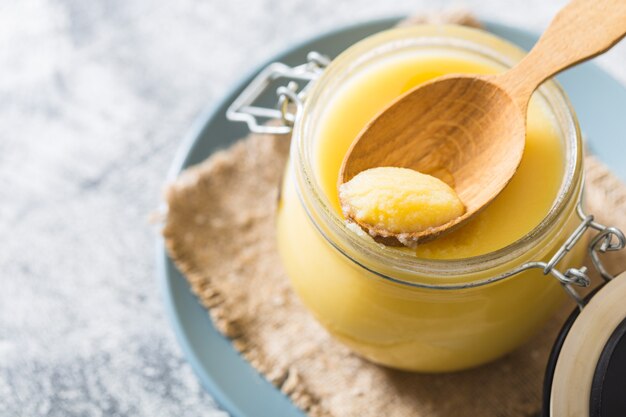
How to Prepare Kalyanaka Ghrita (Method of Preparation)
The Sneha Kalpana Process
Classical preparation follows the standardized Sneha Kalpana process described in Ayurvedic pharmaceutical texts:
- 1.Kalka (Paste): All herbal ingredients are finely powdered and made into a paste using a small amount of water. Standard ratio: 1 part Kalka.
- 2.Sneha (Ghee): Cow's ghee is taken as the base. Standard ratio: 4 parts ghee.
- 3.Drava Dravya (Liquid medium): Triphala decoction and cow's milk serve as the liquid media. Standard ratio: 16 parts liquid.
- 4.Cooking: The ghee is heated on a low flame. Kalka and Drava Dravya are added. The mixture is cooked on Mandagni (low heat) with continuous stirring until the characteristic Sneha Siddhi Lakshanas (signs of completion) appear:
- The paste (Kalka) can be rolled into a wick without sticking
- No crackling sound when a drop of water is added
- The ghee becomes aromatic and clear
- 5.Filtration: The medicated ghee is strained through a clean muslin cloth while warm.
Murchana Samskara — A Critical Pre-Processing Step
One often-overlooked step in quality preparations is Murchana Samskara—a pre-treatment of the raw ghee before the main preparation. This involves heating the ghee with 6 specific herbs (including Haridra, Amalaki, and Bibhitaki) to:
- Remove Ama (toxins) and rancidity from the ghee
- Enhance the ghee's capacity to absorb herbal properties
- Improve shelf life and therapeutic potency
A 2018 study from the International Journal of Ayurvedic Medicine demonstrated that Murchana-processed ghee showed significantly lower peroxide values and better physicochemical stability compared to unprocessed ghee.
Dosage: How to Use Kalyanaka Ghrita
Standard Adult Dosage
| Form | Dosage | Frequency | Anupana (Vehicle) |
|---|---|---|---|
| Traditional Ghrita | 5–10 grams (1–2 teaspoons) | Twice daily | Warm water or warm milk |
| Capsule form | 1–2 capsules (500 mg each) | Twice daily | Warm water |
| 7-Avarthi Capsules (AVP) | 1–2 capsules | Twice daily | Warm water |
Timing: Best taken on an empty stomach—30 minutes before meals, or at bedtime for sleep-related concerns.
Dosage for Children
Pediatric dosing is an area no other resource covers adequately. In traditional Ayurvedic practice, Kalyanaka Ghrita has been used for children with:
- Speech delay (Vak Sanga)
- Behavioral issues and hyperactivity (comparable to ADHD)
- Seizure disorders
- Autism spectrum conditions (Unmada variants in classical terminology)
| Age Group | Dosage | Frequency |
|---|---|---|
| 1–5 years | 1–2 grams (¼–½ teaspoon) | Once or twice daily |
| 5–12 years | 2–5 grams (½–1 teaspoon) | Twice daily |
| 12+ years | Adult dose | Twice daily |
Important: Pediatric use should always be under the supervision of a qualified Ayurvedic physician.
Detailed Course of Treatment
Another gap no competitor fills—how long should you actually take this?
| Condition | Typical Duration | Notes |
|---|---|---|
| Anxiety / Stress | 1–3 months | Can be repeated after a 2-week break |
| Insomnia | 1–2 months | Often combined with Ashwagandha Churna |
| Epilepsy | 3–6 months minimum | Must be used alongside conventional treatment, not as replacement |
| Infertility | 3–6 months | Often combined with Phala Ghrita or Shatavari |
| Skin conditions | 2–3 months | Dietary guidelines (Pathya) essential |
| Cognitive enhancement | 1–3 months | Cyclical use: 3 months on, 1 month off |
Side Effects, Precautions & Drug Interactions
What Are the Side Effects of Kalyanaka Ghrita?
Kalyanaka Ghrita is generally well-tolerated when taken in recommended doses.
However, possible side effects include:
- Digestive heaviness: Due to the ghee base, people with weak Agni (digestive fire) may experience heaviness, nausea, or loose stools initially
- Allergic reactions: Rare, but possible if you're allergic to any of the herbal ingredients
- Weight gain: Prolonged use of ghee-based preparations in sedentary individuals may contribute to weight gain
- Elevated lipids: Patients with hypercholesterolemia should use with caution and get lipid panels monitored
Contraindications
- Pregnancy: Not recommended during pregnancy unless specifically prescribed by an experienced Ayurvedic physician. Some ingredients (like Trivrit) have mild purgative properties.
- Lactation: Use with caution; consult your doctor.
- Diabetes: The ghee base may affect blood sugar management in diabetic patients.
- Acute Ama conditions: If there is significant toxic build-up (coated tongue, sluggish digestion, body aches), Kalyanaka Ghrita should not be started until Ama is cleared through appropriate detox measures.
Interaction with Modern Medicines
This is a critical area that nobody else addresses:
| Drug Category | Interaction Risk | Recommendation |
|---|---|---|
| Anti-epileptic drugs (Valproate, Carbamazepine) | Moderate — potential additive effect | Do not discontinue AEDs; use Ghrita as adjunct only under medical supervision |
| Antipsychotics (Olanzapine, Risperidone) | Low-Moderate | May support dose reduction over time; never self-adjust |
| Antidepressants (SSRIs, SNRIs) | Low | Generally considered safe as adjunct; monitor for excessive sedation with Tagara content |
| Blood thinners (Warfarin) | Low-Moderate | Haridra (turmeric) may have mild anticoagulant effect; monitor INR |
| Diabetes medications | Low | Monitor blood glucose as ghee may affect absorption kinetics |
Bottom line: Always inform both your Ayurvedic practitioner and allopathic doctor about all medications you're taking. Never replace prescribed psychiatric or neurological medication with Kalyanaka Ghrita without professional guidance.
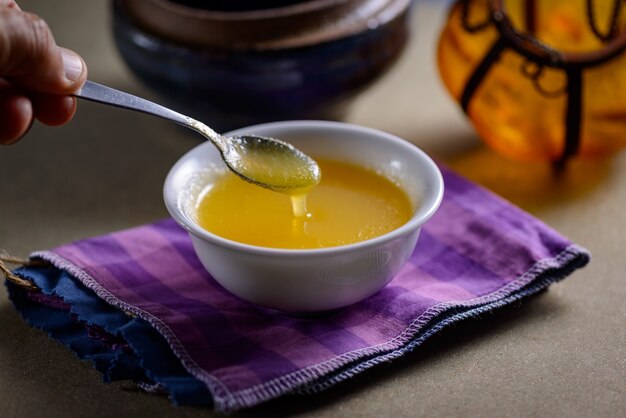
Comparison with Other Ayurvedic Ghrita Formulations
| Feature | Kalyanaka Ghrita | Brahmi Ghrita | Saraswata Ghrita | Panchagavya Ghrita |
|---|---|---|---|---|
| Primary Indication | Psychiatric disorders, infertility, skin | Memory and cognitive enhancement | Speech disorders, intelligence | Epilepsy, psychiatric disorders |
| Key Herb | Multi-herb (28) | Brahmi (Bacopa monnieri) | Saraswata (Brahmi + Vacha) | Panchagavya (5 cow products) |
| Dosha Affinity | Tridosha (Pitta-Vata focus) | Pitta-Vata | Vata-Kapha | Tridosha |
| Sleep Support | Strong (Tagara, Kushta) | Moderate | Mild | Mild |
| Best For | All-round mental health + fertility | Students, elderly cognitive decline | Children's developmental delays | Severe epilepsy, spiritual practices |
Diet and Lifestyle During Treatment (Pathya-Apathya)
Pathya (Favorable)
- Foods: Warm, cooked, easily digestible meals; milk, ghee, almonds, dates; fresh seasonal fruits
- Lifestyle: Regular sleep schedule (by 10 PM), gentle yoga (Shavasana, Yoga Nidra), Pranayama (Nadi Shodhana is particularly complementary), daily oil massage (Abhyanga)
- Avoid: Late nights, screen time before bed, excessive mental stimulation in the evenings
Apathya (Unfavorable)
- Cold, raw, and heavy foods (especially at night)
- Excessive caffeine, alcohol, and fermented foods
- Emotional stress, anger, and suppression of natural urges (Vegadharana)
- Fasting or irregular meals (weakens Agni and reduces absorption of the Ghrita)
Pharmaceutical Quality Standards & Research
Physicochemical Parameters
A 2020 study published in PLOS ONE analyzed Kalyanaka Ghrita samples using advanced analytical methods and established the following quality benchmarks:
| Parameter | Standard Value |
|---|---|
| Acid Value | ≤ 2.0 |
| Peroxide Value | ≤ 5.0 mEq/kg |
| Iodine Value | 26–38 |
| Saponification Value | 220–235 |
| Refractive Index | 1.454–1.458 (at 40°C) |
HPLC analysis confirmed the presence of curcumin and chebulagic acid as marker compounds, which can serve as quality indicators for standardization.
GC-MS chromatographic screening has identified over 40 distinct volatile and semi-volatile compounds in properly prepared Kalyanaka Ghrita, confirming successful extraction of phytochemicals into the ghee matrix.
Clinical Research — What Does the Evidence Say?
Honestly, this is where things get tricky. While Kalyanaka Ghrita has 1,500+ years of traditional clinical use, modern randomized controlled trials (RCTs) are scarce.
Here's what exists:
- Pharmaceutical standardization studies (2018–2020) have validated the preparation method and established quality control parameters, but these are not clinical outcome studies.
- Animal model studies have demonstrated anticonvulsant, anxiolytic, and neuroprotective effects of individual ingredients (especially curcumin, valerian, and licorice), but whole-formulation studies on humans are limited.
- Case series and observational studies from Ayurvedic hospitals in Kerala and Karnataka have reported positive outcomes in epilepsy and anxiety management, but these lack the rigor of double-blinded RCTs.
The gap is real: No competitor mentions this, but it's important for intellectual honesty. We need more well-designed clinical trials on Kalyanaka Ghrita as a complete formulation. The traditional evidence is compelling, and the pharmacological rationale is sound, but Level I evidence (large RCTs) remains pending.
Storage and Shelf Life
| Parameter | Recommendation |
|---|---|
| Storage | Cool, dry place; away from direct sunlight. Amber glass jars preferred. |
| Temperature | Below 30°C; do not refrigerate (may cause condensation and spoilage) |
| Shelf Life | Generally 2–3 years from manufacture (ghee-based preparations improve with age in Ayurveda—Purana Ghrita is considered more potent) |
| Signs of Spoilage | Rancid smell, change in color to dark brown/black, mold growth, sour taste |
Major Manufacturers
| Manufacturer | Location | Available Forms |
|---|---|---|
| Arya Vaidya Sala (Kottakkal) | Kerala, India | Traditional Ghrita (150g, 500g jars) |
| Arya Vaidya Pharmacy (AVP), Coimbatore | Tamil Nadu, India | Ghrita + 7-Avarthi Capsules |
| Nagarjuna Ayurvedic Group | Kerala, India | Traditional Ghrita |
| SNA Oushadhasala | Kerala, India | Traditional Ghrita |
The 7-Avarthi capsule form by AVP represents an innovation—the herbs are processed through 7 cycles of fortification (Avartana), concentrating the active compounds before encapsulating. This format is convenient for those who find the taste or texture of medicated ghee difficult to consume.
Frequently Asked Questions (FAQ)
What is Kalyanaka Guda used for?
Kalyanaka Guda is a different formulation that uses jaggery (Guda) as the base instead of ghee. It shares some ingredients with Kalyanaka Ghrita but is primarily used for anemia (Pandu), general debility, and as a nutritive tonic. The ghee version (Ghrita) is preferred for neuropsychiatric conditions because the lipid base enhances brain penetration of active compounds.
How to prepare Kalyanaka Ghrita at home?
While the Sneha Kalpana process is described above, home preparation is generally not recommended. The formulation requires precise proportions, controlled heating temperatures, and expertise in identifying Sneha Siddhi Lakshanas (endpoint indicators). Improperly prepared medicated ghee can be ineffective or even harmful. Purchase from reputable manufacturers with GMP certification.
Where can I find references for Kalyanaka Ghrita?
The primary references are:
- Ashtanga Hridaya, Uttarasthana, Chapter 6 (Unmada Chikitsa) — Vagbhata
- Ayurvedic Formulary of India, Part I — Government of India
- Sahasrayogam — for Mahakalyanaka Ghrita variants
- Bhaishajya Ratnavali — additional classical reference
How does Kalyanaka Ghrita help with digestion?
- The formulation contains several Deepana-Pachana (appetite-stimulating and digestive) herbs including Pippali, Ela (Cardamom), and Saindhava Lavana. The ghee base itself stimulates bile secretion, which supports fat digestion and nutrient absorption.
- However, it is not primarily a digestive formulation—if digestive issues are the main concern, other preparations like Hingvashtak Churna or Chitrakadi Vati are more appropriate.
Is Kalyanaka Ghrita safe for long-term use?
- In traditional Ayurvedic practice, Ghrita preparations are considered safe for extended use.
- However, it's wise to follow cyclical dosing—for example 3 months on, 2–4 weeks off—to prevent any cumulative effects. Long-term use should always be monitored by a qualified practitioner, especially in patients taking concurrent allopathic medications.
Final Thoughts
Kalyanaka Ghrita remains one of Ayurveda's most sophisticated polyherbal formulations—a 1,500-year-old recipe that modern pharmacology is only beginning to understand. Its multi-target approach to mental health, using a lipid-based delivery system that enhances brain penetration, is remarkably aligned with contemporary drug-delivery science.
That said, it is not a magic cure. It works best as part of a comprehensive treatment approach that includes proper diet (Pathya), lifestyle modifications, stress management, and—where indicated—conventional medical treatment. If you're dealing with epilepsy, severe anxiety, infertility, or sleep disturbances, consult a qualified Ayurvedic physician who can assess your Prakriti (constitution), current Vikruti (imbalance), and design a personalized treatment protocol.
Ready to explore Kalyanaka Ghrita? Speak with a certified Ayurvedic doctor who can guide you on the right dosage, duration, and complementary therapies for your specific condition.
Scientific Sources
- Product development and characterization of a lipid-based Ayurvedic polyherbal formulation: Kalyanaka Ghrita — Singh Y et al., 2024, Journal of Ayurveda and integrative medicine
- Quantitative evaluation of Kalayanak Ghrita and Sarasvat Ghrita dosage using a Drosophila life-history framework — Tapadia MG et al., 2026, microPublication biology
- Prakriti phenotyping in Central Serous Retinopathy (CSR): case series on Ayurvedic therapeutic outcomes in Vata individuals — K S et al., 2025, Frontiers in medicine
आयुर्वेदिक डॉक्टर से एक प्रश्न पूछें और मुफ़्त या सशुल्क मोड में अपनी चिंता की समस्या पर ऑनलाइन परामर्श प्राप्त करें।
2,000 से अधिक अनुभवी डॉक्टर हमारी साइट पर काम करते हैं और आपके प्रश्नों की प्रतीक्षा करते हैं और प्रतिदिन उपयोगकर्ताओं को उनकी स्वास्थ्य समस्याओं को हल करने में मदद करते हैं।
संबंधित आलेख