आयुर्वेदिक डॉक्टर से प्रश्न पूछें और निःशुल्क या भुगतान मोड में अपनी चिंता की समस्या पर ऑनलाइन परामर्श प्राप्त करें। 2,000 से अधिक अनुभवी डॉक्टर हमारी साइट पर काम करते हैं और आपके प्रश्नों का इंतजार करते हैं और उपयोगकर्ताओं को उनकी स्वास्थ्य समस्याओं को हल करने में प्रतिदिन मदद करते हैं।


Body DetoxEar, Nose, and Throat DisordersGeriatrics & RejuvenationImmunodeficiencyInfertility TreatmentNutritionOrthopedic DisordersPediatricsRespiratory DisordersSexually Transmitted Diseases (STDs)Surgery RecoveryUrological DisordersVascular DisordersDental DisordersEndocrinological DisordersGastrointestinal DisordersYoga TherapyGeneral MedicineAllergic DisordersCardio DisordersGynecology and ObstetricsCosmetologySkin and Hair DisordersEye DisordersInfectious DiseasesMental DisordersNeurological DisordersOncologyPanchakarmaSexual Health & DisordersSports Medicine
पर प्रकाशित 03/05/25
(को अपडेट 08/15/26)
3,065
Maha Manjishtadi Kashayam – Ayurvedic Decoction for Blood Purification & Skin Health
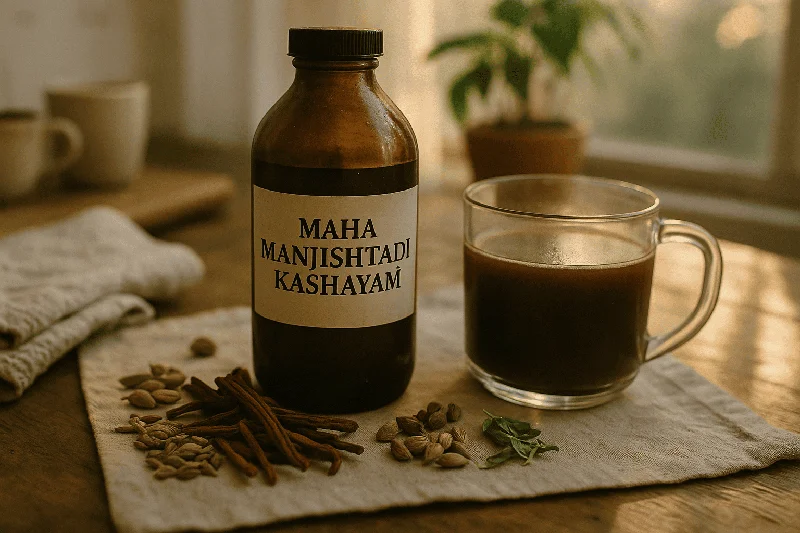
Maha Manjishtadi Kashayam is a classical Ayurvedic decoction (kashaya) primarily used for blood purification, chronic skin disorders, and inflammatory joint conditions. Rooted in centuries-old Sanskrit texts, this polyherbal formulation combines over 40 medicinal herbs — with Manjistha (Rubia cordifolia) as the lead ingredient — to detoxify the blood, pacify aggravated Pitta and Kapha doshas, and restore healthy skin from within. Whether you're dealing with stubborn eczema, recurring acne, psoriasis, or even gout (Vatarakta), this kashayam remains one of the most widely prescribed formulas in traditional Ayurvedic practice across Kerala, Karnataka, and the rest of India.
In this comprehensive guide, we cover everything you need to know: the complete ingredient list with proportions, scientifically-studied benefits, exact dosage guidelines, how it differs from regular Manjishtadi Kashayam, its role in Panchakarma protocols, and the gaps that no other resource has addressed — including drug interactions, course duration, and seasonal recommendations.
What Is Maha Manjishtadi Kashayam?
Definition and Classical Reference
Maha Manjishtadi Kashayam is a traditional Ayurvedic herbal decoction classified under "Kashaya Kalpana" — one of the five fundamental dosage forms in Ayurveda. The formulation is referenced in Bhaishajya Ratnavali, Kushtharogadhikara (Chapter 54, Shlokas 1–20) and also finds mention in Sahasrayogam, Kashaya Prakarana. The prefix "Maha" (meaning "great" or "expanded") indicates that this is the extended version of the simpler Manjishtadi Kashayam, containing a significantly larger number of herbs for broader therapeutic action.
The original Sanskrit shloka describes it as a remedy for "Sarva Kushtha" (all types of skin diseases), Vatarakta (gout), Upadansha (venereal diseases), Shleepada (filariasis), and Medaroga (metabolic/obesity-related disorders).
> Sanskrit Reference: "Mahamanjishtadi kashayam kushthaghnam raktashodhakam | Vataraktaharam chaiva sarva kushtha vinashanam"
> Translation: Maha Manjishtadi Kashayam destroys skin diseases, purifies the blood, and alleviates Vatarakta.
Maha Manjishtadi vs Manjishtadi Kashayam — Key Differences
This is one of the most commonly asked questions, yet surprisingly, no major Ayurvedic resource online has clearly explained the distinction.
Here's a detailed comparison:
| Feature | Manjishtadi Kashayam | Maha Manjishtadi Kashayam |
|---|---|---|
| Number of Ingredients | 8–12 herbs | 40+ herbs |
| Primary Text | Ashtanga Hridayam | Bhaishajya Ratnavali, Sahasrayogam |
| Scope of Action | Mild to moderate blood impurities, simple skin rashes | Chronic, deep-seated skin diseases, autoimmune-like conditions, systemic toxicity |
| Dosha Action | Pitta-Kapha shamana | Pitta-Kapha-Vata shamana (broader spectrum) |
| Strength | Moderate | Strong — "Maha" denotes enhanced potency |
| Use in Panchakarma | Rarely used | Often used as pre/post Panchakarma support |
| Suitable For | Early-stage or mild conditions | Chronic, recurrent, or treatment-resistant cases |
In simple terms: if Manjishtadi Kashayam is the "standard" formula, Maha Manjishtadi Kashayam is the "heavy-duty" version designed for stubborn and complex conditions.
Rasa, Guna, Virya, Vipaka (Ayurvedic Pharmacology)
Understanding the pharmacological profile of the overall formulation helps practitioners select it appropriately:
- Rasa (Taste): Predominantly Tikta (bitter) and Kashaya (astringent), with secondary Madhura (sweet) notes
- Guna (Properties): Laghu (light), Ruksha (dry)
- Virya (Potency): Sheeta (cooling)
- Vipaka (Post-digestive effect): Katu (pungent)
- Dosha Karma: Primarily pacifies Pitta and Kapha; also addresses Rakta Dosha (blood tissue vitiation)
The cooling potency is what makes it so effective in inflammatory and burning skin conditions, while the bitter-astringent taste profile supports liver detoxification and blood cleansing.
Ingredients and Composition
Complete List of Ingredients (with Sanskrit, Hindi & Latin Names)
One significant gap across existing resources is the absence of a complete ingredient list with proportions from the classical source. Below is the full formulation as described in Sahasrayogam and Bhaishajya Ratnavali. Each herb is used in equal parts unless otherwise noted, with Manjistha taken as the base proportion (1 part each):
| # | Sanskrit Name | Hindi Name | Latin/Botanical Name |
|---|---|---|---|
| 1 | Manjistha | Manjith | Rubia cordifolia |
| 2 | Musta | Motha | Cyperus rotundus |
| 3 | Kutaja Tvak | Kurchi Chhal | Holarrhena antidysenterica |
| 4 | Guduchi | Giloy | Tinospora cordifolia |
| 5 | Kushta | Kuth | Saussurea lappa |
| 6 | Triphala (Haritaki, Bibhitaki, Amalaki) | Triphala | Terminalia chebula, T. bellirica, Emblica officinalis |
| 7 | Nimba Tvak | Neem Chhal | Azadirachta indica |
| 8 | Patola | Parval Patta | Trichosanthes dioica |
| 9 | Katuka (Kutki) | Kutki | Picrorhiza kurroa |
| 10 | Vacha | Bach | Acorus calamus |
| 11 | Daruharidra | Daruhaldi | Berberis aristata |
| 12 | Haridra | Haldi | Curcuma longa |
| 13 | Bhringaraja | Bhangra | Eclipta alba |
| 14 | Vidanga | Baividang | Embelia ribes |
| 15 | Chitraka | Chitrak | Plumbago zeylanica |
| 16 | Shatavari | Shatavari | Asparagus racemosus |
| 17 | Sariva | Anantmool | Hemidesmus indicus |
| 18 | Ushira | Khas | Vetiveria zizanioides |
| 19 | Chandana | Chandan | Santalum album |
| 20 | Padmaka | Padmakh | Prunus cerasoides |
| 21 | Trayamana | — | Gentiana kurroo |
| 22 | Pippali | Pippal | Piper longum |
| 23 | Devadaru | Deodar | Cedrus deodara |
| 24 | Yashti (Mulethi) | Mulethi | Glycyrrhiza glabra |
| 25 | Aragvadha | Amaltas | Cassia fistula |
| 26 | Bakuchi | Babchi | Psoralea corylifolia |
| 27 | Khadira | Khair | Acacia catechu |
| 28 | Karanja | Karanj | Pongamia pinnata |
| 29 | Trivrit | Nisoth | Operculina turpethum |
| 30 | Danti | Danti | Baliospermum montanum |
| 31 | Tila (Sesame) | Til | Sesamum indicum |
| 32 | Murva | Murva | Marsdenia tenacissima |
| 33 | Nagara (Shunthi) | Sonth | Zingiber officinale |
| 34 | Indrayava | Indrajau | Holarrhena pubescens (seeds) |
| 35 | Saptaparna | Saptaparna | Alstonia scholaris |
| 36 | Kiratatikta | Chirayata | Swertia chirayita |
| 37 | Vishala | — | Citrullus colocynthis |
| 38 | Surasa (Tulasi) | Tulsi | Ocimum sanctum |
| 39 | Bhallataka | Bhilawa | Semecarpus anacardium (purified) |
| 40 | Guggulu | Guggul | Commiphora mukul |
Note: Some regional formulations may include 2–5 additional herbs depending on the textual tradition (Kerala vs. North Indian). The above list represents the most widely accepted classical version.
Key Herbs and Their Roles
- Manjistha (Rubia cordifolia): The primary herb — a powerful Raktashodhaka (blood purifier) with documented anti-inflammatory, antioxidant, and hepatoprotective properties. A 2015 study published in the Journal of Ethnopharmacology confirmed its immunomodulatory and anti-inflammatory actions.
- Guduchi (Tinospora cordifolia): Immunomodulatory, antipyretic, and adaptogenic. Acts as Rasayana (rejuvenative).
- Nimba (Azadirachta indica): Potent antibacterial and antifungal — supports skin healing from infections.
- Kutki (Picrorhiza kurroa): A well-researched hepatoprotective herb. A 2019 study in Phytomedicine demonstrated its efficacy in reducing liver inflammation markers.
- Khadira (Acacia catechu): Classically known as one of the best herbs for skin diseases (Kushtaghna).
- Haridra (Curcuma longa): Curcumin's anti-inflammatory mechanism has been extensively studied, with over 12,000 publications on PubMed.
Synergistic Action of the Formula
What makes Maha Manjishtadi Kashayam uniquely powerful isn't just any single herb — it's the synergistic interplay between them.
The formulation simultaneously works on multiple levels:
- 1.Blood purification layer: Manjistha + Sariva + Khadira cleanse Rakta Dhatu
- 2.Liver detoxification layer: Kutki + Nimba + Bhringaraja support hepatic function and bile flow
- 3.Anti-inflammatory layer: Guduchi + Haridra + Chandana reduce systemic inflammation
- 4.Mild laxative layer: Trivrit + Aragvadha + Triphala ensure toxin elimination through the bowels
- 5.Immune modulation layer: Guduchi + Amalaki + Tulasi strengthen immunity to prevent recurrence
This multi-target approach is why the formula works for conditions that single herbs or simpler formulations cannot resolve.
Health Benefits of Maha Manjishtadi Kashayam
Blood Purification and Detoxification
The primary action of this kashayam is Rakta Shodhana — purification of the blood tissue. In Ayurvedic physiology, impure blood (Rakta Dushti) is the root cause of most skin diseases. The herbs in this formula work together to remove Ama (metabolic toxins) from the bloodstream, support the liver's natural detoxification pathways, and improve the quality of Rasa and Rakta Dhatus.
This isn't just theoretical. A 2018 observational study published in the International Journal of Ayurveda Research on 60 patients with chronic urticaria showed significant improvement in symptoms after 45 days of Maha Manjishtadi Kashayam administration — particularly in pruritis (itching) and skin eruption frequency.
Skin Health: Eczema, Psoriasis, Acne, Dermatitis
This is where the formulation truly shines. It is indicated for virtually all types of Kushtha (skin diseases):
- Eczema (Vicharchika): Reduces itching, oozing, and thickening of skin
- Psoriasis (Kitibha Kushtha): Helps manage scaling, redness, and plaque formation
- Acne Vulgaris (Yuvana Pidika): Addresses the root cause — hormonal imbalance and blood impurity — rather than just surface symptoms
- Chronic Dermatitis: Effective in contact dermatitis and atopic dermatitis
- Non-healing Ulcers (Dushta Vrana): Promotes wound healing by purifying blood supply to tissues
- Fungal Infections: The antifungal properties of Nimba and Khadira provide additional support
Real-world observation: Many Ayurvedic practitioners report that patients with moderate acne begin seeing visible improvements within 3–4 weeks, while chronic conditions like psoriasis typically require 2–3 months of consistent use before significant changes become apparent.
Anti-Inflammatory and Joint Support
Beyond skin health, Maha Manjishtadi Kashayam is classically indicated for:
- Vatarakta (Gout): Reduces uric acid-related inflammation and joint pain
- Amavata (Rheumatoid Arthritis-like conditions): Helps manage swelling and stiffness
- General joint inflammation: The cooling, anti-inflammatory action of Chandana, Guduchi, and Haridra provides systemic relief
Liver Support and Metabolic Health
The formulation provides substantial hepatoprotective benefits:
- Supports bile secretion and improves fat metabolism
- Indicated in Kamala (Jaundice) and early-stage fatty liver (Yakrit Vikara)
- Kutki and Bhringaraja together have demonstrated hepatoprotective activity in multiple pharmacological studies
- Helps manage Medaroga (obesity/metabolic disorders) by improving Agni (digestive fire) and clearing Ama from Medo Dhatu
Extended Classical Indications
Several important classical indications are rarely discussed on other platforms:
- Shleepada (Filariasis): Reduces lymphatic swelling and improves drainage
- Upadansha (Syphilis/STDs): Used as an adjunct in managing venereal diseases
- Pakshaghata (Paralysis/Hemiplegia): Supportive therapy for neurological conditions involving blood vitiation
- Netra Roga (Eye diseases): Where the root cause is Pitta-Rakta vitiation
- Supta Roga (Numbness): Conditions involving impaired sensation due to circulatory issues
(In Hindi: सर्व कुष्ठ रोग, वातरक्त, उपदंश, श्लीपद, पक्षाघात, सुप्त, मेदोरोग, नेत्ररोग)
Dosage of Maha Manjishtadi Kashayam
Standard Adult Dosage
| Form | Dosage | Frequency | Timing |
|---|---|---|---|
| Liquid Kashayam (decoction) | 15–20 ml | Twice daily | Before meals (empty stomach) |
| Kashayam Tablets (Gulika) | 2 tablets | Twice daily | Before meals with warm water |
| Powder (Churna for home preparation) | 10 g boiled in 400 ml water, reduced to 100 ml | Twice daily | Before meals |
Anupana (Adjuvant/Vehicle): Typically taken with warm water. In some traditions, honey or ghee is added based on the dominant dosha — honey for Kapha conditions, ghee for Pitta conditions.
Dosage for Children
Children aged 5–12 years: 5–10 ml of liquid kashayam or 1 tablet, once or twice daily, strictly under practitioner supervision. Not recommended for children below 5 years.
Dosage for Elderly
Elderly patients (above 65): Start with a lower dose of 10 ml once daily and gradually increase based on tolerance and digestive capacity.
Recommended Course Duration
This is a critical detail that no competitor has adequately addressed.
Based on classical guidelines and clinical practice:
- Acute conditions (mild acne, rashes): 2–4 weeks
- Moderate conditions (eczema flare-ups, recurring acne): 4–8 weeks
- Chronic conditions (psoriasis, chronic eczema, gout): 8–12 weeks, sometimes up to 6 months with periodic breaks
- Maintenance/prevention: Some practitioners recommend cyclical courses — 3 months on, 1 month off
Always consult a qualified Ayurvedic physician (BAMS/MD Ayurveda) for personalized duration recommendations.
Expected Timeline of Results
| Condition | First Noticeable Improvement | Significant Results |
|---|---|---|
| Acne | 2–3 weeks | 6–8 weeks |
| Eczema | 3–4 weeks | 8–12 weeks |
| Psoriasis | 4–6 weeks | 12–16 weeks |
| Gout (Vatarakta) | 1–2 weeks (pain reduction) | 4–8 weeks |
| Blood purification (general) | 2–3 weeks | 6–8 weeks |
These timelines are approximate and vary based on disease chronicity, individual constitution, diet compliance, and concurrent therapies.
How to Prepare Maha Manjishtadi Kashayam at Home
If you have access to the coarse powder (Yavakuta Churna), you can prepare it at home following the traditional Kashaya Kalpana method:
Step-by-Step Process:
- Take 10–15 grams of Maha Manjishtadi Kashayam powder
- Add 400 ml (approximately 2 cups) of clean water
- Soak the powder in water for 2–4 hours (or overnight for best extraction)
- Boil on medium flame, stirring occasionally
- Reduce the liquid to one-fourth of the original volume — approximately 100 ml
- Strain through a clean muslin cloth
- Drink warm on an empty stomach
- Storage: Freshly prepared kashayam should be consumed within 24 hours.
- Do not refrigerate and reheat — prepare fresh each day for best results.
Tip: The decoction will taste predominantly bitter and astringent. If the taste is too strong, you can add a teaspoon of honey (for Kapha-type conditions) after the liquid cools to a drinkable temperature.
स्वयं दवा न लें और प्रतीक्षा न करें। अभी डॉक्टर से चैट शुरू करें
Forms of Maha Manjishtadi Kashayam: Which One Should You Choose?
No resource currently compares the different forms available in the market.
Here's what you need to know:
| Form | Pros | Cons | Best For |
|---|---|---|---|
| Traditional Liquid Kashayam (freshly prepared) | Maximum potency, full spectrum of active compounds | Bitter taste, short shelf life (24 hrs), inconvenient | Serious/chronic conditions, traditional practitioners |
| Ready-made Liquid (bottled, e.g., AVP, Kottakkal) | Convenient, standardized, shelf life 2–3 years | Contains preservatives (usually sodium benzoate), slightly lower potency | Moderate conditions, daily use |
| Kashayam Tablets (Gulika) | Very convenient, travel-friendly, no bitter taste | Lower bioavailability vs. liquid, may require higher doses | Mild conditions, patients who can't tolerate bitter taste, travellers |
| Powder (Churna) | Good potency when freshly prepared, longer shelf life than liquid | Requires preparation time | Those who want freshness without sourcing raw herbs |
Shelf Life:
- Fresh decoction: 24 hours
- Commercially bottled liquid: 2–3 years (check label)
- Tablets: 3–5 years
- Powder: 1–2 years if stored in airtight container away from moisture
Pathya-Apathya (Diet & Lifestyle During Treatment)
This section is crucial but almost completely ignored across existing online resources. In Ayurveda, the medicine is only half the treatment; the other half is Pathya (favorable diet and lifestyle).
Pathya (Recommended)
- Foods: Bitter gourd, pointed gourd (parwal), old rice, moong dal, barley, pomegranate, amla, green leafy vegetables
- Lifestyle: Regular mild exercise, adequate sleep, stress management, wearing loose cotton clothing (for skin conditions)
- Helpful additions: Drinking warm water throughout the day, applying coconut oil or Nalpamaradi Keram externally
Apathya (To Be Avoided)
- Foods: Sour foods (excessive tamarind, citrus, fermented foods), spicy foods, fried/oily foods, jaggery, sesame-based preparations, curd/yogurt (especially at night), fish with milk, contradictory food combinations (Viruddha Ahara)
- Lifestyle: Excessive sun exposure, daytime sleep, suppression of natural urges, excessive physical exertion, hot water baths (for Pitta-predominant skin conditions)
Ignoring Pathya is one of the most common reasons for slow or incomplete results, even when the right medicine is being taken.
Role in Panchakarma Protocols
Maha Manjishtadi Kashayam plays a supporting role in comprehensive Panchakarma therapy:
- Pre-Panchakarma (Purvakarma): Used for 7–14 days before Virechana (therapeutic purgation) to initiate blood purification and bring toxins to the GI tract
- Post-Panchakarma (Paschat Karma): Prescribed as Shamana Aushadhi (palliative medicine) after Shodhana (purification) for 30–90 days to prevent disease recurrence
- During Raktamokshana (bloodletting therapy): Given as an internal complement to support blood tissue regeneration
In chronic psoriasis management, many Kerala-based Ayurvedic hospitals use a combined protocol: Virechana → Raktamokshana → Maha Manjishtadi Kashayam (oral, 3 months) → Topical applications (Eladi Keram/Pinda Tailam). This integrated approach typically yields far better outcomes than oral medicine alone.
Side Effects and Contraindications
Possible Side Effects
Maha Manjishtadi Kashayam is generally well-tolerated when taken in recommended doses.
However, some individuals may experience:
- Mild gastric discomfort or loose stools (especially in the first few days) due to bitter herbs
- Excessive cooling in Vata-predominant individuals — may manifest as bloating or coldness
- Hypoglycemia risk — some ingredients may lower blood sugar; monitor levels if diabetic
Contraindications
- Pregnancy: Strictly contraindicated — contains herbs like Danti, Trivrit, and Chitraka that can stimulate uterine contractions
- Lactation: Use only under strict medical supervision
- Severe debility or emaciation (Krisha patients): The formula is Ruksha (drying) and Laghu (light) — may aggravate Vata in severely depleted individuals
Drug Interactions
This is a significant gap that no existing resource addresses adequately:
- Blood thinners (Warfarin, Aspirin): Manjistha and Guduchi may have mild anticoagulant properties — concurrent use could increase bleeding risk. Consult your doctor.
- Anti-diabetic medications: May potentiate hypoglycemic effect — monitor blood sugar closely
- Immunosuppressants (Methotrexate, Cyclosporine): Guduchi is an immunomodulator; theoretical interaction exists — discuss with both your Ayurvedic and allopathic doctors
- Hepatotoxic drugs: Since the formula is hepatoprotective, it may alter metabolism of drugs processed by the liver
Important: Always inform your physician about all Ayurvedic medicines you're taking, especially if you're on any prescription medications.
Seasonal Recommendations (Ritucharya)
Another topic entirely absent from competing resources.
According to Ayurvedic principles:
- Best seasons for intake: Sharad Ritu (autumn, October–November) and Vasanta Ritu (spring, March–April) — these are natural Pitta aggravation periods where blood purification is most beneficial
- Caution in: Hemanta and Shishira Ritu (winter months, November–February) — the cooling nature of the formulation may aggravate Vata; if needed during winter, combine with warm Anupana and add a pinch of dry ginger
- Grishma Ritu (summer): Can be taken, but ensure adequate hydration as the formula is Ruksha (drying)
Can Maha Manjishtadi Kashayam Help with Weight Loss?
This question appears frequently in Google searches. While this kashayam is not a "weight loss medicine" per se, it does support weight management indirectly through several mechanisms:
- Improves Agni (metabolism) and reduces Ama (metabolic toxins)
- Addresses Medaroga (excess fat tissue) — one of its classical indications
- Supports liver function, which is central to fat metabolism
- The mild laxative herbs promote regular elimination
However, for significant weight loss, it should be combined with appropriate diet, exercise, and possibly other formulations like Varanadi Kashayam or Navaka Guggulu. Don't rely on it as a standalone weight loss remedy.
Can You Take Manjistha Daily?
- Manjistha as a single herb can be taken daily for moderate periods (4–8 weeks) for blood purification.
- However, Maha Manjishtadi Kashayam — being a multi-herb, potent formulation — should be taken in defined courses rather than indefinitely. Continuous long-term use without breaks is not recommended in Ayurveda. Follow the course duration guidelines mentioned above, and always work with a qualified practitioner for ongoing management.
Frequently Asked Questions (FAQ)
What is Mahamanjisthadi Kadha used for?
Mahamanjisthadi Kadha (another name for Maha Manjishtadi Kashayam — "Kadha" means decoction in Hindi/Marathi) is used for chronic skin diseases like eczema, psoriasis, acne, and dermatitis. It's also indicated for blood purification, gout, liver disorders, filariasis, and metabolic conditions. Think of it as a broad-spectrum blood-purifying and skin-healing formulation.
What is the difference between Manjishtadi Kashayam and Mahamanjishtadi Kashayam?
The key difference lies in the number of ingredients and therapeutic scope. Manjishtadi Kashayam contains 8–12 herbs and is suited for mild conditions, while Maha Manjishtadi Kashayam contains 40+ herbs with a broader, more powerful action suitable for chronic and resistant conditions. See the detailed comparison table above.
What is the use of Mahathikthakam Kashayam?
Mahathikthakam Kashayam is a different formulation, also used for skin diseases but with a stronger emphasis on Pitta pacification and conditions involving burning sensation, bleeding disorders, and deep tissue inflammation. While Maha Manjishtadi Kashayam focuses on blood purification, Mahathikthakam focuses on Tikta Rasa (bitter taste) dominant cooling therapy. They are sometimes prescribed together in complex cases.
Is Maha Manjishtadi Kashayam available in tablet form?
Yes. Several reputable manufacturers including Kottakkal Arya Vaidya Sala, AVP (Arya Vaidya Pharmacy), and Sitaram Ayurveda offer Maha Manjishtadi Kashayam in tablet (Gulika) form. Tablets are convenient but generally considered slightly less potent than the liquid decoction form.
How should I store Maha Manjishtadi Kashayam?
Store bottled liquid kashayam in a cool, dry place away from direct sunlight. Once opened, refrigerate and use within 2–3 months. Tablets should be stored in airtight containers. Powder form stays fresh for 1–2 years in airtight, moisture-free containers. Freshly prepared kashayam must be consumed within 24 hours.
Can I take Maha Manjishtadi Kashayam without a doctor's prescription?
While it is available over the counter in India, it is strongly recommended to consult a qualified Ayurvedic practitioner before starting this formulation. The dosage, duration, and suitability vary based on individual Prakriti (constitution), disease severity, and concurrent medications. Self-medication with potent polyherbal formulas can sometimes do more harm then good.
Conclusion
Maha Manjishtadi Kashayam stands as one of Ayurveda's most comprehensive formulations for blood purification, skin health, and systemic detoxification. With over 40 carefully chosen herbs working in synergy, it addresses the root cause of skin diseases rather than merely suppressing symptoms. Whether you're dealing with chronic eczema, stubborn psoriasis, metabolic disorders, or simply want to support your body's natural detoxification — this time-tested kashayam offers a powerful, holistic solution.
That said, Ayurveda is not one-size-fits-all. Your Prakriti, Vikriti, Agni status, and the specific nature of your condition all matter. Work with a qualified Ayurvedic physician who can customize the dosage, duration, Anupana, and Pathya specifically for you.
Ready to start your journey with Maha Manjishtadi Kashayam? Consult a certified Ayurvedic doctor to get a personalized treatment plan tailored to your unique constitution and health goals.
Scientific Sources
- Tulsi - Ocimum sanctum: A herb for all reasons — Cohen MM, 2014, Journal of Ayurveda and integrative medicine
- Arjunolic acid: a novel phytomedicine with multifunctional therapeutic applications — Hemalatha T et al., 2010, Indian journal of experimental biology
- Reporting an alliance using an integrative approach to the management of lymphedema in India — Ryan TJ et al., 2012, The international journal of lower extremity wounds
- Therapeutic potential of curcumin in eye diseases — Radomska-Leśniewska DM et al., 2019, Central-European journal of immunology
- Bomohs, doctors and sinsehs--medical pluralism in Malaysia — Heggenhougen HK, 1980, Social science & medicine. Medical anthropology
- Cupping Therapy — Sina RE et al., 2026
- Healthcare and disease management in Ayurveda — Mishra L et al., 2001, Alternative therapies in health and medicine
- Transforming Medicinal Oil into Advanced Gel: An Update on Advancements — Maurya R et al., 2024, Gels (Basel, Switzerland)
- A comprehensive analysis on Symplocos racemosa Roxb.: Traditional uses, botany, phytochemistry and pharmacological activities — Acharya N et al., 2016, Journal of ethnopharmacology
- Development of Cissus quadrangularis-Loaded POSS-Reinforced Chitosan-Based Bilayer Sponges for Wound Healing Applications: Drug Release and In Vitro Bioactivity — Aker SD et al., 2023, ACS omega
- Complete Resolution of Plantar Psoriasis With Ayurveda, A Case Report — Borse S et al., 2024, Alternative therapies in health and medicine
- The stages of development of Ayurvedic medicine(https://pubmed.ncbi.nlm.nih.gov/23808050/) — Subotialov MA et al., 2013, Problemy sotsial'noi gigieny, zdravookhraneniia i istorii meditsiny
- The importance of a pleasant process of treatment: lessons on healing from South India — Halliburton M, 2003, Culture, medicine and psychiatry
- Comparative study on cellular entry of incinerated ancient gold particles (Swarna Bhasma) and chemically synthesized gold particles — Beaudet D et al., 2017, Scientific reports
- Burning Mouth Syndrome in Association With Angular Cheilitis: A Case Report — Bhaiyya PS et al., 2024, Cureus
- Ocimum sanctum Tulsi as a Potential Immunomodulator for the Treatment of Ischemic Injury in the Brain(https://pubmed.ncbi.nlm.nih.gov/36515030/) — Yadav I et al., 2024, Current molecular medicine
- Modernization of a Traditional Siddha Medicine Paccai eruvai into a Novel Nanogel Formulation for the Potent Wound Healing Activity-A Phyto- Pharmaceutical Approach — Sakthiganapathi M et al., 2023, Pharmaceutical nanotechnology
- Enhanced Internalization of Indian Ayurvedic Swarna Bhasma (Gold Nanopowder) for Effective Interaction with Human Cells — Kashani AS et al., 2018, Journal of nanoscience and nanotechnology
- Patient agency revisited: "healing the hidden" in South India — Sieler R, 2014, Medical anthropology quarterly
- Screening of anti-cancerous potential of classical Raudra rasa and modified Raudra rasa modified with hiraka bhasma (nanodiamond) through FTIR & LC-MS analysis — Dash MK et al., 2022, Journal of complementary & integrative medicine
उपयोगकर्ताओं के प्रश्न
How does Manjistha contribute to overall skin health and vitality?
Client_d27f4f
24 दिनों पहले
Manjistha, or Rubia cordifolia, primarily supports skin health by acting as a blood purifier, which can result in clearer, more vibrant skin. It is believed to help detoxify the blood and reduce inflammation, making it beneficial for conditions like acne and eczema. Manjistha can be taken daily for 4–8 weeks for these benefits, but improvements in skin conditions might vary based on individual health factors and the severity of the issue. Consult a healthcare provider if you notice no improvement or if skin conditions worsen while using Manjistha.
How does Mahathikthakam benefit skin healing and detoxification?
Client_9f2357
33 दिनों पहले
Mahathikthakam is primarily known in Ayurveda for its role in skin healing and detoxification due to its bitter (Tikta Rasa) taste, which is believed to help cleanse the blood and improve skin health. Practically, this involves the use of herbal ingredients aimed at reducing inflammation and promoting better circulation. Skin improvements might require consistent use over several weeks, but it varies individually. If you experience persistent skin issues or adverse reactions, consult a healthcare provider as these may require professional medical evaluation.
What are the potential side effects of Maha Manjishtadi Kashayam?
Client_35e5fd
43 दिनों पहले
Maha Manjishtadi Kashayam is a herbal formulation used primarily for blood purification and skin health in Ayurveda. Potential side effects might include gastrointestinal issues, allergic reactions, or changes in energy levels. Continuous long-term use without breaks is discouraged, as it might lead to imbalances. Consult a healthcare provider before using this kashayam, especially if you experience side effects or take other medications. Children should only use it under medical supervision. Always store it properly to preserve its efficacy.
How does Maha Manjishtadi Kashayam compare to other Ayurvedic skin treatments?
Client_e08184
53 दिनों पहले
Maha Manjishtadi Kashayam is often utilized in Ayurvedic medicine for skin conditions like eczema, psoriasis, acne, and dermatitis due to its anti-inflammatory and detoxifying properties. Compared to other Ayurvedic treatments, this formulation is specifically used to target chronic skin disorders with symptoms such as itching and eruptions, as evidenced by a study showing symptom improvement within 45 days. Unlike Mahathikthakam Kashayam, which focuses on pacifying the Pitta dosha and is recommended for conditions involving burning sensations and bleeding, Maha Manjishtadi Kashayam is typically chosen for its broader skin benefits. If skin symptoms persist or worsen, it is advisable to consult with a healthcare professional for personalized assessment and treatment.
Can Maha Manjishtadi Kashayam help reduce inflammation in the skin?
Client_5ac10f
62 दिनों पहले
Maha Manjishtadi Kashayam may help reduce inflammation in the skin due to its blood detoxifying and anti-inflammatory properties, primarily attributed to its main ingredient, Manjistha (Rubia cordifolia). This polyherbal formulation is traditionally used in Ayurveda to address skin issues by targeting their root causes rather than just alleviating symptoms. While it is available over the counter in India, it is crucial to consult a qualified Ayurvedic practitioner for personalized advice, as individual conditions and dosha imbalances can vary significantly. Often, improvements might be noticed within a few weeks, but timelines can differ widely depending on the condition's severity and individual response to treatment. If skin issues persist or worsen, it's advisable to seek medical attention to rule out more serious underlying conditions.
Can Maha Manjishtadi Kashayam assist in improving liver function and metabolic health?
Client_81f497
72 दिनों पहले
Yes, it can assist! Maha Manjishtadi Kashayam supports liver function, which is key for better metabolic health. It helps improve digestion, reduces toxins (ama), and aids in fat metabolism. Though, for best results, combine it with a balanced diet and regular exercise. Long-term use should be done carefully. Always good to talk to a practitioner for personalized advice!
Can I use Maha Manjishtadi Kashayam for conditions other than skin disorders?
Client_f1be55
82 दिनों पहले
Yes, you can use Maha Manjishtadi Kashayam for other conditions too! It's got blood-purifying properties, so it could also help with things related to Rakta Dushti, like joint pain or some digestive issues. But it’s a good idea to check with a practitioner to see how it fits your specific needs.
What factors can lead to vitiated blood and how can they be addressed?
Client_cca8c7
91 दिनों पहले
Factors like an unhealthy diet, stress, environmental toxins, or poor digestion can lead to vitiated blood (Rakta Dushti). To address this, focus on eating a balanced diet that suits your dosha, practicing yoga or meditation to manage stress, and using ayurvedic herbs like Manjistha to detoxify. Ensure your agni is strong to prevent ama buildup and support Rakta balance.
What is the recommended dosage of Maha Manjishtadi Kashayam for best results?
Client_7ad483
100 दिनों पहले
The usual dosage for Maha Manjishtadi Kashayam is generally around 15-20 ml twice a day, mixed with an equal amount of warm water. But it's alway best to consult with an Ayurvedic doctor for personalized advice. Dosage can depend on one's dosha balance, digestive fire, and specific health needs.
Can Maha Manjishtadi Kashayam help with discoloration and scarring from past acne?
Client_e09f23
109 दिनों पहले
Yep, Maha Manjishtadi Kashayam can help with discoloration and scarring from past acne. It’s great for balancing the doshas, especially Pitta, which can lead to skin issues. Its properties help purify the blood (Rakta Shodhana), which can aid in healing and improving skin texture. It's good to pair it with a balanced lifestyle for better results, though.
संबंधित आलेख

Skin and Hair Disorders
Pithorin: Ayurvedic Remedy for Skin Disorders and Healthy Skin
Discover the proven benefits, proper dosage, side effects, and scientific research behind Pithorin, a powerful natural supplement for holistic wellness.
4,611

Skin and Hair Disorders
How to Prevent Hair Whitening?
Learn how to prevent hair whitening naturally with Ayurvedic tips. Discover causes, white hair treatments, and effective solutions for early greying problems
2,968

Skin and Hair Disorders
आयुर्वेदिक बालों की बढ़त के टिप्स और बाल झड़ने के उपाय
बाल झड़ना – यह एक ऐसा शब्द है जिससे कई लोग डरते हैं, यह हमारे आत्मविश्वास को हिला सकता है और हमें समाधान ढूंढने के लिए मजबूर कर सकता है।
6,984
Skin and Hair Disorders
Palitya – Ayurvedic Perspective on Premature Graying of Hair
Discover the Ayurvedic approach to treating Palitya, a condition referring to premature graying of hair before age 35. Learn how natural remedies restore melanin production and hair vitality.
3,575

Skin and Hair Disorders
Dhurdhurapatradi Oil Uses: Benefits, Research, and Application
Explore Dhurdhurapatradi oil uses, potential benefits, and current research. Learn how this Ayurvedic remedy supports scalp health and hair care naturally.
4,752

Skin and Hair Disorders
Manjishtadi Kashayam Uses – Ayurvedic Herbal Decoction for Detox & Health
Explore the uses of Manjishtadi Kashayam, a traditional Ayurvedic herbal decoction known for detoxification, skin health, and overall wellness through natural healing practices.
3,210

Skin and Hair Disorders
क्या डैंड्रफ बाल झड़ने का कारण बनता है और आप इसके बारे में क्या कर सकते हैं?
जानें कि क्या डैंड्रफ बाल झड़ने का कारण बनता है और आयुर्वेदिक देखभाल से डैंड्रफ के कारण होने वाले भारी बाल झड़ने का इलाज कैसे करें। जानें कि डैंड्रफ बाल झड़ने का कारण क्यों बन सकता है।
4,295
Skin and Hair Disorders
Yashad Bhasma Uses for Skin – Ayurvedic Remedy for Skin Health and Rejuvenation
Discover the benefits and uses of Yashad Bhasma, an Ayurvedic zinc-based formulation, renowned for its ability to treat skin conditions like acne, pigmentation, and aging signs.
5,023

Skin and Hair Disorders
How to Get Black Hair Naturally: Ayurvedic Methods for Permanent Results
How to get black hair naturally? Discover Ayurvedic ways to turn white or grey hair black permanently at home without dye using oils, herbs, and natural care
11,117

Skin and Hair Disorders
Ayurvedic Treatment for Ichthyosis Vulgaris: Skin Healing Guide
Explore Ayurvedic approaches for ichthyosis vulgaris. Discover natural remedies, herbal treatments, and lifestyle tips to manage dry, scaly skin and promote healthy complexion.
4,294
विषय से संबंधित परामर्श
अतिरिक्त दस्तावेज़
© 2024 Ask Ayurveda. सर्वाधिकार सुरक्षित।