आयुर्वेदिक डॉक्टर से प्रश्न पूछें और निःशुल्क या भुगतान मोड में अपनी चिंता की समस्या पर ऑनलाइन परामर्श प्राप्त करें। 2,000 से अधिक अनुभवी डॉक्टर हमारी साइट पर काम करते हैं और आपके प्रश्नों का इंतजार करते हैं और उपयोगकर्ताओं को उनकी स्वास्थ्य समस्याओं को हल करने में प्रतिदिन मदद करते हैं।
मुफ्त! आयुर्वेदिक डॉक्टरों से पूछें 24/7

 तेज़ प्रतिक्रियाएँ
 1000+ सत्यापित डॉक्टर
Body DetoxEar, Nose, and Throat DisordersGeriatrics & RejuvenationImmunodeficiencyInfertility TreatmentNutritionOrthopedic DisordersPediatricsRespiratory DisordersSexually Transmitted Diseases (STDs)Surgery RecoveryUrological DisordersVascular DisordersDental DisordersEndocrinological DisordersGastrointestinal DisordersYoga TherapyGeneral MedicineAllergic DisordersCardio DisordersGynecology and ObstetricsCosmetologySkin and Hair DisordersEye DisordersInfectious DiseasesMental DisordersNeurological DisordersOncologyPanchakarmaSexual Health & DisordersSports Medicine
पर प्रकाशित 03/06/25
(को अपडेट 06/18/26)
2,771
Bharangyadi Kwath – Natural Ayurvedic Detox & Healing Decoction
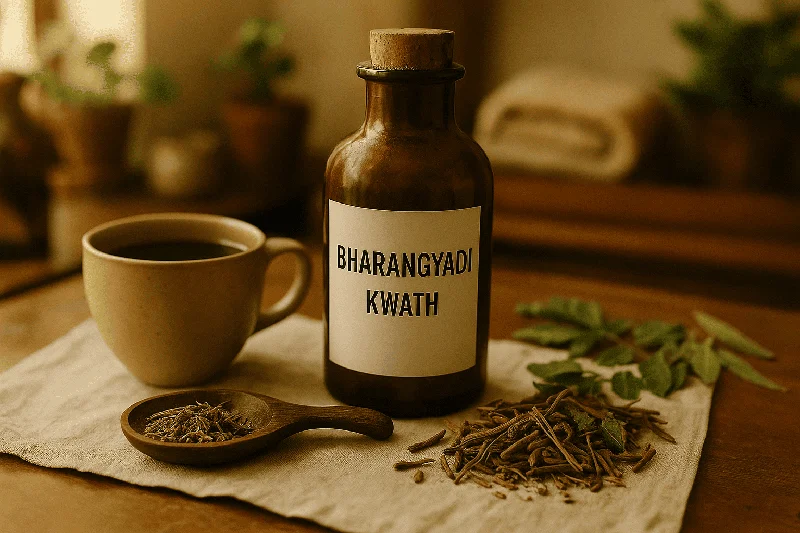
Bharangyadi Kwath is a classical Ayurvedic decoction (kashayam) primarily used for treating chronic respiratory disorders, persistent cough, recurrent fever, and chest congestion. Rooted in ancient Ayurvedic pharmacology and referenced in authoritative texts like the Yoga Ratnakar and the Ayurvedic Formulary of India (AFI), this bitter herbal formulation works by balancing Kapha and Vata doshas, strengthening the respiratory tract, and eliminating accumulated toxins (ama) from the body.
If you've been searching for a natural, time-tested remedy for stubborn respiratory issues that modern cough syrups barely touch — this guide covers everything you need to know. From the complete ingredient list and pharmacological mechanism to dosage for different age groups, contraindications, drug interactions, and even how Bharangyadi Kwath compares to similar Ayurvedic formulations.
What Is Bharangyadi Kwath?
Bharangyadi Kwath (also spelled Bharangyadi Kashayam or Bharangyadi Kwatha) is a polyherbal decoction where the primary herb is Bharangi (Clerodendrum serratum). The suffix "kwath" or "kashayam" means a water-based decoction prepared by boiling coarsely powdered herbs until the liquid reduces to a specific volume.
This formulation belongs to the Kashaya Kalpana category — one of the five fundamental dosage forms described in classical Ayurveda. Unlike tablets or syrups, a freshly prepared kwath delivers the water-soluble active compounds of herbs in their most bioavailable form.
Classical Reference & Origin
The primary textual reference for Bharangyadi Kwath comes from the Yoga Ratnakar, a widely respected Ayurvedic compendium compiled around the 17th-18th century CE. The formulation is documented in the Jwara Chikitsa (management of fever) section, highlighting its role in addressing chronic and recurrent fevers with respiratory complications.
It is also listed in the Ayurvedic Formulary of India (AFI) Part I, published by the Government of India's Ministry of AYUSH, which gives it official pharmacopeial recognition. This inclusion means the formulation meets standardized manufacturing and quality control criteria.
Sanskrit Shloka (Classical Verse)
The original Sanskrit verse describing this formulation reads:
> भारङ्ग्यादिक्वाथः —
> भारङ्गी कण्टकारी च हरिद्रा वासका तथा |
> क्वाथोऽयं कासहरः प्रोक्तो ज्वरघ्नश्च विशेषतः ||
Translation: "A decoction prepared from Bharangi, Kantakari, Haridra, and Vasaka is especially beneficial in alleviating cough (kasa) and fever (jwara)."
The shloka underscores the formulation's dual action on both the respiratory system and systemic febrile conditions — a combination that makes it uniquely versatile among Ayurvedic kwath preparations.
Bharangyadi Kwath Ingredients (Complete Composition)
Understanding what goes into this formulation is critical — not just for transparency, but because every single herb plays a specific therapeutic role.
Complete Ingredient List with Botanical Names
| # | Sanskrit Name | Botanical Name | Common English Name | Part Used |
|---|---|---|---|---|
| 1 | Bharangi | Clerodendrum serratum | Blue Glory / Bharangi | Root |
| 2 | Kantakari | Solanum surattense (syn. S. xanthocarpum) | Yellow-berried Nightshade | Whole plant |
| 3 | Haridra | Curcuma longa | Turmeric | Rhizome |
| 4 | Vasaka | Adhatoda vasica | Malabar Nut | Leaves |
| 5 | Pippali | Piper longum | Long Pepper | Fruit |
| 6 | Shunthi | Zingiber officinale | Dry Ginger | Rhizome |
| 7 | Guduchi | Tinospora cordifolia | Giloy / Heart-leaved Moonseed | Stem |
| 8 | Karkatashringi | Pistacia integerrima | Crab's Claw | Gall |
Note: Some regional variations of the formulation may include or exclude 1-2 herbs. The above list follows the Yoga Ratnakar reference. Always verify the composition on the product label of whichever manufacturer you choose.
Role of Each Ingredient in the Formulation
- Bharangi (Lead Herb): The star of this formulation. Bharangi is classified as a potent Kasahara (anti-tussive) and Shwashara (anti-dyspneic) herb. It directly acts on the respiratory passages, reducing bronchospasm and clearing accumulated phlegm.
- Kantakari: One of the Dashamoola herbs, Kantakari is specifically indicated for Tamaka Shwasa (bronchial asthma) and productive cough. It complements Bharangi by working on the lower respiratory tract.
- Vasaka: Perhaps the most well-known Ayurvedic bronchodilator. Its active alkaloid vasicine has documented mucolytic and expectorant properties. Vasaka thins the mucus, making it easier to expel.
- Haridra (Turmeric): Adds potent anti-inflammatory and anti-allergic action. In respiratory conditions, inflammation of the bronchial mucosa is a key pathological factor — Haridra addresses this directly.
- Pippali (Long Pepper): A bioavailability enhancer (Yogavahi) that improves the absorption of other herbs. Also a powerful Kaphahara that clears congestion and stimulates Agni.
- Shunthi (Dry Ginger): Supports digestive fire, reduces ama formation, and has a warming effect that counteracts the cold, heavy qualities of Kapha accumulation in the chest.
- Guduchi (Giloy): The immunomodulator of the formula. Guduchi is classified as Rasayana (rejuvenative) and Jwarahara (antipyretic), making it essential for chronic febrile conditions where immune function is compromised.
- Karkatashringi: Specifically used in paediatric respiratory conditions and chronic cough. It has a unique astringent-sweet action that soothes irritated respiratory mucosa.
Synergy of Herbs — How They Work Together
This isn't a random collection of respiratory herbs. The formulation follows a deliberate Ayurvedic pharmaceutical logic:
- 1.Primary action group (Bharangi + Kantakari + Vasaka): Directly targets the respiratory system — reduces bronchospasm, dissolves thick mucus, and opens the airways.
- 2.Anti-inflammatory group (Haridra + Guduchi): Addresses the underlying inflammation and immune dysregulation that perpetuates chronic respiratory conditions.
- 3.Bioavailability and digestive support (Pippali + Shunthi): Ensures the body can properly absorb and utilize the other herbs while simultaneously addressing the ama (metabolic toxins) that Ayurveda considers the root cause of most chronic diseases.
- 4.Soothing agent (Karkatashringi): Provides mucosal protection and is particularly gentle on sensitive respiratory passages.
This multi-layered approach is what distinguishes a classical Ayurvedic formulation from a simple single-herb remedy.
Ayurvedic Pharmacology (Dravyaguna Properties)
No competitor covers this. Yet for any Ayurvedic practitioner or serious student, understanding the Dravyaguna profile of a formulation is essential for prescribing it correctly.
Rasa, Guna, Virya, Vipaka
| Property | Value |
|---|---|
| Rasa (Taste) | Predominantly Tikta (bitter) and Katu (pungent); secondary Kashaya (astringent) |
| Guna (Quality) | Laghu (light), Ruksha (dry) |
| Virya (Potency) | Ushna (hot) |
| Vipaka (Post-digestive effect) | Katu (pungent) |
Dosha Karma (Effect on Tridosha)
Primary action: Kapha-Vata Shamaka — This formulation principally pacifies Kapha dosha (responsible for mucus, congestion, and heaviness in the chest) and secondarily pacifies the Vata component involved in respiratory spasm and erratic immune responses.
Due to its Ushna Virya and predominantly Katu-Tikta Rasa profile, it can mildly aggravate Pitta in excess doses or prolonged use. This is why duration of course matters (covered below).
Karma (Pharmacological Actions):
- Kasahara — Anti-tussive
- Shwasahara — Anti-dyspneic (relieves breathlessness)
- Jwarahara — Antipyretic
- Deepana-Pachana — Kindles digestive fire, digests ama
- Kaphaghna — Removes excess Kapha
- Srotoshodhaka — Clears blocked channels
Benefits & Therapeutic Uses of Bharangyadi Kwath
Respiratory Disorders (Cough, Cold, Asthma, Chest Congestion)
This is the primary indication.
Bharangyadi Kwath is most effective for:
- Chronic productive cough (Kaphaja Kasa) where thick, sticky mucus is difficult to expel
- Bronchial asthma (Tamaka Shwasa) — especially the Kapha-dominant type with wheezing, heaviness in the chest, and worsening at night or in cold weather
- Recurrent upper respiratory infections — frequent colds, sinusitis, post-nasal drip
- Chest congestion with a feeling of tightness or fullness in the thoracic region
The formulation works both as a mucolytic (thinning the phlegm) and a bronchodilator (opening the airways), providing relief from both the cause and the symptom.
Chronic Fever (Jeerna Jwara)
In Ayurveda, Jeerna Jwara refers to fever that persists beyond 12 days or keeps recurring. This type of fever is typically associated with deep-seated ama and disturbed Agni. Bharangyadi Kwath addresses chronic fever through its combination of antipyretic herbs (Guduchi, Bharangi) and digestive stimulants (Shunthi, Pippali) that clear the metabolic toxins fueling the fever.
Digestive Support & Detoxification (Shodhana)
While primarily a respiratory formulation, the Deepana-Pachana (digestive stimulant and ama-digestant) properties of Shunthi and Pippali make this kwath valuable for:
- Reducing ama accumulation systemically
- Supporting sluggish digestion that often accompanies chronic respiratory illness
- Post-illness recovery when appetite is diminished
Some Ayurvedic practitioners incorporate Bharangyadi Kwath into broader detox protocols, especially during seasonal transitions (Ritucharya), when Kapha accumulation is naturally higher — particularly during late winter to early spring (Shishira to Vasanta Ritu).
Immunity Enhancement
Guduchi (Giloy) in this formulation is classified as Rasayana — a rejuvenative that strengthens the body's natural defense mechanisms. Clinical observations in Ayurvedic practice suggest that patients taking Bharangyadi Kwath during recurrent respiratory infections show reduced frequency of episodes over time, likely due to this immunomodulatory component.
Tuberculosis & Chronic Respiratory Conditions
- Classical Ayurvedic texts reference the use of Bharangi-based formulations in Rajayakshma (a condition with significant overlap with tuberculosis).
- Important disclaimer: Bharangyadi Kwath is NOT a replacement for modern anti-tubercular therapy. However, it may serve as a complementary support to manage symptoms like chronic cough, low-grade fever, and weakness — always under the supervision of both an Ayurvedic physician and a pulmonologist.
स्वयं दवा न लें और प्रतीक्षा न करें। अभी डॉक्टर से चैट शुरू करें
How to Prepare & Use Bharangyadi Kwath
Preparation Method (Step-by-Step)
The traditional method for preparing any Ayurvedic kwath follows a standardized ratio:
- Take one part coarse powder (yavakuta churna) of the herb mixture — typically 10–12 grams for one dose
- Add 16 parts water (approximately 192 ml or roughly 200 ml for practical purposes)
- Bring to a gentle boil on low to medium flame
- Continue boiling until the liquid reduces to 1/4th of its original volume (approximately 48–50 ml)
- Strain through a clean muslin cloth while still warm
- Drink warm, preferably on an empty stomach or as directed
- Practical tip: Do not use aluminum vessels. Earthen pots are ideal; stainless steel is acceptable.
- The boiling process should be slow and steady — rapid boiling destroys volatile compounds.
Available Forms (Dry Powder vs Liquid Extract vs Kashayam Tablets)
| Form | Description | Convenience | Potency |
|---|---|---|---|
| Yavakuta Churna (Coarse Powder) | Raw herbs in coarse powder form; you boil it yourself | Low — requires daily preparation | Highest — fresh decoction every time |
| Ready-made Kashayam (Liquid) | Pre-prepared decoction, often with preservatives | High — ready to drink | Moderate — some degradation during storage |
| Kashayam Tablets / Ghana Vati | Concentrated aqueous extract in tablet form | Very High — travel-friendly | Moderate to Low — processing reduces some volatile compounds |
| Syrup Form | Sweetened liquid preparation (Bharangyadi Syrup) | High — palatable | Moderate — sugar base alters some properties |
- For maximum therapeutic benefit, the fresh-prepared kwath from coarse powder is always preferable.
- But let's be honest — not everyone has the time or patience for daily preparation. Kashayam tablets are a reasonable compromise for maintenance therapy.
Dosage
Adult Dosage
- Fresh kwath (decoction): 40–50 ml, twice daily, before meals
- Kashayam tablets (Ghana Vati): 2 tablets (typically 500 mg each), twice daily with warm water
- Ready-made liquid kashayam: 15–25 ml, diluted with equal quantity warm water, twice daily
Children & Elderly Dosage
Children (Ages 5–12)
- Fresh kwath: 10–20 ml, once or twice daily (dilute with warm water if taste is too bitter)
- Kashayam tablets: 1 tablet, once or twice daily
- Not generally recommended below age 5 without direct supervision of an Ayurvedic pediatrician
Elderly (Above 65)
- Start with half the adult dose and increase gradually based on tolerance
- The Ushna Virya can sometimes cause mild gastric discomfort in elderly patients with weakened digestion — monitor carefully
Duration of Course
This is a critical gap that most sources ignore entirely. Here are general guidelines based on classical principles and clinical practice:
| Condition | Typical Duration | Notes |
|---|---|---|
| Acute cough/cold | 5–7 days | Discontinue once symptoms resolve |
| Chronic cough | 2–4 weeks | Re-evaluate after 2 weeks |
| Bronchial asthma (adjunct) | 4–8 weeks | Under physician supervision |
| Chronic/recurrent fever | 2–3 weeks | May extend based on response |
| Seasonal detox protocol | 7–14 days | During Ritu Sandhi (seasonal junctions) |
General rule: Do not self-medicate beyond 2 weeks without consulting a qualified Ayurvedic physician. Prolonged use of Ushna Virya formulations can aggravate Pitta and cause dryness.
Anupana / Adjuvants (What to Take It With)
The Anupana (vehicle/adjuvant) can significantly influence how the formulation works:
- Honey (Madhu): Best for Kapha-dominant conditions — productive cough, chest congestion, heaviness. Honey is itself Kaphahara and enhances the scraping action of the kwath.
- Warm water: General-purpose adjuvant, suitable for most patients
- Pippali Churna with honey: For severe bronchial asthma — this combination intensifies the bronchodilatory effect
- Mishri (rock sugar) dissolved in the kwath: When administering to children or patients who cannot tolerate extreme bitterness
Pathya — Diet & Lifestyle During Treatment
Ayurveda emphasizes that medicine alone is insufficient; the right diet and lifestyle (Pathya) are equally important for recovery.
Foods to Favour
- Warm, freshly cooked meals (avoid refrigerated or reheated food)
- Light grains: old rice (Purana Shali), barley (Yava), wheat
- Warm soups, especially Mudga Yusha (green gram soup)
- Warm water or herbal teas throughout the day
- Honey (in moderate amounts, never heated above 40°C)
- Garlic, ginger, black pepper, turmeric in cooking
Foods to Avoid
- Cold beverages, ice cream, frozen foods
- Heavy, fried, or oily foods
- Dairy products — especially curd/yogurt, cheese, and cold milk (these are Abhishyandi — channel-blocking)
- Bananas, watermelon, and other cold-potency fruits
- Excessive sugar and processed foods
- Incompatible food combinations (Viruddha Ahara) such as fruit with milk
Lifestyle recommendations: Avoid cold exposure, air conditioning for prolonged periods, sleeping during daytime, and excessive physical exertion during acute illness. Light Pranayama (especially Kapalbhati and Anulom Vilom) supports recovery, but should be done gently — not aggressively.
Side Effects & Precautions
Known Side Effects
Bharangyadi Kwath is generally well-tolerated when taken in recommended doses for the appropriate duration.
However, some patients may experience:
- Mild gastric irritation or burning sensation — due to the Ushna Virya nature; more common in Pitta-dominant individuals
- Loose stools — occasionally, especially during the first 2-3 days
- Excessive dryness of the mouth or throat — rare, typically with prolonged use
- Mild headache — uncommon, usually resolves on its own
These side effects are generally self-limiting. If they persist beyond 3 days, reduce the dose or discontinue.
Contraindications
No competitor lists clear contraindications.
Here they are:
- Pitta-dominant conditions — active gastritis, peptic ulcers, hyperacidity (Amlapitta)
- Bleeding disorders (Raktapitta) — the Ushna Virya can aggravate bleeding tendencies
- Severe dehydration — the Ruksha (dry) quality of the formulation can worsen fluid depletion
- Known allergy to any ingredient in the formulation
- Dry cough without mucus (Vataja Kasa) — this formulation is designed for productive, Kapha-type cough. Using it for a dry, irritative cough can actually worsen the condition.
Drug Interactions
- Anticoagulants/blood thinners (Warfarin, Aspirin): Haridra (turmeric) has mild antiplatelet activity. Concurrent use may theoretically potentiate blood-thinning effects. Monitor if taking both.
- Antihypertensive medications: Some ingredients may have mild hypotensive effects. Monitor blood pressure.
- Immunosuppressants: Guduchi has immunomodulatory activity that could theoretically interfere with immunosuppressive therapy (e.g., post-organ transplant medications).
- Anti-diabetic drugs: Guduchi and Haridra both have hypoglycemic potential. If you're diabetic on medication, monitor blood sugar more frequently.
Always inform your doctor (both Ayurvedic and allopathic) about all medications you are currently taking.
Safety During Pregnancy & Lactation
- Pregnancy: NOT recommended. Several herbs in this formulation (particularly Pippali and Bharangi) have Ushna Virya and may stimulate uterine contractions. Avoid entirely during all trimesters.
- Lactation: Use with caution and only under medical supervision. While there is no direct evidence of harm, the bitter compounds may pass into breast milk and affect the infant's digestion.
Bharangyadi Kwath vs Other Respiratory Kwath Formulations
This comparison helps practitioners and patients choose the most appropriate formulation for their specific condition.
| Parameter | Bharangyadi Kwath | Kantakari Kwath | Dashamoola Kwath | Sitopaladi + Talisadi (Churna combo) |
|---|---|---|---|---|
| Primary Indication | Chronic cough, Kapha-type asthma, recurrent fever | Asthma, dry cough, smoker's cough | General Vata-Kapha disorders, body aches with cough | Acute cough, cold, mild bronchitis |
| Dominant Dosha Action | Kapha-Vata Shamaka | Kapha-Vata Shamaka | Vata Shamaka primarily | Kapha Shamaka |
| Fever Management | Strong (contains Guduchi) | Mild | Moderate | Minimal |
| Immunomodulation | Yes (Guduchi) | No | No | No |
| Suitable for Children | Yes (adjusted dose) | Yes | Yes | Yes — often preferred for children |
| Form | Kwath (decoction) | Kwath (decoction) | Kwath (decoction) | Churna (powder) |
| Anti-inflammatory Potency | High (Haridra + Guduchi) | Moderate | Moderate | Low to Moderate |
| Classical Reference | Yoga Ratnakar | Sharangadhara Samhita | Multiple texts | Siddha Yoga Sangraha |
When to choose Bharangyadi Kwath specifically: When the patient presents with chronic productive cough + recurrent low-grade fever + Kapha-Vata Prakriti + weakened immunity. This combination of features makes Bharangyadi Kwath the most targeted choice.
Storage & Shelf Life
| Form | Storage | Shelf Life |
|---|---|---|
| Coarse powder (Yavakuta) | Airtight container, cool dry place, away from direct sunlight and moisture | 12–24 months from manufacture |
| Freshly prepared decoction | Refrigerate if not consumed immediately | Use within 12 hours (ideally fresh each time) |
| Ready-made liquid kashayam | Cool, dry place; refrigerate after opening | 2–3 years unopened; use within 3 months after opening |
| Kashayam tablets | Airtight container, room temperature | 3–5 years (check manufacturer date) |
Do not store the dry powder in the refrigerator — moisture condensation can cause fungal growth. If you notice any change in smell, color, or taste, discard immediately.
Scientific Research & Evidence on Key Ingredients
While large-scale clinical trials on the complete Bharangyadi Kwath formulation are limited (a common reality for most classical polyherbal preparations), individual ingredients have been studied extensively:
- Clerodendrum serratum (Bharangi): A 2011 study published in the Journal of Ethnopharmacology demonstrated significant anti-asthmatic activity in animal models, with the root extract showing mast cell stabilization comparable to ketotifen. A 2019 review in Phytomedicine confirmed its bronchodilatory and anti-inflammatory mechanisms mediated through inhibition of histamine release and leukotriene pathways.
- Adhatoda vasica (Vasaka): The alkaloid vasicine and its derivative vasicinone have been extensively studied. Research published in the Indian Journal of Pharmacology showed mucolytic activity comparable to bromhexine — in fact, bromhexine was originally synthesized based on the vasicine molecule.
- Curcuma longa (Haridra/Turmeric): Curcumin's anti-inflammatory effects are among the most well-documented in herbal medicine. A 2016 systematic review in the Journal of Clinical Immunology found curcumin effective as an adjunct in managing allergic asthma by modulating Th2 immune response.
- Tinospora cordifolia (Guduchi): A randomized controlled trial published in 2020 in Phytotherapy Research showed that Guduchi extract significantly improved immune markers (CD4+, CD8+ T cells) in immunocompromised patients. During the COVID-19 pandemic, the Ministry of AYUSH recommended Guduchi-based formulations for prophylactic immune support.
- Piper longum (Pippali): Research in the Journal of Ayurveda and Integrative Medicine (2014) demonstrated that piperine from long pepper enhanced the bioavailability of co-administered compounds by 30–200%, partly explaining its traditional role as a Yogavahi (bioavailability enhancer).
These individual findings collectively support the rationale behind the classical formulation — even though a comprehensive RCT on the whole kwath remains a research gap.
Frequently Asked Questions (FAQ)
What is Bharangyadi Kwath used for?
Bharangyadi Kwath is primarily used for chronic cough, bronchial asthma, chest congestion, recurrent fever (Jeerna Jwara), and respiratory infections where Kapha dosha is predominant. It also supports digestion and helps eliminate systemic toxins.
What are the benefits of Bharangi?
Bharangi (Clerodendrum serratum) is the lead herb in this formulation. Its key benefits include bronchodilation, mast cell stabilization (anti-allergic), expectorant action, anti-inflammatory effects on the respiratory mucosa, and antipyretic activity. It is one of the most valued herbs in Ayurveda for respiratory conditions.
What is the difference between Bharangyadi Kwath and Bharangyadi Syrup?
The kwath is the traditional decoction prepared fresh from coarse herbal powder. The syrup is a commercially processed, sweetened liquid form with added preservatives for longer shelf life. The kwath is considered more potent therapeutically, while the syrup offers convenience and better palatability — especially for children.
Can Bharangyadi Kwath be taken with allopathic medicines?
In many cases, yes — but with appropriate spacing (at least 1-2 hours apart) and under the guidance of both your Ayurvedic and allopathic doctors. Specific caution is needed with blood thinners, immunosuppressants, and anti-diabetic medications due to potential interactions.
Is Bharangyadi Kwath good for diabetes?
While it contains herbs like Guduchi and Haridra that have documented hypoglycemic activity, Bharangyadi Kwath is not specifically formulated for diabetes management. Dedicated anti-diabetic formulations like Nisha Amalaki or Chandraprabha Vati are more appropriate. However, diabetic patients with concurrent respiratory issues can benefit from Bharangyadi Kwath — just monitor blood sugar levels more closely.
What is Gojihwadi Kwath and how is it different?
- Gojihwadi Kwath is another classical Ayurvedic decoction used for respiratory conditions, but its primary focus is on Swarabheda (hoarseness of voice) and upper respiratory inflammation.
- Bharangyadi Kwath targets deeper respiratory pathology — bronchospasm, chronic cough, and lower respiratory congestion. The two can sometimes be used in combination under practitioner guidance.
Can children take Bharangyadi Kwath?
Yes, children above 5 years can take it in adjusted doses (10-20 ml of the decoction or 1 tablet twice daily). For children below 5, consult a qualified Ayurvedic pediatrician. The taste is intensely bitter, so mixing with honey or rock sugar can improve compliance.
Conclusion
Bharangyadi Kwath represents the best of classical Ayurvedic respiratory medicine — a thoughtfully designed polyherbal formulation where each ingredient serves a specific purpose, and together they address not just the symptoms but the underlying pathology of chronic respiratory and febrile conditions.
What sets this formulation apart is its multi-dimensional approach: bronchodilation + mucolysis + anti-inflammation + immunomodulation + digestive support, all in a single preparation. Few modern respiratory medications offer this breadth of action with the safety profile of a well-prepared herbal decoction.
That said, Ayurvedic medicine works best when used intelligently — with proper diagnosis, appropriate dosing, correct duration, supportive diet and lifestyle, and professional oversight. Self-medication for chronic conditions is never advisable.
Consult a qualified Ayurvedic practitioner who can assess your Prakriti, Vikriti, and the specific nature of your condition before starting Bharangyadi Kwath. When used correctly, this ancient formulation can deliver remarkable results that stand the test of time — because it already has, for centuries.
Scientific Sources
- Utilization of Ayurveda in health care: an approach for prevention, health promotion, and treatment of disease.Part 1--Ayurveda, the science of life — Sharma H et al., 2007, Journal of alternative and complementary medicine (New York, N.Y.)
- The use of integrative therapy based on Yoga and Ayurveda in the treatment of a high-risk case of COVID-19/SARS-CoV-2 with multiple comorbidities: a case report — Mishra A et al., 2021, Journal of medical case reports
- Ayurveda formulations induced liver injury-A myth? — Mohan P, 2018, Indian journal of gastroenterology : official journal of the Indian Society of Gastroenterology
- Some excerpts from Charaka Samhita - An ancient treatise on Ayurveda & healthy living — Katiyar CK et al., 2017, Journal of ethnopharmacology
- Hrdaya in Ayurveda — BANERJEE DN, 1947, Indian medical record
- Confused mystification of Ayurvedic concepts — Krishna GL, 2025, Indian journal of medical ethics
- Traditional veterinary medicine in India — Mazars G, 1994, Revue scientifique et technique (International Office of Epizootics)
- Editorial: Special issue on Ayurveda — Mukherjee PK et al., 2017, Journal of ethnopharmacology
- Ayurveda: alternative or complementary? — O'Cathail S et al., 2012, The Lancet. Oncology
- Resuscitation of Ayurveda — BANERJEE DN, 1947, Journal of the Indian Medical Association
- Ayurveda, malaria and the indigenous herbal tradition in Sri Lanka — Silva KT, 1991, Social science & medicine (1982)
- Ayurveda for chemo-radiotherapy induced side effects in cancer patients — Metri K et al., 2013, Journal of stem cells
- Ayurvedic medicines — Ernst E, 2002, Pharmacoepidemiology and drug safety
- Ayurveda and gynecological disorders — Jadhav AN et al., 2005, Journal of ethnopharmacology
- From nature's bounty to drug discovery: Leveraging phytochemicals and molecular approaches to combat multi-drug-resistant (MDR) tuberculosis — Nalam SM et al., 2024, The Indian journal of tuberculosis
- Give truth a chance — Krishna GL, 2023, Indian journal of medical ethics
- Clerodendrum viscosum: traditional uses, pharmacological activities and phytochemical constituents — Nandi S et al., 2016, Natural product research
- Ayurveda for Animals — Dohmen L, 2025, The Veterinary clinics of North America. Small animal practice
- The scientific value of Ayurveda — Hankey A, 2005, Journal of alternative and complementary medicine (New York, N.Y.)
- Public Health Approach of Ayurveda and Yoga for COVID-19 Prophylaxis — Tillu G et al., 2020, Journal of alternative and complementary medicine (New York, N.Y.)
उपयोगकर्ताओं के प्रश्न
Can Bharangyadi Kwath help improve my energy levels and overall vitality?
Millie
14 दिनों पहले
Yes, Bharangyadi Kwath can help with energy and vitality! It boosts your digestive fire (Agni) and helps balance the doshas, which are key for well-being in Ayurveda. By detoxifying and improving digestion, it can enhance your overall vitality and energy. Just make sure it suits your dosha type and consult with an Ayurvedic practitioner if needed. 😊
Can I use Bharangyadi Kwath for chronic inflammation and how does it help?
David
22 दिनों पहले
Yes, you can use Bharangyadi Kwath for chronic inflammation. It's great for reducing internal inflammation and balancing doshas. It supports digestive health by enhancing agni (metabolic fire) and helps eliminate ama (toxins), promoting overall vitality and well-being. Just remember, always good to consult with a practitioner too!
What are the historical uses of Bharangyadi Kwath in traditional Ayurvedic medicine?
Noah
32 दिनों पहले
Bharangyadi Kwath has been historically used in Ayurveda for its detoxifying and healing properties. This herbal decoction stimulates digestion, helping to eliminate toxins (ama), and to balance doshas. It's often recommended in classical texts for its bitter properties, aiding in strengthen the digestive system and improve overall health.
What is the traditional preparation method for Bharangyadi Kwath in Ayurveda?
Sophia
42 दिनों पहले
Bharangyadi Kwath is traditionally made by boiling specific bitter herbs in water until it's reduced to an essence. Typically, you'd start with dry herbs like Bharangi and mix in a few others (depending on the specific formula). Use a ratio of about 1:16 of herbs to water, simmer till reduced to 1/4. That's it!
What is the recommended dosage for Bharangyadi Kwath to achieve detoxification benefits?
Uriah
51 दिनों पहले
For Bharangyadi Kwath, the typical dosage could be around 15-30 ml twice a day before meals, but it's super important to check with an Ayurvedic practitioner first! They can tailor it to your unique dosha and health needs. Consulatation ensures your agni and dhatus benefit the most. Keep it balanced :)
Is it normal to experience side effects when starting Bharangyadi Kwath?
Shelby
61 दिनों पहले
Experiencing side effects when starting Bharangyadi Kwath might happen, especially since it's working to detoxify and balance doshas. Some people might feel changes in digestion or a mild headache as toxins leave the body, but it should be temporary. If it continues or feels too intense, best to consult with an Ayurvedic practitioner to tailor the approach. Remember: everyone's unique balance.
Is it safe to use Bharangyadi Kwath during pregnancy?
Abigail
71 दिनों पहले
I wouldn't recommend using Bharangyadi Kwath during pregnancy without consulting a healthcare provider. Pregnancy requires special care to ensure safety, and while this kwath is great for digestion and detox, its strong properties might not be suitable for expecting moms. It's best to talk things over with an Ayurvedic practitioner who can give specific advice based on your unique situation and constitution.
What is the best way to store Bharangyadi Kwath to maintain its potency?
Rae
80 दिनों पहले
To keep Bharangyadi Kwath potent, store it in a cool, dry place away from direct sunlight. An airtight container helps keep moisture out, really keeping its goodness locked in. Consume it within its shelf life, usually mentioned on the package, to ensure effectiveness! Funky storage areas can spoil it quick, ya know?
What should I look for when choosing a brand of Bharangyadi Kwath to ensure quality?
Elizabeth
156 दिनों पहले
Look for a brand that's well-known, uses organic ingredients (without fillers), and adheres to traditional Ayurvedic methods. Check for certifications that ensure quality like GMP (Good Manufacturing Practices). It's good to choose one that provides detail on its sourcing and formulation, to really ensure authenticity and efficacy 💪.
Will Bharangyadi Kwath interact with medications I’m currently taking, and how can I find out?
Walter
162 दिनों पहले
You should definitely consult with a healthcare professional or an Ayurvedic practitioner about interactions with your medications. They’ll have a better understanding of your unique health needs and can provide personalized advice. Sometimes herbal formulations can interact with meds due to similar actions or effects. Better safe than sorry!
संबंधित आलेख

Body Detox
Ayush Kwath Powder: How to Use It, Benefits, and Daily Dosage
Explore Ayush kwath powder uses. Learn the correct dosage, benefits, uses, and ingredients of Ayush kwath powder and how to prepare it at home for immunity
3,141

Body Detox
Navaka Guggulu – Benefits, Dosage, How To Use, Side Effects, Ingredients
Exploration of Navaka Guggulu – Benefits, Dosage, How To Use, Side Effects, Ingredients
4,537

Body Detox
Panchakarma Cleanse: Ayurvedic Detox and Rejuvenation
If you've been feeling heavy, foggy, maybe just... off, you're definitely not alone. It’s wild how modern life pulls us out of balance without us even noticing until one day we wake up thinking, something's not right. That's actually how I stumbled into t
2,664
Body Detox
Dasamoolarishtam and Jeerakarishtam: Ayurvedic Benefits Backed by Science
Discover the health benefits, research evidence, and clinical relevance of Dasamoolarishtam and Jeerakarishtam in modern Ayurvedic healthcare.
3,427

Body Detox
Patanjali Divya Shuddhi Churna
Exploration of Patanjali Divya Shuddhi Churna
3,495

Body Detox
कौन सी सब्जी गैस्ट्रिक समस्या और पाचन के लिए अच्छी है?
पता करें कि कौन सी सब्जी गैस्ट्रिक समस्या के लिए अच्छी है, गैस्ट्रिक सब्जियों की पूरी सूची और किन खाद्य पदार्थों से बचना चाहिए। पाचन के लिए सबसे अच्छे विकल्प और आयुर्वेदिक टिप्स जानें।
5,825

Body Detox
अधिकतम लाभ के लिए मोरिंगा पाउडर कब लें
यह जानें कि मोरिंगा पाउडर का सेवन कब करना चाहिए ताकि आपको अधिकतम स्वास्थ्य लाभ मिल सके। जानें कि ऊर्जा और सेहत के लिए मोरिंगा पाउडर को रोजाना कब लेना, पीना या खाना सबसे अच्छा होता है।
21,820

Body Detox
What Is Mango Ginger? Ayurvedic Guide to Benefits, Tea, and Usage
What is mango ginger? Discover mango ginger benefits for skin and digestion, how to use it in tea, and Ayurvedic insights on this unique root
9,910

Body Detox
Mahasudarshan Kadha – Herbal, Benefits, Uses, Dosage
Exploration of Mahasudarshan Kadha – Herbal, Benefits, Uses, Dosage
3,709

Body Detox
Can We Drink Water After Eating Watermelon? Ayurvedic Perspective and Facts
Wondering if you can drink water after eating watermelon? Learn the Ayurvedic view, possible side effects, and how long you should wait for better digestion
10,895
विषय पर संबंधित प्रश्न
जिंदल में पहले ठहरने के बाद वजन घटाने और कमर दर्द से राहत पाने के लिए डिटॉक्स कैसे करें?
21 दिनों पहले
108 किलो वजन वाले 20 साल के लड़के को डाइट बदलने के बाद भी कोई रिजल्ट नहीं मिला है, तो उसे डिटॉक्स कैसे करें?
26 दिनों पहले
क्या मुझे बेहतर परिणामों के लिए ब्लड डिटॉक्स खाने के साथ लेना चाहिए या बिना?
27 दिनों पहले
अतिरिक्त दस्तावेज़
© 2024 Ask Ayurveda. सर्वाधिकार सुरक्षित।