आयुर्वेदिक डॉक्टर से प्रश्न पूछें और निःशुल्क या भुगतान मोड में अपनी चिंता की समस्या पर ऑनलाइन परामर्श प्राप्त करें। 2,000 से अधिक अनुभवी डॉक्टर हमारी साइट पर काम करते हैं और आपके प्रश्नों का इंतजार करते हैं और उपयोगकर्ताओं को उनकी स्वास्थ्य समस्याओं को हल करने में प्रतिदिन मदद करते हैं।


Body DetoxEar, Nose, and Throat DisordersGeriatrics & RejuvenationImmunodeficiencyInfertility TreatmentNutritionOrthopedic DisordersPediatricsRespiratory DisordersSexually Transmitted Diseases (STDs)Surgery RecoveryUrological DisordersVascular DisordersDental DisordersEndocrinological DisordersGastrointestinal DisordersYoga TherapyGeneral MedicineAllergic DisordersCardio DisordersGynecology and ObstetricsCosmetologySkin and Hair DisordersEye DisordersInfectious DiseasesMental DisordersNeurological DisordersOncologyPanchakarmaSexual Health & DisordersSports Medicine
पर प्रकाशित 02/25/25
(को अपडेट 08/13/26)
2,676
Guggulu Tiktaka Kashayam – Ayurvedic Bitter Decoction for Detox & Healing
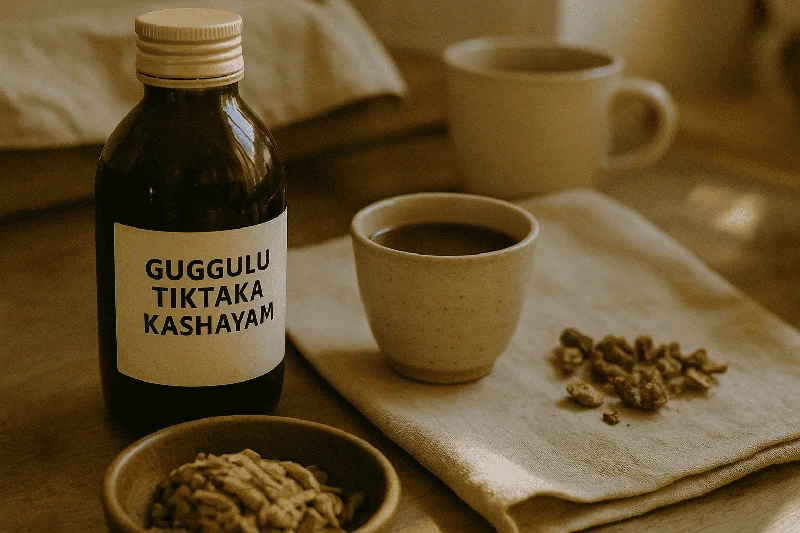
Guggulu Tiktaka Kashayam (also spelled Gulguluthikthakam Kashayam or Guggulutiktam Kashayam) is a classical Ayurvedic bitter decoction primarily used for chronic skin diseases, inflammatory joint conditions, and deep-tissue detoxification. Rooted in the ancient text Ashtanga Hridaya (Chikitsa Sthana, Chapter 21), this formulation combines the resin of Guggulu (Commiphora mukul) with a powerful group of bitter herbs — including Neem, Patola, and Vasa — to pacify aggravated Kapha and Pitta doshas, purify blood (Rakta Dhatu), and support healing from within.
Whether you're dealing with stubborn eczema, psoriasis flare-ups, rheumatoid arthritis, or metabolic imbalances, this guide covers everything you need to know: from classical references and ingredient breakdown to modern research, dosage charts, dietary guidelines, and how Guggulu Tiktaka Kashayam compares to similar Ayurvedic formulations.
What Is Guggulu Tiktaka Kashayam?
Definition and Meaning
The name itself reveals the formulation's nature. "Guggulu" refers to the oleo-gum resin of Commiphora mukul, "Tiktaka" means bitter (Tikta Rasa), and "Kashayam" denotes a water-based herbal decoction prepared by boiling coarsely powdered herbs until the volume reduces to one-fourth or one-eighth. This kashayam is essentially a concentrated bitter extract designed for maximum bioavailability and rapid absorption.
In Ayurvedic pharmacology, kashayam (decoction) is considered the most potent oral dosage form because the active phytochemicals are already extracted into an aqueous medium, making them ready for assimilation without requiring significant digestive effort.
Historical Origins and Classical References
The formulation originates from Ashtanga Hridaya by Vagbhata (circa 7th century CE), specifically in the chapter on Kushtha Chikitsa (treatment of skin diseases). It also appears in Chakradatta (11th–12th century) and Sahasrayogam, a widely used Kerala Ayurvedic text.
The original Sanskrit shloka describes the formulation as a remedy for Kushtha (obstinate skin diseases), Vatarakta (gout), Asthi-Sandhi Vikara (bone and joint disorders), and Bhagandara (fistula-in-ano). Over centuries, practitioners in the Kerala Ayurvedic tradition refined the preparation method, emphasizing precise water-reduction ratios and the sequential addition of Guggulu resin.
What makes this formulation historically remarkable is its evolution from a simple decoction to a sophisticated polyherbal preparation — adapted across at least three major classical texts spanning roughly 500 years.
Forms Available: Kashayam vs. Tablets vs. Syrup
| Feature | Kashayam (Liquid Decoction) | Kashayam Tablets (Gulika) | Syrup/Kwath |
|---|---|---|---|
| Bioavailability | Highest — pre-extracted actives | Moderate — requires dissolution | Moderate to High |
| Taste | Intensely bitter | Mild (coated) | Sweetened, less bitter |
| Convenience | Low — needs dilution, refrigeration | High — portable, no preparation | Moderate |
| Shelf Life | ~3 years (with preservative) | ~3–5 years | ~2–3 years |
| Ideal For | Chronic/severe conditions | Maintenance therapy, travel | Patients who can't tolerate bitterness |
| Common Brands | Kottakkal AVS, AVP | Kottakkal, Vaidyaratnam | AVP, SNA Oushadhasala |
Key point: For acute or severe conditions like active psoriasis or deep-seated arthritis, most Ayurvedic practitioners recommend the liquid kashayam form due to its superior absorption. Tablets are often prescribed for long-term maintenance or for patients who simply cannot tolerate the intense bitterness.
Key Ingredients and Composition
Guggulu (Commiphora mukul) — The Anchor Ingredient
Guggulu is the defining component. Its oleo-gum resin contains guggulsterones (E and Z isomers), which have demonstrated anti-inflammatory, hypolipidemic, and thyroid-stimulating properties in multiple pharmacological studies. A 2009 study published in Molecular and Cellular Biochemistry confirmed that guggulsterone E suppresses NF-κB activation — a key inflammatory signaling pathway involved in both arthritis and chronic dermatitis.
Standardized Guggulu extracts typically contain ≥2.5% guggulsterones. When sourcing this kashayam, checking for this benchmark ensures therapeutic potency.
Neem (Azadirachta indica) — The Blood Purifier
Neem contributes powerful bitter and astringent qualities. Its active compound, azadirachtin, exhibits anti-bacterial, anti-fungal, and anti-parasitic activity. In Ayurvedic terms, Neem is the quintessential Rakta Shodhaka (blood purifier) and Krimighna (anti-microbial). Its role in this formulation directly targets Pitta-related skin manifestations like acne, eczema, and non-healing ulcers.
Patola (Trichosanthes cucumerina) — The Bitter Gourd Vine
Patola is classified under the Tikta Skandha (bitter group) of Ayurvedic herbs. It supports liver detoxification, enhances bile flow, and helps clear excess Kapha from channels (Srotas). Its synergy with Neem amplifies the blood-purifying action.
Vasa (Adhatoda vasica) — The Respiratory-Skin Bridge
Vasa contains vasicine and vasicinone — alkaloids with bronchodilatory, anti-inflammatory, and mild blood-thinning properties. Its inclusion addresses the Ayurvedic understanding that skin diseases often have a respiratory or Pranavaha Sroto connection. Vasa helps clear Pitta from the Rasa and Rakta Dhatus simultaneously.
Other Supporting Herbs
The complete formulation typically includes 15–20 herbs.
Key supporting ingredients include:
- Guduchi (Tinospora cordifolia) — Immunomodulator, adaptogenic
- Patha (Cissampelos pareira) — Anti-inflammatory, analgesic
- Dhanvayasa (Fagonia cretica) — Cooling, anti-Pitta
- Chandana (Santalum album) — Soothes burning sensations
- Triphala (Haritaki, Vibhitaki, Amalaki) — Digestive support and gentle laxation
- Musta (Cyperus rotundus) — Deepana (appetite-kindling), Pachana (digestive)
- Pippali (Piper longum) — Bioenhancer that increases absorption of other actives
Complete Ingredient Table
| Sanskrit Name | Botanical Name | Key Action in Formula |
|---|---|---|
| Guggulu | Commiphora mukul | Anti-inflammatory, lipid-lowering |
| Nimba (Neem) | Azadirachta indica | Blood purifier, antimicrobial |
| Patola | Trichosanthes cucumerina | Liver support, bile stimulant |
| Vasa | Adhatoda vasica | Anti-inflammatory, bronchodilatory |
| Guduchi | Tinospora cordifolia | Immunomodulator |
| Haritaki | Terminalia chebula | Mild laxative, Tridosha balancer |
| Amalaki | Emblica officinalis | Antioxidant, Pitta pacifier |
| Vibhitaki | Terminalia bellirica | Expectorant, Kapha reducer |
| Musta | Cyperus rotundus | Digestive, anti-spasmodic |
| Pippali | Piper longum | Bioenhancer |
| Chandana | Santalum album | Cooling, anti-burning |
| Dhanvayasa | Fagonia cretica | Anti-Pitta, cooling |
| Patha | Cissampelos pareira | Analgesic, anti-inflammatory |
| Katuka (Kutki) | Picrorhiza kurroa | Hepatoprotective |
How Guggulu Tiktaka Kashayam Works: Mechanism of Action
Ayurvedic Perspective — Rasa, Virya, Vipaka, Prabhava
From the classical Ayurvedic lens:
- Rasa (Taste): Predominantly Tikta (bitter) with Kashaya (astringent) undertones
- Virya (Potency): Ushna (hot) — primarily due to Guggulu and Pippali
- Vipaka (Post-digestive effect): Katu (pungent)
- Prabhava (Special action): Kushthghna (destroys skin diseases), Vedanasthapana (pain-relieving)
The bitter taste directly depletes excess Kapha and Pitta, while the hot potency ensures that Vata — the driving force behind chronicity in any disease — is also kept in check. This dual action explains why the formulation works in conditions that seem contradictory: both hot, inflamed skin (Pitta) and cold, stiff joints (Kapha-Vata).
Modern Pharmacological Mechanisms
At a molecular level, several documented pathways explain the clinical effects:
- 1.NF-κB suppression — Guggulsterones inhibit nuclear factor kappa-B, reducing production of TNF-α, IL-1β, and IL-6. This directly dampens chronic inflammation in joints and skin.
- 2.Azadirachtin interference — Disrupts microbial cell membranes, providing broad-spectrum antimicrobial protection.
- 3.Vasicine-mediated anti-inflammation — Acts on COX-2 pathways, reducing prostaglandin synthesis.
- 4.Hepatoprotective synergy — Kutki and Patola together enhance Phase I and Phase II liver detoxification, improving the body's ability to clear metabolic waste products that manifest as skin disease.
A randomized controlled trial published in the Journal of Ethnopharmacology (2020) demonstrated that Guggulu-based formulations showed a 40% improvement in PASI (Psoriasis Area and Severity Index) scores over 8 weeks compared to placebo. A pilot study conducted in Mumbai reported significant LDL cholesterol reduction when Guggulu Tiktaka Kashayam was used as part of an integrative protocol.
Doshic Action: Balancing Kapha and Pitta
- The formulation's primary doshic target is Kapha-Pitta aggravation, particularly when lodged in Rakta (blood), Mamsa (muscle), and Asthi (bone) Dhatus.
- However, its Ushna Virya also prevents Vata provocation — a common side effect of excessively bitter or cold formulations. This makes Guggulu Tiktaka Kashayam suitable across a broader range of constitutions then many other bitter preparations.
Health Benefits and Therapeutic Uses
Skin Disorders — Eczema, Psoriasis, Vitiligo, Chronic Ulcers
This is the primary domain of Guggulu Tiktaka Kashayam. In classical Ayurveda, virtually all chronic skin diseases fall under Kushtha — a broad category encompassing:
- Psoriasis (Ekakushtha/Kitibha) — The combination of blood purification, NF-κB suppression, and Pitta pacification directly addresses the autoimmune inflammatory loop. In one documented case, a 45-year-old male with chronic plaque psoriasis showed approximately 40% improvement in lesion severity after 2 months of Guggulu Tiktaka Kashayam combined with external Panchakarma therapies.
- Eczema (Vicharchika) — Reduces itching, oozing, and skin thickening through Kapha-Pitta balancing.
- Vitiligo (Shvitra) — Used as an adjunct to support melanocyte function through improved blood circulation and Bhrajaka Pitta correction. Results are slower, typically requiring 4–6 months.
- Non-healing ulcers and fistula-in-ano (Bhagandara) — Promotes granulation tissue formation and controls infection.
Joint Health and Musculoskeletal Conditions
- Rheumatoid Arthritis (Amavata) — Addresses both Ama (metabolic toxins) and Vata aggravation.
- Gout (Vatarakta) — Specific classical indication; the bitter herbs help clear uric acid through enhanced hepatic and renal metabolism.
- Osteoarthritis — Supports Asthi Dhatu integrity through Guggulu's affinity for bone tissue.
Metabolic and Detoxification Support
Guggulu's proven hypolipidemic action makes this kashayam useful for elevated cholesterol and triglycerides. The hepatoprotective herbs support the liver's detoxification capacity — critical for patients on long-term medications or those with sluggish metabolism.
Bone Health and Fracture Healing
Guggulu has a well-documented Asthi Sandhanakara (bone-knitting) action. Combined with the anti-inflammatory herbs, this formulation can support faster recovery from fractures when used alongside conventional orthopedic care.
Dosage and Administration
Standard Adult Dosage
| Condition | Dosage | Frequency | Duration |
|---|---|---|---|
| Chronic skin diseases (psoriasis, eczema) | 12–24 mL | Twice daily, before meals | 2–3 months (minimum) |
| Joint disorders (arthritis, gout) | 15–20 mL | Twice daily, before meals | 6–12 weeks |
| Metabolic support / cholesterol | 12–15 mL | Once or twice daily | 8–12 weeks |
| General detoxification | 12 mL | Once daily | 4–6 weeks |
- How to take it: Mix the prescribed dose with an equal quantity of lukewarm water.
- Take on an empty stomach — ideally 30 minutes before breakfast and dinner. The empty stomach enhances absorption of the bitter actives significantly.
Anupana (Vehicle) — Seasonal Recommendations
The Anupana, or vehicle, can be adjusted based on the season and predominant dosha:
- Kapha season (Spring/late winter): Mix with warm water and a teaspoon of honey
- Pitta season (Summer): Mix with room-temperature water or Draksha (grape juice)
- Vata season (Autumn/early winter): Mix with warm water and a few drops of ghee
Pediatric Dosage by Age Group
| Age Group | Recommended Dose | Notes |
|---|---|---|
| 3–5 years | 2–4 mL twice daily | Dilute with double the amount of water; add jaggery if bitter taste is intolerable |
| 6–10 years | 5–8 mL twice daily | Mix with warm water |
| 11–15 years | 8–12 mL twice daily | Approaching adult dose |
| 16+ years | Adult dose (12–24 mL) | Standard protocol |
Important: Pediatric use should always be supervised by a qualified Ayurvedic practitioner. These are general guidelines and individual dosing depends on the child's body weight, Prakriti (constitution), and severity of the condition.
Recommended Course Duration by Condition
One of the biggest gaps in available information is how long to actually take this kashayam.
Here's a practical breakdown:
- Acute conditions (recent skin rash, mild joint pain): 4–6 weeks
- Chronic skin diseases (psoriasis, vitiligo): 3–6 months, often in cycles (2 months on, 2 weeks off)
- Rheumatoid arthritis: 2–3 months as initial course, may be repeated after a 1-month gap
- Metabolic correction (cholesterol, detox): 8–12 weeks
स्वयं दवा न लें और प्रतीक्षा न करें। अभी डॉक्टर से चैट शुरू करें
Diet and Lifestyle During the Course (Pathya-Apathya)
No Ayurvedic treatment works in isolation. The concept of Pathya (favorable diet/lifestyle) and Apathya (unfavorable diet/lifestyle) is absolutley critical during a Guggulu Tiktaka Kashayam course — yet almost no resource spells this out clearly.
Foods to Include (Pathya)
- Bitter vegetables: Bitter gourd (karela), drumstick (moringa), fenugreek leaves, neem flowers
- Whole grains: Old rice (Purana Shali), barley (Yava), green gram (Mudga)
- Proteins: Lentils (especially Mudga dal), light preparations of chicken or fish (in moderation)
- Spices: Turmeric, cumin, coriander, fennel
- Fats: Ghee in moderate quantity — assists herb absorption and prevents excessive drying from bitter herbs
- Fluids: Warm water, buttermilk with cumin, herbal teas (ginger, tulsi)
Foods to Avoid (Apathya)
- Sour and fermented foods: Vinegar, pickles, idli/dosa batter (excessive fermentation), sour curd
- Highly salty foods: Papad, chips, preserved meats
- Incompatible combinations (Viruddhahara): Fish with milk, fruit with meals
- Refined sugars and processed foods: Pastries, white bread, artificial sweeteners
- Alcohol: Directly aggravates Pitta and Rakta, counteracting the medicine's effects
- Heavy, oily foods: Deep-fried items, excessive cheese, cream-based curries
Lifestyle Recommendations
- Avoid daytime sleep (increases Kapha)
- Regular mild-to-moderate exercise or yoga (Surya Namaskar, Trikonasana for joint health)
- Avoid excessive sun exposure during Pitta-type skin flares
- Manage stress — chronic stress elevates cortisol, which directly worsens both skin and joint conditions
Role in Panchakarma and Detox Programs
This is an area that no competitor has adequately addressed.
Guggulu Tiktaka Kashayam serves as a potent Shamana Aushadhi (palliative medicine) and can also be used in the Purvakarma (pre-procedure) and Paschatkarma (post-procedure) phases of Panchakarma:
Pre-Virechana (Therapeutic Purgation)
Administered for 5–7 days before Virechana to soften and liquefy accumulated Pitta-Kapha toxins in the GI tract and blood. The bitter herbs prepare the body by mobilizing Doshas from tissues into the gut for expulsion.
Post-Basti (Enema Therapy)
After Tikta Kshira Basti (medicated milk enema with bitter herbs) — a specific Basti type for bone and joint disorders — oral Guggulu Tiktaka Kashayam continues the therapeutic action, sustaining anti-inflammatory effects and preventing relapse.
In Combination with Lepam (External Application)
- For skin diseases, this kashayam is often prescribed alongside external applications like Nalpamaradi Tailam or Pinda Tailam.
- The internal-external synergy accelerates healing — the kashayam addresses root cause (impure blood, aggravated doshas) while the external application manages symptoms (itching, scaling, discoloration).
Guggulu Tiktaka Kashayam vs. Similar Ayurvedic Formulations
| Feature | Guggulu Tiktaka Kashayam | Kaishore Guggulu | Triphala Guggulu | Yogaraja Guggulu |
|---|---|---|---|---|
| Form | Liquid decoction | Tablet | Tablet | Tablet |
| Primary Indication | Skin diseases + joints | Gout, skin, blood disorders | Piles, fistula, obesity | Vata disorders, pain |
| Doshic Target | Kapha-Pitta | Pitta-Kapha | Kapha-Pitta | Vata-Kapha |
| Key Differentiator | Deep-tissue detox, rapid action | Uric acid metabolism | GI-focused, lipid metabolism | Musculoskeletal pain focus |
| Bioavailability | Highest (liquid) | Moderate | Moderate | Moderate |
| Bitterness | Intense | Mild | Mild–Moderate | Not bitter |
| When to Choose | Severe/chronic skin + joint issues | Gout with skin involvement | Hemorrhoids, weight management | Pure joint/nerve pain |
When to choose Guggulu Tiktaka Kashayam specifically: When the clinical picture involves both skin and joint manifestations simultaneously, when the condition is chronic and deep-seated, or when faster onset of action is required (liquid > tablet). If you're only dealing with isolated gout, Kaishore Guggulu may suffice. For pure Vata-type pain without skin involvement, Yogaraja Guggulu is more appropriate.
Side Effects, Contraindications, and Drug Interactions
What Are the Side Effects of Guggulu Tiktaka Kashayam?
When taken at recommended doses under qualified guidance, side effects are uncommon.
However, the following may occur:
- Gastric discomfort — The intense bitterness can trigger nausea or mild stomach upset, especially in Vata-predominant individuals. Taking with a small amount of jaggery or after a light snack can help.
- Loose stools — The Virechana (purgative) tendency of bitter herbs may cause mild diarrhea in sensitive individuals. This usually resolves within 2–3 days.
- Dryness — Prolonged use without adequate ghee or oil intake can cause skin dryness, constipation, or aggravated Vata.
Contraindications
- Pregnancy and breastfeeding — Guggulu has mild uterine stimulant properties. Avoid unless specifically prescribed by a practitioner.
- Severe emaciation or debility — Bitter formulations can further deplete tissue in underweight or malnourished patients.
- Active gastric ulcer or gastritis — The bitter and hot qualities may aggravate existing mucosal erosion.
Drug Interactions — A Systematic Overview
| Medication Class | Interaction Risk | Mechanism | Recommendation |
|---|---|---|---|
| Anticoagulants (Warfarin, Heparin) | Moderate–High | Guggulu may enhance anti-platelet activity | Maintain 2-hour gap; monitor INR |
| Thyroid medications (Levothyroxine) | Moderate | Guggulsterones stimulate thyroid function | Adjust thyroid dose under supervision |
| Anti-diabetic drugs (Metformin, Glipizide) | Low–Moderate | May enhance hypoglycemic effect | Monitor blood sugar closely |
| Statins (Atorvastatin) | Low | Additive lipid-lowering effect | Generally safe; inform your doctor |
| Immunosuppressants | Low–Moderate | Guduchi may modulate immune response | Use under specialist guidance |
| Oral contraceptives | Low | Theoretical competition for hepatic metabolism | No significant clinical reports, but disclose use |
Quality, Sourcing, and How to Choose the Right Product
What to Look For
- Guggulsterone content: Reputable manufacturers certify ≥2.5% guggulsterone content. Ask for a Certificate of Analysis (CoA).
- Heavy metal testing: Ensure the product is tested for lead, mercury, arsenic, and cadmium. GMP-certified manufacturing facilities are a minimum requirement.
- Classical formulation adherence: Some commercial products modify the original formulation. Look for labels referencing Ashtanga Hridaya or Sahasrayogam as the source text.
Trusted Manufacturers
- Kottakkal Arya Vaidya Sala — Gulguluthiktham Kashayam (200 mL, approximately ₹240)
- AVP (Arya Vaidya Pharmacy, Coimbatore) — Gulguluthikthakam Kashayam
- Vaidyaratnam — Available in both kashayam and tablet (Gulika) forms
- SNA Oushadhasala — Thrissur-based, follows traditional Kerala preparation methods
Frequently Asked Questions (FAQ)
What is the use of Gulguluthikthakam Kashayam?
It is primarily used for chronic skin diseases (psoriasis, eczema, vitiligo), inflammatory joint conditions (arthritis, gout), non-healing ulcers, and fistula-in-ano. It also supports metabolic detoxification and cholesterol management.
What are the ingredients in Guggulu Tikta Kashayam?
The key ingredients include Guggulu (Commiphora mukul), Neem (Azadirachta indica), Patola (Trichosanthes cucumerina), Vasa (Adhatoda vasica), Guduchi, Triphala, Musta, Chandana, Kutki, and Pippali, among others. A full ingredient table is provided above.
Can I take Guggulu Tiktaka Kashayam with modern medicines?
In most cases, yes — but with precautions. Specific interactions exist with anticoagulants, thyroid medications, and anti-diabetic drugs. Always maintain a minimum 2-hour gap between the kashayam and any allopathic medication. Consult both your Ayurvedic and allopathic doctors.
How does Guggulu Tiktaka Kashayam differ from tablets?
The liquid kashayam form has higher bioavailability and faster onset of action compared to tablets. Tablets (Kashaya Gulika) are more convenient and portable but may require longer treatment durations to achieve similar outcomes. For severe or chronic conditions, the liquid form is generally preffered.
Is Guggulu Tiktaka Kashayam safe during pregnancy?
No, it is generally contraindicated during pregnancy due to Guggulu's mild uterine stimulant properties. If you are pregnant or planning to conceive, consult a qualified Ayurvedic practitioner before use.
What is the classical reference (Shloka) for this formulation?
The primary reference is Ashtanga Hridaya, Chikitsa Sthana, Chapter 21 (Kushtha Chikitsa). It is also documented in Chakradatta and Sahasrayogam. The original Sanskrit verses describe it as a remedy for Kushtha, Vatarakta, and Bhagandara.
Can children take this kashayam?
Yes, under medical supervision. The dose must be adjusted according to age and body weight. See the pediatric dosage table above for age-specific guidelines.
How long does it take to show results?
- For skin conditions, initial improvements are typically noticable within 3–4 weeks, with significant results by 8–12 weeks.
- Joint conditions may respond faster — within 2–4 weeks for pain relief. Metabolic effects on cholesterol levels usually require 8–12 weeks of consistent use.
Conclusion
Guggulu Tiktaka Kashayam stands out as one of Ayurveda's most comprehensive formulations — bridging skin health, joint care, and metabolic detoxification in a single preparation. Its classical pedigree spanning over 1,300 years, combined with emerging modern research supporting its anti-inflammatory and hypolipidemic mechanisms, makes it relevant for both traditional and integrative healthcare approaches.
The key to getting results lies in three factors: choosing the right form (liquid kashayam for severe cases, tablets for maintenance), following appropriate Pathya-Apathya guidelines, and working with a qualified practitioner who can tailor dosage and duration to your specific condition and constitution.
If you are considering Guggulu Tiktaka Kashayam for a chronic health concern, consult an experienced Ayurvedic doctor who can evaluate your Prakriti, current Dosha imbalance, and potential drug interactions — and design a treatment protocol that integrates this powerful kashayam into a holistic plan for lasting recovery.
Scientific Sources
- Rosemary and neem: an insight into their combined anti-dandruff and anti-hair loss efficacy — Hashem MM et al., 2024, Scientific reports
- Bangladeshi medicinal plant dataset — Borkatulla B et al., 2023, Data in brief
- Phytotherapy in periodontics as an effective and sustainable supplemental treatment: a narrative review — Gawish AS et al., 2024, Journal of periodontal & implant science
- Formulation and Evaluation of Turmeric- and Neem-Based Topical Nanoemulgel against Microbial Infection — Giri S et al., 2024, Gels (Basel, Switzerland)
- Medicinal plants with traditional use: Ethnobotany in the Indian subcontinent — Rupani R et al., 2018, Clinics in dermatology
- Pharmacology and chemistry of a potent hepatoprotective compound Picroliv isolated from the roots and rhizomes of Picrorhiza kurroa royle ex benth. (kutki) — Verma PC et al., 2009, Current pharmaceutical biotechnology
- Design and development of a stable polyherbal formulation based on the results of compatibility studies — Bhope SG et al., 2011, Pharmacognosy research
- Picrorhiza kurroa, Royle ex Benth:Traditional uses, phytopharmacology, and translational potential in therapy of fatty liver disease — Raut A et al., 2023, Journal of Ayurveda and integrative medicine
- Phytochemical Screening, Antioxidant, and Inhibition Activity of Picrorhiza kurroa Against α-Amylase and α-Glucosidase — Nisar J et al., 2022, Dose-response : a publication of International Hormesis Society
- Phytochemical studies for quantitative estimation of iridoid glycosides in Picrorhiza kurroa Royle — Sultan P et al., 2016, Botanical studies
उपयोगकर्ताओं के प्रश्न
What ingredients are commonly found in Guggulu Tiktaka Kashayam?
Client_39a4d0
26 दिनों पहले
Guggulu Tiktaka Kashayam typically includes ingredients such as Guggulu (Commiphora mukul), Musta (Cyperus rotundus), and Nimba (Azadirachta indica). These herbs are known for their anti-inflammatory and detoxifying properties, making the formulation beneficial for skin conditions and joint health. It's crucial to consult with a healthcare provider, especially if you are on medications like anticoagulants or have pre-existing health conditions. Results can vary and may take weeks to observe, so professional advice ensures safe and effective use.
How long does it take to see results from Guggulu Tiktaka Kashayam?
Client_444f17
36 दिनों पहले
While Guggulu Tiktaka Kashayam is used in Ayurvedic traditions to treat conditions like skin diseases, gout, and joint disorders, the specific timeline to see results can vary significantly based on individual health conditions, severity of the issue, and adherence to treatment. Some people may notice improvements within a few weeks, while others might require several months. It's crucial to monitor your symptoms and consult a healthcare provider, especially if there's no improvement after a reasonable period or if symptoms worsen. Always ensure you use authentic and vetted sources when obtaining this herbal remedy.
How does Vasa help improve respiratory health and breathing issues?
Client_11c6bd
45 दिनों पहले
Vasa (Adhatoda vasica) can improve respiratory health and breathing issues because it contains the alkaloids vasicine and vasicinone, which exhibit bronchodilatory and anti-inflammatory properties. These compounds help widen the air passages in the lungs and reduce inflammation, easing breathing. For most individuals, effects like eased breathing may be noticeable within a few days to a week. Monitor for any interactions with medications such as anticoagulants and thyroid or anti-diabetic drugs. If symptoms persist or worsen, consult a healthcare professional.
How does Guggulu Tiktaka Kashayam promote metabolic detoxification over time?
Client_629762
55 दिनों पहले
Guggulu Tiktaka Kashayam is thought to promote metabolic detoxification by supporting liver function and aiding in the body's natural elimination processes. Its active herbal compounds, including azadirachtin, can help manage cholesterol levels, a process that typically requires 8–12 weeks of consistent use. This detoxification process can sometimes cause mild diarrhea due to its purgative effects. It is advisable to monitor for any adverse reactions, especially if you are on other medications, and consult with a healthcare provider before using Guggulu Tiktaka Kashayam, especially if you experience symptoms like severe diarrhea or if you are pregnant or breastfeeding.
What is the proper dosage of Gulguluthikthakam Kashayam for treating chronic skin conditions?
Client_4fcc4d
64 दिनों पहले
For Gulguluthikthakam Kashayam, the dosage often depends on your specific condition, age, and body weight. A common guideline is around 15-30 ml mixed with an equal amount of warm water, taken twice a day before meals. But best to consult an Ayurvedic doc for personalized advice, since everyone's different. Take care!
What skin conditions can Guggulu Tiktaka Kashayam effectively treat?
Client_7535cd
74 दिनों पहले
Guggulu Tiktaka Kashayam is quite effective for skin conditions like eczema, psoriasis, vitiligo, and chronic ulcers. It's really most known for helping with these kind of skin issues, thanks to its anti-inflammatory and detoxifying properties. Just make sure to consult with your Ayurvedic doc to determine the right dose for your specific body type.
Can Guggulu Tiktaka Kashayam help improve liver function and how does it work?
Client_b62569
84 दिनों पहले
Yes, Guggulu Tiktaka Kashayam can help improve liver function! It works by enhancing digestion and detoxification. The bitter herbs stimulate digestive secretions and help remove toxins that can burden the liver. Plus, by balancing doshas and modulating inflammation, it supports overall liver health. Just make sure to consult an ayurvedic practitioner for personal guidance!
What is the role of guggulu in reducing oxidative stress in inflammatory conditions?
Client_2dea1b
94 दिनों पहले
Guggulu's role in reducing oxidative stress is due to its potent anti-inflammatory properties. It works at the cellular level to modulate inlammatory cytokines which helps to lower oxidative stress, often seen in conditions like arthritis. By doing this, it can protect cells from damage. If you're considering using it, talking to an Ayurvedic practitioner to know how it fit you personally is helpful!
Is Guggulu Tiktaka Kashayam beneficial for skin health and acne treatment?
Client_5fd035
103 दिनों पहले
Yeah, Guggulu Tiktaka Kashayam might be helpful for skin health and acne. It balances Pitta and Kapha doshas which can cause skin issues like acne. Its anti-inflammatory and detoxifying properties support clearing out impurities and calming skin inflammation. But remember, everyone's needs are different, so it’s good to check with an Ayurvedic practitioner!
Can I drink Guggulu Tiktaka Kashayam if I have a sensitive stomach?
Client_950ced
112 दिनों पहले
If you have a sensitive stomach, it might be wise to be cautious with Guggulu Tiktaka Kashayam. While it helps with digestion, its potency might be a bit much for sensitive guts. Maybe start with a small dose and see how your body reacts. It’s always best to consult with an Ayurvedic practitioner who can offer personalized advice for your constitution.
संबंधित आलेख

Skin and Hair Disorders
Indralupta Mashi – Effective Ayurvedic Treatment for Hair Loss
Learn about Indralupta Mashi, a powerful Ayurvedic formulation for promoting hair growth, preventing hair loss, and rejuvenating the scalp naturally.
6,114

Skin and Hair Disorders
Panchvalkal Kwath: A Comprehensive Exploration of Ayurveda’s Ancient Remedy
Discover Panchvalkal Kwath—its benefits, scientific insights, and usage. Learn how this Ayurvedic formulation supports holistic wellness and skin care.
2,990

Skin and Hair Disorders
लोमसथाना थैलम: अनचाहे बालों के लिए आयुर्वेदिक दवा
जानें कि आयुर्वेद कैसे अनचाहे बालों का समाधान करता है लोंमसथाना थैलम और अन्य प्राकृतिक उपायों के जरिए। जानें इसके फायदे, उपयोग के टिप्स और पारंपरिक आयुर्वेदिक ज्ञान पर आधारित जानकारी।
10,130

Skin and Hair Disorders
Which Dry Fruit Is Good for Skin and Hair: Ayurvedic Guide
Exploration of Unlock Radiant Skin and Lustrous Hair with Dry Fruits: A Comprehensive Guide
5,879

Skin and Hair Disorders
मेलास्मा के लिए बेस्ट आयुर्वेदिक क्रीम्स: त्वचा की चमक के लिए टॉप नैचुरल सॉल्यूशन्स
जानें मेलास्मा के लिए सबसे अच्छे आयुर्वेदिक क्रीम्स के बारे में, उनके फायदे, वे कैसे काम करते हैं, सही इस्तेमाल और साफ, चमकदार त्वचा के लिए विशेषज्ञों की सिफारिशें।
6,081
Skin and Hair Disorders
Gandhaka Rasayana: Scientific Insights & Health Applications
Explore Gandhaka Rasayana, an Ayurvedic sulfur-based remedy. Learn its science, research backing, potential benefits, and safety considerations.
2,878

Skin and Hair Disorders
क्या एलोवेरा टैन हटाएगा? आयुर्वेदिक गाइड और फायदे
क्या एलोवेरा टैन हटाएगा? जानें कैसे एलोवेरा टैन हटाने, चेहरे की देखभाल और त्वचा को निखारने में मदद करता है। प्राकृतिक तरीके से टैन हटाने के लिए आयुर्वेदिक विधियों के बारे में जानें।
8,077

Skin and Hair Disorders
Cyst Treatment in Ayurveda: A Comprehensive Overview
Explore cyst treatment in Ayurveda, backed by scientific insights. Learn herbs, lifestyle tips, and evidence-based approaches for holistic cyst management.
6,356

Skin and Hair Disorders
प्राकृतिक समाधान खोजें: चेहरे पर मेलास्मा के लिए सबसे अच्छा आयुर्वेदिक इलाज
चेहरे पर मेलास्मा के लिए शीर्ष आयुर्वेदिक उपचारों की खोज करें, जिसमें जड़ी-बूटियाँ, उपाय और जीवनशैली के सुझाव शामिल हैं, ताकि आप स्वाभाविक रूप से साफ और चमकदार त्वचा पा सकें।
6,443
Skin and Hair Disorders
मंजिष्ठादि लेपम: त्वचा की सेहत के लिए पारंपरिक आयुर्वेदिक पेस्ट
मंजिष्ठादि लेपम के बारे में जानें, जो एक पारंपरिक आयुर्वेदिक पेस्ट है। इसके फायदे, उपयोग, खुराक और त्वचा की सेहत और उपचार के लिए वैज्ञानिक जानकारी प्राप्त करें।
3,474
विषय से संबंधित परामर्श
अतिरिक्त दस्तावेज़
© 2024 Ask Ayurveda. सर्वाधिकार सुरक्षित।